Showing posts with label transsexualism. Show all posts

Sunday, May 24, 2026

Must we choose the least worst option?

The Tickle v Giggle case has finally been decided in the Federal Court of Australia. The gist of the case is that a TERF feminist, Sall Grover, founded a women's only networking app called Giggle. Transsexuals were excluded from the app via facial recognition. One of these transsexuals, Roxanne Tickle, challenged the ban in the courts and won. 

One interesting feature of all this is that because TERF feminists are no longer very welcome on the left, they are increasingly orienting to the right. People on the right are generally supportive of the idea that biological sex is real and that women should be allowed to have their own spaces. 

The Giggle app

But there's a catch. TERF feminists are the modern version of the most radical feminists of the 1970s. Is it really the case that social conservatives should embrace the politics of these women? 

Some undoubtedly will. They will look at aspects of what these women are saying and find reason to agree. This, for instance, is how Sall Grover began her presentation of her TERF feminist beliefs after losing her court case:


Most people on the right will be sympathetic to this. If this were it, then it would be very easy to form an alliance with TERF feminists. But consider what Sall Grover listed straight after this:


This is a very radical doctrine, with radical implications. The first thing I'd note is this. The TERF feminists often claim that to call a biological man a woman is a suppression of truth and reality. But is this not what Sall Grover is doing in making these claims? She is asking us to believe that there is no connection between the fact of biological sex and sex based character traits. 

This isn't credible. It is not credible that men and women would be so biologically dimorphous, with the female body clearly adapted for the bearing of children, whilst the male body is clearly more adapted for warfare and hunting, and for all of this to not be expressed in any way in our character traits. It's like someone asserting that genetics has no role in who we are. It is ignoring all the science of sex based hormones and of differences in the wiring of the brain. It ignores what parents observe time and again in their children. It ignores what we all observe in relationships with the opposite sex. It is a type of ideological suppression of reality - of thinking something is true because it serves our political values. It is an example of living within a hyperreality, in which the conditions of truth are not that something conforms to reality, but that it conforms to what people think is proper to believe in order to get ahead in society, or in order to advance the interests of a particular group or movement.  

There's a second problem. TERF feminists often talk about transsexualism being an erasure of women and girls. However, the logic of TERFism is in its own way an erasure of womanhood. It empties the category of meaning. All that is left is a difference in body shape and reproductive organs. Apart from that, men and women are considered to be the same. For TERFS there is nothing distinctly feminine about women - they consider the feminine to be merely "socially constructed and imposed". In fact, TERFs often have very little understanding of what the feminine might even mean. They usually talk about it as if it only referred to external physical adornment, like wearing lipstick. But, if this is so, if men and women are exactly the same except for our physical shape, then "womanhood" as a category is mostly meaningless. It doesn't signify much about a person. So why are TERFs so keen to uphold the category? Because it has become associated with what they call "sex based rights". They treat it as a political category in which you compete for special rights against other groups. But, as they have found, other groups can do the same thing even better, with transsexuals generally being thought to occupy higher ground in the intersectional hierarchy.

Finally, the TERF position is not so much a bulwark against transsexualism as it is a preparation for it. The ground for transsexualism was prepared when feminists decoupled sex and gender, so that it was thought that men and women could not only swap natures, but that it was progressive and liberating to do so. When Sall Grover declares that men and boys can be feminine and women and girls can be masculine, she is being semi-trans - strictly speaking, she is advocating for transgenderism rather than transsexualism. She wants it to be the case that we can declare ourselves to be the opposite "gender" (masculine or feminine) but not the opposite sex (biologically male or female). She wants to go 90% of the way toward transsexualism, but to stop just before we get to the point at which we might declare ourselves to be the opposite sex.

And this position has done damage. One of the problems with it is that it often rests on an assumption that the feminine is inferior and therefore women should try to be more masculine, as criticised in the following social media post:


I've known a lot of Gen X feminists. Some of them strove to present themselves as masculine. They adopted a masculine personal presentation and masculine hobbies (boxing, motorbikes etc.). But underneath it all they were heterosexual women and could never really pass as men. They occupied a no-man's land (excuse the pun), in which they were neither attractively feminine, nor believably masculine, just confused about what they should be. As they aged, they gradually dropped the pretence and mostly returned to a more feminine persona, which always made me wonder what the point of it was. I just don't think they ever gave themselves permission to be women.

In the 1970s, TERFism was recognised to be a radically left-wing politics. Today, there is something of a push for it to be accepted by social conservatives. If this happens, it will be because it is thought of as a better option than transsexualism. Faced with Tickle v Giggle, social conservatives will choose Giggle. 

But there is no need to do this. We should not allow ourselves to be pressed into choosing the least worst option. The TERFs need us a lot more than we need them. If they wish to garner support from us, then we should do so carefully and strategically, until that time that they are willing to abandon the more harmful aspects of their politics.

Postscript: Saw the following on social media and thought it relevant to the point I was trying to make about feminism preparing the ground for transsexualism:


Saturday, July 26, 2025

Responding to a modern day Millian

 I was on social media and, in a debate about transsexualism, saw the following comment:


It's an example of someone separating out sex and gender, which then allows the two to be set against each other. I responded with this comment:


The original poster then went for a Millian liberal response, along the lines of "everyone can do whatever they want as long as it does not harm anyone else":


In the past, this might have been a winning move. People who were brought up in the liberal frame might have accepted the premises of this argument and so have been influenced to accept a picture of society in which everyone simply stays neutral in terms of the human good and so tolerates whatever other people do. 

I was happy to note that many of those who responded did not buy into this type of thinking. The Millian line was rejected, overwhelmingly, on the grounds that the supposed neutrality of liberalism is a fiction. 

It was argued that, far from remaining neutral, a liberal culture forced people to accept and confirm the transsexual belief system, for instance, by threatening to remove children from parents; through the attempt to replace ordinary words so that, for instance, a biological woman is referred to as a "person with a uterus"; through forcing women to accept biological males in restrooms and change rooms; through pressure to adopt pronouns and so on.

There have been leftists who have argued, in principle, for this absence of real neutrality. Herbert Marcuse, a leading voice of the New Left in the 1960s, wrote a famous essay titled "Repressive Tolerance". In it, he argued that full tolerance should only be extended to those on the political left, who were agitating for socialist liberation and therefore against a "false consciousness". Marcuse was critical of,

the active, official tolerance granted to the Right as well as to the Left, to movements of aggression as well as to movements of peace, to the party of hate as well as to that of humanity I call this non-partisan tolerance 'abstract' or 'pure' inasmuch as it refrains from taking sides

This is the earliest example I know of where non-leftist speech is categorised and made illegitimate as representing "hate". Whether the term "hate speech" is derived directly from Marcuse or not I'm not sure, but the mindset here is clear enough: that neutrality is abandoned when it does not serve the leftist cause; and that non-leftist politics is to suffer intolerance on the grounds that it represents "hate".

Marcuse even set out the specific conditions in which non-leftist thought might or might not be tolerated. He used the term "indiscriminate tolerance" to describe where neutrality might be permissible:

Such indiscriminate tolerance is justified in harmless debates, in conversation, in academic discussion; it is indispensable in the scientific enterprise, in private religion. But society cannot be indiscriminate where the pacification of existence, where freedom and happiness themselves are at stake: here, certain things cannot be said, certain ideas cannot be expressed, certain policies cannot be proposed, certain behavior cannot be permitted without making tolerance an instrument for the continuation of servitude.

Again, modern society has taken this type of Marcusian turn. It is generally understood that something you might say in a private "harmless" context could not be said in a more scrutinised public context. And the level of scrutiny is advancing over time.

The larger point, then, is that society is not neutral in terms of competing goods. I think it's a good thing that people are recognising this and not complacently accepting claims about neutrality.

I myself went for a different option. I don't think the vision of a community in which we are studiously indifferent to what everyone might choose to do can work in the longer run.


There were moral concepts employed in the West that reflected this need to hold things together in a self-disciplined way. To fail to do so was regarded negatively as being wanton (a lack of restraint or control), or abandoned, or incontinent, or dissolute, or dissipated, or licentious, or debauched. The more positive moral vocabulary was that of having integrity or being sound or, in more recent times, of being centred. 

These words now sound old-fashioned, but they nonetheless are grounded in something accepted by popular science writers of today like Steven Pinker who writes,

The…ultimate purpose of life, mind, and human striving: to deploy energy and information to fight back the tide of entropy and carve out refuges of beneficial order.

Most people would be aware of this. If we just follow whatever inclinations or appetites happen to come to mind, then we gradually fall into self-destructive habits. We lose our integrity of being - our lives become increasingly disordered. And so we are all forced, to some degree, to make an effort - to apply energy - to maintain our health and our well-being. 

If we care about our social bodies - the communities we belong to - then we will be concerned with upholding the integrity of these as well. This obviously has to be balanced with the good of individual freedoms. But it's not possible to have a society in which every individual acts in any direction and is indifferent to all other individuals, and expect this society to avoid the centrifugal effects of entropy - a drifting away into disorder and decay. There has to be a common commitment to upholding the larger integrity of the community.

The key to achieving this is to understand how much our own higher goods depend upon this life in common. It is difficult to sustain our own spiritual life, ourselves as embodied souls, without the particular loves and commitments that we find within our communal traditions. And so it makes sense for each individual to act purposefully and deliberately and meaningfully to uphold the integrity of these traditions and to encourage others to do the same.

Sunday, June 26, 2022

One more story

I have been focusing on one theme in recent posts, namely de-transition stories, and would like to do just one more. The account this time is by a young man, Steven Richards, who transitioned not because of gender dysphoria but because identifying as trans provided a community and a purpose lacking in his life:

I went from being a lonely, insecure teenager to a member of a loving community engaged in a heroic battle against an evil society that desired my destruction. Left-wing oppression narratives disseminated online and in local “queer youth” groups run by adult members of the movement cast “cis” people as villains. "Transitioning" was a baptismal ritual in which I was cleansed of my wicked nature as a “cis male” oppressor and reborn as a virtuous “marginalized” person with a new name and body.

Adult transsexuals online coached me on how to convince my parents, doctors, and therapists that I was suffering from gender dysphoria. The term supposedly refers to an incongruence between one’s sexed body and internal sense of gender but is used among transgender people as a catch-all term for any negative emotion. It’s an attractive narrative for vulnerable teenagers who are struggling with their developing bodies, sexualities, and the looming responsibilities of adulthood.

This is similar to the account by Helena in an earlier post who wrote that adopting a trans identity allowed her to enjoy the camaraderie of like-minded youths and to escape the burden of being a "cis" person within a political milieu where this made you an evil oppressor. 

Transitioning did not make Steven any happier; unfortunately, he decided to keep taking more radical steps along this path before finally deciding that none of this was ever going to be a solution for his emotional problems.

I'm half way through reading the book After Virtue by Alasdair MacIntyre. The content of the book goes some way, I think, in explaining how we could ever have reached this point (I'm not claiming it explains everything, just that it sets out some of the groundwork).

What MacIntyre focuses on is the loss of a teleological view, particularly during the Enlightenment. The classical approach was to think of man as having an untutored nature, that then had to be disciplined by moral precepts and habits, so that he could fully realise his telos (his ends/purposes as a man).

The Enlightenment strongly rejected an Aristotelian teleology, which then severed the inherited store of moral belief from its practical role in guiding man toward his true ends.

If we still had the idea that our nature as men contains within it a potential telos, and that we are to be ordered toward fulfilling this telos through moral self-discipline, then there would not be the same grounds for young men like Steven to believe that purpose was to be found through the rejection of his own sexed body. 

The older Aristotelian view is fast declining within modern culture, but there are still remnants of it. The idea that there is meaning and purpose within our essence as men is not entirely lost. 

Here, for instance, is a comment by a woman defending men from the usual charges:


This woman also recognises the good within the masculine:


Saturday, June 11, 2022

More reasons why

Why might young people wish to transition? The official answer is that they were born in the wrong body, so that the solution is to change bodies. Last month I looked at the life stories of two young people who had once been "trans" but who had then decided to de-transition. Neither of them thought that the real reason for wanting to transition was being born in the wrong body. 

The first de-transitioner I looked at gave a very articulate account of what was running through his mind at the time. He described a modern-day Gnosticism:

The world is wicked, and it is that way because it was made wicked by the Enemy...[the "White Supremacist Capitalist Cis-Hetero-Patriarchy"]

One has to understand the nature of the world’s evil before one can repair it. The first step in obtaining that knowledge is realizing that our bodies are not us, but things which we're trapped inside of. We're not humans; we're ghosts haunting rotting corpses. To stop the Enemy, trans people need to make us all understand that our true selves don’t exist in our corrupted material forms. This is what gender identity actually means: We are not our bodies.

The end goal is a very familiar one centred on a utopian vision of individual autonomy:

The dream of the trans movement is of a world where no one has to do anything they don't want, where no one is forced to work, where everyone can indulge their every desire without fear or shame, where all distinctions between people have been abolished and we're all completely equal. In a word: Utopia.

I was reminded of this reasoning when I read a story about an English girl named Kate. She was driven out of her school for questioning the trans movement. She politely questioned the movement because she recognised similarities between it and her own experience of anorexia:

'I couldn't help but hear the anorexic mentality reverberate in conversations about gender dysphoria,' she says.

'Both anorexia and gender dysphoria [make people] aspire to reach an idealised form of the self, liberated from the grotesque realities of material existence. Both are driven by a desire to control one's reality — to unveil a potential 'truth'.

Again, you can recognise a gnostic quality to this: a belief that our material existence is both wicked and illusory and that it is possible to attain special powers through access to a hidden knowledge. 

Then there are the words of this trans person:

This person wants to use fae/faer pronouns, which I understand indicates a desire to identify as a fairy. What's noteworthy is what is said at the end:
I'm excited because fae/faer pronouns make me feel very affirmed in my not feeling like a person.

It is more evidence for what our first de-transitioner claimed, that as a trans person he believed that "our bodies are not us, but things which we're trapped inside of. We're not humans..."

What does all this suggest? Well, Gnosticism is an ancient belief and likely to be always with us. However, it doesn't help that there is overlap between Gnosticism and certain aspects of liberal modernity.

The more traditional Western view is that we are part of a divinely created order and made, in fact, in the image of God. There may be both good and evil within nature, growth and decay; benevolence and cruelty, but we nonetheless find within our own creatureliness a connection to a higher meaning that gives form and substance to our lives. Gnosticism does not find fertile soil within this traditional view and, unsurprisingly, was condemned as a heresy by the early Christian church.

Liberal modernity has tended to divorce man from this meaningful relationship to creation. Patrick Deneen, in his book Why Liberalism Failed, sketches the history of how this came about. Early moderns sought dominion over nature. At first, this was not meant to be a dominion over our own nature (which was conceived negatively as fundamentally self-interested):

Liberalism...embraced and advanced as well an economic system - market-based free enterprise - that similarly promoted human use, conquest, and mastery of the natural world. Early-modern liberalism held the view that human nature was unchangeable - human beings were, by nature, self-interested creatures whose base impulses could be harnessed but not fundamentally altered.

But a second-wave of liberals in the later 1800s did seek to extend this dominion over the natural world to include our own nature. Deneen observes that these two waves of liberalism are still represented within modern politics:

First-wave liberals are today represented by "conservatives," who stress the need for scientific and economic mastery of nature but stop short of extending this project to human nature. They support nearly any utilitarian use of the world for economic ends...Second-wave liberals increasingly approve nearly any technical means of liberating humans from the biological nature of our own bodies.

The liberal project is to maximise individual autonomy in the name of freedom. This is made possible by removing humans from an embedded place within a given realm of nature:

Liberalism...seeks to transform all of human life and the world. Its two revolutions - its anthropological individualism and the voluntarist conception of choice, and its insistence on the human separation from and opposition to nature - created its distinctive and new understanding of liberty as the most extensive possible expansion of the human sphere of autonomous activity.

And so we all become self-creating autonomous individuals, unwilling to acknowledge any limitations imposed by our created nature. This is a more fertile ground for Gnosticism to flourish and to exert an influence within modern culture.

Monday, May 16, 2022

Their reasons why

There has been a big focus on transgenderism over the past few years. The official account of this is that there are large numbers of young people who are trapped in the wrong body and who therefore should "transition" into the right body, either by a change in outward appearance or, more radically, through the use of hormones and surgery.

There are now some young people, however, who have gone through this process and have regretted it to the point of choosing to detransition. It is worth the effort to read through their accounts of what led them to adopt a trans identity, because they do not match the official explanation. I read two such accounts on the weekend; I'll summarise them below, but the message is probably better imparted by reading the originals. 

a) Tree

"Tree" begins his account by pointing out, with some skill, the contradictions of the ruling "gender ideology". He then explains how he came to adopt a trans identity. It began when he was fifteen and became involved in a left-wing Tumblr online community:
When I was fifteen years old, I adopted a kaleidoscopic, schizophrenic ideology patched together from hundreds of individual posts talking about feminism, disability, gender identity, queerness, race, capitalism, and leftism. I didn't have the context for any of it, and neither did any of the other teenage kids on Tumblr at the time–of which there were many...We took this stuff in and internalized it. We believed it.

The underlying belief was that gender was socially constructed by the patriarchy to oppress women and that without the patriarchy all would be equal. But if gender is socially constructed why would the young people following this ideology want to transition to the opposite sex?

According to Tree, many of the trans people he knew did not really believe that they were born into the wrong sex:

Radical transsexuals will admit, to trusted cult members, that they believe gender is socially constructed. They'll admit that they weren't born trans, but chose to become trans.

But why choose to become trans? Tree describes very ably what he calls the "metaphysics" behind the movement - a set of assumptions about the world and human ends. It sounds very much like a modern Gnosticism. If you are familiar with the concept of "immanentizing the eschaton" you will recognise it in his account of the trans philosophy.

In short, Tree describes a vision of the world in which the world as it exists is wicked; in which souls are trapped in bodies ("corrupted material forms"); in which knowledge of evil allows us to be special, to be virtuous; in which this knowledge leads ultimately to a victory over the evil ones and the radical transfiguration of the world into a place of utopian equality and freedom.

He describes the trans philosophy he adopted as a young man as follows:
The world is wicked, and it is that way because it was made wicked by the Enemy...[the "White Supremacist Capitalist Cis-Hetero-Patriarchy"]

One has to understand the nature of the world’s evil before one can repair it. The first step in obtaining that knowledge is realizing that our bodies are not us, but things which we're trapped inside of. We're not humans; we're ghosts haunting rotting corpses. To stop the Enemy, trans people need to make us all understand that our true selves don’t exist in our corrupted material forms. This is what gender identity actually means: We are not our bodies.
This is a view of the material world as fundamentally evil and corrupt which is commonly associated with Gnosticism. It encourages the idea, as Tree points out, that "we are not our bodies" - which then makes possible the disconnect between our physical sex and our personal identity. 

The next step is to believe that some people are marked out in a special way to transcend this corruption. According to Tree, it is those who are most marginalised through their embodiment who, via their suffering, rise to virtue:
Virtuous souls have been unjustly trapped in profane flesh. The most virtuous are those who suffer most from their embodiment: women, “queer” people, the disabled, those lower in the hierarchy of the racial caste system...These are the Marginalized. The Marginalized are the chosen people. They are chosen because they suffer. 

Trans people are especially virtuous within this schema because they choose their own marginalisation: 

If you aren’t Marginalized, you can become Marginalized by deciding to transition. If you’re already Marginalized, you can become even more virtuous through transition...trans people are the converts who have voluntarily accepted Marginalization. They choose to suffer more from their involuntary embodiment. Because of this, they become virtuous. They are saved.

According to Tree, this underlying philosophy leads trans people to be highly motivated activists for the cause, rather than simply wanting to integrate into society. The ultimate aim is the familiar modernist one of maximum individual autonomy, where we can do as we will and where distinctions between individuals have been erased:

The dream of the trans movement is of a world where no one has to do anything they don't want, where no one is forced to work, where everyone can indulge their every desire without fear or shame, where all distinctions between people have been abolished and we're all completely equal. In a word: Utopia.

 b) Helena

Helena's account is longer and more personal, but it overlaps with the previous one. She begins by asking:

But what leads a girl with no history of discomfort with stereotypical “girl” toys and clothes, or even the slightest desire to be a boy in childhood, to want to be a “man” through hormonal injections as she approached adulthood?

She did not have as happy a family life as might have been desired and so at age fifteen found herself on Tumblr as part of an online community of disturbed teenage girls who were prone to self-harm and eating disorders.  

This community was also dominated by intersectional politics, in which being a "cishet white girl" meant having to be apologetic:

On Tumblr, the situation was such that any claim to being “oppressed” would accumulate social credibility, while any unfortunate “privileged” status was justification for verbal abuse. As a “privileged” person, you were expected to constantly grovel and apologize, you had no right to speak on any issue involving the group you were “oppressing”, and you could not object in any way to any mistreatment hurled against you because of your race, gender, or sexuality.

I found myself in a bit of a double bind. On one hand, I had found what felt like the perfect group of friends who understood me on an intuitive level, who I was able to talk to openly about the things I liked and made me “weird” in real life, but on the other hand I was a “cishet white girl” in an environment where that was one of the worst things to be. Since Tumblr users are mostly biological females, the “cishet white girl” holds the position of most privileged and therefore most inherently bad group. In this climate, you are made to feel guilty and responsible for all the horrors and atrocities in the world...

Its understandable that any young person exposed to this kind of belief system would grow to deeply resent being white, “cis”, straight, or (biologically) male. The beauty of gender ideology is it provides a way to game this system, so that you can get some of those targets off your back and enjoy the camaraderie of like-minded youths. You can’t change your race, pretending to have a different sexuality would be very uncomfortable in practice, but you can absolutely change your gender, and it’s as easy as putting a “she/they” in your bio. Instantly you are transformed from an oppressing, entitled, evil, bigoted, selfish, disgusting cishet white scum into a valid trans person who deserves celebration and special coddling to make up for the marginalization and oppression you supposedly now face. Now not expected to do as much groveling and reaffirming to everyone how much you love checking your privilege, you can relax a little and talk about your life without wondering if you are distracting from the struggles of or speaking over marginalized groups, because you are marginalized too. With the new pronouns often comes a wave of positive affirmation from friends and followers, and the subconscious picks up quickly that there’s a way to make the deal of being on Tumblr even sweeter.

So by putting a "she/they" in her bio, she put herself in a much better position within the Tumblr community she belonged to.

From here she started to make rationalisations. She had body image issues and so rationalised that it must be because she didn't like her body being female. She did not have a lot of offline friends, and so rationalised that it must be because being a girl wasn't her authentic self and so on. 

She also became heavily involved in fanfiction, in which the main characters were boys and she began to identify obsessively with their lives; she was too bashful to see herself at this time as developing real life relationships with the opposite sex (she provides evidence here for the idea that trans identity is sometimes motivated by wanting to become the sex you are attracted to).

She provides this well-written summary of the pressures that led her toward a trans identity:

My perception of myself as trans formed in the intersection between overwhelming emotional struggles, heavy fantasy, emotional and intellectual infatuation with males (real people, fictional characters, and the idea of males generally), fanfiction, social and ideological incentives to be trans, and insulation from experiences and perspectives that might have challenged the views I was developing about myself and the world.

She went as far as taking testosterone for a period of time, but this made her emotional and psychological condition only worse and so she decided to detransition. It took several years for this process to take effect, but you can see from the photo below how she has recovered.


It may not be the case that all young people who seek to "transition" do so for the same reasons as the two people I have discussed in this post. Even so, these two accounts should give us pause for thought when it comes to how we approach transgenderism and transitioning.

Friday, May 13, 2022

How does Calvin Klein do Mother's Day?

Calvin Klein marked Mother's Day in the US this year with an ad featuring a "pregnant trans man". As one news outlet reported:

The caption to the ad read: "“Today, in support of women and mothers around the world, we highlight the reality of new families”, the brand wrote in its description, along with a carousel of photos riddled with images of single mothers and interracial couples.

It's liberal modernity on steroids. We are to be "liberated" from the constraints of nature. A woman can become a man but still be pregnant, her husband can be a woman. Something as straightforward as Mother's Day becomes a statement about "men" being pregnant, or women not needing a husband.

Patrick Deneen, in his book Why Liberalism Failed, notes that traditional societies saw the human person as being part of a natural order:

Premodern political thought...understood the human creature as part of a comprehensive natural order. Humans were understood to have a telos, a fixed end, given by nature and unalterable. Human nature was continuous with the order of the natural world, and thus humanity was required to conform both it its own nature and, in a broader sense, to the natural order of which it was a part.

What a strand of liberal modernity asserts instead is that we are free when there is no given nature that might constrain our will to do or to be as we choose. If you follow this strand of modernity, then talking about "pregnant men" on Mother's Day will seem edgy in a positive "progressive" way, rather than denatured or disfigured.

Who is responsible for the ad? The current CEO appears to be a woman named Trish Donnelly. She says of herself:

My family is everything. My husband and I have been together for 25+ years and our two kids are in college. I’m a big Premier League fan, love swapping Spotify playlists with my kids

Trish Donnelly
You'll notice that she herself is relatively conservative compared to the norm defying role models pushed by the company she leads. She is in a position where she can safely advertise the dissolving of natural categories because she herself has a stable, supportive family life and because the upper classes are more likely to have the resources to prevent dysfunctional individuals from sliding down into a social underclass.

I'm not sure that the members of this class understand the real world effects of this kind of liberalism on more marginal people. A loss of stability in identity or family relationships can have devastating effects lower down the social scale. It doesn't look trendily edgy anymore. Nor is it usually a status game of "say one thing and do another". It becomes instead a real life question of whether individuals can still hold together.

Sunday, April 10, 2022

Are Terfs really any better?

If you were to set out the basic traditionalist position on sex distinctions it would look something like this:

1. We are born male or female

2. If we are born male we are connected in our nature to the masculine; if female to the feminine

3. Masculine and feminine are real qualities. If we wish to fulfil our own created nature, we will seek to embody the better qualities of the masculine if we are men, and the feminine if we are women. In doing so, our self manifests a transcendent good that helps give meaning and purpose to our existence.

I got into a debate yesterday with a group of Terfs on this issue. These are "trans exclusionary radical feminists", i.e. feminists who do not believe that males can suddenly declare themselves to be women. They insist, just like traditionalists, that a woman is an adult human female. They would agree with traditionalists on the first proposition I set out above, namely that we are born male or female.

What struck me during the debate, however, was not the common ground but the vast gulf separating these Terfs from my own politics. I came away thinking that they had extraordinarily awful beliefs about men and women. I think it's useful to set out the reasons why I came to this conclusion.

a) Terfs still reduce the category of womanhood to a point that it becomes meaningless

Terfs might agree with traditionalists on the first proposition, but they entirely reject the next two. What this means is that they define a woman as someone who has female reproductive organs, but that is it. For them, a woman (or a man) can be absolutely anything else that they choose to be. Being a man or a woman has no further relevance to anyone's life, except for the fact of reproductive organs. So why then think it important? What is the point of the category itself if it is irrelevant to anything we might do or be?

In short, Terfs still hold very strongly to the distinction between sex and gender. They accept the fact of biological sex, but they think any sex based characteristics are merely "gender" that is socially constructed and oppressive. 

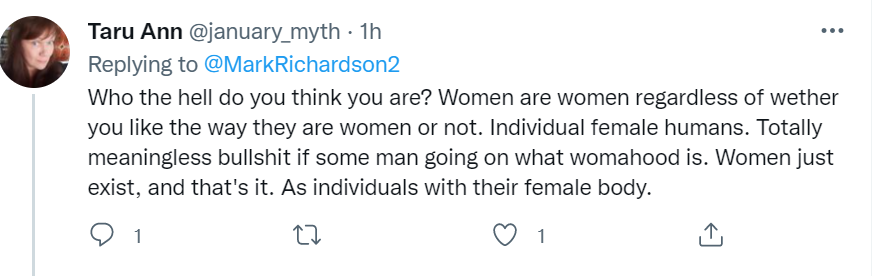
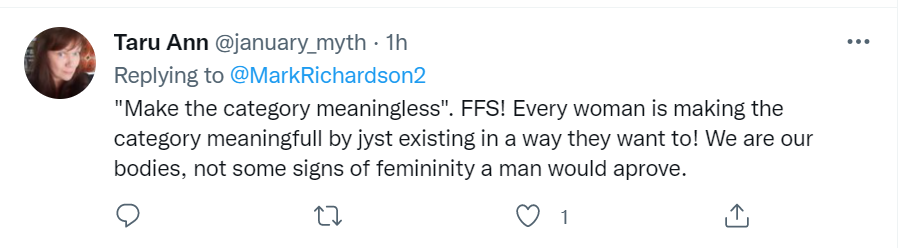
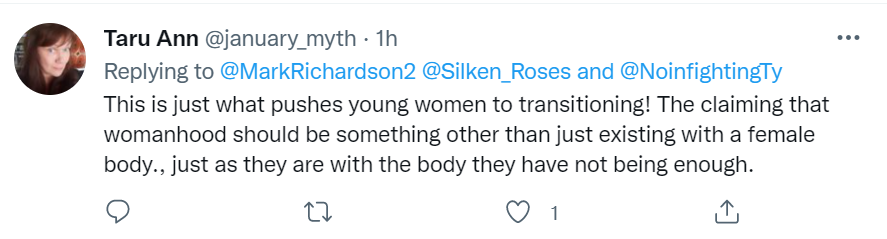
When I suggested that these Terfs were reducing the category of womanhood to something meaningless, these are the type of responses I got:


As you can see, the Terfs were very firm in asserting that being a woman has no meaning apart from the fact of being born female ("women just exist", "individuals with a female body", "just existing in a way they want to", "a matter of biology and nothing else", "being born female...the beginning and end of how to be a woman"). When I challenged them about whether this was a meaningful category, they gave the only answer that they logically could, namely that the biological facts of menstruation and pregnancy gave a point of distinction between men and women. This, it seems to me, reduces women, as women, to something like "walking wombs".

b) Terfs still pander to transsexuals

Despite the fierce animosity between Terfs and transsexuals, the Terfs are still willing to go to extraordinary lengths to remodel the world so that transsexuals might better fit in.

Their idea is as follows. Let's say you have someone who is male but who wants to be female. What the Terfs want is for our concept of "male" to fully embrace what is female. In this way, the transsexual would not need to transition. Being male would incorporate the desire to be female. 

They are serious about this. Look at the following tweet:


Similarly:


What do the Terfs think we need to do to make transsexuals feel more comfortable in their own bodies? The answer: completely sever any connection between our biological sex and our masculinity or femininity. We are just supposed to "exist with a male body" or "exist with a female body" and nothing more.

I would hope my traditionalist readers would understand by now why I think the Terf position is a complete non-starter for us.

c) The Terfs associate masculinity and femininity with negative life outcomes

The Terfs might argue along the lines of "be whatever you want" but when drawn out in debate they revert to the idea that masculinity and femininity are oppressive social constructs that lead to terrible life outcomes, such as domestic violence, rape and misogyny.

This, of course, raises the problem of what younger people are meant to do in response to these beliefs. Imagine you were a 14-year-old girl and you really believed that your own femininity and the masculinity of the boys around you were going to lead to violence and rape. Would it not potentially destabilise your psychological and emotional development? It seems to me to be a kind of mental trap that is difficult to escape from. If you cannot be feminine, and it is equally wrong to be masculine, and if there is no hope of ever having a happy relationship with the opposite sex (because masculinity is tarnished by its association with rape and violence), then along what lines is positive development into adulthood supposed to occur? Is it any wonder that so many young women are developing psychological issues?

Here is just a sample of what "Alliecat" had to say in relation to masculinity and femininity:


You can see that for this woman "gender" has been cast in the most negative terms. Given that it is such a core aspect of life, you can only imagine the detrimental psychological effects that such a worldview must have.

Something else occurs to me here also. For men to love women, they need to be able to form an idealised view of women as having admirable feminine character traits. Men don't need to believe that women are perfect, but they do need to uphold an image of women as being caring, sympathetic etc. But if young women are led to believe that such feminine traits are merely a path to oppression, then they won't be cultivated. Even worse, if young women are led to believe that womanhood is defined merely by reproductive organs, then this even further shifts the emphasis in relationships from love to sexuality. You then start to get the complaint from men that all women are offering is sex appeal.


d) In spite of all of the above, the Terfs are not neutral between men and women but promote radical female superiority

If all this wasn't enough, some of these Terfs are also committed to the idea of a matriarchal future, in which men have a very limited role in society.

This might seem odd, given all the complaints about patriarchy and misogyny and the like. You would think that the Terfs would envisage some form of sex-blind equality. Instead, you get self-descriptors in their Twitter bios that read "unironic Matriarchy proponent". What does this mean? Here is an example:


They are arguing that the family should be a female sphere over which men should exercise no influence, but should merely support financially. The children are hers alone, she should transmit her culture and values and not him, she should be the one to spend the money even if she does not earn it.

If these Terfs really want to live this way they could move to Japan. My understanding is that Japanese men are expected to work long hours, hand over their money to their wives, receive a small allowance and have little to do with the domestic sphere (Japanese men will often spend the hours after work socialising with other men rather than returning home).

Does the Japanese model work? I don't think so. Japan has falling birth rates (down to 1.36); very low marriage rates; a growing avoidance of romantic relationships; widespread prostitution; and a problem of young men withdrawing from society (hikikomori). Young men describe not wanting to get married because they see marriage simply as a burden. From a Guardian report:

Aoyama says the sexes, especially in Japan's giant cities, are "spiralling away from each other". Lacking long-term shared goals, many are turning to what she terms "Pot Noodle love" – easy or instant gratification, in the form of casual sex, short-term trysts and the usual technological suspects: online porn, virtual-reality "girlfriends", anime cartoons. Or else they're opting out altogether and replacing love and sex with other urban pastimes.

The Terfs are not thinking things through. If men have no respected role within the family, why would they bother committing to it? It will come to be thought irrational.

I'm sorry that I can't report more positively on my debate with the Terfs. I suppose that I can commend a few of them for being willing to debate and not just name call, but that's the only positive spin I can put on it. They are still peddling wildly destructive ideas, to the point that it's difficult to see them as any better politically than their transsexual opponents.

Tuesday, February 22, 2022

Sebastian Milbank: biology itself has become the enemy

Does liberalism influence the way that individuals view their own bodies? Sebastian Milbank believes that it does and with dramatically negative consequences. He has penned a very thought provoking article which I encourage you to read in full. I think, though, that I can summarise the basic argument adequately, as I've made similar observations myself. 

It begins with the liberal idea that we are to be liberated from any constraints on ourselves as autonomous individuals. Our sexed bodies, however, do represent such a constraint, as they point to our "telos" - to aspects of what we are designed to be and to do. Milbank himself observes that,

Nothing more expresses the teleological nature of human existence than the fact of our sexed bodies — sex and reproduction are a constant drumbeat reminding us that we don’t exist for ourselves, but for the sake of our descendants.

And so the logic of liberalism is that we must somehow assert our own autonomous self over and against our own body. How do we do this? Milbank believes that the gentler means of achieving this include "such new cultural practices as tattoos, piercings, non-natural hair colours, and of course gender non-conforming grooming and fashion". At a more extreme level there are: 

“gender affirming” surgeries which remove or reshape healthy tissue and organs, transhumanist “body modification” in which people seek to permanently mould their bodies to integrate technology or imitate animals, reproductive surrogacy with “rented wombs”, genetic modification, and voluntary sterilisation.

The key passage in which Milbank sets out the ideological background to these developments is this:

If you want to understand the insanity of the past 20 years over sexuality and gender, you have to first get to grips with what liberalism is. At its heart is the concept of individual autonomy — the idea that the single highest principle of our society should be the absolute power and ownership of a person over their own body and being, and a no less absolute taboo on any outside force that seeks to compromise that autonomy.

Having stripped back many prior norms about male and female roles, sexual ethics and family life in the name of a broadly conceived “freedom” for the individual, liberalism has now taken a more introspective turn. After removing most of the outward and formal demands of law and society on the individual and their body, the individual must now be absolutely freed by purging themselves of the interior restraints they may still possess, and at the same time claim absolute possession of their own physical and psychic self.

In this interior battle, it is biology itself that has become the enemy. Nothing more expresses the teleological nature of human existence than fact of our sexed bodies — sex and reproduction are a constant drumbeat reminding us that we don’t exist for ourselves, but for the sake of our descendants. Severing sex and reproduction have long been a liberal project, and technological progress has certainly helped accelerate that process.

However the ideological project must go still further — even when sex is fully contracepted and bodies safely sterilised, our sexed nature is still stubbornly pointing and gesturing towards reproduction, reciprocity and the renunciation of the self in the embrace of the other.

Friday, January 21, 2022

Can modern society define what a woman is?

Last year I had a debate with someone who insisted that the term "woman" could refer to anything that a person identifying as such wanted it to mean. My objection that if the term could mean anything at all that it became meaningless fell on deaf ears. 

This debate has now gone mainstream. Matt Walsh was invited onto the Dr Phil show and he had this argument with a trans activist (starting from about 7:20):


The discussion kicked off when Matt Walsh asked the trans activist (Addison) to define the term "woman". Addison replied: "Womanhood is something that I cannot define because I myself am not [a woman]. Matt Walsh interjected: "But you used the word, so what did you mean when you said transwomen are women if you don't know what it means?" Addison: "So here's the thing, so I do not define what a woman is because I do not identify as a woman. Womanhood is an umbrella term, it includes people who...." Matt Walsh interjecting: "That describes what?" Addison: "People who identify as a woman." Matt Walsh: "Identify as what?" Addison: "As a woman." Matt Walsh: "What is that?" Addison: "To each their own. Each woman, each man, each person is going to have a different relation with their own gender identity and define it differently." Matt Walsh: "You won't even tell me what the word means though".

In my post I suggested that this inability to define a term like "womanhood" could be traced back to the metaphysics of philosophers like Thomas Hobbes who rejected realism in favour of nominalism:
You can see here the logic of nominalism (that there are only individual instances of things) and a certain type of materialism (that we are just matter in motion) in undermining a "teleology" - a view that there are proper ends to human life that are discernible through reason.
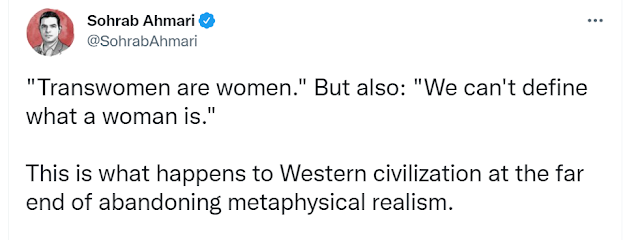
  Sohrab Ahmari had a similar take on the Matt Walsh discussion:


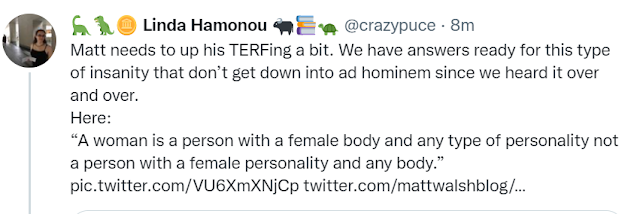
And what of the feminists? One made this comment:


This doesn't really help much. Yes, it defines the term "woman" with clarity as "a person with a female body". But it deliberately stops there and refuses to give any meaning to the term "womanhood". Our terf feminist wants "womanhood" to be self-defined in a similar way that the trans activists want "woman" to be self-defined.

Terfs and trans are both running with the same principle, of claiming that our sex has no real content that might influence who we are or what we do. For that reason, championing the terf position prepares the ground for adopting the trans one - it becomes very difficult to hold the line once the general principle is accepted.

Nor is the terf position persuasive even in terms of biology. If it is clear that we are biologically distinct sexes, then it is unreasonable to suggest that these biological distinctions would have no effect on personality. If men evolved more muscular bodies fit for the purposes of hunting large game and for defending the tribe in warfare, and if women's bodies are designed for the bearing and nurture of infants, then how could you possibly claim that this would have no effect at all on who we are in our personhood? 

And why should people even care about manhood and womanhood under the terms suggested by terf feminism? If it is just a matter of different bodies, with no ramifications for the human person, then who would care if they were erased as coherent categories? The categories would be merely accidental to life if what the terfs say is true.

Nor are terf feminists consistent in severing sex and personality. They are not as laid back in claiming that each man can have any kind of personality. Instead, there is a categorising of some kinds of masculine personality as "toxic" and attempts to educate men into adopting more emotional expressions of personality. In other words, there are value judgements when it comes to expressions of manhood, rather than "each man can equally define for himself in any direction he chooses". 

It is better to acknowledge some positive content to manhood and womanhood, rather than making these terms wholly based on subjective, individual preference or practice. This does not have to be overdone, to the point that they are felt to be unnecessarily restrictive or limiting. But look at what happens when a society refuses to define at all and denies any objective meaning to terms like woman or womanhood. The categories are then effectively erased and become meaningless except, as Matt Walsh aptly put it in the video, as "costumes that can be worn".

Monday, December 23, 2019

Terf or trans?

Maya Forstater
Maya Forstater is a feminist who believes a man cannot be a woman. For uttering this thought on social media she was fired from her job. An employment tribunal in the UK upheld her dismissal. The judge found that holding to the idea that a man cannot be a woman violated the dignity of transsexuals and was "not worthy of respect in a democratic society".

Now, I'm sure that most traditionalists will be appalled by the case. The assertion of a basic aspect of reality is being declared by the courts to be "not worthy of respect" and therefore not a protected belief. It is a sign of our disordered times.

I'm sure, too, we can agree with Maya Forstater when she declares:
I struggle to express the shock and disbelief I feel at reading this judgment, which I think will be shared by the vast majority of people who are familiar with my case.

My belief … is that sex is a biological fact, and is immutable. There are two sexes, male and female. Men and boys are male. Women and girls are female. It is impossible to change sex. These were until very recently understood as basic facts of life by almost everyone.

… This judgment removes women’s rights and the right to freedom of belief and speech. It gives judicial licence for women and men who speak up for objective truth and clear debate to be subject to aggression, bullying, no-platforming and economic punishment.

So do traditionalists stand with Maya? Well, yes and no. I have no doubt we would support her in speaking up for objective truth when it comes to the issue of sex being an immutable, biological fact.

But things are not as straightforward as they might seem. After all, feminists like Maya Forstater also push their own version of unreality.

Both the "terfs" (feminists like Maya Forstater who believe that sex is immutable) and "trans" have a common philosophical starting point. Both believe that we should be subject only to what we ourselves determine as individuals.

But they have a different take on this liberal principle. For feminists, the unchosen fact of sex, of being male or female, exists as a biological reality, but it is to be made not to matter. Feminists achieve this by separating out sex and "gender". Feminists declare that our sex is real, but that masculinity and femininity are mere social constructs, based negatively on an attempt by men to oppress and exploit women. Therefore, the aim is to deconstruct the distinctions between men and women, so that there is something like an equality of sameness.

Transsexuals also separate out sex and "gender". But their take on this is different. They believe that gender is innate but is not connected to our biological sex. Therefore, I can identify as a woman even if I am, as a matter of human biology, a man.

If you look at this dispassionately, is the feminist idea any less radical or any less damaging than the transsexual one? Both are based on the idea that you can separate out sex and "gender". (There is an argument to be made that feminists, in separating the two, paved the way for transsexualism.)

Maya Forstater spoke at a feminist conference in May of this year and said:
I think the position that women exist as a sex is something like gravity. That's going to be held by people across the political spectrum. I think it's important to make the distinction between people who say men should be men and women should be women meaning that sex is innate and is linked to masculinity and all the gender stereotypes we are trying to fight against and the position that says that sex is innate and that gender is something that is imposed on us.

She declares that women exist as a sex but denies that there is any meaning to being a man or a woman as "gender is something that is imposed on us". Sex exists but is wholly irrelevant to who we are is the feminist mantra. This separating out of sex and "gender" is a radical denial of sexual reality, just as is the transsexual claim that we can be a woman if we are a man.

If we accept the feminist view we are forced to live a lie just as much as if we are forced to address a man as "ma'am". Let me give just one example of this. Every year at my workplace we have a lunch before the Christmas holidays where we farewell people who are leaving. By the end of this I am always struck by how different women are to men. When a woman steps up to give the farewell speech for another woman, she is already struggling. She starts to fan her eyes to try to stop the tears, she tries not to look at her friend who is leaving, her voice starts to fail her, she stops to try to compose herself, but fails and the tears begin. She is handed tissues, she starts again, now her colleague is also crying, then other women in the audience. One year the whole process had to be abandoned because of the emotional scenes. I just sit there in wonderment, not thinking badly of women (it's touching in a way), but struck by how different the interior life of a woman must be to that of a man.

But Maya Forstater wants me to think that no such differences exist and that what I am observing is just "gender" that is "imposed on us" and that has nothing to do with our existence as men and women.

I think we have to call out the lack of commonsense in both the feminist and the trans positions. And we have to recognise that both are engaged in a common project of separating out sex and "gender" - a project that we as traditionalists very firmly reject.

A note to Melbourne readers. If you are sympathetic to the ideas of this website, please visit the site of the Melbourne Traditionalists. It's important that traditionalists don't remain isolated from each other; our group provides a great opportunity for traditionalists to meet up and connect. Details at the website.

Saturday, October 05, 2019

UK judge: Christian belief incompatible with human dignity

The UK was once a very Christian nation. I've been reading a biography of the radical poet Percy Bysshe Shelley (Shelley: The Pursuit), who, unusually for his time, was an atheist. In 1811 he met his future wife Harriet Westbrook. This is how she described her initial reaction to his beliefs:
You may conceive with what horror I first heard that Percy was an Atheist...at first I did not comprehend the meaning of the word; therefore when it was explained I was truly petrified. (p.67)

But how things have changed. A UK judge has recently declared Christian belief to be incompatible with human dignity. In a way, this is not surprising, as Christianity does not fit in with the ruling state ideology in the UK, namely liberalism.

The story runs as follows. Dr David Mackereth was employed by the Department for Work and Pensions (DWP) as a disability assessor. He was queried by a supervisor about whether he would, hypothetically, refer to a 6ft tall bearded man by female pronouns. He answered that he couldn't in conscience do this given his Christian belief that we are created male or female by God (Genesis 1:27) and that we cannot change our sex according to our own will.

There is some dispute about whether or not Dr Mackereth was then directly dismissed from his position or not, but regardless the case ended up at an employment tribunal hearing. Judge Perry found in favour of the DWP and it is the reasons he gave for his decision which are the most significant part of the story.

Judge Perry began by noting that according to the European Convention for the Protection of Human Rights and Fundamental Freedoms:
Everyone has the right to freedom of thought, conscience and religion

So what's the catch? Well, another judge, J Burton, (in the case of Grainger v Nicholson) defined what constituted an acceptable "philosophical belief" or religion. And one of his criteria was the following:
(v) It must be worthy of respect in a democratic society, be not incompatible with human dignity and not conflict with the fundamental rights of others

Judge Perry then ruled that:
belief in Genesis 1:27, lack of belief in transgenderism and conscientious objection to transgenderism in our judgment are incompatible with human dignity and conflict with the fundamental rights of others, specifically here, transgender individuals.

And this:
We accept Dr Mackereth’s account that his beliefs are inherent to his wider faith. In so far as those beliefs form part of his wider faith, his wider faith also does not satisfy Grainger.

According to Judge Perry, the orthodox Christian view "does not satisfy" the criteria for acceptable belief in a society because it is incompatible with human dignity and conflicts with the fundamental rights of others. Therefore, orthodox Christianity is not protected under the convention of human rights.

The underlying problem is not that Christianity is incompatible with human dignity but that it is incompatible with liberalism. A Christian might argue that the belief that our male and female natures are God-given and a part of God's plan for us enhances the dignity of our persons. But for a liberal human dignity comes from the act of autonomous choice in which we self-determine our own personhood.

For a Christian, the moral thing is to fully develop our given natures as men and women, i.e. to order ourselves toward ideals or standards of masculine and feminine virtue. We discern what is best within our masculine and feminine natures and attempt to fully develop these qualities, as a way of completing ourselves and meeting one of our missions in life (our telos).

For a liberal, the moral thing is not only to author our own identity but to respect the right of others to do the same. Because liberals do not like the idea of a given nature, it will be held to be particularly moral to act against "stereotypes" when it comes to masculinity or femininity (hence the banning in the UK earlier this year of a car ad which briefly portrayed a mother sitting next to a pram, the image being ruled to be a harmful and offensive stereotype).

Given the logic of the situation, it seems naive to me to expect that orthodox Christianity will be well tolerated within a liberal system. Either it will change to fit in better with liberalism (which usually means becoming irrelevant, as it then loses its animating principles) or else it will have to more self-consciously recognise the difficulty of the situation and use whatever power it has to defend its own place in society.

A note to Melbourne readers. If you are sympathetic to the ideas of this website, please visit the site of the Melbourne Traditionalists. It's important that traditionalists don't remain isolated from each other; our group provides a great opportunity for traditionalists to meet up and connect. Details at the website.

Monday, September 09, 2019

How a law came to pass

A new law has been passed here in the Australian state of Victoria to allow people to change whether they are listed as male or female on their birth certificates:
The bill was introduced a second time by Attorney-General Jill Hennessy, who celebrated its passing on Tuesday night.

"These important new laws are about ensuring everyone can live their life as they choose, and that includes having a birth certificate that reflects their true identity," she said.

As you can see from the quote, the Attorney-General justified the new law by emphasising the importance of a freedom to live as we choose, even to the point of choosing our sex. Supporters of the new law likewise held up placards reading "Autonomy & Freedom," connecting freedom with an autonomy to self-define.


None of this is surprising. Courts in the U.S., for instance, have made very explicit the idea that a right to self-define is fundamental to how moral issues are decided. One example of this was a decision of the Iowa Supreme Court in 2018 which struck down a law requiring women to wait 72 hours before procuring an abortion on the grounds that:
Autonomy and dominion over one's body go to the very heart of what it means to be free. At stake in this case is the right to shape, for oneself, without unwarranted governmental intrusion, one's own identity, destiny, and place in the world. Nothing could be more fundamental to the notion of liberty.

Liberty is being tied together here with an autonomous individual self-defining in whatever direction they choose.

This is not a new notion in the West. It was one of two approaches to freedom that seem to have contested for the Western soul from the early modern period onward.

I wrote a post earlier this year about a dispute in England in 1620 on the question of transvestism. Was it right for women to wear men's clothes? In one pamphlet the reasons given in favour were very similar to those still being made today. The transvestite woman defended herself with the argument that freedom existed when there was no "restraint from those actions which the mind of its own accord doth most willingly desire". Therefore, she was free if she was able to follow her desire to dress as a man. Similarly, she claimed that "for me to follow change according to the limitation of mine own will and pleasure, there cannot be a greater freedom." She believed that she was free if she could act with nothing to limit her but her own will and pleasure.

But in 1620 there was another way of thinking about freedom. Her opponent in the debate reproaches her with these words:
You have wrested out some wit, to wrangle forth no reason; since everything you would make for excuse, approves your guilt still more ugly: what basest bondage, or what more servile baseness, than for the flattering and soothing of an un-bridled appetite, or delight, to take a wilfull liberty to do evil, and to give evil example? This is to be Hells Prentice, not Heaven’s Free-woman.

There is no freedom, in this view, in asserting "unbridled appetite, or delight". If we choose to act basely, then we are not exercising freedom, but falling into a servile bondage.

The woman eventually reveals that she never really wanted to wear men's clothes but only did so to shame men into acting less foppishly themselves. She quotes some lines of a poem in which the hero has been beguiled by a witch and has lost his manliness:
His Locks bedewed with waters of sweet savour;
Stood curled round in order on his head;
He had such wanton womanish behaviour,
As though in Valor he had ne’re been bred:
So chang’d in speech, in manners and in favour,
So from himselfe beyond all reason led,
By these inchantments of this amorous Dame;
He was himselfe in nothing but in name.

The lines are significant because they suggest that we have fit ends within our nature as men and women that we know best when in a certain state of right mind/reason, but that we can be led beyond reason and therefore fail to inhabit what we are meant to be. Freedom, in other words, is more a capacity to act according to what is best within our given natures as men and women, rather than an autonomy to self-define.

The man is inspired to firmly reject his own effeminate dress and declares:
From henceforth deformity shall pack to Hell, and if at any time he hide himself upon the earth, yet it shall be with contempt and disgrace...Henceforth we will live nobly like ourselves

The writer of the 1620 pamphlet felt that the more he approached the nobler qualities of manhood the more he lived as himself.

The transvestite woman did not win the argument in the 1620 pamphlet but today she inhabits the benches of supreme courts throughout the Western world. It is her understanding of liberty, as a freedom to self-define, which is now the ruling principle, having vanquished the other, once influential, Western tradition that connected freedom, reason and nature.

Sunday, March 31, 2019

Liberalism & the body

Below is a tweet from Teen Vogue:


The logic of liberalism is continuing to unfold. There is a strong assertion in this video from Teen Vogue that there are no male and female bodies, i.e. nothing about the body that would reasonably qualify a person as male or female.

Chase Strangio, an attorney for the ACLU, claims in the video that,
We all have characteristics that are typically male and typically female and it is really about political choices, social factors, ideological choices that we assign meaning to different parts of our body.

Katrina Karkazis says,
The body doesn't have just one place where we can sit there with a microscope or something else and say, hey wait a second, this is really who you are, this is your true sex. In fact, who you are is who you say you are.

There are people who are now claiming that their body parts are male or female depending on what they identify them to be. In other words, if someone has breasts then this is not objectively an aspect of female biology. They are a part of either male or female biology depending on what the person who has them identifies as.

One of the trans participants in the video asserts,
When I say I'm a woman I don't just mean that I identify as a woman, I mean that my biology is the biology of a woman regardless of whether or not doctors agree. 

It was almost inevitable we'd arrive at this point. In a liberal society what matters is maximising individual autonomy, which means that anything which limits our ability to determine who we are or what we do is seen as a limitation which the individual needs to be liberated from.

We do not get to determine our biological sex. Liberalism's first response to this "problem" was to say, well, we'll make a person's sex not matter in life. There will be no "sexism', meaning no sphere in life and no social role pertaining to one sex and not the other. To achieve this, it was claimed that traditional sex roles were based only on "gender" and that gender was an oppressive social construct that could be deconstructed.

But this was inevitably only a first step, as it still left people with a biological sex that they did not choose for themselves. Being a man or a woman no longer meant as much socially, but I still didn't get to choose for myself which one I would be.

And so the next step is to make the idea of biological sex itself something that is chosen by individuals. Hence the claim by Chase Strangio that there is no objective meaning to being born with certain body parts; the meanings are socially constructed, through political and ideological choices or through social forces.

Teen Vogue chose an interesting week to make all these claims as it coincided with the public release of research showing that differences between the brains of boys and girls begins in the womb, and therefore before any possible social influences. Science continues to suggest that at least some differences between the sexes are hardwired rather than being created by culture and socialisation.

Finally, it should be pointed out that Teen Vogue is not alone in pressing forward with these sorts of claims. The Tasmanian Government has just decided to put forward legislation that would make abortions legal for men:


A note to Melbourne readers. If you are sympathetic to the ideas of this website, please visit the site of the Melbourne Traditionalists. It's important that traditionalists don't remain isolated from each other; our group provides a great opportunity for traditionalists to meet up and connect. Details at the website.