Showing posts with label Hobbes. Show all posts

Sunday, February 09, 2025

Being more than whatever

Jacinta Allan is currently the Premier of the Australian state of Victoria. She was asked by a journalist about Donald Trump's executive order declaring that only two genders would be recognised, male and female. 

Her response included the following:

Every Victorian should have the right to practise their faith, whatever that faith may be...and to love who they love and to be who they are....we've got to focus on supporting people to be who they are, to love who they want to love, and to practise their faith, whatever their faith may be.


Jacinta Allan is a Labor politician, and therefore a social democrat. Nonetheless, what she is saying here is foundational to a liberalism that goes back hundreds of years. It is the type of thinking that is shared by all kinds of liberals, both of the right and the left. It is a deeply flawed way of looking at things.

In the late 1500s and early 1600s, Europe was devastated by religious wars that had no clear winner. This led ultimately to a focus on religious tolerance, but it also helped to usher in a new metaphysics, devised by men like Thomas Hobbes.

In this metaphysics, there are only individual desires and aversions. Something becomes the good because we desire it, evil because we are averse to it. Each one of us is determined differently, and so we have different subjective goods that are known only to ourselves. We are self-interested in the pursuit of our own individual goods. Freedom is not so much freedom of will to choose between different goods, but a freedom of will to pursue, without external constraint, the particular subjective good determined for us. The good exists at the individual level: we only contract to form associations and governments so that our peaceful and secure individual existence might be upheld. 

Once you adopt this metaphysics, certain things follow. For instance, there is no longer an "essence" to different types of creatures. There is, in other words, no longer a certain quality given to us as part of our created nature that we might develop along and try to perfect. Nor is there a "telos" or a "final cause" - there are no common ends or purposes to life that we have been created for. Nor do we need to cooperate with others to fulfil aspects of our own nature: we do not need to contribute to a common good in order to realise our own individual good. There is only our own individual good upheld via individual rights or via our contract with the state.

So when Jacinta Allan says that we have a right to "be who we are", she is adopting the mental framework of the Hobbesian metaphysics. We are supposed to assume, in accepting her comment, that there are no qualitative differences in what we might be. One thing is as good as another. Nothing is more, nothing is less. Nothing is higher, nothing is lower. Nothing is more meaningful, nothings is less meaningful. We are just individually determined to be....whatever. And who can say what we are? Well, it is known only to ourselves, so my declaration that "I am x" settles the matter.

There is a passage from St Paul that I think is relevant here. He wrote "I do not understand what I do. For what I want to do I do not do, but what I hate I do." (Romans 7:15). Paul attributed this inability to do what he really wanted to do to the presence within him of sin. It is a recognition that it is easy for the human personality to be disordered by uncontrolled desires or impulses - by our vices - so that we do not really live up to being or doing what we know we really should do or be. 

So it is glib to say that people should just be who they are. This does not recognise that what we are in practice can be disordered by our own inability to be virtuous and to live up to the standard of the good, or even just to standards that we set for ourselves. And there is a danger that, in being told to be "who we are", we collapse into our own disordered self and begin to identify with our own vices.

Nor is it the case that "who we are" is something arbitrary and unknowable to others. We have a created nature as men and women which gives us what used to be called a "quiddity" - qualities that make us distinct in our being, an inherent nature. These are now usually termed essences. As I mentioned earlier, modern metaphysics tends to deny the existence of these essences. The classic articulation of this is from Judith Butler, who denied that the masculine or the feminine were real qualities within male and female nature:

... gender is a performance ... Because there is neither an “essence” that gender expresses or externalizes nor an objective ideal to which gender aspires; because gender is not a fact, the various acts of gender create the idea of gender, and without those acts, there would be no gender at all. Gender is, thus, a construction...

And yet we do, in our everyday lives, recognise a feminine quality in women and a masculine quality in men. And we do want to admire feminine qualities in women and masculine qualities in men: in fact, when we are young and romantically minded we are likely to idealise and love the more attractive expressions of these qualities, and actively seek them out in a spouse. They are real to us in a way that matters, and they can even inspire in us a sense of a transcendent good that ennobles human life.

It is true that such essences are likely to be expressed a little differently according to our individual personalities. But they are not infinitely elastic. There is a limit where we might say of a woman "she is acting mannishly" or of a man "that is coming across as effeminate". There is a range, but also a point at which the quality is lost or diminished.

So if we have this given nature, one part of our telos in life is to develop it so that we might express our own potential being more fully and so that we might embody an aspect of a transcendent good in who we are. 

Who we are and what we do might also be guided by our understanding of objective moral goods. If there are standards of what is morally right or wrong, then our actions and how we identify ourselves should ideally conform to these. A Hobbesian mindset is blind to this because it rests upon the idea that there are only subjective goods, so that when we desire a thing, that thing then becomes the good. So someone with a Hobbesian mindset can blandly assert that a person should just be whatever it is that they happen to be at a particular moment in time, but someone with a sense of objective moral goods would want that person to continue to develop toward a better self that is more in line with moral goods - in part, because this is how we grow to be more fully ourselves.

We might also aim in a positive way toward a certain understanding of purity. By this I do not mean abstaining from any sexual experience. What I am referring to is that as well as developing along the givens of our nature, so that we more fully express our higher potential, that we also have the task of maintaining intact aspects of our original form. The point here is to retain our integrity in what we choose to be or to do, rather than damaging or degrading or making something lower of ourselves. It can sometimes be difficult to get back what we have lost. Again, people need encouragement in this task, rather than the false reassurance that they should just be whatever. 

Finally, Jacinta Allan's approach also fails because it does not recognise that many of the more important things we want to be or to do can only be achieved at a supra-individual level. I might want to be a loving husband, respected within my family. I cannot achieve that alone at a purely individual level. I need a quality wife for this to be realised, and my chances of meeting such a woman will depend, in part, on what happens within the culture, which is itself the product of the choices of many thousands of individuals. 

The message of just be whatever is not going to help me much here. If we all just follow our own individual desires, seeking our own subjective goods, without much concern for our significant social roles, or our impact on the wider society, or of what is required of us to uphold our role in creating a good society, then we will operate within a lower trust society in which it becomes more difficult than it needs to be to realise the goods that are most important to us. 

We exist as part of larger social bodies; our well-being depends on the functioning of these bodies; part of our identity and sense of belonging derives from these bodies; and therefore it is right that we cultivate qualities that allow us to successfully and loyally discharge our duties to these bodies. We need to be more than "whatever".

Sunday, April 28, 2024

Liberalism, Christianity & entropy

In a recent debate on social media a woman asked the following reasonable question:


To which she received the following reasonable reply:

A leftist thought this to be a good opportunity to win over women to his side:


Which led to this exchange:


So here we have the modernist idea that there is no objective good, or, to put it differently, whatever we seek becomes by definition "the good". This is similar to the Hobbesian view as described below by Michael Allen Gillespie:

We are all only individual beings, determined by our idiosyncratic passions. Good and evil for each of us is thus measured not by our progress toward a rational, natural, or supernatural end but by the vector of our desire. No direction is naturally better than any other. Good is what pleases us, evil what displeases us, good what reinforces our motion, evil what hinders it.
I responded as follows:


What all this made me think of is that the concept of entropy is underused within traditionalist thinking. It is particularly useful because it is so widely accepted within science, which has a certain prestige within modern thought. 

Entropy is the idea that systems of any sort do not naturally maintain themselves but will tend toward increasing disorder and decay unless sufficient energy is applied to combating entropy. This is something we are likely to experience in our own lives as we age. To maintain the same muscle mass as we get older requires an active effort in the gym; what begin as bad habits solidify over time into vices that are increasingly difficult to wind back and so on. Eventually entropy wins, but it is part of our natures to resist and to seek to maintain the order and integrity of our persons and our cultures.

The respected intellectual Steven Pinker puts it this way:

The…ultimate purpose of life, mind, and human striving: to deploy energy and information to fight back the tide of entropy and carve out refuges of beneficial order.

And here's the thing. Political liberalism is by nature entropic. It says to people that there is no objective good to be pursued, but that we should act on "what is in our mind" or according to "the vector of our desire". But all this does is to set ourselves, and our communities, more passively in the flow of entropy that is embedded into the reality we inhabit. 

The concept of entropy, whilst not being Christian in and of itself, is an easy entry point into aspects of Christianity. It suggests that there is something like a "logos" embedded into the nature of reality, a kind of higher ordering principle that needs to be actively upheld. It fits in, too, with a Christian virtue ethics, in which there are dissolute vices to avoid, but also ordering virtues that we should discipline ourselves to, to form good habits that maintain our integrity of person. 

It is interesting that Jordan Peterson became famous for advising people to clean their rooms. I haven't read his book, so don't know the surrounding context of this, but consider the following online description (by an unnamed author) of what entropy means:

Combatting entropy requires energy. When you clean a messy house, you use energy to return the house to a previous, simpler, tidier state. This is why entropy is nature’s tax. You need to expend energy just to maintain the current state. Failing to pay nature’s tax means things get more complicated, disorganized, and messier.

We cannot expect anything to stay the way we leave it. To maintain our health, relationships, careers, skills, knowledge, societies, and possessions requires never-ending effort and vigilance.

Perhaps cleaning your room is just accepting a mindset that we need to direct energy toward "negentropy":

Negentropy is reverse entropy. It means things becoming more in order. By 'order' is meant organisation, structure and function: the opposite of randomness or chaos.

At least some of Peterson's followers have ended up converting to Christianity:

A Catholic priest who attended the Providence show confirmed that "a fair number" of recent converts he's encountered at Mass said they came to the faith after listening to Peterson.

One final point. A mistaken conclusion to be drawn from this is that we need authoritarian government to provide the "strong arm" to combat entropy in society. I don't think this is so. The Chinese government is authoritarian, but signs are that the Chinese are failing just as much as we in the West to uphold the kind of values that would help their society to survive into the future. For instance, here are Chinese people explaining why they chose not to have children:

Young people are more focused on ourselves and we don't think about the future, we just think about what makes us happy, because if you have children it costs lots of money and lots of time.
And this:
Beijing resident Four Wang, 42, and his wife have decided it is too much of a risk. "It would be just like opening a mystery box," Mr Wang said. "I have no courage to open it." The finance worker said a child would be expensive and could reduce his quality of life. The money I saved can be used for shopping," he said. "I won't need to worry about children's lives, health, safety, et cetera."

What matters is the metaphysics that people live by; the social and cultural norms within a community; and the ability of individuals to self-regulate toward a common good. To come at this from a different angle, the more that a community gets its settings right, at the level of individual, family and local government, the less that any intrusive government overreach can be justified.

Tuesday, January 10, 2023

What is wrong with Mr Hobbes? (Part 1)

I am reading The Invention of Autonomy by J.B. Schneewind. I reached chapter five which is on Thomas Hobbes and, predictably, only read a couple of pages before becoming enraged and wanting to fling the book at a wall. This happens every time I read something on Hobbes - he is the person in world history I revile the most.

Interestingly, some of his contemporaries had the same reaction. For instance, in 1676 a German by the name of Samuel Rachel wrote: "We will give the last place to Thomas Hobbes for filth falls on the hindmost...Never...have I lighted on any writer who has put before the world views more foolish or more foul." Schneewind goes on to note that "Hobbes's theories...aroused lasting hatred and fear in some of the strongest thinkers of the time."

Why my visceral disgust? I think it is because Hobbes is incompatible with the best of the Western mind and soul. His ideas make impossible a distinction between what is noble and elevated and what is base and common. His ideas undermine the traditional concept of the good, the beautiful and the true. His ideas deny the affinities which naturally tie together human communities. His ideas are incompatible with finding a common good for human communities based on virtue or on the ordering of the social, spiritual and biological nature of man. 

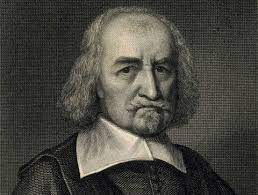
Thomas Hobbes

By the time I had finished the chapter I had calmed down. Schneewind does a decent job of explaining why Hobbes took the positions that he did. Hobbes was radically committed to scientism, nominalism, materialism, determinism and voluntarism and he was concerned, in an era marked by religious and civil war, to block any justifications for rebelling against the monarch.

It is a little difficult to condense Schneewind's arguments, so I'll focus on picking out a few of the more interesting parts. 

First, Hobbes states directly that the point of moral philosophy is to avoid the calamity of civil war: "all such calamities...arise...chiefly from civil war...few in the world that have learned those duties which unite and keep men in peace...the knowledge of these rules is moral philosophy."

This is a poor foundation for moral philosophy but it shows how much the historical context matters.

Hobbes's materialism was radical. He thought that humans were just clusters of atoms. Sometimes the atoms move toward something and this is named desire. Sometimes they move away and this is named aversion. The radical consequence of seeing things this way is that the meaning of the term "good" changes. As Schneewind puts it:

When we are moved toward something, we call that toward which we are moved "good". Thus we do not desire something because we think it good. We think it good simply because the thought of it moves us to get it.

We are not moved toward the good; the good is a word we apply to whatever we are moved toward. As Schneewind puts it, "for Hobbes to call something good is only to say one wants it". 

The endless pursuit of desire is, for Hobbes, the very thing that constitutes the motion of the self. Therefore, there can be no "final end" such as contentment in the knowledge of God, because "for Hobbes the absence of desire is the absence of motion, and that is, simply, death. Felicity lies rather in seeking and obtaining whatever we happen to want."

For Hobbes, our desires "stem from the interaction between our bodies and causal chains originating outside them, and they determine literally our every move". They are simply material effects that are part of the physical world. Therefore, Hobbes believes that desires cannot be ordered toward higher goods which might then form a common good around which communities might be harmoniously ordered. 

This is not possible, first, because we will not find like-minded people, as the causal chains will act differently on people, creating desire in some and aversion in others. Second, there is no rational deity in this scheme of thought ordering the world toward harmony - the physical laws that act on people do so indifferently and without meaning. Finally, I would presume as well that Hobbes sees individual behaviour as being too rigidly determined by causal chains to allow for a process of rationally ordering goods.

What all this means is that Hobbes does not believe that you can find the civil peace, which he believes is the foundation of moral philosophy, via a common commitment to a set of goods (i.e. to a common good). He writes that there is no "common Rule of Good and Evill, to be taken from the nature of the objects themselves".

Schneewind proceeds to note Hobbes's famous belief that humans form communities not out of natural sociability or through love of other people but through self-interest. Here we get to specific pronouncements about the nature of man that form Hobbes's anthropology. Hobbes thinks we share a fear of death and a desire for glory. We have "an insatiable desire for security" (Schneewind) which makes us want to perpetually have superior power over everyone else, leading to a war of all against all. Our natural state is the most low trust condition you could imagine.

For Hobbes, this means that there are two laws of nature. First, to seek peace as a means to obtain security. Second, if this is not possible do what it takes to stay alive.

I want to pause here to reflect on the ramifications of this. Hobbes was committed to scientism in the sense of believing that a moral theory had to have a kind of mathematical certainty. He was not alone in this commitment; his chief English detractor, Richard Cumberland, felt obliged to respond to Hobbes via a scientistic approach to morality as well (there had been a strain of scepticism which denied that we can know anything with certainty which was one reason why some were pushed toward scientism).

You can see where this leads. You end up with some very basic foundational propositions. Man here is almost abstracted out of existence. All that Hobbes can say about man's nature is that he wants to live and that he wants power and glory. Hobbes does later claim that you can build a superstructure of beliefs about virtues and vices on the basis of his "natural laws", but it is still ultimately motivated only by the desire for self-preservation.

In the more traditional view, man as a creature has a distinct nature that a person will seek to develop to its higher purposes and ends in order to fulfil his or her own being. There are, for instance, qualities of manhood that a man will rightly seek to embody because they are an "essential" aspect of his nature, through which he completes or perfects his being in the world, and which represent a higher good that he aspires to embody. What this traditional view requires is not one or two "mathematical" foundational propositions, but an insightful description of what constitutes a masculine ideal for men to seek to live by - and this will be relatively complex, as it will bring together the physical, social and spiritual elements of a man's being and will also include the distinct roles of men within the family and society.

This makes little sense within Hobbes's world picture, as for him there are no objects that are inherently good, as something is made good simply by virtue of us wanting it. Hobbes's view does, it must be admitted, fit well within a consumer society based on the pursuit of individual choice in the market - perhaps this is part of what gives me the unsettling sense that we are living excessively through Hobbesian values in the modern world.

(I'll finish reporting on Schneewind's account of Hobbes in my next post.)

Wednesday, July 28, 2021

A latter day Hobbes?

When you read the philosophy of Thomas Hobbes you can't help but notice how well it fits with the mindset of some people today. There are Hobbesians among us.

In previous posts I have summarised the philosophy of Hobbes, as set out by Michael Allen Gillespie in his book The Theological Origins of Modernity. Here are some choice quotes from the book outlining Hobbes's ideas:

We are all only individual beings, determined by our idiosyncratic passions. Good and evil for each of us is thus measured not by our progress toward a rational, natural, or supernatural end but by the vector of our desire. No direction is naturally better than any other. Good is what pleases us, evil what displeases us, good what reinforces our motion, evil what hinders it.

And this:

For Hobbes reason means something different than what it did for his predecessors. It is not a separate power that can discern the appropriate ends of life and guide us in a proper direction. It is thus not teleological but instrumental, the spy and scout of the passions. It thus helps us to maximise the satisfaction of our desires but not to train, direct or control them.

 And finally this: 

Thus, while we all desire to exist, what any one of us wants to exist for or wants out of existence can only be specified by the individual. The happiness of each individual thus depends upon his getting what he wants, and this is related to his power...Such power is the basis for what Hobbes believes is rightly called freedom.

You can see here the logic of nominalism (that there are only individual instances of things) and a certain type of materialism (that we are just matter in motion) in undermining a "teleology" - a view that there are proper ends to human life that are discernible through reason. 

What you have instead is a belief that it is the freedom to pursue my own idiosyncratic wants that matters. It does not matter so much what these wants are - one direction is neither better nor worse than another. The important thing is that I have the power to follow my desires without external interference. 

The implications of all this become clearer when you see these ideas expressed in debate. For instance, I recently saw the following posted on social media:


Now, whether or not you completely agree with this assertion, note that this is not Hobbesian, as it suggests that women do have a "telos", a distinct end in life to fulfil. Predictably, this drew a horrified response from some readers, who shuddered at the thought that womanhood might be linked in a meaningful way to motherhood. I noted this in the thread:


Now, perhaps you think that I was exaggerating in my last remark. But consider what follows when I enter into debate with a poster named Steven.


Steven is channelling Hobbes when he claims that the purpose attached to womanhood is "whatever the woman wants". The argument continued:


I've tried to explain in the comments above that in practice denying that we have natural ends in life does not free the individual to do anything, but instead provides no limits to what is expected of the individual within a technocratic social order. Why would a society be organised to facilitate family formation, a culture of stable family relationships, and the fulfilment of a fatherhood and motherhood role, if none of these are rational, natural or supernatural ends of men and women? 

The digging deeper into Hobbesian soil continued:


It was part of the Hobbesian philosophy that no direction is better than any other. And here we have a latter day Hobbesian claiming much the same thing: that hedonism is as meaningful a direction as responsible parenthood.


Steven is claiming here that the category of womanhood is meaningful because that is how some people define themselves and that it doesn't matter what womanhood is actually thought to be. It could be made to be one thing or something entirely contradictory to that thing. There is no rational limit to how we can define anything, it is an arbitrary decision of the individual (who, in a sense, gets to act just like the God of nominalism).

(Note as well that Steven believes that it is either his wife who gets to define womanhood or else me doing it for her - the option that womanhood is a real thing that both of us can perceive is not part of his mental framework. This fits Hobbes's view that freedom is the power to have my own "motion" left unhindered by that of any other person.)

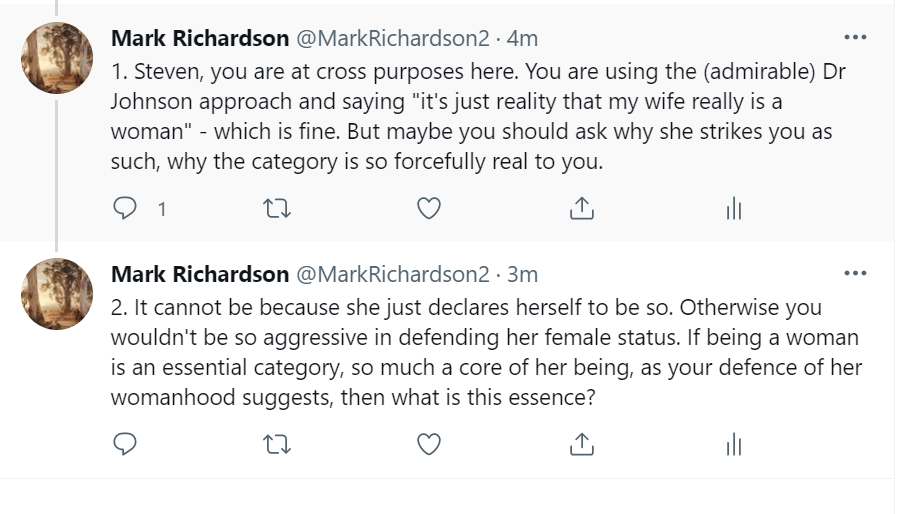
Steven then began to more aggressively defend his wife's status as a woman. I wondered why he would so vigorously defend a category which he had, to this point, reduced to a merely subjective and arbitrary choice:


Steven chose not to budge from his radical Hobbesian/nominalist framework:


There is a lot to draw from this exchange, but I'll just briefly mention two things. First, Steven's position is a "dissolving" one. This too fits in with Hobbes's philosophy, in particular with his scornful rejection of "quiddity" - the inherent essence or nature of people or things. Second, we have to be open to the possibility that the philosophical foundations of the modern West are part of the problem we face today. In other words, the problem is not just that one political leader, or party, or movement has put things off course, but rather that there are some philosophical assumptions that became prominent in the early modern period that need to be rethought. 

Sunday, July 18, 2021

Hobbes & the ends of man

Politics has been quieter than usual since the American election, but I'm pleased to note that the questioning of liberalism continues to grow. Here is a recent example:


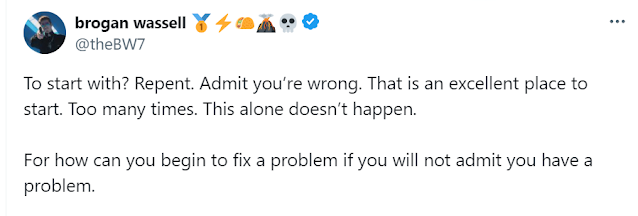
The responses to the tweet were mixed, but most recognised that liberalism had reached a point of crisis. One person, though, defended liberalism on the following basis:


I checked this person's feed and he is a reasonably open-minded right-liberal type. What I would like to focus on is his claim that there is no higher meaning outside of the choices we make.

It brought to mind my recent reading on the philosophy of Thomas Hobbes. Hobbes radically diminished the meaning of human life. He thought that everything was merely matter in motion, so that humans were acted on in ways that activated our passions and so freedom and happiness meant having the power to pursue our own idiosyncratic passions without external constraint.

What this means is that humans do not have free will. To be autonomous or self-determining has a truncated meaning in this philosophy. Our actions are not really determined by ourselves, but by the actions of external bodies upon us. We are "self-determining" only in the sense that it is our own passions that we follow without hindrance, rather than someone else's.

Hobbes scorned the medieval philosophers, particularly those who discussed "quiddity" - the inherent nature or essence of someone or something. This is important, I think, in discussing whether there is a higher meaning to things. In the twitter thread, a lot of commenters acknowledged that the liberal principle was destroying society, but they thought that religion had too weak a hold to be able to provide a counteracting principle.

Even though I am religious myself, this attitude surprises me. After all, if you can accept "quiddity" then at the very least, even without being religious, you ought to be able to accept that creatures have natural ends, i.e. that they will seek to fulfil or bring to fruition their inherent nature. For instance, men will seek to develop masculine qualities and to fulfil masculine roles, women the same for the feminine. As we are social creatures, this then has implications for our commitments within a society, including upholding certain social norms that allow our nature to successfully unfold.

The problem is that Hobbes's philosophy does not even allow for such natural ends, let alone supernatural ones. Michael Allen Gillespie, in his book The Theological Origins of Modernity, describes Hobbes's view of ends this way:

We are neither superhuman nor depraved. We are all only individual beings, determined by our idiosyncratic passions. Good and evil for each of us is thus measured not by our progress toward a rational, natural, or supernatural end but by the vector of our desire. No direction is naturally better than any other. Good is what pleases us, evil what displeases us, good what reinforces our motion, evil what hinders it. Or to put the matter in different terms, good is an increase in our power and evil its decrease...Each person in Hobbes' view is thus a self-interested individual who seeks to maximise his own power and satisfaction.

I suspect the problem here is that once a Hobbesian view sinks into political thought, there is an acute sensitivity to the idea that any restraint or self-limitation is not a rational one designed to help us, as social creatures, unfold our own ideal nature but is instead a power play by which one group of people seek to block our own "vector of desire" in order to more readily follow their own. In other words, an appeal to natural ends will be rejected as an attempt to exploit or oppress, because that assumption is built into the framework of a Hobbesian philosophy.

So you cannot then simply argue against one aspect of a Hobbesian view - it needs to be more generally dismantled in order for a different politics to emerge. This is possibly the kind of thing Antonio Garcia Martinez is referring to in his first thesis here:


Sunday, July 11, 2021

Hobbes & the metaphysics of modernity

It is commonly assumed that modern politics - secular & liberal - is not based on metaphysics. From this is derived the belief that we should keep metaphysics out of politics, particularly metaphysics of the Christian variety. For some Australians, for instance, it is troubling that our PM is a member of a Baptist church.

The dictionary definition of metaphysics is as follows:

a division of philosophy that is concerned with the fundamental nature of reality and being and that includes ontology, cosmology, and often epistemology

What is obvious from this definition is that all politics, including those of liberal modernity, must be based on a set of metaphysical assumptions. What matters then is not the impossible aim of excluding metaphysics, but trying to get the metaphysics broadly right, so that a human community is not thrown off course.

I have recently read Michael Allen Gillespie's The Theological Origins of Modernity. One of his arguments is that liberalism is based not so much on a rejection of Christian metaphysics, but developed from the theological debates that took place in the West following the adoption of a nominalist world view from the fourteenth century onward.

Gillespie sees Descartes and Hobbes as being two key proto-liberal thinkers. In order to demonstrate the metaphysical assumptions involved in the development of liberal thought, I'd like to focus on Gillespie's treatment of Hobbes. I think it is clear from his explanation of Hobbes's thought, that Hobbes was not operating neutrally from within a metaphysical vacuum, but rather that the edifice of Hobbes's thought was built upon a series of metaphysical assumptions about the nature of the cosmos; a theory of knowledge; the nature and purposes of man; the relationship between God and man and so on.

Hobbes

Gillespie begins with an account of Hobbes's physics. As interesting as this is, for the purposes of brevity I am going to skip it and focus on one aspect only of Hobbes's thought, namely his anthropology. There is enough in this alone to demonstrate the metaphysical commitments of the early modern philosophers.

It was Hobbes's view that men are "complex automata". As such, we do not have free will. Instead, we are moved by our passions (which are aroused by the impact of external objects on our bodies). If we have no free will then we cannot strive for moral perfection. Instead, our happiness depends on satisfying our bodily desires.

What are these desires? Only the most rudimentary desires, such as seeking to preserve our own lives, are basic to men. As a nominalist, Hobbes was committed to the idea that we are radically individualistic beings with idiosyncratic passions. To quote Gillespie "Thus, while we all desire to exist, what any one of us wants to exist for or wants out of existence can only be specified by the individual. The happiness of each individual thus depends upon his getting what he wants, and this is related to his power...Such power is the basis for what Hobbes believes is rightly called freedom".

You can see already how the underlying philosophy colours the meaning of terms like "freedom". With Hobbes the concept of freedom is stood on its head. We are free, according to previous ways of thinking, when we are not slaves to our passions. With Hobbes, we are free when there is nothing to impede our passions. As Gillespie puts it:

There is no freedom God bestows on us with an infusion of his will. Hobbes believes such pious hopes merely subordinate us to the passions of priests and religious fanatics. Humans are bodies driven by passions, and to be free for Hobbes is to pursue the objects of our passions without external constraints. This is practical but not metaphysical freedom...While we are thus predestined to be the kinds of beings we are and to have the passions that we have, this does not affect our freedom because it is precisely these passions that define our identity.

You can see how this overlaps with modernist thought. Moderns tend to identify freedom with an absence of external constraints; they tend to define their identity around their idiosyncratic passions; and in the English speaking tradition there has long been a hypersensitivity to the idea of priests representing an external tyranny. What is different, perhaps, is that moderns tend to combine, in an unprincipled way, the voluntarist idea that we create who we are as an act of our own will with a materialist and determinist view of the cosmos. 

For Hobbes the next step is to emphasise the significance of power in being able to pursue our desires unimpeded:

The degree of our freedom depends on our power...Our power depends on the strength of our bodies, the number of our supporters, the extent of our external resources, and above all on our capacity to reason. For Hobbes reason means something different than what it did for his predecessors. It is not a separate power that can discern the appropriate ends of life and guide us in a proper direction. It is thus not teleological but instrumental, the spy and scout of the passions. It thus helps us to maximise the satisfaction of our desires but not to train, direct or control them. To live by right reason, for Hobbes, is thus not an end but a means. Indeed, the purpose of deliberation is not to moderate the passions, as Petrarch believed, but to increase our power to get what we want.

This too is recognisably modern. You see it when women defend the unconstrained display of sexuality as empowerment. Note too the way that concepts like "reason" so readily change their meaning when placed within a different metaphysics. 

The unfolding of Hobbes's thought leads to a particular take on what the ends of human life are:

We are neither superhuman nor depraved. We are all only individual beings, determined by our idiosyncratic passions. Good and evil for each of us is thus measured not by our progress toward a rational, natural, or supernatural end but by the vector or our desire. No direction is naturally better than any other. Good is what pleases us, evil what displeases us, good what reinforces our motion, evil what hinders it. Or to put the matter in different terms, good is an increase in our power and evil its decrease...Each person in Hobbes' view is thus a self-interested individual who seeks to maximise his own power and satisfaction. 

It is interesting how enduring this view of man has been. In the later twentieth century, for instance, both the left and the right of politics adopted a game theory which required individuals to act in a self-interested way, just like Hobbesian man might be expected to act.

What does it mean to envisage a society made up of millions of idiosyncratically individual actors, each attempting to further his own power so that he has the means to satisfy his desires? First, given that our needs are limitless, there is an impetus to master/conquer nature to provide the resources to satisfy these unlimited wants, thereby providing conditions that might provide security. Second, in a state of nature, men will compete for finite resources; the natural condition of man is therefore a war of all against all.

Conclusion

This is obviously not an exhaustive account of Hobbes's thought. I hope it has shown, though, not only that metaphysics matters, but that liberal modernity is undergirded by its own metaphysics. We live in a society that has been shaped over time by a metaphysics that has been in place for some centuries now.

The alternative does not need to be an attempt to base politics on the metaphysics of any one particular church and its theology. We do, however, need to "unconceal" the metaphysics on which modernity is based and challenge aspects of it. This includes its nominalism; its reductive anthropology; its reduction of authoritative knowledge to either an apodictic science or to whatever grants power/mastery over nature; and its generally base understanding of human ends/purposes. 

Friday, January 18, 2019

Shelley & the descent of the left

An American teacher gave her students a test and asked them to identify "obstacles that keep people from moving ahead". One student gave the simple answer "white people".


Now, you might ask what this has to do with the English poet Shelley. As it happens, Shelley is part of a chain of thought on the left side of politics that ultimately leads to this answer.

In my last post I tried to explain why Shelley's concept of freedom was inseparable from a concept of equality. Shelley's political philosophy went something like this:

1. Human nature is not "tainted" in the sense of being fallen or having a fixed potential to do evil.
2. The reason why people do the wrong thing is because of existing political institutions which are based on some people having power over others (i.e. power structures).
3. Man can be regenerated if these power structures are abolished.
4. Power structures were those of the ancien régime, i.e. kings, aristocrats and priests.
5. This power structure should be replaced by democratic rule.
6. If power structures were replaced, then people would live an "Edenic" existence, i.e. a return to an idyllic, untainted existence as before the Fall.
7. Shelley, as a poet, unsurprisingly conceived this to be a kind of poetic existence within nature, with people living in complete freedom and equality, doing as they wanted, motivated by pure, selfless love, without jealousy or acquisitiveness etc.

This was how Shelley saw things in 1820. A generation later Karl Marx came along and made a key observation. Marx realised that you could get rid of the ancien régime, but in its place you would still have a power structure. The bourgeoisie would still hold power over the proletariat within a democratic system. Marx, cleverly in a way, revised the Shelleyan system, by noting that if the working class were to take power, there would be no other class below them to exploit. In other words, there would no longer be a class based power structure.

In that case, thought Marx, the power structure of society would be abolished, and you would have the kind of Edenic existence that Marx briefly sketched in his writings. His Eden was less poetic than Shelley's, but was similarly based on the idea of abolishing nations and families, and having people wander round as "unencumbered" individuals, doing whatever productive work they felt like doing (fishing, writing etc.).

Marxism is clearly a tweaking of Shelleyism, or at least of political ideas that were already in vogue.

And what of the modern left? Well, there has been a further tweak to the system. Even though Shelley did want to abolish sex distinctions, nations and marriage, he believed the key power structure to be overthrown was the class one (aristocracy). The same for Marx (the bourgeoisie). The modern left, though, focuses more on race and biological sex as power structures to be deconstructed (whiteness and the patriarchy). Only then will humanity reach its final destination of true freedom and equality.

So you can see why that school student dutifully answered that it was "white people" who were an obstacle to people moving ahead. That student is the end product of a current of thought that has existed within the left since at least the 1820s (probably earlier).

There are a few other things I should point out. First, there are other currents of thought which have also shaped the modern left. For instance, there is still the influence of the Fabians, who believed that progress would be led by a class of neutral experts employed by the state, i.e. by a technocracy ruling along scientific lines.

Second, it's interesting that the modern left no longer envisages the end point of history as a return to Eden. Perhaps that's a result of Christianity no longer shaping the mental landscape, even of those rejecting it, as much as it used to. What we are left with is a belief that white men are the privileged class upholding a power structure and that freedom and equality will finally be achieved when this power structure is defeated.

Third, it is noticeable that some of those pushing the modern version of Shelleyism are doing so to gain power for themselves, rather than to achieve a vision of utopian freedom. Middle-class feminists are often most interested in using "gender politics" to gain a competitive advantage in high status professions. They want status, money and power for themselves, rather than a system in which such things no longer exist. Similarly, it is clear that if whites become a minority in Western countries, that power will simply be passed to a new non-white majority rather than there being no power structure.

The main conclusion to draw from all this, though, is that it is the initial assumptions of Shelley that have to be challenged. Where did these beliefs of Shelley come from? I can't be exactly sure, but it's possible they go back all the way to thinkers like Hobbes and Locke. Shelley himself traced the intellectual journey of his ideas about human nature as follows (from his 1820 political manifesto):
the new epoch was marked by the commencement of deeper enquiries into the point of human nature than are compatible with an unreserved belief in any of those popular mistakes upon which popular systems of faith with respect to the cause and agencies of the universe, with all their superstructure of political and religious tyranny, are built. Lord Bacon, Spinoza, Hobbes, Boyle, Montaigne, regulated the reasoning powers, criticized the history, exposed the past errors by illustrating their causes and their connexion, and anatomized the inmost nature of social man. Then, with a less interval of time than of genius, followed Locke and the philosophers of his exact and intelligible but superficial school. Their illustrations of some of the minor consequences of the doctrines established by the sublime genius of their predecessors were correct, popular, simple and energetic. Above all, they indicated inferences the most incompatible with the popular religions and the established governments of Europe.

Shelley here praises Hobbes (and others) for having "anatomized the inmost nature of social man" and then praises Locke for having popularised the genius of thinkers like Hobbes.

So what was Hobbes' view of the nature of man? Hobbes began by imagining a state of nature in which men were free to do as they wanted. Hobbes then argued that in such a state of nature life would be short and brutish as individuals would attack each other and there would be no security of life or property. Therefore, argued Hobbes, individuals rationally made a social contract to give up part of their rights to government in return for such security. Hobbes used this argument in favour of the authority of kings.

The problem with this Hobbesian view is that it it undermines natural, uncontracted, prepolitical forms of human community, such as family and nation. The reality is that we don't begin as disconnected individuals, reluctantly combining via a social contract. We are by nature social creatures, and we express important aspects of our created natures within a social context.

It is possible that Shelley ran with the Hobbesian view, as it undermined the idea of a natural and/or divine order, but that he refigured it by challenging the idea that human nature was selfish and violent. In other words, Shelley built on some of the framework established by Hobbes (autonomous individuals in a state of nature) but made these individuals naturally good and therefore able to live a peaceful, free and equal coexistence, once the tainting influence of power structures was removed.

If we want to reject modern leftism in a principled way, it is possible that we have to go back all the way to the seventeenth century and reject the Hobbesian way of framing politics.