Showing posts with label traditionalism. Show all posts

Monday, July 15, 2024

Conservatism: A Rediscovery Part 1

I've begun reading Conservatism: A Rediscovery by Yoram Hazony. As I'd hoped, it is proving an excellent book for stimulating thinking on some important issues. I'm not far in enough to give an overall assessment, but there are already some points I think are worth making.


First, Hazony deplores the way that conservatism is confused with classical liberalism (he calls it Enlightenment liberalism). He wants the two clearly demarcated:

Which brings us to the second remarkable fact about contemporary conservatism: the extraordinary confusion over what distinguishes Anglo-American conservatism from Enlightenment liberalism (or "classical liberalism" or "libertarianism" or, for that matter, from the philosophy of Ayn Rand). Indeed, for decades now, many prominent "conservatives" have had little interest in political ideas other than those that can be used to justify free trade and lower taxes, and, more generally, to advance the supposition that what is always needed and helpful is a greater measure of personal liberty. And if anyone has tried to point out that these are well-known liberal views, and that they have no power to conserve anything at all, he has been met with the glib rejoinder that What we are conserving is liberalism or that Conservatism is a branch or species within liberalism, or that Liberalism is the new conservatism. (p.xvii)

I think he is right. Where I might disagree is that this has gone back further in time than he perhaps realises. But to illustrate his point, take a look at the following comment on social media:

She defines conservatism as "our freedom to be who we want and do as we wish". This is the underlying principle of liberalism. Professor John Kekes defines liberalism as follows:
the true core of liberalism, the inner citadel for whose protection all the liberal battles are waged [is] autonomy … Autonomy is what the basic political principles of liberalism are intended to foster and protect.

And what do liberals mean by the term autonomy? According to Professor Raz,  "Autonomy is an ideal of self-creation, or self-authorship"; similarly, Professor Sumner writes of the "conception of the person as self-determining and self-making".

Does it make sense to think of a "freedom to be who we want and do as we wish" as conservative? No, because, as Hazony points out, this formula "has no power to conserve anything at all". In fact, there is a dissolving logic to it. If the point is to make me as an individual as autonomous as possible, so that I can choose in any direction without negative consequence or judgement, then anything that is not open to individual choice has to be rejected as an oppressive limit on the self that the individual has to be "liberated" from or that needs to be socially "deconstructed".

And so, unsurprisingly, the woman quoted above has some very radical views on family life. She sees the unchosen biological role of women as limiting and oppressive and so looks forward to technology making the family redundant:


This is an admittedly extreme example, but it illustrates my point that people who hold to the formula of maximising a freedom to be who we want and do what we wish are likely to end up with a mindset that is dissolving of society - despite claiming to be conservatives. Rebecca is even willing to dissolve motherhood itself.

If you do not see the good in things, including things given as part of the nature of reality, and therefore wish to conserve them, but only see the good in the act of choice itself, and therefore are focused on removing any constraints on choice, regardless of the consequences, then you are a liberal and not a conservative. And a large majority of politicians in the right-wing parties are liberals and have been for many decades.

I'll finish with one last example of what Yazony is referring to when he deplores the confusion between conservatism and liberalism. Jeremy Boreing is the co-founder of the media company The Daily Wire:


Tuesday, January 10, 2023

What is wrong with Mr Hobbes? (Part 1)

I am reading The Invention of Autonomy by J.B. Schneewind. I reached chapter five which is on Thomas Hobbes and, predictably, only read a couple of pages before becoming enraged and wanting to fling the book at a wall. This happens every time I read something on Hobbes - he is the person in world history I revile the most.

Interestingly, some of his contemporaries had the same reaction. For instance, in 1676 a German by the name of Samuel Rachel wrote: "We will give the last place to Thomas Hobbes for filth falls on the hindmost...Never...have I lighted on any writer who has put before the world views more foolish or more foul." Schneewind goes on to note that "Hobbes's theories...aroused lasting hatred and fear in some of the strongest thinkers of the time."

Why my visceral disgust? I think it is because Hobbes is incompatible with the best of the Western mind and soul. His ideas make impossible a distinction between what is noble and elevated and what is base and common. His ideas undermine the traditional concept of the good, the beautiful and the true. His ideas deny the affinities which naturally tie together human communities. His ideas are incompatible with finding a common good for human communities based on virtue or on the ordering of the social, spiritual and biological nature of man. 
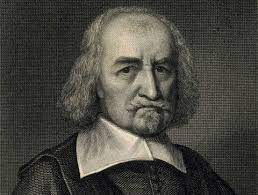
Thomas Hobbes

By the time I had finished the chapter I had calmed down. Schneewind does a decent job of explaining why Hobbes took the positions that he did. Hobbes was radically committed to scientism, nominalism, materialism, determinism and voluntarism and he was concerned, in an era marked by religious and civil war, to block any justifications for rebelling against the monarch.

It is a little difficult to condense Schneewind's arguments, so I'll focus on picking out a few of the more interesting parts. 

First, Hobbes states directly that the point of moral philosophy is to avoid the calamity of civil war: "all such calamities...arise...chiefly from civil war...few in the world that have learned those duties which unite and keep men in peace...the knowledge of these rules is moral philosophy."

This is a poor foundation for moral philosophy but it shows how much the historical context matters.

Hobbes's materialism was radical. He thought that humans were just clusters of atoms. Sometimes the atoms move toward something and this is named desire. Sometimes they move away and this is named aversion. The radical consequence of seeing things this way is that the meaning of the term "good" changes. As Schneewind puts it:

When we are moved toward something, we call that toward which we are moved "good". Thus we do not desire something because we think it good. We think it good simply because the thought of it moves us to get it.

We are not moved toward the good; the good is a word we apply to whatever we are moved toward. As Schneewind puts it, "for Hobbes to call something good is only to say one wants it". 

The endless pursuit of desire is, for Hobbes, the very thing that constitutes the motion of the self. Therefore, there can be no "final end" such as contentment in the knowledge of God, because "for Hobbes the absence of desire is the absence of motion, and that is, simply, death. Felicity lies rather in seeking and obtaining whatever we happen to want."

For Hobbes, our desires "stem from the interaction between our bodies and causal chains originating outside them, and they determine literally our every move". They are simply material effects that are part of the physical world. Therefore, Hobbes believes that desires cannot be ordered toward higher goods which might then form a common good around which communities might be harmoniously ordered. 

This is not possible, first, because we will not find like-minded people, as the causal chains will act differently on people, creating desire in some and aversion in others. Second, there is no rational deity in this scheme of thought ordering the world toward harmony - the physical laws that act on people do so indifferently and without meaning. Finally, I would presume as well that Hobbes sees individual behaviour as being too rigidly determined by causal chains to allow for a process of rationally ordering goods.

What all this means is that Hobbes does not believe that you can find the civil peace, which he believes is the foundation of moral philosophy, via a common commitment to a set of goods (i.e. to a common good). He writes that there is no "common Rule of Good and Evill, to be taken from the nature of the objects themselves".

Schneewind proceeds to note Hobbes's famous belief that humans form communities not out of natural sociability or through love of other people but through self-interest. Here we get to specific pronouncements about the nature of man that form Hobbes's anthropology. Hobbes thinks we share a fear of death and a desire for glory. We have "an insatiable desire for security" (Schneewind) which makes us want to perpetually have superior power over everyone else, leading to a war of all against all. Our natural state is the most low trust condition you could imagine.

For Hobbes, this means that there are two laws of nature. First, to seek peace as a means to obtain security. Second, if this is not possible do what it takes to stay alive.

I want to pause here to reflect on the ramifications of this. Hobbes was committed to scientism in the sense of believing that a moral theory had to have a kind of mathematical certainty. He was not alone in this commitment; his chief English detractor, Richard Cumberland, felt obliged to respond to Hobbes via a scientistic approach to morality as well (there had been a strain of scepticism which denied that we can know anything with certainty which was one reason why some were pushed toward scientism).

You can see where this leads. You end up with some very basic foundational propositions. Man here is almost abstracted out of existence. All that Hobbes can say about man's nature is that he wants to live and that he wants power and glory. Hobbes does later claim that you can build a superstructure of beliefs about virtues and vices on the basis of his "natural laws", but it is still ultimately motivated only by the desire for self-preservation.

In the more traditional view, man as a creature has a distinct nature that a person will seek to develop to its higher purposes and ends in order to fulfil his or her own being. There are, for instance, qualities of manhood that a man will rightly seek to embody because they are an "essential" aspect of his nature, through which he completes or perfects his being in the world, and which represent a higher good that he aspires to embody. What this traditional view requires is not one or two "mathematical" foundational propositions, but an insightful description of what constitutes a masculine ideal for men to seek to live by - and this will be relatively complex, as it will bring together the physical, social and spiritual elements of a man's being and will also include the distinct roles of men within the family and society.

This makes little sense within Hobbes's world picture, as for him there are no objects that are inherently good, as something is made good simply by virtue of us wanting it. Hobbes's view does, it must be admitted, fit well within a consumer society based on the pursuit of individual choice in the market - perhaps this is part of what gives me the unsettling sense that we are living excessively through Hobbesian values in the modern world.

(I'll finish reporting on Schneewind's account of Hobbes in my next post.)

Sunday, August 22, 2021

What does it mean to be modern? (2)

 In the first part of this series, I quoted Michael Allen Gillespie's definition of modernity: 

...at its core, to think of oneself as modern is to define one's being in terms of time. This is remarkable. In previous ages and other places, people have defined themselves in terms of their land or place, their race or ethnic group, their traditions or their gods, but not explicitly in terms of time...To be modern means to be "new," to be an unprecedented event in the flow of time, a first beginning, something different than anything that has come before, a novel way of being in the world, ultimately not even a form of being but a form of becoming.

To understand oneself as new is also to understand oneself as self-originating, as free and creative in a radical sense, not merely as determined by a tradition or governed by fate or providence. To be modern is to be self-liberating and self-making, and thus not merely to be in a history or tradition but to make history. 
If you see yourself this way as a modern, then logically you will end up cutting yourself off from your own tradition. You will no longer be a culture bearer.

It took some time for this logic to fully work its way through Western culture. You can see it at work in Australia by the 1940s, at least in the corridors of power. It took an even more radical form by the 1960s. For instance, Malcolm Fraser, who was soon to become PM, gave a speech in 1968 criticising the languages on offer at the University of Melbourne. He complained that the university "recognises the following languages - French, German, Greek, Latin, Hebrew, Italian, Russian and Japanese" and that "the list as a whole is one belonging to the last century except for one of the languages mentioned."

What he meant is that only the Japanese language was relevant to Australia in the twentieth century. He had no sense of affinity with the Western cultural roots of his own country. He was defining himself, and his nation, in terms of "time," which then allowed him to rupture the culture of his own country, on the grounds of what was "modern" or "new".

It got worse. Fraser did not see himself as a culture bearer, but by the 1990s it was common for it to be denied that there was any culture to be borne. I remember contributing to a debate at the University of Melbourne where the phrase "Australian culture" was mentioned. It led to a quizzical riposte of "What is Australian culture?" as if it were surprising to hear the claim that there was such a thing.

Nor was this just a local phenomenon. At around the same time, I watched an interview on TV with someone from Austria. He too was stumped when asked about culture and replied "What is Austrian culture anyway?". I thought this particularly curious coming from someone living in the heart of Vienna.

Since then the schools have focused in an unrelenting way on presenting Australian history as being a story of oppression and discrimination. It has had the intended effect of disconnecting many people from their own past.

One point to be made here is that for things to change you would need to do something more than just tweak the school curriculum. If the teachers see themselves as moderns, and if this means defining yourself not in terms of land or place, ethny or tradition, but as a continuous "becoming" into something new and self-making, then there will not be a positive account of one's own history. It will always be something to be broken from.

If we are no longer culture bearers then what are we? It strikes me that moderns are tourists. They still need the connection to a living culture, but no longer identify with their own. And so they act like outsiders experiencing the cultures of others. This does not just mean experiencing these cultures when travelling overseas, but in their own countries as well. Perhaps this also contributes to the push in Australia to have Aboriginal culture as the national culture, even though an overwhelming majority are not Aboriginal. This would be odd if we thought of ourselves as culture bearers of our own tradition, but for a modern who does not see themselves this way, but who still wants a connection (as an outsider) to a culture, it makes sense. (Which explains as well why moderns are comfortable with the "welcome to country" ceremonies - they don't see themselves as connected to land, people or tradition, and so don't mind being placed in the position of "guests" and "outsiders" to another culture).

By rejecting the role of culture bearer, the Western individual has lost a significant aspect of his being. As culture bearers, we take the baton from past generations, attempt to live up to their achievements and to pass them on to future generations. This gives us a standard to measure ourselves by, or even to surpass, a mission in the world that requires us to live up to an ideal, and a reason to feel a pride in what we represent. It connects our individual efforts in life to a larger and enduring communal tradition.

So how do we break from modernism? There is a lot that could be said, but I'll focus on just a few points. First, modernism relies on a belief in linear progress - that we are making continual progress toward ever more advanced forms of society. For many people, the main evidence for this is technological progress. We now have smart phones and smart TVs, a growing array of apps and this is held to be proof of progress.

What we should be pointing out is that these kind of technologies are just tools. They can be used for beneficial purposes or for harmful ones. For instance, if a young girl has all the latest communications technology, but it just carries junk culture to her, culture that is likely to lead to poor life outcomes, then in what way is the technology a measure of progress? What is more important, surely, is the quality of the culture she inhabits, and whether this culture encourages her to develop along higher, rather than lower, lines, in terms of her commitments, her virtues, her maturity, her wisdom, her relationships. The state of culture does not inevitably advance, it only improves over a period of generations, via much love and self-sacrifice - which is one reason to admire and to be grateful for the positive aspects of culture that we do inherit.

Then there is the issue of eschatology - of the idea of human history culminating in the end days. This is a feature of both pagan (e.g. Ragnarok) and Christian theology. The danger is not with the religious belief, but with its secularisation into a humanistic belief in a linear progress of humanity to some ultimate end point. Linear progress then becomes part of an implicit religion that is difficult to challenge, first because it is an aspect of the overall world picture of moderns through which people try to make sense and meaning of their lives and, second, because it is left implicit and so is absorbed as part of the general culture which means it is less likely to be examined.

This does not mean that a belief in linear progress can't be challenged, but we shouldn't expect easy victories. I think the key steps here are not only to point out that society hasn't progressed in the ways it was expected to, but also to provide an alternative world picture to replace the one that moderns cling to. One task, then, is a recovery of ideas that were once central to Western thought, particularly those that relate to the ordering of self and society toward higher goods.

One final point. I have emphasised the importance of being a culture bearer. Western culture was, until recently, a richly developed, "grand" culture. The next step, however, may not be to uphold the most sophisticated, urbanised aspects of this culture. It may be necessary to re-establish our own cultures and traditions at a smaller scale and at a local level, at least to begin with. To maintain continuity might require a measure of adaptability.

Thursday, April 13, 2017

Guillaume Faye: a return to values

Sydney Trads have a "quote of the week" feature at their website. I particularly liked this one by French writer Guillaume Faye:
Moreover, as the philosopher Raymond Ruyer, detested by the left-bank intelligentsia, foretold in his two important works, Les nuisances idéologiques and Les cents prochains siècles, once the historical digression of the nineteenth and twentieth centuries has finally closed, with egalitarianism’s hallucinations having descended into catastrophe, humanity will return to archaic values, that is, quite simply, to biological and human (anthropological) values: distinctive sexual roles; the transmission of ethnic and popular traditions; spirituality and sacerdotal organization; visible and supervisory social hierarchies; the worship of ancestors; initiatory rites and tests; the reconstruction of organic communities that extend from the individual family unit to the overarching national community of the people; the deindividualization of marriage to involve the community as much as the couple; the end of the confusion of eroticism and conjugality; the prestige of the warrior caste; social inequality, not implicit, which is unjust and frustrating, as in today’s egalitarian utopias, but explicit and ideologically justifiable; a proportioned balance of duties and rights; a rigorous justice whose dictates are applied strictly to acts and not to individual men, which will encourage a sense of responsibility in the latter; a definition of the people and of any constituted social body as a diachronic community of shared destiny, not as a synchronic mass of individual atoms, etc.

I had to look up the meaning of the words synchronic and diachronic:

synchronic: concerned with something as it exists at one point in time.

diachronic: concerned with the way in which something has developed and evolved through time.