Tuesday, January 10, 2023

What is wrong with Mr Hobbes? (Part 1)

I am reading The Invention of Autonomy by J.B. Schneewind. I reached chapter five which is on Thomas Hobbes and, predictably, only read a couple of pages before becoming enraged and wanting to fling the book at a wall. This happens every time I read something on Hobbes - he is the person in world history I revile the most.

Interestingly, some of his contemporaries had the same reaction. For instance, in 1676 a German by the name of Samuel Rachel wrote: "We will give the last place to Thomas Hobbes for filth falls on the hindmost...Never...have I lighted on any writer who has put before the world views more foolish or more foul." Schneewind goes on to note that "Hobbes's theories...aroused lasting hatred and fear in some of the strongest thinkers of the time."

Why my visceral disgust? I think it is because Hobbes is incompatible with the best of the Western mind and soul. His ideas make impossible a distinction between what is noble and elevated and what is base and common. His ideas undermine the traditional concept of the good, the beautiful and the true. His ideas deny the affinities which naturally tie together human communities. His ideas are incompatible with finding a common good for human communities based on virtue or on the ordering of the social, spiritual and biological nature of man. 
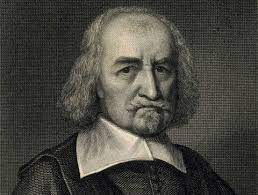
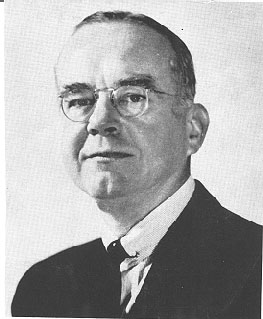
Thomas Hobbes

By the time I had finished the chapter I had calmed down. Schneewind does a decent job of explaining why Hobbes took the positions that he did. Hobbes was radically committed to scientism, nominalism, materialism, determinism and voluntarism and he was concerned, in an era marked by religious and civil war, to block any justifications for rebelling against the monarch.

It is a little difficult to condense Schneewind's arguments, so I'll focus on picking out a few of the more interesting parts. 

First, Hobbes states directly that the point of moral philosophy is to avoid the calamity of civil war: "all such calamities...arise...chiefly from civil war...few in the world that have learned those duties which unite and keep men in peace...the knowledge of these rules is moral philosophy."

This is a poor foundation for moral philosophy but it shows how much the historical context matters.

Hobbes's materialism was radical. He thought that humans were just clusters of atoms. Sometimes the atoms move toward something and this is named desire. Sometimes they move away and this is named aversion. The radical consequence of seeing things this way is that the meaning of the term "good" changes. As Schneewind puts it:

When we are moved toward something, we call that toward which we are moved "good". Thus we do not desire something because we think it good. We think it good simply because the thought of it moves us to get it.

We are not moved toward the good; the good is a word we apply to whatever we are moved toward. As Schneewind puts it, "for Hobbes to call something good is only to say one wants it". 

The endless pursuit of desire is, for Hobbes, the very thing that constitutes the motion of the self. Therefore, there can be no "final end" such as contentment in the knowledge of God, because "for Hobbes the absence of desire is the absence of motion, and that is, simply, death. Felicity lies rather in seeking and obtaining whatever we happen to want."

For Hobbes, our desires "stem from the interaction between our bodies and causal chains originating outside them, and they determine literally our every move". They are simply material effects that are part of the physical world. Therefore, Hobbes believes that desires cannot be ordered toward higher goods which might then form a common good around which communities might be harmoniously ordered. 

This is not possible, first, because we will not find like-minded people, as the causal chains will act differently on people, creating desire in some and aversion in others. Second, there is no rational deity in this scheme of thought ordering the world toward harmony - the physical laws that act on people do so indifferently and without meaning. Finally, I would presume as well that Hobbes sees individual behaviour as being too rigidly determined by causal chains to allow for a process of rationally ordering goods.

What all this means is that Hobbes does not believe that you can find the civil peace, which he believes is the foundation of moral philosophy, via a common commitment to a set of goods (i.e. to a common good). He writes that there is no "common Rule of Good and Evill, to be taken from the nature of the objects themselves".

Schneewind proceeds to note Hobbes's famous belief that humans form communities not out of natural sociability or through love of other people but through self-interest. Here we get to specific pronouncements about the nature of man that form Hobbes's anthropology. Hobbes thinks we share a fear of death and a desire for glory. We have "an insatiable desire for security" (Schneewind) which makes us want to perpetually have superior power over everyone else, leading to a war of all against all. Our natural state is the most low trust condition you could imagine.

For Hobbes, this means that there are two laws of nature. First, to seek peace as a means to obtain security. Second, if this is not possible do what it takes to stay alive.

I want to pause here to reflect on the ramifications of this. Hobbes was committed to scientism in the sense of believing that a moral theory had to have a kind of mathematical certainty. He was not alone in this commitment; his chief English detractor, Richard Cumberland, felt obliged to respond to Hobbes via a scientistic approach to morality as well (there had been a strain of scepticism which denied that we can know anything with certainty which was one reason why some were pushed toward scientism).

You can see where this leads. You end up with some very basic foundational propositions. Man here is almost abstracted out of existence. All that Hobbes can say about man's nature is that he wants to live and that he wants power and glory. Hobbes does later claim that you can build a superstructure of beliefs about virtues and vices on the basis of his "natural laws", but it is still ultimately motivated only by the desire for self-preservation.

In the more traditional view, man as a creature has a distinct nature that a person will seek to develop to its higher purposes and ends in order to fulfil his or her own being. There are, for instance, qualities of manhood that a man will rightly seek to embody because they are an "essential" aspect of his nature, through which he completes or perfects his being in the world, and which represent a higher good that he aspires to embody. What this traditional view requires is not one or two "mathematical" foundational propositions, but an insightful description of what constitutes a masculine ideal for men to seek to live by - and this will be relatively complex, as it will bring together the physical, social and spiritual elements of a man's being and will also include the distinct roles of men within the family and society.

This makes little sense within Hobbes's world picture, as for him there are no objects that are inherently good, as something is made good simply by virtue of us wanting it. Hobbes's view does, it must be admitted, fit well within a consumer society based on the pursuit of individual choice in the market - perhaps this is part of what gives me the unsettling sense that we are living excessively through Hobbesian values in the modern world.

(I'll finish reporting on Schneewind's account of Hobbes in my next post.)

Monday, January 02, 2023

Repression, DV & the Freudian left

Earlier this summer eleven Australian women were murdered over a three week period. It led to a debate on social media about domestic violence and how it might be tackled.

On one side of the debate were those who emphasised two things. First, that women are the victims of violence and men the perpetrators. Second, that the solution is for men to change, in particular, by becoming less repressed and by better expressing their emotions. For instance, one woman I engaged with ("Megwa") began by demanding that we "Fix the men". When I asked her what she meant by this, she replied "by taking down the patriarchal bs that inhibits teen boys from showing their emotions, oh sorry, fighting’s okay, but don’t cry."

a) The narrative

There is a strong tendency in these debates for the facts to be filtered to uphold a narrative of men as perpetrators and women as victims. This is despite the fact that men are considerably more likely than women to be the victims of violence (for instance, 70% of those murdered in Australia are men). 

It is true that men are also more likely to be the perpetrators, though not to the extent that those who believe in the narrative imagine. For instance, my female colleagues guessed that when it comes to domestic violence that 95% of the perpetrators are men. The real figure is not nearly this high. The NSW Government provides up to date data on those brought to court by police on charges of domestic violence (i.e. physical assault). In the period from October 2021 to September 2022, there were 10,790 men proceeded against by NSW police and 4,531 women, giving a roughly 70/30 split. 

If violence is caused by the socialisation of men, how then do you explain the 30% of domestic violence assaults that are perpetrated by women? There must be another explanation.

b) Men and emotions

There is a commonly held belief that problems in society are caused by boys being socialised to repress their emotions. If boys could be raised to be more girl-like in their emotions, the theory goes, then you would not have the pathologies of "toxic masculinity". 

This idea is taken so seriously that there are organisations in Australia which go to schools and conduct group therapy sessions for the boys to guide them to release their feelings as a future model of masculinity.

Where does this belief come from? It is a survival of left Freudianism, one of those "accretions" within the larger political culture. I'm not as well versed in left Freudianism as I'd like to be, but my current understanding of it runs as follows. Freud himself thought that repression led to discontent within the individual but that it was necessary for civilisation. The left Freudians, in the mid twentieth century, took a different approach. They thought that it was not enough to have a political revolution to reform society - this had been tried in places like Russia but had led only to a new type of authoritarianism. To succeed, there had to be a psychological transformation of the individual and this would occur when the individual ceased to repress their instincts, feelings and emotions.

You get a sense of this left Freudianism in the claims that masculinity is toxic because it leads men towards dominance and power which is exerted in oppressing women through acts of violence and that the path forward is for men to not be socialised to repress their emotions and feelings. In other words, we have a left Freudian claim that an authoritarian personality type is being created via psychological repression.

This is often joined together with another accretion within our political culture, namely the leftist belief that there are power structures which have denied humans an Edenic existence of living in peace, harmony and equality. In this case, the power structure most usually targeted is the patriarchy, which is held responsible for encouraging boys to repress their feelings.

The American feminist Gloria Jean Watkins (commonly known by her pen name bell hooks) wrote a book titled The Will to Change: Men, Masculinity and Love (2004). In this work, she gives voice to these ideas about men. She complains that,

...masses of men have not even begun to look at the ways that patriarchy keeps them from knowing themselves, from being in touch with their feelings, from loving. To know love, men must be able to let go the will to dominate.

She adds:

...by supporting patriarchal culture that socializes men to deny feelings, we doom them to live in states of emotional numbness. 

c) Criticisms

1. Lack of awareness

My first criticism of this common approach to ending male violence is that those who hold it aren't aware of where their ideas come from, i.e. that they are blindly following the accretions within modern political culture.

2. Rousseau

My second criticism is that there is a faulty assumption about human nature in this view, one that shares with Rousseau the idea that humans are good by nature but corrupted by society. This suggests that human nature is perfectible and that it is therefore reasonable to demand an end to male violence as an immediately achievable goal (some of those commenting on social media believe that it is within the power of men to stop other men from being violent). There is too little acknowledgement that human nature is flawed and that a complete eradication of violence is not a likely prospect, even in the most rationally ordered social settings.

3. Solipsism

Some of the women involved in the debate assume that if men are to have emotions they must be experienced and expressed in the same way as women - otherwise they do not exist. It is difficult to explain to these women that a man can have a rich inner life without being "emotional". Men are generally more able to be analytically detached from their feelings and to express them less overtly, but this does not mean that a man is incapable of love and other deeply felt inner states. 

Despite claiming that men are emotionally numb in a patriarchy, Gloria Jean Watkins makes two telling admissions. First, she admits that men are able to love women for who they are, whereas women are more likely to care for men on the basis of a man's performative role:

We struggle then, in a patriarchal culture, all of us, to love men. We may care about males deeply. We may cherish our connections with the men in our lives. And we may desperately feel that we cannot live without their presence, their company. We can feel all these passions in the face of maleness and yet stand removed...Caring about men because of what they do for us is not the same as loving males for simply being. When we love maleness, we extend our love whether males are performing or not. Performance is different from simply being. 

Second, she admits that she did not like her own partner opening up emotionally because it undermined her sense of his masculine strength:

When I was in my twenties, I would go to couples therapy, and my partner of more than ten years would explain how I asked him to talk about his feelings and when he did, I would freak out. He was right. It was hard for me to face that I did not want to hear about his feelings when they were painful or negative, that I did not want my image of the strong man truly challenged by learning of his weaknesses and vulnerabilities.

4. Raising boys

The idea that the key to raising boys is to encourage emotional vulnerability is not harmless, because it disrupts one important aspect in the raising of boys, namely the "make strong" ethos. It is normal and healthy for fathers to want to encourage physical and mental strength in their sons. This does not mean that boys or men should never seek help with problems, particularly if these are acute, but this is not the general mindset by which men seek to develop who they are as men.

5. Tackling violence

If the aim is to reduce the level of violence in society, it is important to understand what promotes it. The data suggests that violence is more likely to occur within a social underclass marked by drug and alcohol abuse, unemployment, homelessness and mental health issues. Anglicare Victoria has suggested that these factors are present in about 80% of cases of domestic violence. In cases of female homicide victims:

James and Carcach (1998) suggest that almost 85 per cent of victims, and a little over 90 per cent of offenders, belong to what can be described as an underclass in Australian society.

The aim should be, therefore, to do what can be done to limit the size of this underclass in if we wish to reduce the prevalence of violence. Asking ordinary men to cry more is not a targeted solution.

6. Repression & emotions

If the aim is to promote a healthier inner life for men, then the left Freudian idea of not repressing our feelings, instincts and urges is misguided. The better aim is to rationally order these feelings, instincts and urges both toward our own good and toward the common good. It is more in the failure to achieve this that our inner life is radically diminished and that we are cut off from sources of love and connectedness, i.e. that we become emotionally and spiritually damaged or broken. 

If we truly want to help men live an emotionally rich life, then we should encourage earlier family formation; a more stable culture of family life; an opportunity to provide and protect for a family; a more secure experience of fatherhood; a reasonable work/life balance, including an opportunity to cultivate male friendships within male social settings; an opportunity for serious participation within a religious tradition; an active participation within a polis; and a culture which connects men to their family lineage and to their own ethny and culture.

Wednesday, December 28, 2022

Feminism & the absent father

A remarkable fact about feminism is that many of its leading figures suffered from absent fathers. To name but a few:

Germaine Greer: wrote a book titled Daddy We Hardly Knew You.

Kate Millett: her father abandoned the family to live with a nineteen-year-old.

Eva Cox: her father left the family to pursue a relationship with a pianist "leaving an embittered wife and a bewildered and rebellious daughter".

Jill Johnston: her father left when she was a baby. She wrote a book titled: Mother Bound: Autobiography in Search of a Father.

Gloria Steinem: she said of her father that he "was living in California. He didn't ring up but I would get letters from him and saw him maybe twice a year".

Rebecca West: her father left when she was three, both she and her two sisters became radical feminists.

There was another second wave feminist, Gloria Jean Watkins (but better known by her pen name "bell hooks") who acknowledged the impact that an absence of father love had made on the feminist movement (her own father did not abandon the family but he was an emotionally distant, authoritarian figure).

In the opening pages of her influential book The Will to Change: Men, Masculinity and Love, published in 2004, Gloria Jean Watkins connects an absence of masculine love with female rage:

Every female wants to be loved by a male...she wants to feel the love of father, grandfather, uncle, brother or male friend. We live in a culture where emotionally deprived females are desperately seeking male love. Our collective hunger is so intense it rends us...The male bashing that was so intense when contemporary feminism first surfaced more than thirty years ago was in part the rageful cover-up of the shame women felt not because men refused to share their power but because we could not seduce, cajole or entice men to share their emotions - to love us.

She describes the effect that a loss of father love has on a child:

No one hungers for male love more than the little girl or boy who rightfully needs and seeks love from Dad. He may be absent, dead, present in body yet emotionally not there, but the boy or girl hungers to be acknowledged, recognized, respected, cared for...No wonder then that these boys and girls grow up angry with men, angry that they have been denied the love they need to feel whole, worthy, accepted.

She believes that girls who miss out on paternal love often,

make romantic bonds the place where they quest to find and know male love. But that quest is rarely satisfied. Usually rage, grief and unrelenting disappointment lead women...to close off the part of themselves that was hoping to be touched and healed by male love.

Finally, she gives voice to her own personal experience:

As a child I hungered for the love of my dad. I wanted him to notice me, to give me his attention and affections. When I could not get him to notice me by being good and dutiful, I was willing to risk punishment to be bad enough to catch his gaze, to hold it, and to bear the weight of his heavy hand. I longed for those hands to hold, shelter and protect me, to touch me with tenderness and care, but I accepted that this would never be.  

The lesson of all this is that fathers do matter. Men should understand that the quality of the relationship they have with their children has a profound effect. Fathers have to negotiate having a dual responsibility toward the child: on the one hand, needing to socialise and discipline, but on the other hand needing to be a source of reassuring paternal love, care and protection.

And if this is absent? Then, as Gloria Jean Watkins noted, you will sometimes get the kind of lifelong rage that consumes third wave feminist Sophie Lewis. Sophie Lewis had a troubled relationship with her father and used the following quote (from Katherine Angel) to describe the subsequent emotional fallout:

The anger and rage we might feel towards a father...is not something we can expel, once and for all, and nor does it yield a clear solution. Rage has instead to be folded into everything else we may simultaneously feel; it does not simply burn itself out.

You might too get the women with "daddy issues" who are too emotionally damaged to successfully pair bond with men in marriage. 

At a larger level, the rage against the absent father can translate into political rebellion (as we have seen with the feminist leaders). Mary Eberstadt believes that those deprived of a father are prone to a form of ressentiment:

...these disinherited young are beyond furious. Like Edmund, too, they resent and envy their fellows born to an ordered paternity, those with secure attachments to family and faith and country.

For Lawrence Auster the father represents a principle of structure:

Symbolically, the father is the structuring source of our existence, whether we are speaking of male authority, of the law, of right and wrong, of our nation, of our heritage, of our civilization, of our biological nature, of our God. All these structuring principles of human life, in their different ways, are symbolically the father. The rebellion we've discussed is...a rebellion against the father. The belief that the universe is structured, intelligible, and fundamentally good, and that one can participate in this universe - this is the experience of having a father, which is the opposite of the experience of alienation that drives contemporary culture.

Modern society cannot recognise any of this because it is committed to the view that any type of family arrangement is as good as another. The danger is that men might internalise this false view and come to believe that their presence in family life does not matter. It is important that we reject the modern view: it is an approach that will leave many young women angry, unable to pair bond and prone to rebellion not only against family but against the higher, structuring principles of existence.

Monday, December 26, 2022

Runaway rights

If you visit the website of the Castlemaine Art Museum this is what you are greeted with:


This kind of thing is becoming normal now in Australia. At meetings and sporting events we acknowledge Aboriginal elders and are welcomed to Aboriginal country. Some left-wing politicians prefer to fly the Aboriginal flag rather than the national one. About 40% of the continent is now held by small Aboriginal communities, with more to come. In NSW there is a plan to hand over management of all national parks to local Aboriginal groups. This has already led to one significant trail at Mt Warning being closed to the public. There is also a referendum to be held next year to provide an Aboriginal "Voice" to Parliament, with no clear indication of what powers this voice will have.

Back in 2015 the Canadian PM, Justin Trudeau, told a journalist that,
Canada could be the “first postnational state...There is no core identity, no mainstream in Canada.”

Australia is following a somewhat different course, one suggested by the feminist Germaine Greer in a book titled Whitefella Jump Up (2004), in which she claimed that an Australian national identity could be framed around Aboriginality.

How to explain all this? It is becoming increasingly clear to me that you have to understand politics as an inherited culture, with this culture being formed through accretions. The logic of each accretion plays out, each in its own way. It can be difficult to understand what is happening, because there are multiple sources that are not always entirely in harmony with each other.

One of these accretions is minoritarianism. There were campaigns to establish equal rights for religious minorities in the UK in the 1800s; these campaigns succeeded for Protestant dissenters in 1828, for Catholics in 1829, for Jews in 1858, and for atheists in 1888. Equal rights for minorities became an established part of the political landscape, but this does not explain why the identity of a majority should be stripped away and replaced by that of a minority. I think there are at least two additional points that need to be made here.

The first has been put forward by Eric Kaufmann. He has argued that the initial support for minority rights later became embedded as an emotional reflex:

Once liberalism turned from defending the rights of disenfranchised majorities to protecting minority rights, the narrative shifted. When it came to the rights of Catholics and Jews (in Protestant countries), racial minorities, or homosexuals, the “bad guys” were the majority, who menaced minorities in need of protec­tion. The emotive pairing of majority with malice and minority with empathy began this way. What started as a modest habit of mind has deepened into a reflexive demonization of majorities and lionization of minorities.

Kaufmann believes that this mentality crystalised in the US in the early 1900s. It led as early as 1916 to certain liberal progressives such as Randolph Bourne taking the now familiar attitude of lionising the culture of immigrant minorities whilst disparaging their own.

I do believe that Kaufmann is correct here and that there is an inherited emotional reflex at work that is deeply important for some people. It is noteworthy, for instance, that Germaine Greer felt so deeply about this majority/minority distinction, that she wished at one point in time to be Jewish and later on had herself adopted into an Aboriginal tribe.

However, I don't think this could have happened without a second factor coming into play. Let's say the aim is to extend minority rights. At some point in time, for there to be a workable politics, there needs to be an end point at which these rights have been satisfied. If there is no end point, then the minority will accrue more and more rights and eventually be in the far superior position. What is the logical limiting factor to ensure that this doesn't happen? It is the majority following through with a normal concern for their own common good, i.e. wanting to uphold their own existence and to pursue the best within their own tradition.

Liberalism has made it difficult for the majority to do this, thereby removing any boundaries to minoritarianism. For instance, the anthropology of the first wave of liberalism is a negative one, in which humans are selfish and solitary and only come together in society via a social contract. For first wavers, social life is to be organised around the pursuit of profit in the market, harnessing low aspects of human nature such as greed. The former PM of the UK, Boris Johnson, gave voice to this "accretion" within modern politics when he said:

I don't believe that economic equality is possible; indeed some measure of inequality is essential for the spirit of envy and keeping up with the Joneses that is, like greed, a valuable spur to economic activity.
Those who hold to this view will see politics in terms of Economic Man, with the "nation" being conceived as something like a vast economic enterprise in competition with other such enterprises. They will not give much weight to traditional ties of kinship.

The second wave liberals held that human nature was perfectible. It was corrupted by institutions of power (by inequality, therefore by "distinctions"). The solution was to commit to the larger "wholes" in which humans were by definition equal, such as the human race. As Lawrence Auster wrote:
On the left, socialists and Communists...believe in larger wholes, but the wholes they believe in are seen in terms of equality: the whole of society—equal; the whole of the human race—equal. They believe that man has the ability to engineer this larger, equal whole into existence, wiping out the unequal, inherited orders of class, sex, nation, race, religion, morality, and thus creating a New Humanity. Only the largest whole—humankind—is good, because only at the level of all humanity can there be true equality and fraternity uniting all people.
White leftists, therefore, are not primed to uphold the existence of their inherited national identity. They are more likely to focus on issues relating to structural inequality that such identities are thought to create. Leftists often condemn white identities as "supremacist" for this reason - so again, there is nothing here to limit an excessive emphasis on minority rights from this "accretion" within modern politics.

The solution to all this is not an easy one, as cultures form over time and become deeply rooted. If you do criticise one particular policy it does not change the larger culture, which will continue to form people in a certain way.

There are things that might be done. Clearly articulating the negative accretions would help, as would recovering the worthier understandings that preceded them. And, at some point, there needs to be a challenge to the process of formation. This is particularly true of schools which are more focused on propagating the political culture than people realise.

Monday, November 28, 2022

To break the chain?

Earlier this month a young biracial woman denounced her white father at his funeral. In her speech she said of her father:

You’ll never be what you could have been, but only what you are. And what you are is a racist, misogynistic, xenophobic, Trump-loving, cis, straight white man. That is all you will ever be to me.
There are two striking things about this. First, it demonstrates clearly the changed understanding of the virtue of justice. In the ancient world, justice meant giving someone their due. This meant giving due respect to those entities who gave us our existence, including God, our parents and our larger national family. "Honour your father and your mother" as it says in the Bible. In Ancient Rome, this was considered to be an aspect of the natural order to be upheld through the virtue of "pietas", defined by the Encylopaedia Britannica as "a respectful and faithful attachment to gods, country, and relatives, especially parents".

Justice in our own times has mostly lost this ancient meaning. It is now focused on notions of social equality. You can see this in the daughter's speech: she castigates her father for his transgression of modern ideas of equality, i.e. for being racist and sexist and for belonging to supposedly privileged groups (white, male, cisgendered etc.)

In her mind, she is fighting to make the world a better and more just place. To more ancient minds, she is acting unjustly in disrespecting her own father at his funeral. A key question here is why this transition in the meaning of justice has taken place. I will give a possible explanation shortly, but it will help first to look at another striking aspect of the speech, namely what it demonstrates about social class.

The father in question is Donald Foss. He was worth $2 billion at the time of his death and so was part of an upper class elite. His daughter was raised in a position of immense class privilege, living in mansions and attending elite private schools.

And yet his daughter, with a furious energy, chooses to present herself as being at the bottom of the social hierarchy and as being a victim of privileged forces, such as white, male, "cisgendered" men like her father.

Again, there has been a transition here in how the upper class justifies its privileged social position. In the past, the elite would signal its status through refinement (of manners, of speech, of taste); through displays of wealth (homes, clothing, banquets); and through cultivating knowledge and an appreciation of the fine arts. There was also the important concept of noblesse oblige, meaning that if you were noble in status you should act nobly in character ("Whoever claims to be noble must conduct himself nobly"). Noblesse oblige was also understood to mean that those in a privileged social position had a duty toward those less privileged - so this concept connected the upper classes in a positive way toward those of other social classes.

The older justification of wealth and privilege barely exists today. It is true that modern day billionaires do sometimes commit to philanthropic causes, although these are often international efforts to promote some form of "identity equality". What is increasingly common, though, is for upper class people to seize upon identity politics to claim to be suffering from some form of oppression, i.e. to present themselves as lacking privilege rather than enjoying it.

Which brings me to my theory of why this change has taken place. If we consider the world picture that existed in the ancient world, and compare it to that of modern times, one significant difference is the loss of the idea of a great chain of being. There were two key aspects of this chain of being. First, it was hierarchical. Those further up the ladder had more elevated attributes. Second, every creature in the chain was necessary to hold it together and so, in this sense, each was a vital link.

It has to be remembered that this chain of being was thought of, in concrete terms, as representing the way that the cosmos was structured. In other words, reality was understood through this idea of a chain of being.

One of the consequences of understanding the world this way, is that there was both an "above" and a "below" when it came to man's position in the cosmos. Above man were the angelic beings and God, below man were the animals and the inanimate forms of creation. There was a vertical realm of existence within which man could look upwards, but also could feel set above and therefore dignified in his position.

What I would like to conjecture is this: that if your world picture included the great chain of being, then it was possible to believe that if you were higher up the social ladder that you represented something higher in the scale of being. If so, the major distinction between the social classes, of nobility and commoner, would be a relatively profound one. It would not just rest on money or power, but would signify also an "ontological" difference, i.e. of being formed in some higher way.

In the American Declaration of Independence there is a famous phrase that "We hold these truths to be self-evident, that all men are created equal". This is not obviously true. Men are clearly not equal in many respects. It is possible that the emphasis here is on men having equal rights. Perhaps, though, it is also a move away from the older view, in which the distinction between nobility and commoners really did suggest men being created unequally.

This elevated view of the nobility can be seen to have had both positive and negative consequences (sometimes intermixed). For instance, it makes sense in such a social situation for people to look up to and to seek to emulate the culture of the upper classes, since this culture will be thought of as being higher up a scale of existence. This is clearly preferable to the situation in our own times in which culture looks downwards, so that the middle-classes begin to ape behaviours once associated with bikies, sailors or "gangtas". 

On the other hand, when you have an elevated upper class, the possibility emerges of people fawning to this social class. It's interesting in this regard that nineteenth century Australian culture strongly rejected this aspect of old world culture and replaced it with a more egalitarian "mateship" ethos (Australian soldiers in WWI had a reputation for not respecting officers as they were supposed to).

Again, if I am right here, and the nobility thought of themselves as being a breed apart, this would anchor their identity, in part anyway, on the possession of higher attributes of character that they would then have to live up to. Yes, it might justify snobbishness as well, but it softens the idea that class privilege is only about power or money. It provides a foundation for more positive ideals of what it means to be upper class.

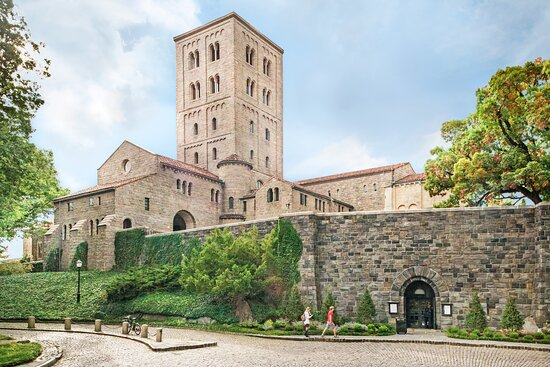
The older concept of the nobility still retained some influence in the modern period, at least until the early 1900s. For instance, if you look at the magnates of the American Gilded Age you find a mixture of modern sensibilities (e.g. technocracy), with some admiration for an aristocratic past. J.P. Morgan, for instance, built a beautiful library in a traditional style and collected older European manuscripts. The Vanderbilts married a daughter, Consuelo, to the Duke of Marlborough. John D. Rockefeller built a museum in a traditional European style in New York, The Cloisters, and purchased many medieval artworks for display. 

The Cloisters, New York

The Morgan Library

If the secular order of the pre-modern West had a built in, inegalitarian social hierarchy, this was balanced to some degree by the clerical or religious order. I mean this not only in the sense that commoners could rise through the ranks of the church, and not even in the sense that the Christian belief that man was made in the image of God supported the dignity of the common man, but more fundamentally that the possession of the virtues most highly regarded within the religious life and the clerical orders did not depend on birth. Ascent within the clerical orders or the realm of religion was measured by faith, love, piety and sanctity, and these did not depend on birth (the New Testament, of course, emphasises that the poor are not disadvantaged in their spiritual fate). 

In this way, the existence of a hierarchical social order was most likely of great benefit to the Church, as it made Christianity that order of life through which the common man could ascend or in which he stood on equal ground. This may help to explain the discontent when the Church hierarchy too closely mimicked that of the aristocracy, as it might have seemed at odds with the true function or role of the Church.

There were radical religious movements which rejected the idea of two orders, and which wanted to abolish the hierarchy within the social realm. They sometimes pointed out that in the prelapsarian state of man, in the Garden of Eden, there were no social classes. They were levellers of one sort or another. Looking back, they seem to have missed the symbiotic relationship between the secular and religious orders. What Christianity offered was made more compelling by the existence of a hierarchy within the social realm. To put this another way, there was an important space made available to Christianity, one in which Christianity was a necessary component of a working order of life, because of the existence of a hierarchical social realm. 

Marx got it wrong in claiming that religion was the opiate of the masses. It was not anything like the bread and circuses of the Romans, nor the distractions of the modern era (Netflix, food courts etc.). Religion in Western civilisation undergirded the dignity of being for the common man - it was the order of life in which the common man held no inferior status of being.

So what do we make now of the great chain of being? I think the loss of this concept has, overall, been damaging. John Lennon boasted about the loss of an above and a below ("no hell below us, above us only sky") but this flattening of our metaphysical horizons has had mostly negative effects.

The great chain of being gave man a distinct place between the purely spiritual realms and the material. (This is, in my opinion, an accurate description of what man is made to be in this life: a creature who experiences, in a profound way, the confluence of the spiritual and the material.) The position of man spanned both realms, with space to be grounded within this material world but also then to reach into the spiritual - without which there is a disenchanting of the experience of life. 

The loss of any above or below represents a hemming in of man's being. It is, perhaps, little wonder that so much emphasis was then put on an ideal of autonomy, in which it was thought that man could be less straitjacketed or caged through a freedom to self-define or self-create. This is reasserting some ontological space but more as a subjective expression of will rather than as an objective feature of existence. 

What I would emphasise, however, is the effect of this metaphysical flattening on social class. We were clearly better off when the upper class set the tone, not only in manners or fashions, but by attempting to live as a more "noble" class ought to live. And we were better off when this upper class accepted the reality of privilege but compensated not through virtue signalling but by accepting responsibilities and duties to others of their own community. 

It is not that the concept of a chain of being can, or should, be recreated exactly as it was in medieval times. We are clearly not, for instance, going to think of the physical cosmos in terms of such a chain as was once the case. We do, however, need to assert more than a horizontal dimension of existence - there is a vertical one as well, which if denied or obscured has damaging consequences.

Saturday, November 19, 2022

Dating & disorder

I've read a few posts by a young English writer for Vogue magazine by the name of Annie Lord. She writes on relationships and gives some insights into the state of dating culture among young people in the UK.

Much of what she describes is familiar. Annie Lord wants to date hot guys, but these men tend to trifle with her and so she ends up disappointed. She has occasional casual hook ups; is worried at the age of 27 about hitting the wall; and is starting to feel jaded with the whole dating scene.

To her credit, she does take some accountability. She understands that she too is undermining the culture by dismissing men on the most trivial and unreasonable grounds. It is also a positive that she acknowledges that there is something wrong with the way dating culture works today, i.e. that things are disordered.

Annie Lord

In theory, liberalism does not order human goods. For liberals, in asserting that some goods are to be preferred to others, we limit what people might choose to do or to be, i.e. we discriminate or exclude. It is therefore the case that some liberal moderns would not acknowledge a state of disorder, because they have no ordering principle, so they cannot distinguish between order and disorder.

In practice, liberals do rank goods. The highest ranked good for many liberals is individual autonomy, understood to mean having the power to act as a free agent and to enact whatever arbitrary choice one wishes to make.

Ever since the very first wave of feminism, Western women have had to choose between this good of individual autonomy and that of love and family. This has put young women in a difficult position, because the instinct toward love and family is a strong one, but it is pitted against an equally strong ideological commitment to autonomy. 

You get a picture of the ensuing internal division in Annie Lord's writing. She clearly would like to find her man, at times to the point of obsession, but she also belongs to a culture which she describes this way: 

Nowadays, for many people I know, love is the last priority. The idea of putting a relationship over your friend or career is presented like the craziest thing you could ever do. “Don’t do that for a man!” friends say because now you must do everything for yourself. And that’s what I’ve been doing.
This is a nice description of the "non serviam" attitude I discussed in my last post, in which women reject the idea of ever doing things for a spouse. Interestingly Annie Lord goes against the usual script by adding the following thought:
But what if doing something for a man is doing something for yourself?

This is interesting as it is a rejection of the zero sum game attitude to relationships, in which it is thought that if one sex gains the other must lose. It suggests, correctly I think, that we develop through what we give as men or as women to family life.

My social milieu is dominated by the most left-liberal of women, so I have some understanding of their approach to relationships. Listening to them can be disheartening. They tend to believe that women should be able to follow any passion or prompting and that men should just fall into line. For instance, if a wife suddenly decides she would like to live in Finland, there should be no barriers to her carrying through with this and that it is her husband's role to follow along. 

Oddly, they see this as a movement toward equality between men and women, because they have persuaded themselves that men are already empowered to do whatever they have a mind to do. The reality is that their concept of equality gives absolute supremacy to the arbitrary will of women; it is like a version of The Handmaid's Tale but with the sexes swapped around.

Unsurprisingly, the relationship success rate amongst these women hovers close to zero percent. 

We do need to order goods. This does not mean claiming that one good is always and in every respect a blessing, and others always evil. It is "ordering" - making a decision about what is the higher good and what is the lower. And it is not just individuals who need to order in this way. As Annie Lord's writings make clear, it doesn't work for just one individual to order rightly if the entire culture has become disordered. There are certain aspects of life that we cannot succeed in alone and that need to be ordered at the communal level.

The focus on individual autonomy has one other negative effect. It encourages a highly individualistic mindset, in which the only unit of society is the individual. Within this mindset, the concept of a spousal union is entirely lost - it no longer registers. A husband and a wife no longer act together for a common purpose, with united interests. For my left-liberal female acquaintances, if a husband acquires anything, this is considered to be to the detriment of his wife. He has gained something, therefore she has lost out. It is assumed that he will put this resource to the purpose of empowering himself, for his benefit, leading to her disempowerment and loss of control and standing. Again, this is in the most striking of ways a zero sum game approach to relationships.

How did we get to this state of affairs? It goes all the way back to metaphysics. We have inherited an understanding of man and the world from a variety of sources, much of it from the early modern period. You can recognise, for instance, the influence of Hobbes in some of this. Hobbes was very strongly materialistic and thought that everything we did was materially determined. Even so, he believed in a certain kind of freedom, namely that of having the power to enact our own individual passions rather than others having the power to have us enact theirs. 

If you accept such an Hobbesian framework, then relationships do necessarily become a zero sum game. It is no longer the case that men and women, as social creatures, fulfil their telos - their ends or purposes - in relationship with each other, as a common good. Instead, what matters is my individual "empowerment" in enacting whatever materially determined passions or desires happen to arise within my will.

The metaphysics needs to be reset.

Saturday, November 12, 2022

The anti-wifely woman

There is a potential in women to develop either wifely or anti-wifely attributes.

When you observe a wifely woman, you are likely to notice an air of feminine receptivity and a higher degree of sexual modesty. She is, in marriage, more likely to focus on an ideal of "making a life together", which includes the grounded, daily, practical tasks associated with family life. Her husband is "personalised", in that he is not just there "for purpose" or as an abstracted figure of infatuation. She genuinely wants to form a family and so is less likely to hold out for an impossible list of requirements in a husband. She will often meet her future husband at a relatively young age and have children in her 20s.

The anti-wifely woman is more combative, seeing life as a struggle between men and women for power and status. She is more overtly sexual, in part, because she rejects the idea of serving a spouse in marriage and so, in the absence of daily gifts of service in marriage, relationships are based more squarely on the expression of sexuality. She is also more likely to cultivate a masculine energy in herself as she is too set apart from men to think of a husband providing this energy within a spousal union. And so she cultivates ambition, pursues masculine hobbies and interests, and creates within her own self an uneasy balance between masculine and feminine attributes.

What creates the anti-wifely woman? There are reasons to do with political ideology, such as the emphasis on individual autonomy within liberalism. But it goes beyond this to an ongoing potential within female nature to react against hierarchical forms of authority, particularly masculine authority. Anti-wifely women are often in a proud rebellion against the patriarchy, traditional Christianity and to serving (i.e. doing things for) a husband. It is a rebellion against the father and is triggered by fathers who were either absent or who did not model a loving form of paternal authority. 

In the 1800s, when Western culture was more heavily saturated with Christianity, these anti-wifely women sometimes identified with the prideful rebellion of Satan against God. Per Flaxneld has written a lengthy book on this theme, titled Satanic Feminism: Lucifer as the Liberator of Woman in Nineteenth-Century Culture. When you read the examples he gives, you are struck by the similarity to the anti-wifely women of today, in the sense that you have the same hostility to traditional Christianity, the same overt sexuality, and the same focus on forms of masculine and/or paternal authority in society.

Why bother to note any of this? First, I think it's important to understand that a layer of women in the modern West are not really fit for marriage and that it is misleading to suggest that there is some formula by which men might successfully partner with them. Second, there is a confirmation here of the important role that fathers play within the family. If a father is absent, or too lacking in authority, or if his authority is wielded unlovingly, this has serious repercussions down the line. Fathers do matter.

Thursday, October 27, 2022

Our changing ends

One approach to life is to attempt to be fit for purpose - or, more specifically, fit for the purposes that are given to a creature of our kind. But this raises the critical question of what our purposes are.

A more traditional answer might be that there are many such purposes. A man, for instance, has the purpose to protect and provide; to seek God and the spiritual goods of life; to defend his people; to defend his church; to mentor his son to be fit for his adult life as a man; to raise his daughter so that she might be fit for her adult life as a woman; to be a good friend; to reach a potential of physical and intellectual development and so on.

There are barriers to following this path in modern life. A long time ago, an influential strand of philosophy rejected the idea that we are a being of a particular given kind, with attached purposes. The rejection of Aristotelian thought in the Enlightenment also dealt a blow to a teleological view of life. The prevailing idea now is that we are all uniquely individual and that our identities and purposes can and should be self-fashioned, rather than given to us as a part of our nature.

What this means is that rather than orienting ourselves to being fit for purpose, we are more likely to think that the world outside should change to fit whatever we fashion ourselves to be.

Having said this, there are still some remnants of the older view of fulfilling a telos in life. People do still speak of becoming their better self, even if the content of this is left vague. And there are assumptions of purpose even within certain strands of liberalism, particularly when these purposes can be easily measured or quantified, are materialistic and are held to be "rational".

For instance, there is the idea of Economic Man, who pursues a "rational self-interest" in the market, whether as a unit of labour, a consumer or an investor. This participation in the market is assumed to be the higher purpose of human life.

You can see this attitude clearly in a post written for Morgan Stanley back in 2019. In this post, titled "Rise of the SHEconomy", it is noted that very soon large numbers of American women aged 25 to 44 will be single - 45% by the year 2030. 

The author sees this as an encouraging development, as a single and childless woman is better able to participate in the market:
What’s driving this trend? For starters, more women are delaying marriage, choosing to stay single or divorcing in their 50s and 60s. Women are also delaying childbirth or having fewer children than in the past.

“These shifting lifestyle norms are enabling more women, with or without children, to work full time, which should continue to raise the labor force participation rate among single females,” says Zentner. Rising labor-force participation rates should put upward pressure on women’s wages and help increase overall consumer spending.

...The trend is set to boost segments of the economy where single women historically spend more, including apparel and footwear, personal care, food away from home, and luxury and electric automobiles.
Similarly, the author sees much promise in trends by which,
a growing population of prime working-age women in the U.S.—many single and focused on career—will have greater representation in the labor force, help boost wages and create potentially large tailwinds in a number of consumer products categories.

And so, for all the talk of a self-fashioning life, a woman's purposes are being determined here by the metaphysics of modernity. And it is a narrow account of purposes, one that explicitly rejects goods relating to marriage, motherhood, love and spirituality. Woman is becoming Economic Man and is being divested of those purposes that do not fit in with this view of her ends.

A note to Melbourne readers. If you are sympathetic to the ideas of this website, please visit the site of the Melbourne Traditionalists. It's important that traditionalists don't remain isolated from each other; our group provides a great opportunity for traditionalists to meet up and connect. Details at the website. 

Friday, September 30, 2022

A kingdom of women warriors

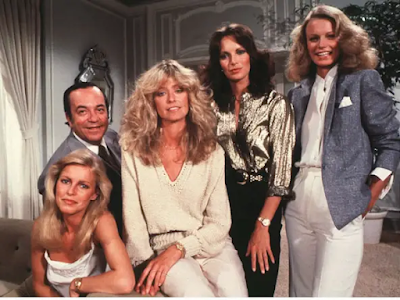
The modern world is doubling down on the idea of women as warriors. This was foreshadowed as far back as the 1970s, with the advent of second wave feminism. The deal back then was that women could be shown bringing down men, as long as they remained glamorously and sexily feminine. You could see this on popular TV shows of the era like "Charlie's Angels" and "Wonder Woman".

Charlie's Angels - 1970s


Since then, there have been multitudes of female characters kick boxing their way across movie and TV screens, with a decreasing emphasis on feminine glamour. That has now progressed to the idea that female warriors were common in real history not just in fiction. I had a lengthy debate with one person on social media who claimed, in all seriousness, that half of the Viking warriors were female (on the basis of one contested grave find). And now, unsurprisingly, a film ("The Woman King") has been released about the Agojie, an all female warrior unit which operated in the Kingdom of Dahomey on the west coast of Africa.

More on the film later. The first issue is why our culture thinks it so important to establish the idea of women as warriors. My first answer is straightforward. If you are a liberal, and you believe that the predetermined aspects of life, such as our sex, are a limitation on our freedom to self-define, then you will want to erase sex distinctions. One powerful way of doing that is to assert that men can be just as emotional and nurturing as women, and women just as capable as men of acting as warriors. 

One of the disturbing consequences of holding such a belief is that it suggests that unless women can be shown to have such masculine qualities that they are somehow lacking. Women manifesting the best feminine qualities no longer suffices, as this will be thought to still support a distinction of sex. Everything comes to rest on the "girl boss" phenomenon. To put this another way, it will be assumed that supporting women means supporting a masculinised version of women.

Rey from Star Wars 2015

There is also a second possible explanation for the "women as warrior" ethos. There is an emphasis within Gnostic thought that "we are not our bodies". Instead of a positive picture of the material world as God's creation, in which aspects of the divine order inhere, Gnostics see the material world as a merely corrupted material form which has to be overcome. In this world view, our physical bodies do not point in a positive way to our ends or purposes as men and women, but are merely the limiting flesh caging our real selves. Our embodiment limits us, in this view, and therefore needs to be transcended. 

And what about the Agojie? Well, it is true that the Kingdom of Dahomey did have such a female warrior corps. However, the film that has recently been released about the Agojie has highlighted some inconvenient truths about the Kingdom of Dahomey. It turns out that this kingdom would raid neighbouring areas, capture men and women, keep some of them as slaves, sacrifice some of them on an annual festival day and sell others to the North Atlantic slave trade.

The Kingdom of Dahomey existed in what is now the country of Benin from about 1600 to 1904. It was a militarised kingdom that focused considerably on slavery:

Both domestic slavery and the Atlantic slave trade were important to the economy of Dahomey. Men, women, and children captured by Dahomey in wars and slave raids were sold to European slave traders in exchange for various goods such as rifles, gunpowder, textiles, cowry shells, and alcohol. 

Other war captives who were not intended to be sold to Europeans remained in Dahomey as slaves. There, they worked on royal plantations that supplied food for the army and royal court.

There was a history of human sacrifice using slaves.

The human sacrifice would happen once a year during the "Annual Customs" celebrations:

Since Dahomey was a significant military power involved in the slave trade, slaves and human sacrifice became crucial aspects of the ceremony. Captives from war and criminals were killed for the deceased kings of Dahomey. During the ceremony, around 500 prisoners would be sacrificed. As many as 4,000 were reported killed in one of these ceremonies in 1727. Most of the victims were sacrificed through decapitation, a tradition widely used by Dahomean kings, and the literal translation for the Fon name for the ceremony Xwetanu is "yearly head business". 

The European who has been called "the greatest slave trader", the Portuguese/Brazilian Francisco Félix de Souza, held an honoured place in Dahomey, being awarded the status of chieftain. Even today there is a statue of him in the port city of Ouidah in Benin (he also has a plaza named after him and a museum).

The British attempted to suppress these practices in Dahomey in the mid-nineteenth century:

Dahomey became an adversary to the British Empire after the abolition of slavery during the 19th century. The British sent diplomatic missions to Dahomey, in an effort to convince King Ghezo to abolish human sacrifice and slave trading. Ghezo did not immediately concede to British demands, however he attempted to maintain friendly relations with the British by encouraging the growth of new trade in palm oil instead. In 1851, the Royal Navy imposed a naval blockade against Dahomey, forcing Ghezo to sign a treaty in 1852 that immediately abolished the export of slaves. However, the treaty was broken and slave trading efforts continued in 1857 and 1858.

Historian Martin Meredith quotes Ghezo telling the British,
The slave trade has been the ruling principle of my people. It is the source of their glory and wealth. Their songs celebrate their victories and the mother lulls the child to sleep with notes of triumph over an enemy reduced to slavery.

Dahomey collapsed during the second Franco-Dahomean War that took place in the early 1890s. Despite being equipped with quality German guns, the Dahomey army could not match a much smaller French force. The Agojie did fight fiercely, but not very effectively:

Between 2,000 and 4,000 Dahomean soldiers—including both men and women—died during the seven-week war. Of the roughly 1,200 Agojie in fighting shape at the beginning of the war, just 50 or 60 remained ready for battle by its end. Comparatively, the French side lost 52 Europeans and 33 Africans on the battlefield. 


A note to Melbourne readers. If you are sympathetic to the ideas of this website, please visit the site of the Melbourne Traditionalists. It's important that traditionalists don't remain isolated from each other; our group provides a great opportunity for traditionalists to meet up and connect. Details at the website.
 

Wednesday, September 28, 2022

Pope Francis on love of homeland

Pope Francis is not exactly known for being a conservative in the Catholic Church, but nonetheless he recently made a good defence of patriotism. Speaking on the topic of the morality of defending one's own country, he stated:

To defend oneself is not only licit, it’s also an expression of love toward one’s homeland; whoever doesn’t defend something, doesn’t love it. Instead, those who defend, love.

I particularly like the way he framed this, as it captures something important about patriotism. When you belong to a genuine national tradition, you see the good in it, and this naturally draws our love - it becomes a love of a significant good, perhaps even a type of transcendent good (a good that draws us to a higher aspect of reality and of ourselves). It then becomes natural to want to defend this good, which is why people will make sacrifices to uphold their national tradition, including making commitments to family life, to raising the next generation, to wanting to maintain the moral standing of the nation they are a part of, to creating a worthy national culture and so on.

The Catholic Church has something of a mixed record on the issue of defence of homeland, and no doubt it was easier for Pope Francis to make his comments, given that he was supporting the right of Ukraine to obtain weapons, and Ukraine is currently considered a progressive cause. 

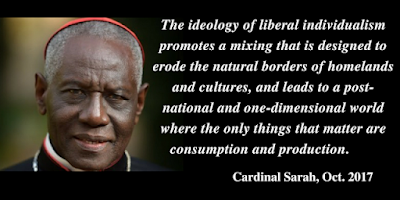
Still, there are many voices within the Catholic Church arguing for patriotism, so Catholics should not be pressured into thinking that they must support globalism. Cardinal Robert Sarah is one such voice:


Cardinal Sarah is aware that globalism favours a technocratic vision in which people become "fungible", i.e. become mutually interchangeable units of production or consumption to the detriment of their personhood.

Similarly, Cardinal Burke has given an extensive speech on the issue, drawing on the work of St Thomas Aquinas. Cardinal Burke concludes by rejecting a globalist agenda:

It is clear that we and our homelands have responsibilities within the international community, but those responsibilities can only be fulfilled through a sound life in the family and in the homeland. Patriotism, in fact, fosters the virtue of charity which clearly embraces citizens of other nations, recognising and respecting their distinct cultural and historical identity.

...The divine authority, in accord with the order written upon the human heart, does not make just and legitimate a single global government...On the contrary, God meets us and orders our lives for the good in the family and in the homeland.


A note to Melbourne readers. If you are sympathetic to the ideas of this website, please visit the site of the Melbourne Traditionalists. It's important that traditionalists don't remain isolated from each other; our group provides a great opportunity for traditionalists to meet up and connect. Details at the website. 

Tuesday, September 20, 2022

Technocracy vs tradition?

Why are the elites so hostile to traditional ways of life? One common answer is that the elites are committed to running society along technocratic, rather than traditional, lines. I don't believe that this is the only factor involved, but it does seem to be part of the problem.

The independent journalist Auron MacIntyre has written a piece for The American Mind on this issue. He begins by summarising the ideas of the writer James Burnham:

In 1941 James Burnham published The Managerial Revolution to explain the fundamental transformation of society around the world. While it appeared that communism, fascism, and liberal democracy were competing for supremacy on the world stage, Burnham noted that these systems shared a common trait of empowering highly-specialized managers who operate a network of large bureaucracies with the goal of standardizing and planning their societies from the top down. This dynamic was easier to observe in the hard totalitarian states where official state organs dictated social and economic behavior. The tight grip of the managers in those societies drove them to collapse, but in the liberal West managers used a gradual approach that proved more resilient.

James Burnham

I think Burnham is right to note the similarities between different kinds of modernist political movements. I'll give examples later of technocratic attitudes in both communist Russia and liberal democratic Australia. First, though, it's helpful to continue with MacIntyre's account of technocracy and why it is so at odds with traditional ways of life:

The political formula of the managerial class is based on its expertise in the operation of large organizations and the efficiency they produce. In order to reliably deliver efficiency through massive bureaucratic institutions managers must impose uniformity. Small businesses, regional governments, and community organizations can mold themselves to the character of the people they serve and cater to the individual needs and tastes of their culture. Mass organizations, in contrast, generate their power due to scale, and to achieve that scale they require mass production and mass consumption. The cultural and moral particularities of a specific community, region, or even nation are a hindrance to the goal of maximizing the efficiency of mass production and consumption. Because those regional particularities represent a hindrance to the applications of managerial techniques, cultural homogenization is a key aspect of the managerial political formula.
I'd like to hone in here on just two characteristics of technocracy identified by MacIntyre: size and expertise. As we will soon see, those who wish to manage society along technocratic lines have a contempt for smaller-scale social institutions run by amateurs. Technocrats prefer to operate on a mass scale but with authority invested in a small class of experts (so the vision, despite being oriented to a mass scale, is nonetheless elitist).

I'll include just one more quote from MacIntyre explaining why the ideologies of the left have been so readily adopted by large economic corporations:
The radical left is a nexus of ideologies designed to break down the traditional structures of society. Structures like family and religion are the institutions through which troublesome regional particularities tend to be expressed and perpetuated. The deracinated individual stripped of all connection to faith, family, culture, or even gender serves as the perfect employee and consumer. Woke ideology may pay lip service to diversity but it dissolves the particularities that generate actual diversity. Total cultural homogenization is the logical consequence of progressivism and serves as the perfect medium for the fungible worker and consumer that larger managerial corporations crave.

The rest of MacIntyre's piece is very good and I encourage you to read it. For now, though, I am going to focus on reinforcing some of the points he has already made.

If we go back to the year 1932, we find the communist leader Leon Trotsky defending the attempt to abolish the family in the years after the 1917 Bolshevik Revolution:

The revolution made a heroic effort to destroy the so-called “family hearth” - that archaic, stuffy and stagnant institution...The place of the family as a shut-in petty enterprise was to be occupied, according to the plans, by a finished system of social care and accommodation: maternity houses, creches, kindergartens, schools, social dining rooms, social laundries, first-aid stations, hospitals, sanatoria, athletic organizations, moving-picture theaters, etc.

Note some of the key features of the technocratic mindset here. Trotsky doesn't like the scale of the family ("petty enterprise"). And he wants it to be replaced entirely by professional organisations ("a finished system of social care"). Trotsky, then, was as much a technocrat as the managerial class we have in the West today - despite the difference in political ideologies. Perhaps we should not be surprised, then, that the modern West has adopted much of the Bolshevik revolutionary programme, albeit in a more reformist way.

Fast forward to Australia, 1942, just a year after Burnham's book on the managerial revolution was published. This was the year that the decision was made to end the Anglo-Australian identity and to replace it with a more heterogeneous population (but still European). What is noteworthy is that the decision was made, in part, by a group of technocrats, such as economists and planners, in an "Inter-Departmental Committee". They had growth targets they wanted to meet and they believed that the fertility rates (depressed in the 1920s and 30s at the end of the long first wave of feminism) in Australia were too low to meet these targets. 

It is also noteworthy that the politician most in favour of the change, Arthur Calwell, believed that maintaining the status quo would leave Australia as "a dull inbred country of predominantly British stock" - which expresses a similar mentality to Trotsky in his complaint that the traditional family was archaic, stuffy and stagnant. The technocrats want a more open or "opened-up" social field to work on - not "inbred" or in Trotsky's words "shut in". 

Let's move forward to 1993. An American secular humanist by the name of Thomas Flynn, just like Trotsky, wished to see the end of the family. Why? 

We expect specialists to build our cars, raise our buildings, make our clothing, write our software - the list is endless. Perversely, only society's most precious products - us - are still entrusted to cottage industry. If society is falling apart as conservatives charge, perhaps the blame lies not with "alternative family structures" (more accurately, non-familial households) but simply with parents, single or married, rich or poor, for whom parenting could never be more than a hobby - pursued in naive isolation, abandoned just when one threatens to get good at it. While procreation and parenting remain yoked, most children are doomed to be raised by amateurs...

The family, our last cottage industry, must go!

Looking Backwards - Issuing A Challenge

In 1888 Edward Bellamy published the utopian novel Looking Backwards, 2000-1887. Bellamy predicted that by the 21st Century capitalism, home, and family would be forgotten. Generations of reformers imbibed Bellamy's vivid images of happy workers who lived in dorms and ate in refectories, of children raised in large cohorts by gifted mentors, and dreamt that this was the shape of things to come. Science-fiction masters like Robert A. Heinlein, Isaac Asimov, and others portrayed futures in which the family had been eclipsed by licensed, professionalized alternatives. Many progressives simply assumed that one day, if not too soon, parenting would be a career like any other. Those most capable of it would be trained to mentor armies of children not their own.

Flynn has gone all out here to put things on a technocratic footing. He wants the small-scale unit of the family to be replaced by "children raised in large cohorts" and by happy workers who lived not in homes of their own but in dorms. And who would be in charge? Not a loving father and mother but "licensed, professionalized alternatives".

(I can't help but note here that Flynn's dream is being increasingly adopted in our education system. There is a gradually increasing expectation that teachers will not just teach a specialist academic subject but will take on an ever more ambitious mentoring role, i.e. teachers are being "trained to mentor armies of children not their own".) 

So what are we to do? Some thoughts.

1. Rejecting a technocratic mindset doesn't mean going completely the opposite way. There are some things that have to be done to a certain scale, and expertise is necessary in some domains of human life.

2. There are, most likely, deeper beliefs underlying the technocratic mindset. For instance, if you believe in equality of outcomes in a radical way, then it will be difficult to accept the lack of uniform outcomes that occur in more traditional social settings. If people are raised mostly in a family setting, then some children will experience a better childhood than others and it will be difficult to "fix" this via bureaucratic interventions. Similarly, if you have a faith that science can be applied in all contexts to create desired social outcomes, you will most likely think in technocratic terms. 

3. Perhaps even more important is the issue of our telos (our ends) as men and women. If you think, along more traditional lines, that these are realised significantly within a family and national setting, then this places limits on the value of technocratic organisation. Technocracy in some senses presupposes a radically individualistic view of human purposes. To adopt a technocratic mindset you need to see the core purposes of human life as being based not on the roles, identities and loves that arise within the family or nation, but on individual purposes within a mass setting (or, alternatively, you need to abstract the mass institution and pursue its measurable external goods - wealth or power - as an aim in itself).

What I am suggesting is that you cannot maintain the larger metaphysics of modernity and hope to permanently curb the worst aspects of technocracy. You can only defend the role of family and nation if it makes sense to do so within your larger world picture. 

A note to Melbourne readers. If you are sympathetic to the ideas of this website, please visit the site of the Melbourne Traditionalists. It's important that traditionalists don't remain isolated from each other; our group provides a great opportunity for traditionalists to meet up and connect. Details at the website.

Links:

Auron MacIntyre on social media

Articles on the changes to Australian policy in the 1940s (here and here)

Wednesday, July 06, 2022

A classical liberal confronts left-modernity

I've just read an interesting piece by Eric Kaufmann, titled "Liberal Fundamentalism: A Sociology of Wokeness".

Kaufmann is a classical liberal who believes that liberalism took a wrong turn and is responsible for some of the worst features of what he calls "left-modernism".

This starting point means that Kaufmann's analysis is different to that of mine or, say, Patrick Deneen's. Deneen and I argue that the problem with liberalism stems from core aspects of its philosophy, including its understanding of freedom as maximum individual autonomy. The more that liberalism is true to itself, the more apparent will be its failures.

Kaufmann, in contrast, defends a liberal ideal of freedom as "negative liberty", i.e. the right to do what you want provided you don't interfere with the same right of others. As nice as this might sound, it lacks a concept of the good that a society might uphold and it is particularly weak in upholding significant goods that require trust and cooperation (e.g. communal traditions, family commitments). It is difficult to assert the existence of worthwhile objective goods in a society that limits itself to the formula of negative liberty, as there will be pressure on individuals to hold their beliefs as pertaining only to themselves, i.e. as subjective preferences only.

Nonetheless, there are aspects of Kaufmann's analysis that are useful for traditionalists to consider. Kaufmann has written a book, The Rise and Fall of Anglo-America, which traces in some detail the intellectual shifts that produced the modernist mindset. He is therefore in a relatively strong position to describe the distinct inputs of liberalism and Marxism into modern day woke culture. He also has an interesting account of how small numbers of activists are able to swing things their way within institutions. 

It is Kaufmann's view that liberalism was the original impetus for the left-modernism that reigns today. Marxism did also have an influence, but it came later. Kaufmann asserts that liberals have developed an identity that is in conflict with liberal principles. This identity emerged in the later 1800s and is focused on a contrast between minorities in need of protection and majorities who are thought of in negative terms as potential oppressors. Kaufmann sees this minoritarian outlook as forming the emotional reflex of modern day liberalism:

The emotive pairing of majority with malice and minority with empathy began this way. What started as a modest habit of mind has deepened into a reflexive demonization of majorities and lionization of minorities, which is the “elephant” driving the “rider” of contemporary left-modernism.
According to Kaufmann, this reflex has its origins with liberal Progressives such as John Dewey and Jane Addams, and freethinkers like William James and Felix Adler. They began to adopt a cosmopolitan outlook, which by 1910 had influenced the Federal Council of Churches. The avant-garde in Greenwich Village are perhaps the first, though, to sound truly like modern leftists. Randolph Bourne, for instance, in 1916 was already pushing the idea that Anglo-Americans had no culture, unlike vibrant immigrant cultures. Bourne wanted Anglo-Americans to give up their cultural identity, but urged the immigrants to retain theirs.

This is where Kaufmann's analysis becomes particularly interesting:
The result is what I term asymmetrical multiculturalism: ethnicity as wonderful for minorities, poisonous for majorities. This contradiction in the worldview of the left-modernist bohemians established a minoritarian, anti-majority mold which occupies the very soul of today’s woke culture.

This asymmetrical multiculturalism is especially pronounced in Australia. Most prominently, you see it in the different treatment of Aborigines and Anglo-Celtic Australians. Leftists will stridently defend Aborigines as an ethnic people, with a long and proud history and with an enduring culture. Robert Manne, for instance, who describes himself as belonging to "the pro-Labor social justice liberal intelligentsia" once wrote about the Aborigines that,

...if the traditional communities are indeed destroyed, one distinctive expression of human life - with its own forms of language, culture, spirituality and sensibility - will simply become extinct. Humanity is enriched and shaped by the diversity of its forms of life.

This is true, but when it comes to other peoples the "pro-Labor social justice liberal intelligentsia" takes the very opposite view. If an Anglo-Celtic Australian were to defend his own traditional community along the same lines he would be thought to have committed the moral crime of racism, or even perhaps of white supremacism.

There is no rational or reasonable justification for the double standard. Kaufmann may well be right that it has its origins within liberal history but has subsequently taken on a life of its own by forming part of the emotional identity for the modern left:

Yet once the emotional valences had crystallized, the world became a much simpler place, where reflex rather than logic ruled.

The phrase "emotional valences" is important here. It means having an emotional aversion or attraction to a particular event or situation. The emotional valences for liberals came to be focused on the minoritarian identity. This makes a lot of sense to me: you just have to consider what is presented to us in the mainstream media or in classrooms - the aversion/attraction axis is often set up around such issues (think too of the oddness of women being classed as a minority group).

Kaufmann next discusses the distinction between Marxism and progressive liberalism in the mid-twentieth century. He notes that Marxists were for a time unreceptive to liberal minoritarianism because they envisaged an uprising by the working-class majority. At the same time, progressive liberals were put off by the doctrinaire politics of the Marxists.

This changed when the New York intellectuals abandoned Marxism at the time of the Stalinist show trials and gravitated instead "to an expressive liberal-cosmopolitan utopia". However, they brought with them the "purity tests" characteristic of Marxist groups and this, in Kaufmann's view, is the origin of woke cancel culture. 

The weakness of a genuinely conservative movement in the 1940s meant that there was little effective opposition to the growing influence of the left-modernists; the growth of the universities in the 1960s brought a new "knowledge class" which further aided the movement.

The attacks on WASP America then broadened into a hostility to white America more generally. Kaufmann summarises the contributions of liberalism and Marxism this way:

This development, it should be stressed, originates not with Marx­ism but with liberalism’s minoritarian sympathies and anti-majority ethos. In effect, liberalism’s categories of majority and minority cultural identities were plugged into socialism’s oppressor-oppressed terminal, filling the blank slots left by the bourgeoisie and the pro­letariat. While those who point to wokeness as a cultural form of Marxism are partially correct, these influences came later, and ferti­lized a preexisting liberal matrix.

Which leaves one great question unanswered. If much of politics is about the carrying over of liberal forms of identity, and of the expression of emotional valences, how do you go about changing things? Pointing out inconsistencies in liberal thought might be effective for a small number of people, but it doesn't directly confront the unprincipled arena of politics.

Kaufmann points out one of the difficulties that exists within liberal institutions, namely that a small number of more radical "moral entrepreneurs" will often set the terms:

Whenever an institution like a uni­versity or newspaper comes to be mainly populated by the cultural Left, value consensus is assumed and left-modernist moral entrepreneurs rise up to “outbid” others in their commitment to communal values. Even where centrists rather than extremists are dominant, appeals to the liberal identity—in which minorities carry a positive valence while majorities are viewed as threatening—are tricky for moderates to morally contest.

This is insightful. I have witnessed it over and over in my own workplace. When you have value consensus, i.e. it is simply assumed that everyone adheres to the same liberal values, including the minoritarian moral reflex, then a small number (even just a couple) of radicals can push things ever onward, even if they are juniors. There cannot be an "adult in the room" to stand up to them, not even their superiors who theoretically have the power to do so, because opposing the more radical implementation of the values would break the larger moral consensus.

So what does Kaufmann think can be done? He notes a weakness of woke morality, namely that many people feel compelled to go along with it in public, whilst not genuinely following it privately:

This produces Timur Kuran’s “private truths, public lies” in which public reality becomes the performance of a lie. The best the majority can do is to drag its feet or change the subject in the hope that activists will go away. They won’t.

On the one hand, the woke system is like the emperor’s new clothes, a fragile illusion waiting to be exposed. A critical mass of open dissenters can set off a cascade in which fence-sitters move, con­vincing the next set of undecideds, and eventually exposing the entire racket. Desacralizing wokeness is therefore partly a matter of suffi­cient dissidents raising their voices until a tipping point is reached

This is a little too hopeful. Some people do genuinely absorb the woke mentality. I've observed seriously Christian women who, gradually over time, enthusiastically embrace woke causes even if they directly contradict Biblical morality. I have also heard women say that they enjoyed listening to oppression stories: I think they enjoyed the emotional experience of feeling pity and outrage and empathy and were not very interested in independently researching whether these stories had any merit.

Nonetheless, Kaufmann is right that the aim is to break the consensus. There are perhaps two ways to do this. One would be to create parallel institutions. The other would be to launch a challenge from within existing institutions. The latter strategy is achievable, but would need more than "one brave individual" as Kaufmann puts it (I have tried this with zero success). It would need at least several people within an institution to carefully coordinate their actions to put the values consensus in question.

A useful point Kaufmann does make is that status matters in challenging the consensus. Appealing to patriotism or religion won't work, as these have been consigned as low status by the educated middle-class people powering wokeism. Kaufmann thinks it a good sign that edgy comedians have begun to push back (e.g. Chapelle, Gervais) and I would add that it's a positive sign that a growing number of academics are now challenging the modernist path. 

I'll finish by summarising what I think are the two key points in Kaufmann's article. The first is that most liberals do not act according to a formal theory, but according to an emotional valence, in which minority culture and rights have a reflexive moral and emotional appeal, whereas there is reflexive aversion to the majority culture. This liberal narrative developed fairly early on in liberalism's history:

When liberalism was about metaphorically slaying despotic elites, its narratives were grounded in ideas of “the people,” like democracy and nationhood. Once liberalism turned from defending the rights of disenfranchised majorities to protecting minority rights, the narrative shifted. When it came to the rights of Catholics and Jews (in Protestant countries), racial minorities, or homosexuals, the “bad guys” were the majority, who menaced minorities in need of protec­tion. 

Second, there is a logic by which a very small number of more radical liberals are able to successfully push their agenda in institutions through an appeal to a values consensus.

I don't believe that this explains all of the dynamic of liberal modernity, but it does seem to me to be part of it and it therefore needs to be understood. For instance, liberals have had many decades now to promote the aversion to the majority as a moral and emotional reflex. It has been so intense that even a three-year-old Australian girl is reflexively averse to her own existence:

How do we battle on this front, particularly when we do not have much influence over the levers of popular culture? There is clearly a need to promote a more positive reflex, but this isn't done as a matter of winning formal arguments, but of promoting achievements and a positive narrative.