Showing posts with label Aborigines. Show all posts

Saturday, August 17, 2024

Missing from view

Carl Benjamin, otherwise known as Sargon of Akkad, wrote a post on X this week which I think is worth a read. The first part runs as follows:

The worst thing about every single person who considers themselves as "liberal" or "left wing" is that they are raging against the very soul of humanity with no understanding of what it is they are vanquishing with every step they take. It's so embedded in everything they do it is invisible to them, beyond their comprehension, absurd to even contemplate. It's just babble, to them, to speak of honour, heroism, sacrifice. It's been observed for a long time, but we're reaching the true reification of this paradigm now. These people cannot think or speak of anything other than negation, impulse, and a kind of grasping immediacy that makes them seem at once ludicrous, unsensible and, when viewed from a certain perspective, the terrible footsoldiers of a world order that will destroy the very spirit of man--indeed, they themselves have had their own spirits torn from them before they were even able to properly spell their own names. They were baked into a uniform human type, with uniform lifeless terminology, so that they communicate with each other like ants. No extraneous information is transmitted, just the base material of communication alone.

Look at what they're offering: a dead, flat world, lacking in vitality, energy, fidelity, passion, righteousness. They have no parallel concepts to explain these dimensions of the human soul, either. These things are all nonsensical sounds to them. They simply don't have the language required to be able to explain dimensions of the human experience that have been forever closed off to them by their upbringing and belief system, but the result is making them miserable and isolated, forced to live as something less than human. 
Carl Benjamin

Benjamin is here noticing the absence of the vertical dimension of reality within modernity (hence the idea of a "dead, flat world"). In other words, there are no longer qualitative distinctions between the high and the low. There has instead been a levelling or a flattening of existence. This stands in stark contrast to the longer pre-modern Western tradition which was an aspirational one, in which the human soul was directed to the higher and more noble aspects of human existence. St Paul gave voice to this tradition in the following passage:

Finally, brothers and sisters, whatever is true, whatever is noble, whatever is right, whatever is pure, whatever is lovely, whatever is admirable — if anything is excellent or praiseworthy — think about such things and the God of peace will be with you. (Philippians 4:8)

Benjamin goes on to make the following interesting observation:

This is why everything about their worldview is designed to be therapeutic, rather than curative or restorative. The world in which they exist is bad and they go to therapists to brainwash themselves into accepting the negative normal because it is literally beyond them to conceive that there might be an alternative to the personal torment they inhabit. This is why they're all on antidepressants and go to therapists in the first place. The very nature of "therapy" is to trap you in this paradigm.
Leaving aside the issue of whether therapy does or does not help people, it is interesting how therapy has become the "go to" for so many people. There is some legitimacy to the claim that we live in a therapeutic culture, and that this is connected to a worldview in which the higher aspects of reality, and of personhood, are placed out of view and out of reach. 

He continues:

It's also why they're so desperate to protect their "rights". They don't have any frame of reference for any alternative; what else is there in life, if not my personal rights? It's inconceivable that people might have been happy, purposeful, contented, successful without them. They can't even fathom it. No, the past was evil, my right to X or Y has determined this must be so because those people had an absence of this right. 
But they had something you don't even know exists. They had nonmaterial possessions which the average lib can't even recognise as having an existence, let alone having value.
However, the lib does know they've lost something. As soon as they come across a metaphysical culture, they venerate it as if they were zookeepers who have been given a particularly rare species of animal. Oh we must not interrupt their sacred rites because there is something they possess which we, the Westerners, don't!
They don't understand that, actually, we did indeed possess our own sacred rites. They died when we decided we were self-authoring, atomic rights-bearing individuals, and not part of the civilisation that birthed us. When we had something metaphysical to carry forth with us through the ages, we were just like them, only the liberal feels disgust at this concept, bringing them back down to time and place, and in their arrogance believes they've transcended their own particularities, when instead they have slipped beneath them into the morass of common filth that such metaphysics raised us out of in the first place.

Benjamin addresses two issues here. First, he identifies the problem of autonomy being the first principle of Western society ("we decided we were self-authoring, atomic rights-bearing individuals"), therefore placing ourselves outside of "the civilisation that birthed us".

Second, he raises the issue of the veneration of aboriginal peoples. I have heard different theories for this veneration. Benjamin's explanation is possible, albeit somewhat complex. It involves Western liberals on the one hand not wanting a metaphysical culture for themselves, because they are proud to have "transcended their own particularities" but on the other hand sensing that the aboriginal peoples have a connection to the sacred that they themselves do not - and, as such, being bearers of something significant. As a possible example of this mindset, here is the left-liberal Australian academic, Robert Manne, defending the traditional Aboriginal way of life as being,

not an Edenic but an enchanted world, in the technical sense of the sociologist Max Weber. They discovered an intricate social order in which, through the kinship structure, every human being held a precise and acknowledged place. They discovered a world that was filled with economic purpose; leavened by playfulness, joy and humour; soaked in magic, sorcery, mystery and ritual; pregnant at every moment with deep and unquestioned meaning.

Another theory (that some of my colleagues at the Melbourne Traditionalists prefer) is that it comes back to Rousseau's notion that man is corrupted by civilisation, i.e., it is a form of primitivism, in which organised, civilisational building religion is thought to be corrupting, but primitive forms of religion, at the very least, get a pass. As one colleague noted:

Witness the bizarre fascination that some feminists have for astrology, witchcraft, and other "spiritualities" that allegedly pre-date the invention of writing, patriarchy etc.

Benjamin finishes by prophesying that,

The lib is thereby doomed to be a singular "global citizen", unloved and unplaced, forever belonging to nowhere and appreciated by no-one, until they eventually expire like Rousseau's savage, "without anyone noticing that they have ceased to exist, and almost without noticing it themselves."

One final consideration. Benjamin has in the past described himself as a classical liberal. He seems to have gone beyond the usual limits of right-wing liberalism in what he has written (and now describes himself as a postmodern traditionalist). Right liberals generally have a low view of human nature, seeing people as being motivated primarily by greed and self-interest, and their world view is often focused on the pursuit of economic self-interest on both the individual and national level, rather than on higher, spiritual values.

I can only hope that the descent of Western culture is encouraging men like Benjamin to look outside the current right and left liberal political paradigm, and to consider the source of error as being more foundational, i.e., as being connected to faults in the underlying metaphysics of modernity.

Thursday, January 19, 2023

Living through the other? Part 2

 In my last post I set out an argument the gist of which is:

1. Liberal moderns in Australia are not universalising their moral claims. They are asserting that traditional forms of community are a good for Aborigines but an evil for others.

2. One reason for this is that liberal moderns can no longer identify with a communal tradition of their own. However, the goods associated with communal traditions represent important human values. 

3. Therefore, there are liberal moderns who seek to access these values, not through their own tradition, which is lost to them, but through pre-modern cultures, which in Australia means Aboriginal culture.

I had an intelligent reply to my argument in the comments, which proposed a series of other reasons for the failure to universalise:

1) It’s perhaps possible that promotion of “minority” traditional identities is used as a weapon to further undermine the majority identity and thus advance liberalism in the net. It seems a very sure way to deracinate a man by making him promote foreign cultures and peoples over his own

This is most certainly true. If an Anglo-Australian is welcomed several times a week as a guest to Australia, what is left of his own communal identity? It is an effective method of erasure.

2) It’s possible some liberals view the liberalization (and thus destruction) of Aboriginals as being another form of oppression visited upon them.

As we shall soon see in the case of Germaine Greer, this is also true. You would think it would create cognitive dissonance in the minds of liberal moderns (that the political beliefs they hold to are to be regretted for their destructive effects on Aborigines), but they are not called out for it.

3) The anti-human strain of leftism, particularly dominant in environmentalist sects, sees advancement as bad and primitivism as good. Primitive cultures, such as Aboriginals, are thus likely to be celebrated and mythologized.

Well, yes. This is a similar argument to the one I made myself in the post, namely that some leftists have inherited the idea that civilisation corrupts and that therefore pre-modern cultures are more genuinely human. Again, we will see this idea expressed with Germaine Greer.

4) There are, of course, certain groups throughout European-stock countries that are implacably hostile to European peoples. Promoting other groups, deracinating whites, and forcing or encouraging them to acknowledge and praise ancestors and cultures other than their own serves to weaken them.

Yes, this is part of the picture, though it does not explain why Anglo elites themselves should adopt such views.

5) Of course, the aesthetic and superficial trappings of Aboriginals is not really any threat to liberalism, even amongst Aboriginals.

Again, it is true that promoting Aboriginal traditional identity will not disrupt the working through of liberalism in Australia in the same way that promoting the mainstream identity would.

As you can see, I agree with all of these observations, particularly the first three. Even so, I think my argument still stands - that traditional values are human values and that if they are made inaccessible within our own group that some people will seek to share in them or identify with them or uphold them, via their continuing existence elsewhere.

I want to use the Australian feminist Germaine Greer as my prime example. Some years ago she wrote two long essays on Aboriginal issues. The first was called "Whitefella Jump Up: the Shortest Way to Nationhood" (2003). At the time, her central thesis was startling. She wanted all Australians to embrace Aboriginality as a path to nationhood. She wanted Australians to declare themselves Aboriginal "as if by an act of transubstantiation" (she uses deeply religious terms to express her hope that the Australian identity might become an Aboriginal one). She was ahead of her time. What seemed crazy in 2003 is now increasingly the model of Australian identity.

Germaine Greer

Even more startling, though, is her essay "On Rage" (2008). In this essay she explains the propensity of some Aboriginal men in remote communities to be violent toward Aboriginal women. She blames white men, of course, but it is the detail of her argument that is interesting. For instance, she sympathises with the lament of an Aboriginal woman that "Our communities are like a piece of broken string with women on one side and men on the other". This suggests that it is important for the intactness of a community that men and women not be placed in opposition to each other - but a setting apart of men and women into opposing political classes is what Greer spent much of her life promoting as a Western feminist (the essay itself breathes the very air of Greer as a white woman demonising white men). So here we have an instance of that failure to universalise; Greer applies a socially dissolving attitude to the mainstream, but laments its appearance within Aboriginal communities.

Greer then complains that governments are enabling Aboriginal women to live independently of their men:
The fact that government welfare payments are often made to women...means that more and more women can live independently of men, and are doing so.

...When hunter-gatherer societies begin to break down, it is invariably the gatherers, the women, who combine to hold them together, but in doing so they further marginalise their menfolk, including their own sons.

Again, Greer fails to universalise this position. In 2010, just two years later, she argued that economic independence for Western women was a good thing because it enabled them to divorce their husbands:

As women's economic independence increased, their tolerance of infidelity, cruelty, neglect and emotional and physical abuse on the part of their spouses dwindled steadily. Divorce rates throughout the developed world rose in unison.
She wrote of Western women who chose to divorce and live as single mothers:
Women who face this fate with equanimity have my unstinting admiration. They are choosing a tough but honourable life over a servile and dishonourable one.

But when it comes to Aborigines, she sympathises instead with the men who lose their most cherished possessions and who are humiliated by the loss of family structure:

According to anthropologists RM and CH Berndt, traditionally "the most cherished possessions of men were women, children and their sacred heritage," in that order...The Aboriginal man's wife was not simply a woman he met by chance and fancied, but a kinswoman...it is the level of avoidance which signifies just how fundamental, how absolutely shattering this loss and humiliation must be.

Why this inconsistency? Why claim that financial independence for Aboriginal women has terrible consequences because the men lose their most cherished possession - their women (imagine if Western women were described positively as being a possession of the men) - and are therefore deeply humiliated; whereas financial independence for Western women is a good because it allows them to leave, en masse, men who are simply assumed to be cruel abusers?

One possible reason is that if you are serious about wanting a society to continue into the future and to reproduce itself you will focus on maintaining family structure and on upholding a common good between men and women. Therefore, Greer is a traditionalist when it comes to Aborigines (who she wants to see continue on), but a liberal when it comes to the mainstream.

Which brings me to the key part of Greer's argument. She explains the rage of Aboriginal men as being due to them losing "what makes any life worth living". So, what are these essential human goods? They are the traditional ones, not the liberal ones. She writes that Aboriginal men have lost "all the important things" such as "their families, their social networks, their culture, their religion, their languages and their self-esteem".

Remember, Germaine Greer rose to fame for writing The Female Eunuch in which she proposed abolishing the family and instead placing children on communal farms where parents might occasionally visit, but anonymously, with a child not even knowing that a woman was its "womb-mother". 

For Aborigines, though, the important things that make life worth living include family, religion, culture and self-esteem. How many leftists uphold these things for Western man?

Again, she complains that Aborigines have come to live in "polyglot assemblages", i.e. mixed in with other Aboriginal tribes. This is by modern standards a minor experience of ethnic diversity, which is considered a great good for Westerners, but a catastrophic denial of the things that make life worth living for Aborigines.

Similarly, when Greer discusses the violence of Aboriginal men toward Aboriginal women she is not concerned, as feminist women usually are, to blame the patriarchy and to insist on abolishing masculinity. Instead, she is alarmed that this violence might harm the racial self-preservation of Aborigines:

What is now undeniable is that violence towards women and children across the same spectrum has reached the level of race suicide.

So here you have, as blatant as it is possible to be, the failure to universalise moral goods. The goods for Aborigines include racial self-preservation, ethnic exclusivity, family, culture, religion, self-esteem and the promotion of harmony between men and women. For Westerners, though, the goods are female autonomy, even as expressed in divorce and in an ongoing feminist revolution, diversity and the beating down of national self-esteem (Greer characterises white men throughout her essay as rapists).

What I would like to emphasise is how Greer frames her position. She is enraged that Aborigines might lose the things that make life worth living, the things that are important in life. These are the traditional goods that are expressed within traditional communities. Greer does not even begin to think that these traditional goods that make life worth living might ever be found within the Australian mainstream and so unsurprisingly she asserts that the path forward for Australia is a nationwide adoption of Aboriginality "as if by an act of transubstantiation". 

That she is not alone in thinking this way is suggested by the success of the reframing of Australian identity along Aboriginal lines over the past decade. 

What traditionalists might draw from this is clear. We should highlight the failure of liberal moderns to universalise their moral claims; we should also highlight Greer describing traditional goods as being "what makes any life worth living"; but, unlike Greer, we should seek to uphold these goods within our own communities, rather than attempting to transmogrify into something we are not.

Monday, January 16, 2023

Living through the other?

If you look at the website of Zali Steggall, an independent MP, you find this at the bottom:
Zali and her team acknowledge and pay deep respect to our diverse First Nations communities, the Traditional Custodians, Elders past, present and emerging, whose country we work on. We...are committed to nurturing the world's oldest adapting culture and our First People's connection to land, sea and sky.

This type of thing is very common now in Australia. There is a veneration of Aborigines as a traditional people. This stands in stark contrast to the general attitude to traditional nationalism, which is severely criticised as failing the tests of non-discrimination, tolerance, openness, diversity and inclusion. 

It is as if there are two separate tracks of development. A traditional one for certain Aboriginal peoples and a modern one for everyone else. I say "certain" Aboriginal peoples because the same veneration does not apply to the indigenous peoples of Europe. It is applied only to those Aboriginal peoples who might be thought of, in some way, as having a pre-modern culture.

How do we explain this? Usually moral positions are universalised. If it is thought good for Anglo-Australians to give up a distinct identity because it is discriminatory or exclusive it will likewise be thought good for Aborigines to do the same. Or, if it is thought good for Aborigines to maintain a unique sense of peoplehood, culture and relationship to the land, it will likewise be considered a good for Anglo-Australians to do the same.

But in this case we have a puzzling failure to universalise. What is a good for one group is an evil for the other. The difference cannot be explained on the basis of "Aboriginal groups were there first" because, as I have mentioned, this would then lead to a support for traditional people-hood for the indigenous Europeans - which clearly does not happen.

All across Australia people hold meetings where the first step is for the speaker to pay respects to Aboriginal elders past and present. Now, if it is a good for us to honour our ancestors (which I think it is) then this holds true equally for Aborigines and for non-Aborigines. Therefore, if we universalise this principle, the speaker should be paying respects to his or her ancestors or perhaps to those of the people in the room. But, again, there is a failure to universalise this moral precept. It is considered a good for Aborigines alone. 

I would like to suggest three reasons for this placing of Aborigines on a different moral plane of existence from others. All three reasons push toward the same outcome.

The first reason is the one suggested by the American historian Eric Kaufmann, namely liberal minoritarianism. Kaufmann explains that liberalism originally sought to uphold the rights of majorities, but then later on, in the 1800s, turned toward minority rights. This outlook took on a life of its own, forming a kind of emotional reflex in which majorities were looked at negatively as potential oppressors and minorities as victims:

The emotive pairing of majority with malice and minority with empathy began this way. What started as a modest habit of mind has deepened into a reflexive demonization of majorities and lionization of minorities

Kaufmann explicitly connects this to the ethnic double standard:

The result is what I term asymmetrical multiculturalism: ethnicity as wonderful for minorities, poisonous for majorities. This contradiction in the worldview of the left-modernist bohemians established a minoritarian, anti-majority mold which occupies the very soul of today’s woke culture.

What I would emphasise here is that this minoritarianism is one avenue through which Westerners lose a sense of their own positive identity. If you develop this emotional reflex, in which your own ancestors are demonised as oppressors, then you will lose a positive connection with your own tradition.

The second reason is one I have written about at length. One wing of liberal modernity believes that the end goal of politics is a freedom understood as maximum individual autonomy. We are to self-create and self-define who we are. What this means is that having an inherited identity will be cast negatively as a limitation on this individualistic notion of self. Not only does traditional nationalism give us an identity that we don't get to self-define, it suggests that we have duties to a people and a tradition, which also limits an absolute freedom to choose in any direction. For these reasons, modernity turned away from traditional forms of communal identity. To be a modern came to mean losing your place within a traditional ethnic nation in favour of a more individualistic mode of being.

The third reason is the development of technocratic means of regulating society within liberal modernity. Modernity began with a project of using science to conquer nature. However, this desire to impose control through science turned to the idea of the "rational" control of human populations. We ourselves became the ones acted upon, we became the objects of the experiments to manage and to exert control. 

For this technocratic project to work, human communities needed to be made open and accessible, uniform, unified and predictable. Aspects of common life that were embedded in particular or localised loyalties did not fit well. That's why Leon Trotsky condemned the family as a "shut in, petty enterprise" to be replaced by a "finished system of social care". What technocrats want are systems run by experts, that are efficient and where results can be easily quantified. Again, this does not fit well with a traditional communal life, which flourished on the basis of particular loves and loyalties, and so was never going to be a universal, unified managerial system based on bureaucratic expertise. And so modernity, for this reason as well, came to be associated with a disenchanted form of society, one in which deeper bonds and attachments gradually withered away.

What all this means is that there are Westerners now who simply do not have a positive communal identity of their own. It has been lost due to demonisation of ancestors, a radical individualism, and the impact of technocracy.

I'd like to illustrate this by introducing Stacy, a country vet here in Australia. Stacy is one of the nicer leftists I have debated on social media. She was as curious to understand my mindset as I was to understand hers and she did not descend to name calling but remained polite. Our debate began on the topic of the Aboriginal Voice to Parliament. Predictably she was resolutely focused on the idea that Aborigines had been uniquely mistreated historically. I attempted to correct some of what she was claiming, but eventually decided to get to the crux of our differences by probing her for her own loyalties and commitments:


This is what she came up with:


It is not surprising that she went for professional associations as career is something allowed to moderns. But, as to whether she had any deeper attachments, her answer was an "honestly, no":


She went on to describe herself as follows:


But here's the thing. Let's say you are a Westerner and, like Stacy, you have lost any deeper communal identity of your own. Is it not the case, then, that if you wish to live through communal values you must now do so by identifying with some other group who still has them? 

From a leftist point of view, it makes sense to select a "pre-modern" Aboriginal people to do so. First, because the left have historically followed Rousseau in believing that human nature was originally unspoilt and only corrupted by the effects of civilisation. Therefore, Aboriginal culture will be romanticised as being more authentic or enchanted than Western culture. Second, if modernity is marked by a commitment to individualism and technocracy, then the carriers of traditional human values will have to be pre-modern. 

This identifying with Aborigines can be seen directly in the case of Germaine Greer, who had herself adopted into an Aboriginal tribe. The emphasis on Aborigines having a more enchanted culture is seen in the writings of the leftist Australian academic Robert Manne, who described Aborigines as living in,

not an Edenic but an enchanted world, in the technical sense of the sociologist Max Weber. They discovered an intricate social order in which, through the kinship structure, every human being held a precise and acknowledged place. They discovered a world that was filled with economic purpose; leavened by playfulness, joy and humour; soaked in magic, sorcery, mystery and ritual; pregnant at every moment with deep and unquestioned meaning.

This positive evaluation then led Manne to adopt the double standard I wrote about earlier. He very clearly wanted Aborigines to survive as a traditional people, rather than being subject to modernist standards:

...if the traditional communities are indeed destroyed, one distinctive expression of human life - with its own forms of language, culture, spirituality and sensibility - will simply become extinct. Humanity is enriched and shaped by the diversity of its forms of life. It is vastly impoverished as this diversity declines. If contemporary Australians allow what remains of the traditional Aboriginal world to die, we will be haunted by the tragedy for generations.
And so we arrive at the failure to hold to universal moral standards in which what is good for Aborigines is also good for other people. Modernity has left many Westerners devoid of a deeper identity of their own, and to compensate for this loss of significant human values, they have begun to live through the communal identity of others (to some degree through "vibrant" immigrant cultures, but here in Australia increasingly through that of Aborigines).

So what do we do? There may not be immediate solutions, but I do think it is important to challenge the minoritarian narrative which filters reality to always emphasise the idea of Westerners as oppressors. This narrative disconnects people from a positive identity of their own. It leaves them bereft of important aspects of being human, which they must then search for in other cultures. We should take whatever opportunities arise to foster and to express a positive identification with our own tradition. 

A note to Melbourne readers. If you are sympathetic to the ideas of this website, please visit the site of the Melbourne Traditionalists. It's important that traditionalists don't remain isolated from each other; our group provides a great opportunity for traditionalists to meet up and connect. Details at the website. 

Monday, December 26, 2022

Runaway rights

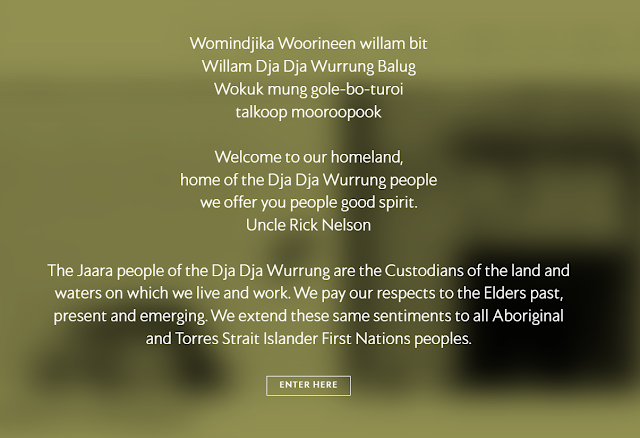
If you visit the website of the Castlemaine Art Museum this is what you are greeted with:


This kind of thing is becoming normal now in Australia. At meetings and sporting events we acknowledge Aboriginal elders and are welcomed to Aboriginal country. Some left-wing politicians prefer to fly the Aboriginal flag rather than the national one. About 40% of the continent is now held by small Aboriginal communities, with more to come. In NSW there is a plan to hand over management of all national parks to local Aboriginal groups. This has already led to one significant trail at Mt Warning being closed to the public. There is also a referendum to be held next year to provide an Aboriginal "Voice" to Parliament, with no clear indication of what powers this voice will have.

Back in 2015 the Canadian PM, Justin Trudeau, told a journalist that,
Canada could be the “first postnational state...There is no core identity, no mainstream in Canada.”

Australia is following a somewhat different course, one suggested by the feminist Germaine Greer in a book titled Whitefella Jump Up (2004), in which she claimed that an Australian national identity could be framed around Aboriginality.

How to explain all this? It is becoming increasingly clear to me that you have to understand politics as an inherited culture, with this culture being formed through accretions. The logic of each accretion plays out, each in its own way. It can be difficult to understand what is happening, because there are multiple sources that are not always entirely in harmony with each other.

One of these accretions is minoritarianism. There were campaigns to establish equal rights for religious minorities in the UK in the 1800s; these campaigns succeeded for Protestant dissenters in 1828, for Catholics in 1829, for Jews in 1858, and for atheists in 1888. Equal rights for minorities became an established part of the political landscape, but this does not explain why the identity of a majority should be stripped away and replaced by that of a minority. I think there are at least two additional points that need to be made here.

The first has been put forward by Eric Kaufmann. He has argued that the initial support for minority rights later became embedded as an emotional reflex:

Once liberalism turned from defending the rights of disenfranchised majorities to protecting minority rights, the narrative shifted. When it came to the rights of Catholics and Jews (in Protestant countries), racial minorities, or homosexuals, the “bad guys” were the majority, who menaced minorities in need of protec­tion. The emotive pairing of majority with malice and minority with empathy began this way. What started as a modest habit of mind has deepened into a reflexive demonization of majorities and lionization of minorities.

Kaufmann believes that this mentality crystalised in the US in the early 1900s. It led as early as 1916 to certain liberal progressives such as Randolph Bourne taking the now familiar attitude of lionising the culture of immigrant minorities whilst disparaging their own.

I do believe that Kaufmann is correct here and that there is an inherited emotional reflex at work that is deeply important for some people. It is noteworthy, for instance, that Germaine Greer felt so deeply about this majority/minority distinction, that she wished at one point in time to be Jewish and later on had herself adopted into an Aboriginal tribe.

However, I don't think this could have happened without a second factor coming into play. Let's say the aim is to extend minority rights. At some point in time, for there to be a workable politics, there needs to be an end point at which these rights have been satisfied. If there is no end point, then the minority will accrue more and more rights and eventually be in the far superior position. What is the logical limiting factor to ensure that this doesn't happen? It is the majority following through with a normal concern for their own common good, i.e. wanting to uphold their own existence and to pursue the best within their own tradition.

Liberalism has made it difficult for the majority to do this, thereby removing any boundaries to minoritarianism. For instance, the anthropology of the first wave of liberalism is a negative one, in which humans are selfish and solitary and only come together in society via a social contract. For first wavers, social life is to be organised around the pursuit of profit in the market, harnessing low aspects of human nature such as greed. The former PM of the UK, Boris Johnson, gave voice to this "accretion" within modern politics when he said:

I don't believe that economic equality is possible; indeed some measure of inequality is essential for the spirit of envy and keeping up with the Joneses that is, like greed, a valuable spur to economic activity.
Those who hold to this view will see politics in terms of Economic Man, with the "nation" being conceived as something like a vast economic enterprise in competition with other such enterprises. They will not give much weight to traditional ties of kinship.

The second wave liberals held that human nature was perfectible. It was corrupted by institutions of power (by inequality, therefore by "distinctions"). The solution was to commit to the larger "wholes" in which humans were by definition equal, such as the human race. As Lawrence Auster wrote:
On the left, socialists and Communists...believe in larger wholes, but the wholes they believe in are seen in terms of equality: the whole of society—equal; the whole of the human race—equal. They believe that man has the ability to engineer this larger, equal whole into existence, wiping out the unequal, inherited orders of class, sex, nation, race, religion, morality, and thus creating a New Humanity. Only the largest whole—humankind—is good, because only at the level of all humanity can there be true equality and fraternity uniting all people.
White leftists, therefore, are not primed to uphold the existence of their inherited national identity. They are more likely to focus on issues relating to structural inequality that such identities are thought to create. Leftists often condemn white identities as "supremacist" for this reason - so again, there is nothing here to limit an excessive emphasis on minority rights from this "accretion" within modern politics.

The solution to all this is not an easy one, as cultures form over time and become deeply rooted. If you do criticise one particular policy it does not change the larger culture, which will continue to form people in a certain way.

There are things that might be done. Clearly articulating the negative accretions would help, as would recovering the worthier understandings that preceded them. And, at some point, there needs to be a challenge to the process of formation. This is particularly true of schools which are more focused on propagating the political culture than people realise.

Sunday, May 29, 2022

The melding of the modern mind

We have a new Labor Government here in Australia and one of their aims is to enact the Uluru Statement. The policy implications of this statement are not entirely clear, but the general aim is to recognise Aborigines within the constitution as a separate people and to give them a separate voice within parliament.

This raises the issue of the incoherence of modern politics. The Aborigines are being treated here as a traditional ethnic nation. If other groups were to claim the same status for their own identity they would be condemned in the harshest moral terms as being racist. This is true even when these groups are themselves the indigenous population, such as the ethnic Swedes in Sweden. The expectation for the mainstream population in countries like Australia is that rather than seeking to preserve their own ethnic identity that they should welcome diversity as a strength and reject "distinctions" (i.e. discrimination) on grounds of race or ethnicity.

If anything, the expectation is that a truly progressive individual would not take a communal identity for themselves seriously and would instead adopt the position of being a neutral observer of, or partaker in, other cultures. How seriously, for instance, does this person take the idea of upholding a homeland of their own?


In this view, we should only ever belong to voluntary associations that we can choose to enter or leave, rather than to inherited, longstanding traditions. But when it comes to Aborigines, the tune changes, and the length of their history is considered a virtue to be extolled rather than a vice to be personally liberated from.

The same sort of contradictions can be found elsewhere. Moderns often see themselves as belonging to the party of science but then claim that it is impossible to define what a woman is. They claim that gender is socially constructed and that femininity is oppressive, but that trans people are born with a feminine identity that is their positive, authentic self. And so on.

Why do moderns unthinkingly accept these contradictions in their beliefs? Years ago, someone (I think it was James Kalb or Lawrence Auster) made the the point that if your beliefs do not truthfully represent reality they will inevitably be contradictory. This is a good point, but I think the explanation can go further than this. 

From what I have read of the history of ideas, it seems to me that the modern mind is made up of several different currents of thought, none of which were ever able to establish supremacy over the others. Therefore, these currents of thought have melded together into a modernist mindset, despite being in certain respects incompatible.

One of these currents of thought is the voluntarist, subjectivist one which emphasises the freedom of the individual human will to self-create in whatever direction it prefers. From this current derives the idea that a woman is whatever a person defines it to be. 

Another current is the empiricist, materialist one. This is the current of thought that insists that all knowledge must be verified along the lines of the natural sciences and that knowledge is a matter of qualified expertise. Someone drawing on this line of thought might claim not to know what a woman is because they are not a biologist or ask you for an academic study if you claim that a woman is an adult female. 

The empiricist, materialist tradition is also connected to the organising of modern life along technocratic lines. It emphasises efficiency and managerial expertise over more private, informal and personal social relationships. (Technocrats would see traditional family life as being too opaque, closed off and amateurish to be an adequate basis for social life and they would criticise the lack of standardised outcomes.) There is, superficially at least, a contradiction between this technocratic intrusion into formerly private realms of living (think of the social credit system) and the modernist emphasis on liberation from all social constraints, though it may be that moderns would see the increased role of the state as "liberating" individuals from institutions like the family.

There is also a contradiction in the two attitudes toward human nature inherited by moderns. The first emphasises lower aspects of human nature, such as greed and the individual pursuit of pleasure, believing that these can be utilised for positive social outcomes. The second, in contrast, believes that human nature can be perfected through social reform. This second current of thought is, at times, utopian, believing that an Edenic existence can be restored through the eradication of power structures in society and via educational programs. The belief is that human nature will be regenerated, the end of history will arrive and humans will no longer have to work, but will live in Arcadia, showing only kindness and beneficence to others, in a world without distinctions but based instead on perfect freedom and equality.

These two approaches to human nature coexist uneasily, but nonetheless both have influence in the modern world. There would be feminists, for instance, who would see a woman pursuing her own sexual pleasure in her own way, without constraint, as positively demonstrating empowerment; whilst at the same time believing that the patriarchy needs to be defeated as a power structure in order to usher in a world in which sex distinctions would no longer matter and in which there would finally be freedom and equality. Feminists holding these beliefs are, in practice, drawing on two very different traditions of thought based on opposing views of human nature.

Why are moderns content to live with an incoherent view of the world? I suspect the reason is that it suits the purposes of the dominant social classes. The moneyed classes in modern society draw their wealth from corporate capitalism. The technocratic organisation of society, based on the logic of the market, and without competition from older loyalties and commitments, strengthens the position of these classes. At the same time, the intellectual classes get to think of themselves as the experts leading humanity forward toward the end of history and the realisation of humanity's ultimate purposes.

But why then are Aborigines given a pass from all this and allowed to exist more traditionally as a type of ethno-nation? The political reason is that Aborigines are thought to have the least power and privilege (the Uluru Statement emphasises that they are "powerless"). This confers upon them the most validity as a people and as an identity. 

It seems as well that Aborigines fill an absence within the modernist mind, namely that of the sacred. It is notable that Aboriginal issues are sometimes framed in ways which suggest a secularised expression of Christianity. Is there not, for instance, an expression of atonement in sorry days? Germaine Greer once wrote an essay in which she combined the idea that Aborigines have the only valid identity with religious concepts drawn from Christianity. She wrote that she earnestly desired and hoped (prayed) that one day all of Australia might adopt an Aboriginal identity "as if by an act of transubstantiation". 

Increasingly the solemn, formalised rituals of Australian life are focused on Aborigines. We have welcome to country ceremonies, the paying of respect to Aboriginal elders, and cleansing and purifying smoking rituals. The connection of Aborigines to the land is also a rare acknowledgement of the sacred within modern Australian life. (The bending of the knee, not to God and altar, but to the BLM is similarly a kind of secularised expression of Christianity in the USA, but I don't think the process has gone as far in America as it has here.)

None of this is to attack Aborigines maintaining their own identity and traditions - this I fully support. It is to highlight (and to attempt to explain) the incoherent thinking characteristic of the modern mind. 

Saturday, August 25, 2012

Catholic schools celebrate "A Proud Race"

Australian Aborigines are not only allowed to be a race, they are allowed to be a proud race:
Proud Race is the unique initiative from the Aboriginal Catholic Ministry Victoria capturing the attention of school communities across Australia. Since Proud Race was launched in June over 105 schools have signed up to take part in the program.

...The National 'Proud Race' campaign is initiated and supported by the Aboriginal Catholic Ministry for Victoria and sponsored by Reconciliation Victoria and Reconciliation Australia to develop the project.

But if we admit that an Aboriginal race exists, then doesn't that mean that other races exist too?

And if it's good for an Aborigine to be proud of his race, then isn't it good for others to be proud of their race as well?

Monday, August 20, 2012

A thought on welcome to country

Overseas readers might not be aware of this but in Australia a custom has arisen in which at the start of a meeting a welcome to country ceremony or acknowledgement of country speech is made.

Sometimes Aborigines perform these roles, but often the person in charge of the meeting will open with something like the following:
I would like to acknowledge the Dharug people who are the traditional custodians of this land. I would also like to pay respect to the elders past and present of the Dharug nation and extend that respect to other Aboriginal people present.

I hear something like this about twice a week. At first I thought it was yet another manoeuvre by the left to bury the Anglo heritage of Australia.  But I think now that it goes deeper and is perhaps more sincere.

It is part of human nature to want to dignify and make solemn the proceedings you are a part of and identify with. Given that most of our institutions are now run by the left and modelled along leftist lines, it's to be expected that the left would want to add an element of solemnity to proceedings.

This used to be done with a brief Christian prayer. But it makes sense that a secular leftist would prefer something else, and the welcome to country ceremony is perhaps intended to fill the role.

The problem is that such moments are supposed to draw an assembly together, to remind them of a common commitment to a shared faith. But when we are told that we are being welcomed to country by an Aboriginal elder that suggests that the audience don't really belong but are merely guests.

It sets up a conflicting response. The solemnity of the moment draws the audience together emotionally, but the message divides the audience intellectually.

And the more the words are repeated, the more formulaic they become and the less likely they are to persuade emotionally.

Why did the left choose the Aborigines as the focus of such emotional bonding? It has to do, in part, with leftist notions of solidarity. There is a tendency on the left to believe that solidarity has little to do with shared roots, or relatedness, or loyalty. Instead it is thought to be based on compassion for the marginalised other. If you are looking for such an "other" in Australia you might well choose the Aborigines. This then means that the natural human instinct toward solidarity becomes focused on identifying positively not with one's own tradition but with the Aborigines.

And if we are not seen to be positively identifying with the Aborigines? Then we might be thought to be breaking the group solidarity, even if we are not Aboriginal ourselves.

If you're a white person, and you follow along with the leftist version of solidarity, then the most "other" kind of person is likely to be a black person, preferably one you can feel compassion for - which sets up a preference for believing that such a person might be marginalised or oppressed or downtrodden.

Finally, and perhaps even more controversially, I don't want my Catholic readers to be too complacent about the status of thought within the Church on such issues. Catholic thought is increasingly overlapping with liberal thought when it comes to an understanding of solidarity, even if there are somewhat different origins for the two lines of thought.

The Catholic view seems to go this way: Christ was on the side of the poor, therefore it is Christian to think of solidarity as being with the poor, the marginalised and the oppressed and so on.

And so it's not surprising that you can have a welcome to country ceremony read out at a meeting hosted by the Australian Catholic University at which a Catholic bishop speaks of "compassion and solidarity" whilst he shares the stage with a former Liberal PM, Malcolm Fraser.

I'm not doubting here that compassion is a virtue, nor that the Church should work charitably with those who need help. But as part of the natural law there are significant forms of solidarity which are not based on compassion but on forms of relatedness and the specific duties and loyalties and identities which flow from such particular relationships.

It is not ordered for a human person to be emotionally blunted to these natural forms of solidarity and the particular loves and commitments which flow from them.

Thursday, December 16, 2010

A failed experiment

There was an article in The Age this morning about the attempt to recruit two Aboriginal boys back in 1849 to become missionaries.

The story is interesting because it highlights how varied the attitude to Aborigines was in colonial times. In this case, there was too high an expectation placed on the two Aboriginal boys:

On January 8, 1849, filled with hope and eager expectation, Francis Xavier Conaci, 7, and John Baptist Dirimera, 11, left Perth with Rosendo Salvado, the energetic abbot of the Benedictine monastery at New Norcia, 160 kilometres north of Perth.

This extraordinary journey was part of Salvado's great mission, conducted over more than 50 years, to enculturate the Aborigines into Christianity. He lived and camped with them, wrote dictionaries of their language and lobbied for them with colonial authorities.

Conaci and Dirimera were from the Yuat tribe, and had begged Salvado to take them to Rome. The Benedictines hoped to train the boys in European ways and send them as missionaries to the Aborigines of Western Australia.
In Europe, the Aboriginal boys were lionised:

In Rome, they met Pope Pius IX, who presented them with their distinctive black woollen Benedictine habits, and told Conaci: ''Australia needs a second Francis Xavier; may the Lord bless this boy, and make him into one!''

Salvado presented them to the king and queen of the Two Sicilies, and then to meet the king and queen of Naples at the palace in Gaeta outside the city...

Both boys were granted patents of nobility by the king and admitted to the College of Nobles.

Things went well at first, with the boys doing well at their studies. But as with so many attempts at assimilation, the experiment ultimately failed:

But in March 1853, the abbot at La Cava warned the Vatican about the poor health of the Aboriginal novices. Doctors, including the Pope's physician - believing that the boys' illnesses were exacerbated by homesickness - advised that they should be sent back to Australia.

Conaci spent two months in a Naples hospital, then moved to the abbey at St Paul's Outside the Walls to recuperate. But his condition worsened and he died on October 10, 1853. Dirimera arrived back in Australia in May 1855 a broken boy. Salvado had a hut built for him in the bush and visited him regularly, but Dirimera died in August. ''They pined away,'' Hayes says.

The Benedictines were demoralised by the deaths and never again sought to recruit Aborigines to the order. "It may be that Salvado lost all hope or got depressed by the whole idea," says Peter Hocking, archivist at the New Norcia monastery.

The problem was not a lack of idealism but an underestimation of how difficult assimilation would be.

Saturday, January 30, 2010

Not so stolen generations

Should we Australians be ashamed of our past? For years we have been told that we should be ashamed of the treatment of the "stolen generations". The claim is that Australian authorities forcibly removed whole generations of Aboriginal children from their parents with the racist aim of breeding out the Aboriginal population.

Keith Windschuttle has written a new volume of his important work The Fabrication of Aboriginal History which investigates these claims in detail. He has presented some of his findings in a brief newspaper article, which is well-argued and well worth reading in full.

I'll try to summarise some of the key information. The historians who originally set up the idea of the stolen generations made some key assertions, including:

  • that 50,000 Aboriginal children were forcibly removed
  • that authorities aimed to seize children as young as possible with the aim that they should lose their Aboriginality and never return home
  • that the children were forcibly removed solely because they were Aboriginal

Windschuttle quotes some leading historians of the stolen generations making such claims:

In his 2008 parliamentary apology, Prime Minister Kevin Rudd endorsed the estimate by Peter Read, the university historian who first advanced the concept of the Stolen Generations, that 50,000 Aboriginal children were forcibly removed in the 20th century.

Read had written that governments removed children as young as possible and reared them in institutions isolated from any contact with Aboriginal culture. "Welfare officers, removing children solely because they were Aboriginal," he said, "intended and arranged that they should lose their Aboriginality, and that they never return home."

The majority were allegedly babies and infants. The SBS television series First Australians claimed most of the 50,000 were aged under five. Henry Reynolds explained the rationale: "The younger the child the better, before habits were formed, attachments made, language learned, traditions absorbed."

But are these claims true? Windschuttle provides some strong evidence that they are far from being true. First, it's not true that most of the children removed from their families were aged under five. Windschuttle looked at the NSW records and found that only 10% were under five, most were teenagers.

Second, it was not "generations" who were removed from their families. For instance, at the Moore River settlement in WA, only about 10 children per year were removed at a time when the Aboriginal population of the state numbered 29,000.

Third, the children were not removed "because they were Aboriginal" but because of concerns for their welfare:

Rather than acting for racist or genocidal reasons, government officers and missionaries wanted to rescue children and teenagers from welfare settlements and makeshift camps riddled with alcoholism, domestic violence and sexual abuse.

In NSW, WA and the Territory, public servants, doctors, teachers and missionaries were appalled to find Aboriginal girls between five and eight years of age suffering from sexual abuse and venereal disease. On the Kimberley coast from the 1900s to the 1920s they were dismayed to find girls of nine and 10 years old hired out by their own parents as prostitutes to Asian pearling crews. That was why the great majority of children removed by authorities were female ...

Government officials had a duty to rescue children from such settings, as much then as they do now.

The prevailing policy of the time was not assimilation but the racial preservation of the Aborigines. It's true that there were two regional officers who did propose assimilation policies: they wanted to marry half-caste Aboriginal women to white men. But they did not have government support for these plans. The plan was rejected in cabinet in 1933 and in 1934 a commonwealth minister declared in parliament that:

It can be stated definitely, that it is and always has been, contrary to policy to force half-caste women to marry anyone. The half-caste must be a perfectly free agent in the matter.

The prevailing policy was expressed by J. F. Bleakley, the chief protector of Aborigines in Queensland and the author of the commonwealth policy of the 1920s and 30s, when he wrote of Aborigines that:

"We have no right to attempt to destroy their national life. Like ourselves, they are entitled to retain their racial entity and racial pride."

This is the opposite of genocide. It is a clear statement that the government of the time wanted Aborigines to continue their own distinct ethnic existence.

There's much more in Windschuttle's article, including evidence that those Aboriginal children who were placed in welfare institutions were not cut off from their families or their Aboriginality and were treated in a similar way to white children in similar circumstances (e.g. sent out to complete apprenticeships).

We're fortunate that Keith Windschuttle has made such a determined effort to write authoritative books on Aboriginal history. He may not be a traditionalist conservative (he's more of a right-liberal) but he's provided an important contribution.

Wednesday, December 23, 2009

The right kind of immersion?

My old school now offers cultural immersion tours for Year 9 boys. No, they are not being immersed in their own culture, they're being sent off to live with South Australian Aborigines for a week.

What did the boys learn from the experience? In short, that white Australians were evil and violent, in contrast to the nature loving and spiritual Aborigines:

The most positive thing I gained from the journey was an insight into the amazing, undiscovered, indigenous culture ... The ways the Aborigines respect nature at such a spiritual level ... Our whole group was transformed ... We learned about the horrors which occurred in the early settlement of Australia. At one stage the group was very disturbed, and we were fighting back tears of sorrow. Our indigenous tour guide Quenten told us that some indigenous elders were forced to dig their own graves before they were shot and buried in them. We also came across an old barn where aboriginal men, women and children were herded like sheep, and massacred like lambs to the slaughter.

At other times we were fighting back tears of joy. We became a part of spiritual dances and rituals ... I will never be able to forget that week which saw me and the rest of the group come right out of our comfort zones ...

As I've written previously, this kind of thing is dangerous. There are conscientious whites who lose a sense of their moral status and authority in society when they accept such vilification of whites as the truth. Their path to redemption is then to break ranks and to identify against their own tradition in favour of the other. As I wrote in a recent post:

Such people will want to speak with moral authority in society, but how can they as white oppressors? The path to redemption is, again, to break ranks and to identify with the non-white other in opposition to other unenlightened whites.

This helps to explain why some liberal whites are so obsessed with an anti-white/pro-other agenda. It comes to express their self-concept and identity. It lies at the heart of how they see themselves and the ground on which they stand.

And what of the massacre claims? It's not likely these took place. I searched a list of claimed massacres of Aborigines during the period of settlement and there is no mention of such events in the Yorke Peninsula. The claims of massacres often turn out to be false when they are properly investigated.

Keith Windschuttle is one person who has undertaken such investigative work. I'll give just one example from his book The Fabrication of Aboriginal History. Sir William Deane, as Governor-General, once apologised on behalf of the nation for a massacre by whites of Aboriginal women and children at Mistake Creek in the 1930s.

However, when the massacre was investigated it turned out to have taken place in 1915 and to have been perpetrated not by whites but by Aborigines (the outcome of a dispute over an Aboriginal woman).

What those Year 9 boys should really be taught is to ask for evidence before accepting claims of massacres. They should also be made aware that frontier violence did not go all one way. I wonder, for instance, if they know of the Maria massacre of 1840, when a group of whites was shipwrecked off the coast of South Australia and then massacred by Aborigines, their bodies being later found stuffed down wombat holes.

Do the boys know of some of the less environmentally friendly practices of Aborigines? Such as the deliberate burning down of forests to flush out animals which transformed the type of vegetation cover over much of Australia?

Are they taught to appreciate the great nature poets and landscape painters of their own tradition? Why not, for instance, immerse them in Wordsworth?

And why should they be taught to associate Aboriginal culture with spirituality rather than their own? Particularly since they are attending a Catholic college. Doesn't Catholicism have something to do with spirituality? Or doesn't that count?

I'm not at all against the Year 9 boys learning to appreciate what Aboriginal culture has to offer. But it should be from a strong, confident, positive awareness of their own culture that they engage with others. Otherwise their school is failing them.

Thursday, May 07, 2009

Battles of the Aborigines 1846

Here is an 1846 account of an Aboriginal battle in what is now suburban Melbourne (in Coburg North or Fawkner):

Battles of the Aborigines: A pitched battle took place between a tribe of the Melbourne and the Goulburn blacks. The scene of warfare was in the vicinity of Sydney Road, about seven miles from town; about 80 blacks on either side placed themselves at a distance of about ten yards apart, two ropes placed at that distance, separating them from each other; the more courageous of either party occasionally advanced within the open space intervening, and were immediately selected as targets by their opponents.

At a short distance from this scene, some forty or fifty women and children, belonging to the respective tribes were also engaged in a similar occupation.

Mr Robinson, the Protector, upon being informed of the circumstance hastened to the spot, and immediately despatched a messenger to town for Dr Thomas, who upon his arrival found between thirty and forty wounded, some dangerously, and one man, belonging to the Melbourne tribe, hopelessly so, having received a spear in his breast, which had penetrated a considerable depth, inflicting a frightful wound. A lubra, belonging to the Melbourne tribe, also received a dangerous wound on the cheek with a boomerang.

Mr Robinson's horse was speared, and when our informant left, the courage and animosity of the belligerents appeared unabated, notwithstanding the severe injuries received on either side. (Bell's Life in Sydney, February 7th, 1846)


I found this little item some years ago when I had the opportunity to browse through the colonial papers held in the State Library of Victoria.

The Aborigines appeared to have had a ritualised kind of warfare. If I remember correctly, similar battles, with the warring tribes lined up at a set distance from each other, were still taking place in the Northern Territory in the 1930s. The injury rate from these battles was considerable; in the case of the Melbourne battle, 30 or 40 were injured in a battle involving 160 men and 40 to 50 women and children.

Young Australian readers should take note of the response of the white settlers. The Aboriginal Protector, George Augustus Robinson, was summoned and he rode close enough to the battle for his horse to be speared. He called a doctor to treat the Aboriginal wounded. The newspaper report is sympathetic both to the courage of the combatants and to those who sustained injuries.

Thursday, April 16, 2009

A Deal? Maybe not, Andrew Bolt.

Herald Sun columnist Andrew Bolt is about as right-wing as it gets in the mainstream media here in Australia. And yet he is clearly a liberal rather than a conservative.

This is most obvious whenever he writes about race and ethnicity. In his most recent column, for instance, he complains that Aboriginal activists who attack whites are often considerably of European descent themselves.

It's a fair point and one that is likely to appeal to the conservative rank and file. However, Bolt also uses the column to push the idea that race is artificial, trivial and should be made irrelevant.

For instance, he writes of Tara Jane Winch, who is of mixed ancestry but identifies as Aboriginal, that:

She could call herself English, Afghan, Aboriginal, Australian or just a take-me-as-I-am human being called Tara June Winch. Race irrelevant.


His comment on the phenomenon of mixed race activists identifying as Aborigines is this:

It's also divisive, feeding a new movement to stress pointless or even invented racial differences we once swore to overcome. What happened to wanting all of us to become colour blind?


He finishes this way:

... let's go beyond racial pride. Beyond black and white. Let's be proud only of being human beings set on this land together, determined to find what unites us and not to invent such racist and trivial excuses to divide. Deal?


Sorry, Andrew Bolt, no deal.

It's important to understand where Andrew Bolt is coming from. Andrew Bolt once criticised a group of Aborigines for wanting to hold onto some historic artefacts. He told the Aborigines that by identifying with their own communal tradition they were forgetting,

The humanist idea that we are all individuals, free to make our own identities as equal members of the human race. In this New Racism, we're driven back into tribes.


This is standard liberal autonomy theory. According to this theory, we are made human by our ability to self-determine who we are. Therefore, we are supposed to reject as impediments to our individual autonomy anything significant to our identity that is inherited rather than self-created.

It's a theory with radical consequences. It means that we can't identify as men and women as our sex is a "biological destiny" rather than something we select for ourselves. And it means that we can't identify with our own race or ethny or nation as we are born into these.

We are not allowed to belong to distinct, particular human communities. Only to a single human one.

This is just about the opposite of a true conservatism: if the term conservative has any meaning it refers to the aim of conserving a particular tradition against the onslaught of liberalism.

Andrew Bolt has not always been so dismissive of ancestral identity. He himself is a Dutch migrant to Australia. As such he did not feel as strongly connected to the mainstream Australian tradition. This changed when he married an Australian woman. He once thanked his two Anglo-Australian grandmothers in his column for granting him this gift of an ancestral connection to country:

I do now have a deep bond to this country, its history and its culture, and a sense of belonging for which I am intensely grateful. Even better, my children have roots that dig deep in this soil. I thank my two Nans for this - for helping to make me and mine feel at home. (Herald Sun 20/10/2000)


This is more the reality of things. No talk here of a single human identity or trivial, invented differences. Bolt here admits the importance of ancestry, history, culture, roots, home and belonging.

Bolt in his more recent columns asks us to give up too much - stable forms of identity and belonging and a deep connection to country - for the sake of a radical political idea, an ideology.

We have to think beyond the limits of Andrew Bolt's right liberalism if we are serious about conserving our own tradition.

Tuesday, December 02, 2008

Luhrmann's low act

Why isn't this considered vilification? Consider how Baz Luhrmann portrays race relations in the early 1940s in his film Australia:

Nullah is a part-Aboriginal boy stolen from his white guardian, a British artistocrat played by Nicole Kidman, by corrupt police acting under a racist law that a pitiless mission official tells Kidman’s character is designed to breed out Aborigines.

As Nullah (beautifully played by the magnetic Brandon Walters) is marched down Darwin’s docks with other captured boys to be sent by boat to the Garden Point home on Melville Island, a sneering white boy holding a joey (yes!) stops and abuses him: “Creamy, didn’t your mother want you?” A racist white kid holding a kangaroo in a film called Australia - could there be anything more archetypally us?

To add to the white sin, the Japanese army is sweeping towards Australia and the boys are being sent to an island that one character notes “will be the first place the Japs hit". White women and children are being evacuated from Darwin in the background, but here the Aboriginal boys are being sent to their deaths by racist white men. To really grind in his point, Luhrmann has the Japanese not just bombing the children’s home at Melville Island (which they didn’t) but invading it as well.

Bear in mind that the film is sold in captions at its beginning and its end as based on historical truths, and is being reported as such, too.


But it's not the historical truth. Andrew Bolt goes on to explain:

But what of this story that Aboriginal children were callously and deliberately sent into danger at Melville Island, while whites were evacuated south?

In fact, Aboriginal women and children were evacuated from Darwin and nearby settlements - including Garden Point - and sent as far south as the Blue Mountains.


So Luhrmann is making stuff up to vilify the white Australians of the 1940s.

If you want a more balanced account of race relations (from the early 1960s) consider the story of Cecily, as told by herself.

She is a member of what has become known as the "stolen generations" - though she wasn't actually stolen.

Cecily tells us that she was abandoned by her Aboriginal mother as a baby, and then raised for a time by her grandmother and an aunt. However, the aunt moved away and the grandmother began to abuse alcohol.

The grandmother arranged for Cecily to be raised in a white foster home. Her life wasn't perfect: she was teased by other Aboriginal children for living with a white family and she felt different as an Aboriginal child living in a white environment.

As a teenager, questions of identity became stronger and she decided, with the support of her white foster mother, to return to live with her Aboriginal mother and siblings. However, she witnessed a shocking incident of domestic violence and went back to live with her foster family.

However, at the age of 17 "the pressure within me started mounting again. I was trying to establish my identity."

She finally returned to live in her Aboriginal community near Nowra. She met her Aboriginal uncles and put some of the missing pieces of her life together, so that "I felt like I belonged".

What does Cecily's story tell us? It can't be used to support the right-liberal assimilationist view, given that Cecily chose to return to her Aboriginal community because of the importance to her of her Aboriginal identity and kinship.

Nor does it support a Baz Luhrmann portrayal of white Australians as evil racist oppressors. This is what Cecily herself has to say of her white foster parents:

I know a couple of Kooris who were fostered by Koori families. They would say to me “I’m glad I wasn’t fostered into a white family”. I smile at these people because they don’t realise how lucky I was to be so loved and wanted. I was fostered for 12 years by a lovely white family in Bega on the far south coast of NSW. Overall I was grateful and I have always respected my foster family ...


Yes, the ideal thing would be for Aboriginal children to be fostered within their own communities, so that children like Cecily would not feel alienated from their own culture and people. But this doesn't mean that the fostering of Aboriginal children by white families was an act of racist oppression.

What has Baz Luhrmann done? He has fabricated an event in the past in order to malign his own countrymen - and then claimed it to be an historical fact. It is a low act.

Saturday, November 29, 2008

Why did Luhrmann make Australia?

I wasn't exactly overjoyed when I found out that Baz Luhrmann was making an epic film set in Australia in the 1940s. When the Australian political class turns to our history, it's usually to follow a narrative in which whites feature as racist oppressors and Aborigines as noble victims.

It seems that I was right to be apprehensive. The actor Hugh Jackman let slip in a recent interview that the real purpose of the film was to highlight the "stolen generations", with other more glamorous parts of the film serving to bring in the audience:

But, Jackman adds, "Baz said if we made a very didactic and earnest story about the Stolen Generations, we'll have about three people watching the movie." Hence, the romance, the drama, the Japanese bombing of Darwin (an actual although little-known event) and a treacherous cattle drive through the desert.


Australian readers will already be familiar with the "stolen generations". For overseas readers, it is a controversial claim that racist white authorities stole generations of Aboriginal children, particularly half-caste children, from their mothers in order to bring them up as Europeans and to breed out the Aboriginal race.

It's difficult, though, to know how much truth there is to this claim, if any. When individual cases are investigated, a different story often emerges. For instance, in the case of activist Charles Perkins it turned out that his mother had begged a Christian boarding school to take him in to give him a better future (he went on to become the first Aborigine to head a government department).

Similarly, Zita Wallace grew up believing she had been stolen, but when she eventually returned to visit her mother it turned out that she had been abandoned:

Said Wallace: "It really hurt me badly. I thought, she doesn't want me, I won't worry about her. It was a really big thing to be rejected by someone who was supposed to be your mother."


Inquests conducted in Victoria, South Australia and the Northern Territory have found that there was "no formal policy for removing children".

So what is the evidence for the stolen generations? The only definite evidence I'm aware of is a note from A.O. Neville, who was a chief protector of Aborigines in Western Australia in the 1930s:

Every administration has trouble with half-caste girls. I know of 200 or 300 girls, however, in Western Australia who have gone into domestic service and the majority are doing very well. Our policy is to send them out into the white community, and if a girl comes back pregnant our rule is to keep her for two years. The child is then taken away from the mother and sometimes never sees her again. Thus these children grow up as whites, knowing nothing of their own environment. At the expiration of the period of two years the mother goes back into service so it really does not matter if she has half a dozen children.


This is the right-liberal, assimilationist attitude to Aborigines - a view which is still around today. For right-liberals what counts is not preserving ethnicity, but adherence to a set of universal liberal values. Right liberals generally support the idea of the European and Aboriginal populations merging together within a universal liberal culture.

Peter Howson, for instance, was the Liberal Party Minister for Aborigines back in 1971-1972. A few years ago, he wrote a newspaper article celebrating the fact that 70% of Aborigines had moved into towns and had married non-Aborigines. He wanted measures introduced to push the remaining Aborigines out of their own communities and into the mainstream.

If the right-liberal view has credibility it's because the separate Aboriginal communities aren't always great places for the raising of children. Levels of drug abuse, alcoholism and violence are high in some of these communities, which are often reliant on government welfare.

So even today there are large numbers of Aboriginal children who are removed from their families:

Welfare workers in NSW are removing Aboriginal children from their homes in numbers far greater than during the Stolen Generations, and the recruitment of Aboriginal staff has done nothing to stem the tide.

... The Australian can reveal that a staggering 4000 Aboriginal children are now in state care in NSW.

This compares with about 1000 Aboriginal children in foster homes, institutions and missions in 1969.

Black children are being removed at 10 times the rate of white children, despite a tripling in the number of Aboriginal welfare workers.

The total suggests that about one in six Aboriginal children in NSW is now a ward of the state.


The alternative to the right-liberal assimilationist policy has been a left-liberal separatism. Left-liberals often look up to the traditional Aboriginal culture and lifestyle and compare it favourably to Western societies. This has led to a policy of supporting separate Aboriginal communities, but to a lack of practical concern with how these communities might adapt and survive in the modern world. The communities are often left to survive on government welfare, which then encourages social breakdown - and the removal of children which the left is so outraged by.

In some ways, the idea of the stolen generations is part of the culture war between left and right liberals. The right-liberals use the breakdown of social norms in Aboriginal communities as an argument for assimilation; the left-liberals have countered by portraying assimilation as a racist attempt to force Aborigines to live as Europeans, up to and including stealing Aboriginal children from their mothers.

The evidence seems to suggest that Aboriginal children who were removed from their families were not stolen. There was no formal policy of removing Aboriginal children and when individual cases are examined the removal was usually for welfare reasons - just as still occurs today.

Monday, November 03, 2008

Willing to believe the worst

We had an Aboriginal speaker visit my workplace on Friday. His theme was the challenges facing young Aborigines today, but much of his speech was a rant about the treatment of Aborigines in colonial times.

I use the word "rant" deliberately. There was little effort to be factual or balanced. The picture he presented was of settlers who had genteel parties at which shooting or poisoning Aborigines was a favoured past-time. I was most angry when he claimed that at some of these parties the white settlers buried Aboriginal babies up to their necks and then kicked off their heads to see who could make them go the furthest.

Where does this extraordinary claim come from? I looked up Keith Windschuttle's book, The Fabrication of Aboriginal History, and found the answer on pp.41-42. The claim about babies was made in a PhD thesis by a student named Rhys Jones in 1971. Jones was no unbiased observer - the relevant chapter of his PhD thesis about the establishment of a British colony in Tasmania is titled "The arrival of the Yahoos".

Jones claimed in his thesis that the settlers were psychopathic sadists and he listed the head-kicking of babies to prove his point. But he never mentioned where or when such incidents happened and he never cited any documentary evidence. In a 1978 TV documentary he repeated his claims and finally pointed to his evidence: letters presented to the 1830 Committee for the Affairs of the Aborigines.

Windschuttle made the effort to read through every document placed before this committee and found no mention of the kicking of babies' heads. So Jones's claim has no evidence and would appear to be another fabrication.

This is exactly what a reasonable person would have expected. Although some of the convicts sent to the colonies were violent men, the settlers themselves were both Christian and cultured. To believe that they would have cheered on a game of baby head-kicking shows a monstrous lack of understanding of the past. (Windschuttle also states in his book that you would have to be "unusually gullible" to believe this particular atrocity story).

When I spoke to my colleagues after the speech to gauge their reactions, I found that they had no feelings about the issue. They were emotionally detached. When I asked them directly if they thought it might be true that settlers had baby head kicking competitions, they shrugged and said they didn't know. They didn't share my indignation.

If you feel a connection to your own ancestors - to your own family going back in time - then you're likely to feel anger when they are unjustly maligned and accused of inhuman crimes they did not commit. It is a natural reaction to have.

I have to assume that many of my colleagues have lost this particular point of connection in life; that they don't see themselves as having a history stretching back through the generations.

Perhaps this is their way of coping with all the claims about colonial wrongdoings. If so, it's a poor strategy. It's better to insist on a more balanced account of colonial history, rather than to divest yourself of any emotional involvement in the issue.

Thursday, August 28, 2008

Responding to Greer's rage

Germaine Greer has published an essay, On Rage, in which she blames white men for the domestic violence in Aboriginal communities.

The essay is yet another example of an ethnic double standard. Greer is a radical liberal in her attitude to white Australian society, but a traditionalist when it comes to Aborigines.

For instance, Greer complains that the effect of white society on Aborigines has been to set men and women against each other and to undermine the traditional male role, thereby marginalising Aboriginal men within the family. This, she argues, has fostered the rage of Aboriginal men which then leads to domestic violence.

Greer quotes an Aboriginal woman who laments that,

Our communities are like a piece of broken string with women on one side and men on the other. (p.56)


Greer also voices disapproval of the effects of government welfare in increasing the autonomy of Aboriginal women to the detriment of the male role within the family:

The fact that government welfare payments are often made to women ... means that more and more women can live independently of men, and are doing so.

... When hunter-gatherer societies begin to break down, it is invariably the gatherers, the women, who combine to hold them together, but in doing so they further marginalise their menfolk, including their own sons. (pp.75,76)


To give you some idea of how Greer treats the Aboriginal family and the male role within it, here is part of her discussion of the issue:

According to anthropologists RM and CH Berndt, traditionally "the most cherished possessions of men were women, children and their sacred heritage," in that order ... The Aboriginal man's wife was not simply a woman he met by chance and fancied, but a kinswoman ... it is the level of avoidance which signifies just how fundamental, how absolutely shattering this loss and humiliation must be. (pp.56,57)


It's curious to find a Western feminist writing in this vein. After all, Greer led a movement to achieve in her own society the very things she is so dismayed occurred in Aboriginal society.

Take the complaint that Aboriginal societies have been left "like a piece of broken string with women on one side and men on the other".

This view of society, in which men and women are set against each other, is built into the feminist theory championed by Greer. In feminist patriarchy theory, men are believed to have organised a power structure in society in order to protect an unearned privilege gained at the expense of oppressed women.

In this world view, the traditional male role within the family is a source of oppression to be overthrown; men are motivated by a desire to assert power over women; women must therefore compete with men for money, power and status.

Millions of Western girls have been brought up to follow this world view, almost like a religion.

The more radical feminists even go so far as to assume that men, by having organised society to oppress women, must be assumed to hate women. Greer herself, in her influential book The Female Eunuch, goes to great lengths to describe male hatred of women.

Nor has Greer overcome this negative view of men. As I'll describe a little later, Greer is all too ready to vilify white men in her essay on rage - the same essay in which she laments the setting apart of Aboriginal men and women.

It's a similar story when it comes to the issue of autonomy. Greer is terribly concerned that Aboriginal men have been emasculated and marginalised by the decline in their provider role (and in their leadership role); this may have made Aboriginal women more independent, but to the overall loss of cohesiveness of Aboriginal communities.

Yet it is exactly a radical individual autonomy which has been most keenly sought by Western feminists, regardless of the larger consequences to society.

There is another aspect to Greer's ethnic double standard. Greer is a traditionalist in wanting Aborigines to survive as a people, as an ethny. For example, when she discusses the problem of domestic violence in Aboriginal communities, she is concerned not with issues of patriarchy or gender equity, but with the survival of Aborigines as a race:

What is now undeniable is that violence towards women and children across the same spectrum has reached the level of race suicide. (p.91)


When Greer writes about Aborigines, traditional attachments are held to matter. She tells us that Aborigines have lost "what makes any human life worth living". What does she include in this category? Well, she holds that Aborigines have lost "all the important things" including "their families, their social networks, their culture, their religion, their languages and their self-esteem". Furthermore, Aborigines, instead of living in their own tribes, have been forced to amalgamate and live in "polyglot assemblages" (pp.30, 31).

So for Greer it is a terrible fate for Aborigines to live in "polyglot assemblages" as this destroys "what makes any human life worth living". Yet isn't "polyglot assemblage" just another term for "diversity". Is Greer willing to apply her principle to Westerners, just as she does for Aborigines?

I suspect not, as Greer vilifies whites frequently throughout her essay. She claims that Judy Atkinson "puts it as delicately as she can" when she writes of "marauding white males" (p.58); she uses terms like "Australian racists"; she claims that the rape of Aboriginal children by white men "prevailed on a massive scale across the continent, wherever the white man penetrated, in the words of Strehlow's superior, "all the time"" (pp.49-51); she writes too that "From the beginning of white contact in the 1780s ... the white man has considered Aboriginal women his for the taking" (pp. 39-40).

At the end of the essay, the derogatory treatment of whites hits a low point: she uses the term "Whitey" in an openly hostile way:

People now talk of establishing an annual sorry day, as if it would do Whitey good to remind himself how magnanimous he was on 13 February 2008. More useful would be an annual angry day, when Whitey would get reminded of just what he has done for Australia. (pp.97-98)


Little concern here for the "self-esteem" of her own race, despite having previously described it as one of the qualities "that makes any human life worth living".

What is happening here with Germaine Greer? The key thing is that Greer cares about Aboriginal society. She identifies with it and wants it to survive as a distinct entity. Therefore she does not apply liberal concepts to it. She takes instead a traditionalist view.

It's important to understand this, so I'll rephrase it. Here we have a leading figure of left-liberalism, who has expressed on many occasions her alienation from her own tradition and her concern for Aboriginal society. It is no coincidence that she pushes liberalism on her own tradition but refrains from doing so when it comes to Aboriginal society. She wishes to conserve Aboriginal society and therefore takes a conservative, rather than a liberal, stance toward it.

So the question then is why she cares for the survival of Aboriginal society but not her own. I can only speculate as to the reasons why.

Perhaps it has to do with a certain understanding of equality widespread on the left. If you assume that our status as humans depends on our autonomy (our power to enact our will), then an imbalance of power means that some people are human at the expense of others. Therefore, you have to either accept that some people aren't fully human (not a palatable option) or else claim that the inequality in the balance of power is the result of an unjust, unnatural, "racist" organisation of society. The group doing the oppression then loses its legitimacy - its moral status.

As whites were the dominant group for a period of time, it's easy for the left to regard them as the illegitimate, oppressive party - and to prefer to identify instead with a non-dominant minority.

Greer has, in fact, throughout her life identified with an ethnic minority. As a young woman she chose to believe that she was Jewish, despite little evidence of Jewish ancestry. More recently she has sought an Aboriginal identity; in one essay (Whitefella Jump Up, 2003) she wrote of Australians declaring themselves Aboriginal "as if by an act of transubstantiation".

In her essay on rage she also emphasises the powerlessness of Aborigines ("utterly powerless"), whereas white society is represented by "racist authorities". It fits the framework of a majority organised illegitimately around the oppression of a powerless minority.

The framework itself deserves to be criticised: it assumes that human equality is contingent and is to be measured by an autonomous power to enact our will; it makes any majority tradition illegitimate; and it falsely assumes that a majority tradition is organised primarily as an act of oppressive dominance over others.

The framework also distorts Greer's understanding of the real situation. She seems to believe that whites are so powerful that their existence can be assumed to be perfectly secure, whereas Aborigines are so powerless they are on the brink.

If anything, the position of Aborigines is advancing, whilst that of whites is declining. Aborigines are becoming more numerous; there is an increasing amount of land set aside permanently for their own use; they are free to celebrate their own existence and there are considerable government funds at their disposable to organise themselves as a community.

In contrast, whites have declining birth rates; are being relegated to minority status throughout the West by immigration; and do not have the same freedom to celebrate their own existence.

That Greer doesn't see this suggests to me that she is still working through the theory I described above. The distance of this theory from reality, and the double standard it encourages in Greer's own writing, are reasons for younger Australians to question the politics of an older generation of left-liberals.