The American political commentator Matt Walsh released a documentary recently titled "What is a woman?" It showed the difficulty many moderns have in answering an apparently simple question.
The question was posed, however, much earlier by the woman credited with kickstarting second wave feminism, Simone de Beauvoir, back in 1949 in her book The Second Sex. Her discussion of the question is interesting because it deals with the metaphysical origins of modernity.
She opens her argument with this:But first we must ask: what is a woman?
It would appear, then, that every female human being is not necessarily a woman; to be so considered she must share in that mysterious and threatened reality known as femininity. Is this attribute something secreted by the ovaries? Or is it a Platonic essence, a product of the philosophic imagination? Is a rustling petticoat enough to bring it down to earth? Although some women try zealously to incarnate this essence, it is hardly patentable. It is frequently described in vague and dazzling terms that seem to have been borrowed from the vocabulary of the seers, and indeed in the times of St Thomas it was considered an essence as certainly defined as the somniferous virtue of the poppy
But conceptualism has lost ground. The biological and social sciences no longer admit the existence of unchangeably fixed entities that determine given characteristics, such as those ascribed to woman...Science regards any characteristic as a reaction dependent in part upon a situation. If today femininity no longer exists, then it never existed.
She claims that there are no innate qualities, and notes that in her time the sciences held character to depend on the social environment. But if there is no such thing as femininity, and we are simply products of our environment, then what does it mean to be a woman?:
But does the word woman, then, have no specific content? This is stoutly affirmed by those who hold to the philosophy of the enlightenment, of rationalism, of nominalism; women, to them, are merely the human beings arbitrarily designated by the word woman. Many American women particularly are prepared to think that there is no longer any place for woman as such; if a backward individual still takes herself for a woman, her friends advise her to be psychoanalysed and thus get rid of this obsession. In regard to a work, Modern Woman: The Lost Sex, which in other respects has its irritating features, Dorothy Parker has written: ‘I cannot be just to books which treat of woman as woman ... My idea is that all of us, men as well as women, should be regarded as human beings.’This is interesting for several reasons. First, it shows that at the end of the long first wave of feminism, the same result occurred that we are seeing today. The term "woman" lost all meaning. Today, if you ask a progressive what the term means, they will simply say "whatever a woman wants it to mean". If you follow up by asking "can it mean anything then?" they will answer "yes". In 1949, the category was also thought to lack any signifying substance - it was held by progressives to be an arbitrary category that should be jettisoned.
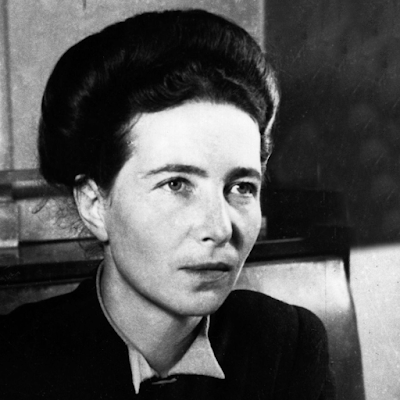 |
| Simone de Beauvoir |
But nominalism is a rather inadequate doctrine, and the antifeminists have had no trouble in showing that women simply are not men. Surely woman is, like man, a human being; but such a declaration is abstract. The fact is that every concrete human being is always a singular, separate individual. To decline to accept such notions as the eternal feminine, the black soul, the Jewish character, is not to deny that Jews, Negroes, women exist today – this denial does not represent a liberation for those concerned, but rather a flight from reality.
In truth, to go for a walk with one’s eyes open is enough to demonstrate that humanity is divided into two classes of individuals whose clothes, faces, bodies, smiles, gaits, interests, and occupations are manifestly different. Perhaps these differences are superficial, perhaps they are destined to disappear. What is certain is that they do most obviously exist.
If her functioning as a female is not enough to define woman, if we decline also to explain her through ‘the eternal feminine’, and if nevertheless we admit, provisionally, that women do exist, then we must face the question “what is a woman”?I have not read all of the remainder of her book. Part of her answer is that women have been defined only in relation to men, as "the Other". She wants, in line with modernity, for women to be autonomous. She has the following negative take on traditional womanhood:
Humanity is male, and man defines woman, not in herself, but in relation to himself; she is not an autonomous being
One is not born, but rather becomes, a woman. No biological, psychological, or economic destiny defines the figure that the human female acquires in society; it is civilization as a whole that develops this product, intermediate between female and eunuch, which one calls feminine.
I'm sorry to disappoint, but I'm not really sure what her answer is to the question "What is a woman?". She seems to focus on the idea that women are not by nature feminine (which she takes to be a negative thing) and should be autonomous in the sense of living for themselves. She writes of her dislike for marriage, motherhood and family and promotes free love, abortion and careers.
She lived to see her preferences realised in Western society. But we do not live in a culture that can answer the question she raised back in 1949. Our culture still does not know what a woman is.

