Sunday, October 31, 2021

On being true

Listening in to liberal friends has made me increasingly aware of how they process moral issues. These people are often highly conscientious and being moral is important to them. But they draw every question back to the same thing. It doesn't matter what the original topic was, it will end up with a nodding agreement about racism or, less frequently, about sexism or more generally discrimination or inclusion. I suspect that, from their point of view, they see themselves as promoting "fairness" in doing so.

This liberal outlook has colonised nearly everything and everyone in a city like Melbourne. If you go to Christian school websites, for instance, the most prominent expression of their values will be inclusion. Some of my liberal friends see themselves as sincere Christians, and attend church services regularly, but their moral framework is still this liberal one. 

The problem is that the liberal framework undermines a very significant aspect of moral character. For most of Western history, it mattered that an individual was "true", in the sense of being loyal and faithful to the significant communities he belonged to and to the particular offices he filled within these communities. These communities were richly diverse. There might be a faithfulness to God, to a church, to a religion, to a spouse, to our children, to our extended family, to our nation or people, to the crown, to our local community, our region, our race and our civilisation.

A faithfulness to these communities and particular relationships then helped to motivate an ethos of service and duty. It also gave the individual a place within longstanding communal traditions, so that the individual might see himself as a bearer of that tradition, which not only dignified his responsibilities, but also drew him more closely into a particular culture, and put him in a relationship not only to his own generation, but to past and future generations. 

When we uphold this ethos of fidelity, much else follows. If you are faithful to your own tradition, then you will be concerned with the good of that tradition, and this will then mean a wider concern with family life, with culture, with the environment, with the economy, with education and so on. You become more strongly motivated, in other words, to uphold healthy family formation, or to organise the economy so that it does not undermine the family, or to create an environment that will elevate rather than degrade those who live within it.

The word "true" originally did not mean "consistent with fact":

Old English triewe (West Saxon), treowe (Mercian) "faithful, trustworthy, honest, steady in adhering to promises, friends, etc.," from Proto-Germanic *treuwaz "having or characterized by good faith", from PIE *drew-o-, a suffixed form of the root *deru- "be firm, solid, steadfast."
You can see here the clustering of moral qualities that the word was used to denote. The liberal moral framework, however, not only ignores the quality of being "true" but undermines it. I get moral points as a liberal if I discard loyalty to my own tradition, so that I do not discriminate. There is a deeply set belief amongst most white liberals that if a white person shows pride in or loyalty to their own traditions, that they are committing a moral evil. This is an inversion of the older view that to be "true" was an essential mark of good moral character.

Moral foundations theory

What I have observed about my liberal acquaintances aligns with research undertaken by Jonathan Haidt. His book The Righteous Mind was published in 2012. He found that liberals focus on just two moral foundations, namely fairness and harm. Conservatives, in contrast, have an equal focus on all five of his moral foundations. 


Haidt's moral foundations are divided into two basic clusters:
According to Moral Foundations Theory, differences in people's moral concerns can be described in terms of five moral foundations: Individualizing cluster of Care and Fairness, and the group-focused Binding cluster of Loyalty, Authority and Sanctity.
Conservatives have an equal concern for treating individuals with care and fairness but also in fostering loyalty to the groups that individuals belong to. Liberals focus more narrowly on the "individualizing cluster". 

Faithlessness

Why would liberals not see loyalty to natural forms of human community as an important moral quality? 

One thing to consider here is the metaphysics of liberal modernity. Thomas Hobbes, for instance, based his world picture on the idea that humans in a state of nature were set against each other, that life was a war of all against all. If individuals coexist at all, in this view, it is only through a social contract. The ends of life, for Hobbes, were also individualistic: the aim was to have the power to follow our own individual passions without external constraint.

There is little place for fidelity within this world view. Human communities are not formed around loyalty, in the Hobbesian philosophy, but through a social contract that has to be enforced by overwhelming governmental power. Nor for Hobbes is meaning to be found within natural forms of community, but rather through an individual "vector of desire".

As this type of metaphysics, over time, penetrated more deeply into Western culture, it is hardly surprising that the group-focused moral foundations receded, leaving only the individualising cluster.

Monday, September 13, 2021

Kathleen Stock 2

In my last post I gave an overview of an online lecture by a British radical feminist, Kathleen Stock. In this post, I'll go through her argument in more detail.


a) Gender abolition

Stock begins by admitting that radical feminists have sought to abolish gender. (A note on terminology: I do not agree with the idea that masculinity and femininity are expressions of "gender" rather than sex. Nonetheless, the term "gender" will crop up repeatedly in this post - it's unavoidable when discussing feminist theory. I am not going to put it in quotation marks from here on.)

As evidence, she quotes Gayle Rubin, a professor of anthropology, who wrote in an influential essay in 1975:
The dream I find most compelling is one of an androgynous and genderless (though not sexless) society, in which one's sexual anatomy is irrelevant to who one is, what one does, and with whom one makes love. ('The Traffic in Women' p.204)
Gayle Rubin
There are two points to be briefly made about the Rubin quote. First, even though Rubin does fit the mould of radical 70s lesbian feminist, the politics she is putting forward are not radical in terms of the state ideology - hence the fact that she ended up a professor, an insider.

The liberalism of this era stressed a freedom of the autonomous individual to self-define. This meant that predetermined qualities like our sex were seen negatively as impediments to human freedom, as fetters or as a straitjacket. It then followed that our sex - being unchosen - ought to be made not to matter. And that is the intent of the Rubin quote. Her dream is that "one's sexual anatomy is irrelevant to who one is, what one does".

Rubin's quote is from an essay which claims, in part, that masculinity and femininity, so far from being meaningful ideals that men and women might aspire to, are instead created in early childhood through some very strange Freudian process that involves a sexual attraction to the mother (Oedipal complex). This is interesting because it is one more step in a process within Western culture in which the vertical structure of reality, in which we apprehend aspects of reality to be more or less elevated, is flattened and the higher things are explained instead in more cynical terms as being a product of some base process.

b) Objections

Kathleen Stock is (mostly) not a gender abolitionist. She does not think it possible, nor desirable. This is not because she is committed to the traditionalist view that our masculinity and femininity are, at least in part, hardwired. She notes that there are some who are now adopting this position, such as Deborah Soh, a neuroscientist and "former feminist". Stock is not hostile to the idea that our masculine or feminine identity is innate, but she does not want her argument to rest on this.

She does, however, base her argument on certain biological realities, namely that humans are sexually dimorphic, with distinctively male and female body types and that heterosexuality is adaptive (in the sense that it furthers the reproduction of the species).

By starting from this biological reality Stock immediately rejects the first and most radical version of gender abolition, namely that the categories of "man" and "woman" should themselves be eradicated. This is the position of Monique Wittig, a French lesbian feminist philosopher and founder of the "red dykes" movement in 1971. In 1976 Wittig wrote:
For the category of sex is a totalitarian one...This is why we must destroy it and start thinking beyond it if we want to start thinking at all, as we must destroy the sexes as a sociological reality if we want to start to exist. 

One of the interesting things about this essay, 'The Category of Sex', is that Wittig openly rejects the philosophically "realist" belief in sexual difference, i.e. the idea that there is metaphysically a real category of the masculine and the feminine. She rejects the belief that,

...there are before all thinking, all society, "sexes" (two categories of individuals born) with a constitutive difference, a difference that has ontological consequences (the metaphysical approach)

Perhaps this shows how nominalism, with its emphasis on the idea that there are only individual instances of things, helps to pave the way for the belief that the idea of sex is merely socially imposed.

Monique Wittig
Again, Wittig explains the high (our embodiment of the masculine and feminine) by the low, though she takes a Marxist rather than a Freudian path. She believes that sex was invented as a political category so that the ruling group could enact its domination: "The ruling ideas are nothing more than the ideal expression of the dominant material relationships".

Wittig famously claimed that lesbians are not women. This makes sense if you accept her argument that "women" only exist as part of a heterosexual dualism by which one political category "men" dominate another category "women". Lesbians escape this kind of sexual "contract". What Wittig did not foresee is that if you so much reduce the category of womanhood it is difficult to sustain a distinctly "woman's" movement. Little wonder that Kathleen Stock rejects the Wittig position.

Stock is more interested in those who accept, as a baseline position, that humans are a sexually dimorphic species (the biological reality position). She wants to consider whether you can argue from this position that gender should nonetheless be abolished.

She begins with those feminists who wish not so much to abolish the categories of "man" and "woman" but any sociocultural differences associated with them. Stock responds by reminding her listeners that the range of such cultural practices is so vast, that the task of abolishing all of them appears unrealistic, particularly as many of them arise in response to the biological differences between the sexes and the fact of heterosexuality.

Stock then makes a cutting point, namely that those who have favoured this type of gender abolition, such as Shulamith Firestone, were aware of the extraordinarily radical social engineering it would require to be successful. Firestone wrote in 1970:

The reproduction of the species by one sex for the benefit of both would be replaced by (at least the option of) artificial reproduction: children would born to both sexes equally, or independently of either, however one chooses to look at it; the dependence of the child on the mother (and vice versa) would give way to a greatly shortened dependence on a small group of others in general, and any remaining inferiority to adults in physical strength would be compensated for culturally. The division of labour would be ended by the elimination of labour altogether (through cybernetics). The tyranny of the biological family would be broken.

Shulamith Firestone
Firestone believed that abolishing sociocultural differences between the sexes would require the abolition of motherhood, of the biological family, of the dependence of children on adults, and of human labour. 

Stock doesn't believe this transformation would be desirable, even if it were possible. She points out that it would leave children with attachment disorders, that its implementation would be authoritarian, and that there would be medical issues in having male bodies gestate children.

Stock's next argument is quite a departure from the usual politics. Instead of arguing that sex-based cultural practices are always and everywhere a fetter on the self-determining individual, she argues that they can have a positive effect, in providing individuals with a source of meaning, obtained via identity, purpose, achievement and camaraderie. She believes that there is a risk of a "profound loss" for the individual if all of this were to be suddenly abolished.

Kathleen Stock makes it clear that she does not support this version of gender abolition. She then turns to a third version of gender abolition, which involves the eradication of all social norms based around sex. Stock treats this version seriously and spends some time looking at the role of social norms in society. It's an interesting discussion, but lengthy, so I'll save it for the next post.

Sunday, August 29, 2021

Who erased women? (1)

The Guardian ran an article a few weeks ago by an Australian feminist, Jane Gleeson-White. She claims that women are being erased by patriarchal economics (because women's domestic work has not been commodified).

It's an odd argument because a patriarchy, by definition, recognises the reality of the sexes. Whether you support the idea of a patriarchy or not, it could not exist without an acknowledgement of the existence of men and women. 

And yet Jane Gleeson-White is correct that there is something like an erasure of womanhood happening in modern society. I wrote about this last month following a debate I had on social media. My opponent argued that it was impossible to define womanhood because womanhood meant whatever people wanted it to mean and that it was "bigotry" to argue otherwise. I pointed out that if womanhood can mean anything and is purely subjective then it is effectively meaningless - it is being erased as a meaningful category.

So who or what is erasing womanhood? In my post I connected the problem to a Hobbesian metaphysics. I won't repeat the argument here, as I'd like to focus instead on how the matter has been argued for politically.

For some decades, the debate about sex followed the general logic of liberalism. Liberals sought to maximise individual autonomy, which was understood to mean maximising the freedom to self-determine and self-define. This meant that predetermined aspects of life were looked on negatively as fetters on the individual. Such predetermined aspects of life included those things we are born into rather than choosing for ourselves, such as our race, our sex and our ethny. The important thing for liberals was to find a way to make such aspects of life no longer matter.

When it came to making our sex not matter, an early step was to separate sex and gender. Being masculine or feminine was no longer something tied naturally to our sex but was instead a separate thing, "gender", that was an oppressive and artificial social construct that could be abolished through such measures as advertising standards or educational programmes. If masculinity and femininity could be abolished, men and women could be made to be the same, and therefore "equal". The fact of biological sex would no longer matter and the liberal project would be realised.

Furthermore, by making gender separate from biological sex it was possible to have a range of personalised expressions of gender. Gender could now be held to be multiple and fluid. Individuals could identify with one or more of a bewildering range of new genders.

And if it is what I identify with that defines my gender, why not make this the same for my sex? It is my identity that now defines my sex rather than the other way round (i.e. instead of my body defining me as male or female, my identity defines whether my body is male or female).

The emergence of transsexualism, as well as the ever expanding variety of "gender expressions", poses a challenge for feminism. The category of womanhood has become, at the very least, leaky. Those who are biologically male can now claim to be part of the women's movement and to occupy female spaces, and it isn't clear if the concept of a woman's movement will make sense to those raised to believe in 52 or more genders.

There has been resistance by old school feminists. The problem is that they have run into the problems that anyone challenging liberalism faces - they are accused of discriminating against a previously oppressed group fighting for the right to self-define ("transphobia"). 


Which brings me to Kathleen Stock, a professor of philosophy at the University of Sussex. She is a lesbian radical feminist, but not really of the type your parents might have known. She has been forced down the same path as the rest of us - she realises that the tide of politics is against her and that what is needed is a rethink of some of the assumptions on which politics is based.

In an online lecture she does a remarkably good job of getting to the heart of things, namely the feminist project to make our sex not matter. She admits that radical feminists have had a project to abolish gender, but argues that this is not achievable. She adds that even if it were possible to abolish these distinctions, this would not be desirable, as it would remove important sources of meaning, identity, camaraderie and achievement for individuals. 

Nor does she think it wise to abolish social norms regulating relationships between the sexes. She notes that these have been looked on negatively in previous feminist thought as "trapping" the sexes into certain roles, but responds by looking into the literature on social norms and finding that they are inescapable for humans who are hardwired to be social and that they can have a beneficial effect. She gives as an example the social norm that it is dishonourable for a man to hit a woman as having a rational origin in the different size and strength of men and women. 

She finishes by arguing that social norms should be judged on whether or not they promote the well-being of men and women. This is, again, a reasonable position with a long pedigree in Western thought, although it does require some debate on what constitutes well-being.

There are some promising aspects of Professor Stock's lecture. I think it's been common for feminists to uphold the categories of male and female only as markers of entry into a political class. The importance of the category of womanhood then becomes for women to seek and to uphold the rights and privileges they have within the political/economic system.

I think it's possible that Kathleen Stock still thinks at least a little along these lines. She says elsewhere, for instance, that, 

There’s a liberal idea that we’ll just keep progressing towards a glorious Utopia. I don’t think that’s right anymore. The picture of human nature that underlies it is flawed. The relationship between men and women is probably always going to be, on some level, antagonistic.

She still puts, at the forefront, the idea of men and women being locked in an antagonistic relationship. Similarly, she says in her lecture that although there are social norms that are beneficial for men, she is only interested personally in promoting those that are beneficial for women. So she is still placing herself on "team women" rather than trying to arrive at some larger framework that will be workable for both sexes.

Nonetheless, she has moved the argument a considerable way toward something else, in particular, by recognising that sex based cultural practices are not only real and inevitable, but also mostly play a positive role in helping to regulate the relationships between men and women, and in providing a source of meaning and identity.

In my next post I'll look in more detail into Professor Stock's lecture. There's some interesting information that's worth delving into.

Sunday, August 22, 2021

What does it mean to be modern? (2)

 In the first part of this series, I quoted Michael Allen Gillespie's definition of modernity: 

...at its core, to think of oneself as modern is to define one's being in terms of time. This is remarkable. In previous ages and other places, people have defined themselves in terms of their land or place, their race or ethnic group, their traditions or their gods, but not explicitly in terms of time...To be modern means to be "new," to be an unprecedented event in the flow of time, a first beginning, something different than anything that has come before, a novel way of being in the world, ultimately not even a form of being but a form of becoming.

To understand oneself as new is also to understand oneself as self-originating, as free and creative in a radical sense, not merely as determined by a tradition or governed by fate or providence. To be modern is to be self-liberating and self-making, and thus not merely to be in a history or tradition but to make history. 
If you see yourself this way as a modern, then logically you will end up cutting yourself off from your own tradition. You will no longer be a culture bearer.

It took some time for this logic to fully work its way through Western culture. You can see it at work in Australia by the 1940s, at least in the corridors of power. It took an even more radical form by the 1960s. For instance, Malcolm Fraser, who was soon to become PM, gave a speech in 1968 criticising the languages on offer at the University of Melbourne. He complained that the university "recognises the following languages - French, German, Greek, Latin, Hebrew, Italian, Russian and Japanese" and that "the list as a whole is one belonging to the last century except for one of the languages mentioned."

What he meant is that only the Japanese language was relevant to Australia in the twentieth century. He had no sense of affinity with the Western cultural roots of his own country. He was defining himself, and his nation, in terms of "time," which then allowed him to rupture the culture of his own country, on the grounds of what was "modern" or "new".

It got worse. Fraser did not see himself as a culture bearer, but by the 1990s it was common for it to be denied that there was any culture to be borne. I remember contributing to a debate at the University of Melbourne where the phrase "Australian culture" was mentioned. It led to a quizzical riposte of "What is Australian culture?" as if it were surprising to hear the claim that there was such a thing.

Nor was this just a local phenomenon. At around the same time, I watched an interview on TV with someone from Austria. He too was stumped when asked about culture and replied "What is Austrian culture anyway?". I thought this particularly curious coming from someone living in the heart of Vienna.

Since then the schools have focused in an unrelenting way on presenting Australian history as being a story of oppression and discrimination. It has had the intended effect of disconnecting many people from their own past.

One point to be made here is that for things to change you would need to do something more than just tweak the school curriculum. If the teachers see themselves as moderns, and if this means defining yourself not in terms of land or place, ethny or tradition, but as a continuous "becoming" into something new and self-making, then there will not be a positive account of one's own history. It will always be something to be broken from.

If we are no longer culture bearers then what are we? It strikes me that moderns are tourists. They still need the connection to a living culture, but no longer identify with their own. And so they act like outsiders experiencing the cultures of others. This does not just mean experiencing these cultures when travelling overseas, but in their own countries as well. Perhaps this also contributes to the push in Australia to have Aboriginal culture as the national culture, even though an overwhelming majority are not Aboriginal. This would be odd if we thought of ourselves as culture bearers of our own tradition, but for a modern who does not see themselves this way, but who still wants a connection (as an outsider) to a culture, it makes sense. (Which explains as well why moderns are comfortable with the "welcome to country" ceremonies - they don't see themselves as connected to land, people or tradition, and so don't mind being placed in the position of "guests" and "outsiders" to another culture).

By rejecting the role of culture bearer, the Western individual has lost a significant aspect of his being. As culture bearers, we take the baton from past generations, attempt to live up to their achievements and to pass them on to future generations. This gives us a standard to measure ourselves by, or even to surpass, a mission in the world that requires us to live up to an ideal, and a reason to feel a pride in what we represent. It connects our individual efforts in life to a larger and enduring communal tradition.

So how do we break from modernism? There is a lot that could be said, but I'll focus on just a few points. First, modernism relies on a belief in linear progress - that we are making continual progress toward ever more advanced forms of society. For many people, the main evidence for this is technological progress. We now have smart phones and smart TVs, a growing array of apps and this is held to be proof of progress.

What we should be pointing out is that these kind of technologies are just tools. They can be used for beneficial purposes or for harmful ones. For instance, if a young girl has all the latest communications technology, but it just carries junk culture to her, culture that is likely to lead to poor life outcomes, then in what way is the technology a measure of progress? What is more important, surely, is the quality of the culture she inhabits, and whether this culture encourages her to develop along higher, rather than lower, lines, in terms of her commitments, her virtues, her maturity, her wisdom, her relationships. The state of culture does not inevitably advance, it only improves over a period of generations, via much love and self-sacrifice - which is one reason to admire and to be grateful for the positive aspects of culture that we do inherit.

Then there is the issue of eschatology - of the idea of human history culminating in the end days. This is a feature of both pagan (e.g. Ragnarok) and Christian theology. The danger is not with the religious belief, but with its secularisation into a humanistic belief in a linear progress of humanity to some ultimate end point. Linear progress then becomes part of an implicit religion that is difficult to challenge, first because it is an aspect of the overall world picture of moderns through which people try to make sense and meaning of their lives and, second, because it is left implicit and so is absorbed as part of the general culture which means it is less likely to be examined.

This does not mean that a belief in linear progress can't be challenged, but we shouldn't expect easy victories. I think the key steps here are not only to point out that society hasn't progressed in the ways it was expected to, but also to provide an alternative world picture to replace the one that moderns cling to. One task, then, is a recovery of ideas that were once central to Western thought, particularly those that relate to the ordering of self and society toward higher goods.

One final point. I have emphasised the importance of being a culture bearer. Western culture was, until recently, a richly developed, "grand" culture. The next step, however, may not be to uphold the most sophisticated, urbanised aspects of this culture. It may be necessary to re-establish our own cultures and traditions at a smaller scale and at a local level, at least to begin with. To maintain continuity might require a measure of adaptability.

Sunday, August 15, 2021

What does it mean to be modern? (Part 1)

What does it mean to be modern? Michael Allen Gillespie, in his work The Theological Origins of Modernity, gives this answer:

...at its core, to think of oneself as modern is to define one's being in terms of time. This is remarkable. In previous ages and other places, people have defined themselves in terms of their land or place, their race or ethnic group, their traditions or their gods, but not explicitly in terms of time...To be modern means to be "new," to be an unprecedented event in the flow of time, a first beginning, something different than anything that has come before, a novel way of being in the world, ultimately not even a form of being but a form of becoming. 

To understand oneself as new is also to understand oneself as self-originating, as free and creative in a radical sense, not merely as determined by a tradition or governed by fate or providence. To be modern is to be self-liberating and self-making, and thus not merely to be in a history or tradition but to make history. To be modern consequently means not merely to define one's being in terms of time but also to define time in terms of one's being, to understand time as the product of human freedom in interaction with the natural world. Being modern at its core is thus something titanic, something Promethean.

This description of modernity helps us to understand why people have such difficulty in breaking cleanly from the modernist project. This project is now something that we live within, and by its nature it has broken with the past as a living tradition, making it difficult to connect to any genuine alternative.

Gillespie goes on to trace the development of the concept of modernity. Modernism, in its current meaning, took some time to emerge. Those who wanted to challenge either the present or the recent past, often did so by looking back to antiquity rather than by embracing "modernity". Gillespie mentions the "quarrel of the ancients and the moderns" that took place in the seventeenth century. When I did some further reading on this I learned that in France the establishment literary figures who supported throne and altar were the ones who considered themselves "moderns". These writers attacked the more radical literary figures who looked back to antiquity. So there was not yet a progressivism in the form that we would recognise.

What is more recognisable are movements like the Italian Futurists of the early 1900s. Below is a sketch by the Italian architect Antonio Sant'Elia that was part of a series called "The New City" (1914).


Sant'Elia's vision of the new city has been described as follows:

The city was a backdrop onto which the dynamism of Futurist life is projected. The city had replaced the landscape as the setting for the exciting modern life. Sant'Elia aimed to create a city as an efficient, fast-paced machine. He manipulates light and shape to emphasize the sculptural quality of his projects. Baroque curves and encrustations had been stripped away to reveal the essential lines of forms unprecedented from their simplicity. In the new city, every aspect of life was to be rationalized and centralized into one great powerhouse of energy. The city was not meant to last, and each subsequent generation was expected to build their own city rather than inheriting the architecture of the past.

The Italian Futurists were influential enough to have buildings approved by Mussolini, such as a new train station in Florence completed in 1934:

The heating plant and main controls cabin for this station are considered masterpieces of Futurist architecture (1929):


In Australia you can see modernism extending its influence among the elite in the interwar period. It was not uniformly so in the 1920s, though. Here is part of a speech given by Sir William Irvine, who at that time was the Chief Justice of the Supreme Court of Victoria. In opening a local high school in 1928 he said,

Such schools present the young with opportunities of rising not merely to technical and industrial efficiency, so that they may make more money or higher wages. That is a useful object and may be the aim of the majority who enter this and other schools but there is something higher.”

The more chances given to the rising generation in the way of education, says Sir William, the better for all concerned...It was the aim of education to bring the minds of people into paths of thought leading to vistas of intellectual truth and beauty. Secondary education should be a means of drawing out the creative intellect of the youth of this fair country, in order that their efforts would lead towards the benefit of all, so that their minds might be uplifted above the sordid cares of ordinary life, and so that they might enjoy the priceless heritage of English history. 

Irvine is clearly not interested in the technological alone and he holds the heritage of his own people in high regard - and so is not entirely a modern. But in the 1930s there continued to develop a strongly technocratic spirit in Australia, and it dominated at the highest level politically in the 1940s. After WWII there still existed a pride in the past at the local level, with the formation of local historical societies, the writing of local and family history, the erection of monuments to honour pioneers and so on. But even this changed by the 1990s. By this time there was an intensely focused campaign, particularly in the schools, to reject the past as something oppressive, something that was not to be identified with.

By this point, it was no longer so easy to think of yourself as a bearer of a culture or of a tradition. This was a logical end point of the understanding of what it means to be modern as set out by Michael Allen Gillespie. If we define ourselves as self-originating, not tied to people or place, nor to history, then it is logical to cut our ties to the past and to our own tradition.

We are no longer culture bearers. That has deep implications that I'll discuss in the second part of this series.

Wednesday, July 28, 2021

A latter day Hobbes?

When you read the philosophy of Thomas Hobbes you can't help but notice how well it fits with the mindset of some people today. There are Hobbesians among us.

In previous posts I have summarised the philosophy of Hobbes, as set out by Michael Allen Gillespie in his book The Theological Origins of Modernity. Here are some choice quotes from the book outlining Hobbes's ideas:

We are all only individual beings, determined by our idiosyncratic passions. Good and evil for each of us is thus measured not by our progress toward a rational, natural, or supernatural end but by the vector of our desire. No direction is naturally better than any other. Good is what pleases us, evil what displeases us, good what reinforces our motion, evil what hinders it.

And this:

For Hobbes reason means something different than what it did for his predecessors. It is not a separate power that can discern the appropriate ends of life and guide us in a proper direction. It is thus not teleological but instrumental, the spy and scout of the passions. It thus helps us to maximise the satisfaction of our desires but not to train, direct or control them.

 And finally this: 

Thus, while we all desire to exist, what any one of us wants to exist for or wants out of existence can only be specified by the individual. The happiness of each individual thus depends upon his getting what he wants, and this is related to his power...Such power is the basis for what Hobbes believes is rightly called freedom.

You can see here the logic of nominalism (that there are only individual instances of things) and a certain type of materialism (that we are just matter in motion) in undermining a "teleology" - a view that there are proper ends to human life that are discernible through reason. 

What you have instead is a belief that it is the freedom to pursue my own idiosyncratic wants that matters. It does not matter so much what these wants are - one direction is neither better nor worse than another. The important thing is that I have the power to follow my desires without external interference. 

The implications of all this become clearer when you see these ideas expressed in debate. For instance, I recently saw the following posted on social media:


Now, whether or not you completely agree with this assertion, note that this is not Hobbesian, as it suggests that women do have a "telos", a distinct end in life to fulfil. Predictably, this drew a horrified response from some readers, who shuddered at the thought that womanhood might be linked in a meaningful way to motherhood. I noted this in the thread:


Now, perhaps you think that I was exaggerating in my last remark. But consider what follows when I enter into debate with a poster named Steven.


Steven is channelling Hobbes when he claims that the purpose attached to womanhood is "whatever the woman wants". The argument continued:


I've tried to explain in the comments above that in practice denying that we have natural ends in life does not free the individual to do anything, but instead provides no limits to what is expected of the individual within a technocratic social order. Why would a society be organised to facilitate family formation, a culture of stable family relationships, and the fulfilment of a fatherhood and motherhood role, if none of these are rational, natural or supernatural ends of men and women? 

The digging deeper into Hobbesian soil continued:


It was part of the Hobbesian philosophy that no direction is better than any other. And here we have a latter day Hobbesian claiming much the same thing: that hedonism is as meaningful a direction as responsible parenthood.


Steven is claiming here that the category of womanhood is meaningful because that is how some people define themselves and that it doesn't matter what womanhood is actually thought to be. It could be made to be one thing or something entirely contradictory to that thing. There is no rational limit to how we can define anything, it is an arbitrary decision of the individual (who, in a sense, gets to act just like the God of nominalism).

(Note as well that Steven believes that it is either his wife who gets to define womanhood or else me doing it for her - the option that womanhood is a real thing that both of us can perceive is not part of his mental framework. This fits Hobbes's view that freedom is the power to have my own "motion" left unhindered by that of any other person.)

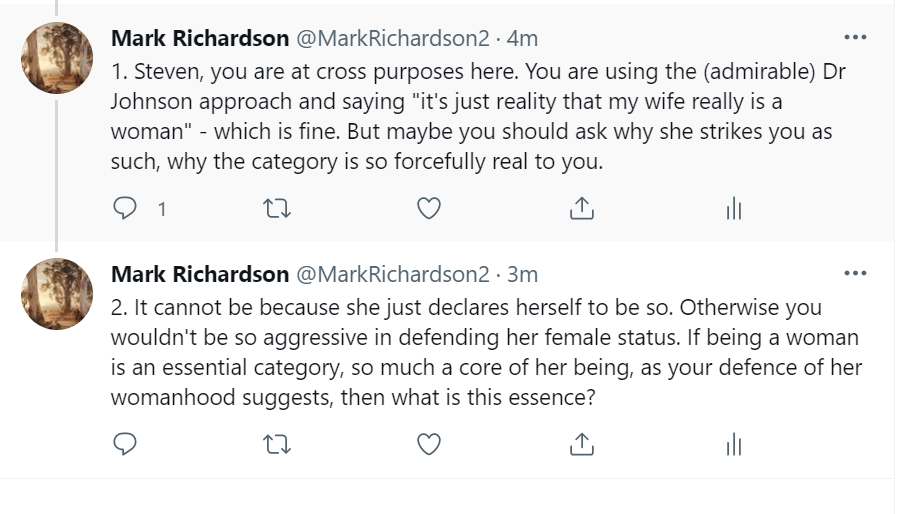
Steven then began to more aggressively defend his wife's status as a woman. I wondered why he would so vigorously defend a category which he had, to this point, reduced to a merely subjective and arbitrary choice:


Steven chose not to budge from his radical Hobbesian/nominalist framework:


There is a lot to draw from this exchange, but I'll just briefly mention two things. First, Steven's position is a "dissolving" one. This too fits in with Hobbes's philosophy, in particular with his scornful rejection of "quiddity" - the inherent essence or nature of people or things. Second, we have to be open to the possibility that the philosophical foundations of the modern West are part of the problem we face today. In other words, the problem is not just that one political leader, or party, or movement has put things off course, but rather that there are some philosophical assumptions that became prominent in the early modern period that need to be rethought. 

Sunday, July 18, 2021

Hobbes & the ends of man

Politics has been quieter than usual since the American election, but I'm pleased to note that the questioning of liberalism continues to grow. Here is a recent example:


The responses to the tweet were mixed, but most recognised that liberalism had reached a point of crisis. One person, though, defended liberalism on the following basis:


I checked this person's feed and he is a reasonably open-minded right-liberal type. What I would like to focus on is his claim that there is no higher meaning outside of the choices we make.

It brought to mind my recent reading on the philosophy of Thomas Hobbes. Hobbes radically diminished the meaning of human life. He thought that everything was merely matter in motion, so that humans were acted on in ways that activated our passions and so freedom and happiness meant having the power to pursue our own idiosyncratic passions without external constraint.

What this means is that humans do not have free will. To be autonomous or self-determining has a truncated meaning in this philosophy. Our actions are not really determined by ourselves, but by the actions of external bodies upon us. We are "self-determining" only in the sense that it is our own passions that we follow without hindrance, rather than someone else's.

Hobbes scorned the medieval philosophers, particularly those who discussed "quiddity" - the inherent nature or essence of someone or something. This is important, I think, in discussing whether there is a higher meaning to things. In the twitter thread, a lot of commenters acknowledged that the liberal principle was destroying society, but they thought that religion had too weak a hold to be able to provide a counteracting principle.

Even though I am religious myself, this attitude surprises me. After all, if you can accept "quiddity" then at the very least, even without being religious, you ought to be able to accept that creatures have natural ends, i.e. that they will seek to fulfil or bring to fruition their inherent nature. For instance, men will seek to develop masculine qualities and to fulfil masculine roles, women the same for the feminine. As we are social creatures, this then has implications for our commitments within a society, including upholding certain social norms that allow our nature to successfully unfold.

The problem is that Hobbes's philosophy does not even allow for such natural ends, let alone supernatural ones. Michael Allen Gillespie, in his book The Theological Origins of Modernity, describes Hobbes's view of ends this way:

We are neither superhuman nor depraved. We are all only individual beings, determined by our idiosyncratic passions. Good and evil for each of us is thus measured not by our progress toward a rational, natural, or supernatural end but by the vector of our desire. No direction is naturally better than any other. Good is what pleases us, evil what displeases us, good what reinforces our motion, evil what hinders it. Or to put the matter in different terms, good is an increase in our power and evil its decrease...Each person in Hobbes' view is thus a self-interested individual who seeks to maximise his own power and satisfaction.

I suspect the problem here is that once a Hobbesian view sinks into political thought, there is an acute sensitivity to the idea that any restraint or self-limitation is not a rational one designed to help us, as social creatures, unfold our own ideal nature but is instead a power play by which one group of people seek to block our own "vector of desire" in order to more readily follow their own. In other words, an appeal to natural ends will be rejected as an attempt to exploit or oppress, because that assumption is built into the framework of a Hobbesian philosophy.

So you cannot then simply argue against one aspect of a Hobbesian view - it needs to be more generally dismantled in order for a different politics to emerge. This is possibly the kind of thing Antonio Garcia Martinez is referring to in his first thesis here:


Sunday, July 11, 2021

Hobbes & the metaphysics of modernity

It is commonly assumed that modern politics - secular & liberal - is not based on metaphysics. From this is derived the belief that we should keep metaphysics out of politics, particularly metaphysics of the Christian variety. For some Australians, for instance, it is troubling that our PM is a member of a Baptist church.

The dictionary definition of metaphysics is as follows:

a division of philosophy that is concerned with the fundamental nature of reality and being and that includes ontology, cosmology, and often epistemology

What is obvious from this definition is that all politics, including those of liberal modernity, must be based on a set of metaphysical assumptions. What matters then is not the impossible aim of excluding metaphysics, but trying to get the metaphysics broadly right, so that a human community is not thrown off course.

I have recently read Michael Allen Gillespie's The Theological Origins of Modernity. One of his arguments is that liberalism is based not so much on a rejection of Christian metaphysics, but developed from the theological debates that took place in the West following the adoption of a nominalist world view from the fourteenth century onward.

Gillespie sees Descartes and Hobbes as being two key proto-liberal thinkers. In order to demonstrate the metaphysical assumptions involved in the development of liberal thought, I'd like to focus on Gillespie's treatment of Hobbes. I think it is clear from his explanation of Hobbes's thought, that Hobbes was not operating neutrally from within a metaphysical vacuum, but rather that the edifice of Hobbes's thought was built upon a series of metaphysical assumptions about the nature of the cosmos; a theory of knowledge; the nature and purposes of man; the relationship between God and man and so on.

Hobbes

Gillespie begins with an account of Hobbes's physics. As interesting as this is, for the purposes of brevity I am going to skip it and focus on one aspect only of Hobbes's thought, namely his anthropology. There is enough in this alone to demonstrate the metaphysical commitments of the early modern philosophers.

It was Hobbes's view that men are "complex automata". As such, we do not have free will. Instead, we are moved by our passions (which are aroused by the impact of external objects on our bodies). If we have no free will then we cannot strive for moral perfection. Instead, our happiness depends on satisfying our bodily desires.

What are these desires? Only the most rudimentary desires, such as seeking to preserve our own lives, are basic to men. As a nominalist, Hobbes was committed to the idea that we are radically individualistic beings with idiosyncratic passions. To quote Gillespie "Thus, while we all desire to exist, what any one of us wants to exist for or wants out of existence can only be specified by the individual. The happiness of each individual thus depends upon his getting what he wants, and this is related to his power...Such power is the basis for what Hobbes believes is rightly called freedom".

You can see already how the underlying philosophy colours the meaning of terms like "freedom". With Hobbes the concept of freedom is stood on its head. We are free, according to previous ways of thinking, when we are not slaves to our passions. With Hobbes, we are free when there is nothing to impede our passions. As Gillespie puts it:

There is no freedom God bestows on us with an infusion of his will. Hobbes believes such pious hopes merely subordinate us to the passions of priests and religious fanatics. Humans are bodies driven by passions, and to be free for Hobbes is to pursue the objects of our passions without external constraints. This is practical but not metaphysical freedom...While we are thus predestined to be the kinds of beings we are and to have the passions that we have, this does not affect our freedom because it is precisely these passions that define our identity.

You can see how this overlaps with modernist thought. Moderns tend to identify freedom with an absence of external constraints; they tend to define their identity around their idiosyncratic passions; and in the English speaking tradition there has long been a hypersensitivity to the idea of priests representing an external tyranny. What is different, perhaps, is that moderns tend to combine, in an unprincipled way, the voluntarist idea that we create who we are as an act of our own will with a materialist and determinist view of the cosmos. 

For Hobbes the next step is to emphasise the significance of power in being able to pursue our desires unimpeded:

The degree of our freedom depends on our power...Our power depends on the strength of our bodies, the number of our supporters, the extent of our external resources, and above all on our capacity to reason. For Hobbes reason means something different than what it did for his predecessors. It is not a separate power that can discern the appropriate ends of life and guide us in a proper direction. It is thus not teleological but instrumental, the spy and scout of the passions. It thus helps us to maximise the satisfaction of our desires but not to train, direct or control them. To live by right reason, for Hobbes, is thus not an end but a means. Indeed, the purpose of deliberation is not to moderate the passions, as Petrarch believed, but to increase our power to get what we want.

This too is recognisably modern. You see it when women defend the unconstrained display of sexuality as empowerment. Note too the way that concepts like "reason" so readily change their meaning when placed within a different metaphysics. 

The unfolding of Hobbes's thought leads to a particular take on what the ends of human life are:

We are neither superhuman nor depraved. We are all only individual beings, determined by our idiosyncratic passions. Good and evil for each of us is thus measured not by our progress toward a rational, natural, or supernatural end but by the vector or our desire. No direction is naturally better than any other. Good is what pleases us, evil what displeases us, good what reinforces our motion, evil what hinders it. Or to put the matter in different terms, good is an increase in our power and evil its decrease...Each person in Hobbes' view is thus a self-interested individual who seeks to maximise his own power and satisfaction. 

It is interesting how enduring this view of man has been. In the later twentieth century, for instance, both the left and the right of politics adopted a game theory which required individuals to act in a self-interested way, just like Hobbesian man might be expected to act.

What does it mean to envisage a society made up of millions of idiosyncratically individual actors, each attempting to further his own power so that he has the means to satisfy his desires? First, given that our needs are limitless, there is an impetus to master/conquer nature to provide the resources to satisfy these unlimited wants, thereby providing conditions that might provide security. Second, in a state of nature, men will compete for finite resources; the natural condition of man is therefore a war of all against all.

Conclusion

This is obviously not an exhaustive account of Hobbes's thought. I hope it has shown, though, not only that metaphysics matters, but that liberal modernity is undergirded by its own metaphysics. We live in a society that has been shaped over time by a metaphysics that has been in place for some centuries now.

The alternative does not need to be an attempt to base politics on the metaphysics of any one particular church and its theology. We do, however, need to "unconceal" the metaphysics on which modernity is based and challenge aspects of it. This includes its nominalism; its reductive anthropology; its reduction of authoritative knowledge to either an apodictic science or to whatever grants power/mastery over nature; and its generally base understanding of human ends/purposes. 

Sunday, June 06, 2021

It's not just the left

If you oppose open borders, you can't just identify the left as the problem. There is an influential part of the political right which also adopts this policy. Take Sam Bowman as an example. He is a Senior Fellow at the Adam Smith Institute and describes himself as a neoliberal. His mindset is what you'd expect from someone whose intellectual formation took place in a university economics/commerce department.

Bowman tweeted that he favours huge amounts of immigration of unskilled workers into Britain even if it reduces the welfare of his countrymen, for instance, through higher rates of crime.


He advocates this despite describing himself as a selfish person in his personal behaviour:


This is a utilitarian approach to morality, in which it is thought that something is moral if it produces the greatest good for the greatest number. Bowman is arguing that the good for the immigrants would outweigh the evil for the natives and therefore the policy would be moral.

It is a mechanical, calculative approach to morality in which it is assumed that the good is the pursuit of material self-interest in the market. Most of the replies to Bowman quite rightly reflect a different view of the human person, as valuing natural forms of relationships that generate particular duties and loyalties. Many of these replies accused Bowman of being a traitor for urging that the welfare of his own countrymen be sacrificed.

It was also suggested by many of Bowman's critics that he was flaunting his upper-class status in his tweet. A wealthy person would be less likely to be adversely affected by the mass immigration of low-skilled workers. Bowman and his supporters responded by claiming that it was a good thing that the rich would be advantaged:


And this:


Bowman and friends believe that their own living standards will be improved by a mass of low-skilled, low wage immigrants, who can act as a kind of servant class to the wealthy. The mindset appears to be that if some native working class people are negatively affected, this is justified by the benefits to the upper classes and to the immigrants.

Although most people do not share Bowman's Economic Man approach to life, a great many influential people at the top do. If we want to create a better political class, we have to be just as critical of the right liberal types as we are of the left liberal ones. 

(One final point. It is difficult to draw any viable notion of a common good from Bowman's politics. The basic idea of the common good is that the rulers of the UK should rule on behalf of all social classes rather than just their own. But if morality only considers the selfish individual and the entire mass of humanity, i.e. if these are the two parts of the equation, then it is likely that the welfare of one part of the community will be sacrificed, as Bowman advocates. In a sense there is no "polis" for a common good to be exercised within, when there is only me as a selfish individual and the whole of humanity as political and moral actors.)

A note to Melbourne readers. If you are sympathetic to the ideas of this website, please visit the site of the Melbourne Traditionalists. It's important that traditionalists don't remain isolated from each other; our group provides a great opportunity for traditionalists to meet up and connect. Details at the website.

Sunday, May 30, 2021

The mechanical girlboss narrative

Helen Roy has written a terrific article on the topic of motherhood. It is impressive because it not only clearly describes the problem, but digs down into the underlying ideas which bring it about.

I encourage you to read the whole piece, as it's difficult to isolate a few key parts. The argument begins in the 1950s when there was already a trend to dissociate women from the biological aspects of motherhood. For instance, only a minority of women breastfed their children and women were drugged and restrained during childbirth.

Helen Roy doesn't mention it, but the technocratic approach to women's lives had crept into Western culture much earlier. In the Melbourne Argus newspaper in 1921 it was argued (by "Vesta") that industrial methods should be applied to the home:

That time means money and that method saves both time and material, that co-ordination of work leads to efficiency, that exactitude in the smallest detail is necessary if a perfect product is to be secured - what a transformation of domestic work would result if these principles could be brought to rule in the kitchen as they do in the factory.

Vesta wanted women to bring into the home "a passion for efficiency" and "a zeal for method and organization".

This same technocratic/industrial mindset was applied in Australia to infant care in the 1920s and 30s: "the very naturalness of mothering became redefined in the light of discussions about the need for mothercraft and for the application of rational, scientific knowledge to the process of childrearing" [The disenchantment of the home, p. 139]. This led to mothers being given extraordinarily detailed timetables for feeding their babies which were to be kept to "absolutely" and some of the more severe advocates even suggested that mothers limit the cuddling of their babies to a "mothering hour" in the late afternoon. A Dr Dunlop from Sydney wrote "It is not good to nurse babies more than can be helped. When breastfed babies are being fed they get their fair share of nursing and cuddling". 

Helen Roy goes on to describe the formation of a countermovement called the Le Leche League and notes that,

The Le Leche League saw considerable success in their struggle against the dissociative view of womanhood prevalent in American culture at the time. But the founders consistently found a foe in the dogmatic belief of liberal feminists that women’s bodies and their reproductive functions were discrete, acute nuisances and impediments to be overcome and neutralized in service of making women economically competitive with men.

And that,

Progressive feminists and scientists shared a perception of the human body divorced from both its immediate personal relationships and its final cause. Denizens of these two powerful cultural entities wrote and practiced as if women and their bodies were arbitrary material sums of discontinuous, infinitely malleable components—not as unique formations of irreplaceable souls, as in the classical model.

The League ultimately failed:
Despite many successes in preaching the gospel of breastfeeding worldwide, this deeper implicit message—about the indispensable character of a woman’s real presence to her family, and about the inextricable connection between her physical and spiritual nature and her duties—was swept away by a more powerful undertow...an unholy alliance between feminism and science remains undefeated in a forever war against the female body.

Why have liberal feminists triumphed? Here Helen Roy connects the positions adopted by liberal feminists to their philosophical foundations:

The movement is unstoppable precisely because their fundamental assumptions about humanity—their rejection of metaphysics, their pious devotion to an always-forthcoming, progressive technological utopia, their obsession with power over their own nature—remain unchallenged. What the Le Leche League needed to, but probably could not, communicate explicitly about womanhood and motherhood was not so superficially emotionally satisfying as the mechanical girlboss narrative.

Helen Roy does not shy away from attempting to challenge the liberal feminist mechanical girlboss narrative:

The truth hurts: motherhood is a permanent sacrifice of one’s body to another. Beyond the acute pain of childbearing and the sometimes frustrating journey of breastfeeding, motherhood means involuntarily suffering when your child suffers, as well as voluntarily conforming your will to your child’s objective good no matter what. Motherhood in all its forms—including spiritual mothers, mothers of unborn children, adopted mothers, de facto mothers, godmothers, and bereaved mothers—indicates the female telos, which is sacrificing oneself for the sake of another for the rest of your life.

This is an unchanging, self-effacing, radically anti-individualist orientation to the world. It is pain with a purpose, punctuated by moments of inarticulable joy. I don’t know a mother who would not die for her children. There is no greater love, and, speaking politically now, there is no greater responsibility. Contrary to the oft-parroted shibboleths of modern feminism, a mother’s role is not beneath her. It is actually above her, in the sense that motherhood inherently elevates women as cultivators of the gratuitous gift we know as life itself. Perhaps they already know this. Perhaps this is the point.

The reciprocal truth of the female body and the female soul is fundamentally incompatible with the progressive, individualist, materialist, liberal feminist worldview. So the two were divided, and in this division, subjected to an antispiritual regime that aggressively robs women of their dignity and unified purpose. For women to be restored in their fullness in public and private life would mean to expose and oppose this centuries-long project of the physical, social, spiritual deconstruction of women’s bodies and minds. It would be to uphold a maternal ideal so radiantly beautiful, powerful, and yet humble, as to make her detractors run and hide in shame. No wonder the enemies of humanity would like to make that Woman disappear.

I can't improve on this. I would only observe that Helen Roy's complaint about liberal feminists having an "obsession with power over their own nature" fits in with Patrick Deneen's observations about liberalism, for instance, that "Second-wave liberals increasingly approve nearly any technical means of liberating humans from the biological nature of our own bodies". Similarly Deneen criticises liberalism's "insistence on the human separation from and opposition to nature".

I think as well that women's "unified purpose" has also been undermined by liberal feminism when it comes to relationships with men. Here too there is a "dissociative view of womanhood" in which a woman's love for a man was thought at times to be an impediment "to be overcome and neutralized in service of making women economically competitive with men" (see here).

A note to Melbourne readers. If you are sympathetic to the ideas of this website, please visit the site of the Melbourne Traditionalists. It's important that traditionalists don't remain isolated from each other; our group provides a great opportunity for traditionalists to meet up and connect. Details at the website.

Monday, May 03, 2021

Which orthodoxy? Which clerics?

Sohrab Ahmari has written a very good piece for The Spectator ("The unenlightenment: liberalism comes at a cost", 1st May 2021), which I encourage you to read in full. I want to focus on the core aspect of it, in which Ahmari contests the liberal claim to neutrality. Ahmari summarises this liberal ideal as follows:

The ideal is that a new liberal order ushers in a new, rational, tolerant and secular regime: cleaving apart day-to-day politics from religion and metaphysics. So instead of enshrining any one orthodoxy, a liberal neutral ground would be created, one that could be contested by rival accounts of the good life. The religious would be able to live happily beside the unbelievers, with all minorities protected.

Ahmari points out the obvious: that in practice the public square in a liberal society is not neutral but that one orthodoxy has been replaced by another:

But has that really come to pass? Given man’s inclination to worship, to build altars in the public square, our societies will always enshrine some orthodoxy or other (and, therefore, empower some clerisy or other). The only questions are: which orthodoxy? Which clerics? If the past couple of years have made anything clear, it is that there is to be no neutrality. The West must choose.

Do we enshrine the orthodoxy of the latest theories on race, sex and gender? Do we empower the woke clerisy, the army of blue-check Twitterati and HR managers who can destroy careers and lives in a matter of minutes over the smallest of ideological infractions, and whose judgments are subject to no reasoned appeal and no code of canon law? Do we live under their new blasphemy laws, ostensibly designed to prohibit ‘hate speech’?

Or do we choose the more forgiving, perhaps old-fashioned orthodoxy that sustained western culture for the better part of two millennia? The Judaeo-Christian values and institutions that venerated natural reason, that by their discipline tamed the big and small would-be tyrants of Europe, reminding them that there exists a higher power than theirs?

I thought this part very good as well:

Anyone, left or right, calling today’s progressive order into question — or daring to propose alternatives — is first asked to apologise for these horrors, stretching from antiquity to whenever enlightened time began (which may be as recently as a couple of years ago). This is a type of intellectual blackmail, and the best defence against it is to go on the offence: no, it’s the actually existing present that increasingly resembles a dystopia, and the onus is on the liberal to give account and apology. The non-liberal’s rejoinder can be summed up with three simple words: look around you.

Look around you: has liberalism delivered on its own terms, on its promise of neutrality between world views?

Tuesday, April 27, 2021

Is Tucker a trad?

I admire Tucker Carlson. He is one journalist who is prepared to take a stand on principle, even if that means going against the narrative and drawing fire on himself. He has stood firm even when activists have, literally, arrived on his doorstep.

I think it is unlikely, though, that he could be termed a traditionalist. He recently gave an online interview in which he was asked what a 22-year-old Carlson would do in 2021. Carlson gave a typically trenchant answer, explaining that he would do his own thing in some rural part of the US rather than enter a big corporation, because "the system is collapsing" and "It certainly doesn't want people like me".


So far there's no problem. But then Carlson muses that the current American regime is based on lies and that if he were 22 he might even look further afield, to another country. He states, "but if I were 22, I might look to see if there's another place that's going to treat me as an individual and not as a member of a tribe. A system that actually cares about people, not identity".


This is a very modern, rather than a traditional, way of seeing the world. Remember it was the liberal radical Shelley who, back in 1820, wanted people to be without tribe and identity. Shelley looked forward to the emergence of a new leftist kind of man, whom he described as follows:

The loathsome mask has fallen, the man remains/ Sceptreless, free, uncircumscribed, but man/ Equal, unclassed, tribeless, and nationless,/ Exempt from awe, worship, degree, the king/ Over himself

There is a considerable irony at play here. Shelley helped set in motion a politics which was based on the idea that we would be free when there were no more distinctions between people that might lead to inequality. Once this state of affairs was reached, then human nature would be regenerated and we could do whatever we wanted as individuals, living a kind of Edenic existence on earth.

Shelley targeted the aristocracy and the church as institutions blocking the path to equality. Later on, Marx targeted the bourgeoisie. More recently, we have feminists and critical race theorists targeting white men like Tucker Carlson.

Tucker, quite reasonably, does not want to be targeted. The answer, though, is not to abandon the most recent phase of leftist thought, merely to return to its Shelleyan origins. It's better to dig deeper and uproot the tree that bears such poisonous fruit.

In this spirit, I'd like to go back even further than Shelley. I find it interesting that Tucker believes that unless you treat each person solely as an individual that you are denying their nature. He says, "And never deny who you are. I thought this was all sort of common knowledge, that we all agreed on this some time ago that we shouldn't have to deny our nature in order to succeed. We should celebrate each person as an individual, but we've given that up completely."


This too is a modernist idea. Tucker is suggesting that it is our nature to be wholly individual. That we are just one instance of a thing, rather than being a member of a class of things. If true, those asserting that there are hundreds of different "genders" would be on the right track. 

Where does the idea come from? I'm currently reading The Theological Origins of Modernity by Michael Allen Gillespie. His argument is that toward the end of the medieval era there was a philosophical turn to nominalism which overturned the long established Western belief in philosophical realism. Nominalists reject the real existence of universals, so that there are no really existing "essences" by which things might be grouped together, or share a common nature (for example, no masculine or feminine essence that individual men or women might represent or express).

If you were to remove the nominalism, it is unlikely that you would set apart human nature and identity. Instead, you would see the two as being closely connected. If there is a masculine essence, and I am born a man, then there is a "given line" along which I can develop and fulfil my nature and define my telos (my purposes). Of course, each man is likely to do this a little differently (so there is still individuality), but I belong to a particular class of being (men), and this is deeply infused in my sense of self (being an "essential" part of who I am). Being a man or a woman is not, as Shelley put it, a "detestable distinction" but a core reality that inevitably helps to define us.

Leftists take a radically nominalist approach, usually claiming that "masculine" and "feminine" are merely oppressive social constructs. However, because they also see "patriarchy" as the oppressive social structure that they wish to destroy in order to liberate humanity, they retain male and female as legitimate terms if they are understood as classes within a political system. 

Nominalism has, perhaps, unhelpfully trained the modern Western mind to think only in terms of the discrete individual. This carries over into issues of national or ethnic identity. We do not, as we should, see our membership of a nation or ethny as helping to fulfil aspects of our nature by deepening our connection to a people and place, which then strengthens our commitments to preserve our heritage, to maintain the health of family life, to uphold unity and solidarity (including between the sexes), to love the natural environment of our homeland, and to uphold what we owe to past and future generations. 

To say, "Why can't we just be individuals?" not only strips us of all this, it leaves us vulnerable to those with a stronger sense of who they are as a people. 

A note to Melbourne readers. If you are sympathetic to the ideas of this website, please visit the site of the Melbourne Traditionalists. It's important that traditionalists don't remain isolated from each other; our group provides a great opportunity for traditionalists to meet up and connect. Details at the website.