Showing posts with label nominalism. Show all posts

Monday, March 09, 2026

A reader comments on Peter Drew

In my last post I looked at the beliefs of Peter Drew, an Australian left-wing artist, particularly on the topic of identity. Drew thinks of identity as something fluid and superficial:

All identity should be fluid in some sense, whether that’s the make up of our blood, that being our race or nationality, or our job, or the behaviour we exhibit, or the clothes we wear. It’s all superficial in some sense, it’s not entirely real...

I went on to argue that this take on identity reflects the liberal concept of freedom, of a self-determining autonomy, and that it is difficult to assert alternative understandings of freedom if you have a nominalist world view in which we have no natural ends toward which we would rationally want to develop.

A reader, Cameron, wrote a comment that I thought put the situation in a strikingly effective way:

One thing this piece (as many of your other ones) makes clear is that the claim of liberalism to make us "free" to be whatever we want is equally well explained, and perhaps better explained, by a denial of freedom to be anything FOR REAL.

Identity is "not entirely real." The true reason that anyone can be an Aussie, in this mindset, is that being an Aussie is not REAL.

This is the real tragedy of nominalism and runs through all of its promises. Men are free to be women only because women are not even free to be women--because there ARE no women, it's all just "labels."

This is something to ponder. Do liberals think there is a real quality to being Australian, but reject it out of principle? Or do they not think in terms of things having real qualities and therefore there is no real content to being Australian and so logically anyone can be one?

I'm not sure that the latter explains everything. For instance, liberals do give some real worth to indigenous culture and identity - which seems to reflect second-wave liberalism's idea that pre-civilised cultures are worthy in ways that Western bourgeois cultures are not. 

Even so, if your philosophy denies essences (this would include postmodernism) that give distinct qualities, (i.e., a definite nature), to things, then you're likely to go down the path that these things are just conventions or constructs of some sort and therefore as Drew puts it "superficial in some sense" and "not entirely real" and so not really constitutive of self.

Sunday, February 15, 2026

Poster boy of the Australian left

Peter Drew is a left-wing Australian artist. He is best known for his posters which show people from different ethnic backgrounds being described as "Aussie".

Peter Drew with his posters

In an interview with a local Indian media outlet, Drew explained his views on identity as follows:

All identity should be fluid in some sense, whether that’s the make up of our blood, that being our race or nationality, or our job, or the behaviour we exhibit, or the clothes we wear. It’s all superficial in some sense, it’s not entirely real, there is some substance to it, but none of it can say who we really are, and so it is fluid in some sense and so it says Aussie on all my posters, it’s a provocation….it’s really to open up the discussion and then allow us to talk about identity in a fluid way, because I think that’s what ultimately is empowering to individuals and gives us the most freedom. [1]

This is not an original thought. It is an orthodox expression of the liberalism which has dominated the Western political class for many decades. 

The basic idea of this liberalism is that the overriding good in life is a freedom to be an autonomous individual, i.e., an individual who is self-determining or self-authoring. This principle has momentous consequences. It means that anything that is not self-determined, but rather predetermined, is thought of negatively as a restriction on individual freedom. And traditional national identities, based as they are on our unchosen ethny, fall into this category. Someone who is ethnically Japanese did not choose to be so, they were simply born into this identity. This type of identity is relatively fixed - this Japanese person cannot suddenly decide that they are ethnically Nigerian.

Which is why Peter Drew is so concerned that identity be fluid, because this is what then opens up the possibility of moving between identities. 

One cost of having easily discarded, or traded in, identities is that they then become merely external to the self-authoring individual. The "I" that chooses must be separate to whatever identities are either selected or abandoned. So therefore it would not be accurate for a person to say "I am Japanese" as the two things would be distinct. As Drew puts it, in this liberal view our identities are "all superficial in some sense" and "not entirely real". Our identities are also flattened - they are all equally choices, so our choice of national identity is spoken of by Drew in the same terms as our choice of the clothes that we wear. It is possible that Drew's use of clothes to illustrate identity is revealing, as a kind of metaphor for identity as he understands it, as he sees identity as something that we can put on or take off, as something that is more of an external cover or adornment, rather than being part of who we truly are.

So how do we challenge this liberal logic by which a commitment to individual autonomy leads to a rejection of deeper forms of unchosen communal identity?

One possibility would be to assert a different understanding of freedom. We could think of freedom not as a radical act of self-authorship, but as the liberty to pursue our given ends, the "telos" which is given to us as part of our nature. 

Why don't we have this understanding of freedom? It would be possible to do so had we kept to an older Western philosophy:

...things have natures, as Aristotle and Aquinas said, that let us know what they ought to be, what their telos, or end is. What makes a human being flourish, and become more human, and what doesn’t? What is good, and what is bad? Are there things we know through our knowledge of the thing’s nature, of man’s nature?
In this philosophy, it makes sense to think of freedom as a freedom for excellence - to pursue that which makes us flourish and become more human; to orient ourselves toward the good; to become what we ought to be.

But there is a more modern strand of philosophy which blocks this path because it rejects the idea of essences. This philosophy took a nominalist and voluntarist stance:

Philosophical voluntarism is the doctrine that assigns a primary role to the will (Latin: voluntas) over intellect or reason in human action, metaphysics, and theology. It posits that free choice and desire are the fundamental drivers of reality and moral obligation, often arguing that truth and morality are created by divine or human will rather than discovered through rational contemplation.

If you hold to this kind of voluntarism you are more likely, I think, to support Peter Drew's claim that there is nothing all that real to be discovered within our given natures, but that what matters is the freedom to assert our own will, even if the identities that we self-create are necessarily superficial.

Nominalism denies the real existence of universals. This means that there are only individual instances of things, with universals being names we give to things:

Nominalists offer a radical definition of reality: there are no universals, only particulars. The basic idea is that the world is made exclusively from particulars and the universals are of our own making. They stem from our representational system (the way we think about the world) or from our language (the way we speak of the world). 

If there are only particulars, then there is no "virtue," "apples," or "genders." There are, instead, human conventions that tend to group objects or ideas into categories. Virtue exists only because we say it does: not because there is a universal abstraction of virtue. Apples only exist as a particular type of fruit because we as humans have categorized a group of particular fruits in a particular way. Maleness and femaleness, as well, exist only in human thought and language.

Take, as an example, masculinity. For a nominalist this is not a real quality or essence that inheres to being a man:

For a nominalist, there is no "essence" of masculinity that exists independently; rather, there are only particular men and specific actions that society conventionally labels as "masculine".

Masculinity is viewed as a social construct or a useful fiction rather than a natural, fixed, or metaphysical reality. It is a label applied to behaviors (e.g., strength, emotional restraint) that may vary across cultures and time periods.

Instead of saying, "These men are masculine because they share the quality of masculinity," a nominalist would say these individual men simply resemble each other in certain ways, and we use the term "masculine" to describe that resemblance.

The characteristics defining masculinity are not fixed by nature but are arbitrarily selected and grouped together by human beings. Because masculinity is a label rather than an inherent property, nominalists recognize that its definition is subjective to cultural contexts, and it can change based on social conventions.

Again, if this is your understanding, then it becomes difficult to see freedom as a movement toward our natural ends, in which we cultivate virtue or identify objective goods to embody or to serve. The nominalist position suggests, first, that such things are merely conventions or constructs, and, second, that lacking an essential nature that might be held in common, that we cannot know what the good for others might be, that there is only what we know of our own selves. But this then pushes in the direction of the liberal definition of freedom, in which individuals are not part of a natural order of existence, but can autonomously make whatever they choose of their own individual being.


[1] The Indian Sun TV. “In conversation with Peter Drew Artist/Activist" (Video).” YouTube, 20 May 2021, https://www.youtube.com/watch?v=C1TJBnBiz9g

Postscript: When reading Peter Drew's account of national identity I was reminded of the writing of Judith Butler on gender identity. The quote by Butler below illustrates the nominalist position very clearly:

... gender is a performance ... Because there is neither an “essence” that gender expresses or externalizes nor an objective ideal to which gender aspires; because gender is not a fact, the various acts of gender create the idea of gender, and without those acts, there would be no gender at all. Gender is, thus, a construction...

You can perhaps see a connection here to Drew's claim that our identities are superficial and "not entirely real". 

Thursday, September 18, 2025

How would you like your society?

Stefan Molyneux, who I generally respect as an independent minded thinker, posted the following comment on social media:


It's as radically individualistic as you can get. And it highlights why philosophy is so important when it comes to politics. 

One issue that comes to mind is that of universals. If you take a nominalist view, that general concepts have no existence outside the mind, you are more likely to believe that only individual instances of things have real existence. In this case, that there are individuals but "society does not exist".

The comments to Molyneux's post were overwhelmingly against his position. There were two main objections to his claim. First, that it makes sense to talk about emergent properties, i.e., that a complex system has properties that cannot be found in its individual parts alone. Second, many commenters pointed out that if you strip something down to its individual parts, that you could not then stop at "individuals exist" because those individuals are made up of cells, and those cells of molecules, and those molecules of atoms and so on in a descending series.

Personally, I would go much further and defend a notion of philosophical realism. My own view is that there are universals, such as the masculine and the feminine, that do exist as qualities or essences. We can, as individual men and women, seek to embody and express the higher aspects of the masculine or the feminine, thereby connecting our own being in the world to a transcendent good that is inherently meaningful. 

This was once more commonly accepted. Academics like Professor Judith Butler took aim at it, claiming that the masculine and the feminine had no real existence, but were merely socially constructed:

... gender is a performance ... Because there is neither an “essence” that gender expresses or externalizes nor an objective ideal to which gender aspires; because gender is not a fact, the various acts of gender create the idea of gender, and without those acts, there would be no gender at all. Gender is, thus, a construction...

Something similar is at play when it comes to communities, whether families or nations. Modern academics tend to emphasise the socially constructed and historically contingent nature of these communities. There is little recognition that these communities might have an 'essence' of their own, in the sense that they bear a distinct and uniquely meaningful character of their own, and carry this through time. People once discerned this as such a good, that they would make considerable sacrifices to defend it. Alexander Solzhenitsyn put it this way:

Nations are the wealth of mankind, they are its generalized personalities: the smallest of them has its own particular colors, and embodies a particular facet of God's design.

Family and nation, in this sense, also connect us to transcendent goods, which is why most people do not feel them to diminish their individuality, but rather to add meaningfully to it.

There is perhaps another philosophical divide at play involving cosmology. I've lately been reading Regime Change by Patrick Deneen. Deneen laments that in modern times the "few" (the elite) and the "many" (the working class) are set against each other, trying to defeat the other. He argues that in times past there were virtues attributed to each class:

Those in the upper class were more likely to attain cultivation and refined tastes. They were more likely to be the beneficiaries of liberal education, and hence liberal by the classical definition: people free from daily cares, and able to develop certain virtues or excellences of character that required leisure and refinement. They could come to appreciate and cultivate fine and high culture, often patrons and preservers of many of the world's most treasured objects of transcendent beauty. At their finest, they governed well for the sake of the whole polity, inspired by lessons of noblesse oblige and chivalry, a disposition that arose in recognition of the gift and privilege of their distinct positions, and the corresponding responsibilities and duties that such station entailed. (p.23)

He then describes the virtues once ascribed to the working classes,

They were more likely to be grounded in the realities of a world of limits and  natural processes, in tune with the cycle of life and rhythms of seasons, tide, sun, and stars. If upper classes could set their sights on higher culture, the working classes often developed practices that reflected life's constant realities, its joys and pains, celebrations and suffering. They have been extolled as the political embodiment of "common sense," bearers of a deposit of practices and beliefs born of close experience with reality, largely untouched by distorted views of reality too often born of abstract theories made possible by a disconnection from limits. Because they lived in more straitened circumstances, they would develop certain virtues that came of necessity, such as frugality, inventiveness, craft, common sense, gratitude for small blessings, and, often, stoic cheerfulness even in the face of penury and suffering. They were often the bearers of everyday culture that acted as a kind of bottom-up law and education, offering guidance to each successive generation on how best to make one's way in a challenging world. While lacking high culture, this "low culture" was often the very essence of culture in its widest and deepest sense: the social loam in which human life grew, persevered, and was memorialised and renewed. (pp. 23-24)

I would not usually quote at such length, but have done so because these descriptions reminded me that human societies were traditionally not conceived of as a collection of discrete individuals. Instead, individuals made up "estates" of the realm, which together formed the "body politic". Just as the different parts of a body need to function well for the good of the body as a whole, so it was with the estates. Perhaps to have a healthy society you need the social classes to develop toward the virtues they are most capable of, and to expect the other social classes to do the same. 

I don't believe that the current elite sees things this way. They don't see themselves as part of one body politic together with the working classes and that each contributes significantly, albeit differently, to the health of the body as a whole.

What I am describing would fall under the category of an organic view of society:

An organic society is a concept that views society as a living, interconnected organism where the various parts work together to sustain the whole. This idea contrasts with the view of society as a collection of autonomous individuals

Or as Dr Tyler Chamberlain explains "the organic theory of society":

Just like a physical body, the body politic requires many parts, each of which must perform its assigned function if the organism is to flourish.

This view seems to have been gradually replaced by something like a "mechanical atomistic" view of society. Social atomism has been defined as,

the tendency for society to be made up of a collection of self-interested and largely self-sufficient individuals, operating as separate atoms

Social atomism tends to see communities as merely aggregates of individuals:

Individualist – atomist – theories emphasize the self-sufficiency and moral autonomy of persons. They speak of freedoms, rights and exceptions; rarely or never of reciprocities, duties and connections. Individualism dominates our self perception. It encourages us to deny the ligaments and nerves of our social lives. Perceiving every society as an aggregate, it assaults or diminishes the systems ... where personal identity, security and satisfaction are achieved. Every such system is, in atomist eyes, no less an aggregate than the passengers in a bus.

Despite the emphasis on the individual, it can nonetheless diminish individuality by treating individuals as fungible (replaceable) within a technocratically ordered system. The sociologist Elizabeth Wolgast argues that,

From the atomistic standpoint, the individuals who make up a society are interchangeable like molecules in a bucket of water – society a mere aggregate of individuals. This introduces a harsh and brutal equality into our theory of human life and it contradicts our experience of human beings as unique and irreplaceable, valuable in virtue of their variety – in what they don't share – not in virtue of their common ability to reason.

This does not mean that those holding to such an outlook are uninterested in achieving social harmony. One wave of modernists promoted the idea of individual rights as a way of achieving harmony. Some second wave liberals wanted to achieve harmony by erasing distinctions. They wanted to abolish classes and nations and even distinctions between the sexes. What would be left would be equal individuals within a universalist framework of individual rights. Some moderns have called for the will of an absolute ruler to be the foundation of harmony; others have advocated for the general will of the people to play this role. I believe it's the case that some leftists today think that harmony can be achieved if all people can be made to join in a group consensus politically, with those who disagree being ostracised for "hate speech" or some form of prejudice or supremacism. 

None of these strategies has functioned adequately. It is painfully obvious that the sexes have been set against each other in modern life, as have the classes. There is an evident absence of loyalty within modern societies, and an absence of a commitment to the common goods of social life. 

I am not suggesting that past forms be revived just as they were. We should, however, look to them to see what principles within them are worthy of being taken forward into newer social conditions. 

Monday, June 09, 2025

Can we reason about the good?

Someone posted an AI generated image on X showing a 40-something single woman crying into a birthday cake she had to make herself. Which prompted this response:


I replied with:

Predictably it drew a rebuke:


This is a common mindset on social media and is worth picking apart a little. What it assumes is that there is no common nature to things and that therefore it is not possible to reason about the human good. Once this assumption is in place, others follow, including the belief that anyone who does reason about the human good does so maliciously.

It's not possible to move forward with this attitude. Aquinas once defined law as "an ordinance of reason for the common good, promulgated by him who has the care of the community". But if it is an act of malice to reason about the good, then law must be understood differently, perhaps as an external imposition. 

Origins?

Why might someone believe that it is not possible to reason about the human good? People who think this way see only one part of reality, namely a uniquely individual calling in life. Of course, this can and does exist. But what they fail to see is the nature we share, from which we can make general observations about the human good.

One possible reason for a person not recognising this shared nature is the influence of nominalism. Nominalism arose a long time ago in the Medieval era. I found the following treatment of it by Robert Reilly helpful:
This change started taking place in the late Middle Ages. William of Ockham is one of the most prominent thinkers who proposed this nominalist and voluntarist way of thinking, that was the obverse of Thomas Aquinas, and the synthesis of faith and reason that he had achieved.

The key to this is theological. As Aquinas said, God’s divine intellect is primary to the divine will. It’s the intellect that conceives, or knows, and it is the will that executes. The reason logos is primary, because it is reason in God’s essence, and will secondary or instrumental, is because it obeys the intellect.

Now, what William of Ockham does is he flips that relationship, he makes God’s will primary, and the divine intellect secondary. It is the will that decides, and there is nothing constraining the will, it can decide anything. The intellect is, then, just an executor, finding the best way for the will to reach its end, its decision, and it is unconstrained. William of Ockham was upset that this Pagan philosopher, Aristotle, who had infected Thomas Aquinas, was constraining the omnipotent God. And Ockham was going to set Him free, you see, by removing these restraints. But he had to do so at the price of reason and nature. Now that the will is primary and God can do anything, what happens to the essences of things?

In other words, things have natures, as Aristotle and Aquinas said, that let us know what they ought to be, what their telos, or end is. What makes a human being flourish, and become more human, and what doesn’t? What is good, and what is bad? Are there things we know through our knowledge of the thing’s nature, of man’s nature? Ockham says that we can’t know any of this, because there are no essences anymore.

[with nominalism]....the words you use for things....don’t relate to anything out there. There’s no correlation between the name you give things and what they are because you can’t really know what they are. There’s no order in nature, because there’s no nature. This is a terribly radical teaching, and you can see how this ontology of the will unmoors everything...There is nothing right or wrong in itself, other than God says it’s right. 

It is possible as well that the mindset derives, in part, from the expressive individualism embedded in modern culture. Robert Bellah defines this as follows:

Expressive individualism holds that each person has a unique core of feeling and intuition that should unfold or be expressed if individuality is to be realized.
In short, the emphasis is on each of us having a "unique core of feeling" that must be socially expressed. There is, again, no room here for reasoning more generally about the human good. After all, we cannot know what the unique core of feeling for billions of humans is. So we have no way of reasoning about what the good might be for each of them. We have to, in one sense, be indifferent to the good of others, as we cannot know it. There cannot be prudence or guidance or social norms or inherited wisdom or learning from past experience. There cannot be any kind of preferring one thing over another at the social or public level. There has to be a learned indifference, in which we do not even register the possibility that someone's life situation may be less than ideal, the assumption being "this is how the person is choosing to express themselves, therefore I must affirm it as legitimate for them". 

Let's say, though, that we do accept the existence of a shared nature. This does not in itself resolve the issue of reasoning about the human good. It is precondition rather than a solution.

There have been a number of approaches to connecting nature to morality in the modern period. In what follows, I'll attempt to sketch some of them, but obviously this is not a complete picture.

One radical approach has been to deny that nature provides any guidance for human behaviour. As a case in point, Yuval Noah Harari has argued that Charles Darwin changed our understanding of morals, because his theory undermined the idea that there are any purposes in nature. If nature has no purposes, then there is nothing that might be considered against nature. The end result is that anything goes:


A different approach was taken by the natural rights theorists. They did not want protections for the individual to be thought of as being granted by governments, but to be inherent and inalienable. This theory has been immensely influential in the modern world, but it has its limitations. It is a defensive approach to morality that sees a potential threat to individual life from governments and seeks to restrict how governments may act toward the individual. It does not, therefore, have a significant focus on how individuals themselves might guide their own behaviour and contribute to the social bodies that help constitute what the individual is. And, although the theory claims to rest on natural law, this has been done somewhat abstractly, with claims, for instance, that such truths are simply self-evident.

There have also been moderns who have sought to base morality on clear and distinct ideas that would be acceptable to all across denominational lines. They wanted a morality that could be grounded according to modern scientific principles. In doing so, they often tried to base their moral theories on some very basic observations about human nature, for instance, that people have a survival instinct and want to stay alive, or that people want to maximise pleasure and avoid pain, or that people have desires and prefer to have their own desires fulfilled rather than someone else's. Some of these thinkers accepted that this starting point led to very unconventional moral positions, but others tried to justify existing moral codes on the new foundations. 

These "scientific" moralities have not borne good fruit. They were too crudely reductionist; and they sometimes had too fixed an anthropology - they identified certain negative traits within human nature, such as people being greedy and selfish, and attempted to leverage these for pro-social ends. Sometimes, as well, the anthropology was based not so much on nature but on a fictional nature, such as Hobbes's theorising about a state of nature in which people begin as individuals and then contract (defensively) to form human societies. 

My own preferred option is necessarily more complex. It's an "order, frame, develop, maintain" approach to morality. The ordering is necessary because human nature has within itself the potential for both higher and lower expressions of who we are. This was a key aspect of the traditional Western understanding of the moral life, namely that we could act in ways that were either more noble or more base. There are qualitative differences, and so the lower has to be made subordinate to the higher. 

Framing is necessary because there is a tripartite order of being. Lawrence Auster explained this as follows:
The order of being means the tripartite order of existence in which we live: the natural order, the social order, and the divine order—the biological, the cultural, and the spiritual. Everything that exists is a part of one or more of those realms, with man in the middle, a part of them all and experiencing them all.
When we consider human flourishing we have to take into account these different orders, so that they are harmonised as much as is possible. It is better, if possible, if they work together rather than against each other. If, for instance, we were to think through what kind of moral norms should apply to family life, it would make little sense to ignore the biological distinctions between men and women, nor basic biological drives involving sexuality and reproduction; but there would also be a consideration of the spiritual, such as the virtue of fidelity and the significance of sexuality as a procreative act; and, finally, there would need to be a realistic understanding of some of the social considerations that apply to marriage and family life, such as the significance of a husband's social status, the need to provide certain kinds of social supports to the wife and so on.

What this means is that a morality has to be framed in such a way that the pieces fit together and the larger framework is able to hold. 

The "develop" aspect of morality acknowledges that we do have purposes given to us, in part, by our nature as men and women, and that part of the moral life is to develop in ways that allow us to give full expression to these purposes. If we are men, for instance, then one of our purposes is to develop the higher qualities of manhood, i.e., to fully express the higher aspects of the masculine, including in our roles as husbands and fathers. 

The "maintain" aspect recognises that one moral aim in life is to preserve our original integrity of being. This is a difficult task as we are all subject to entropy, i.e., that aspect of reality in which an ordered state declines into disorder or chaos. The traditional moral language of the West often reflected this aim of maintaining an integrity of being. We were to avoid being dissolute, dissipated, licentious, decadent, debauched, incontinent, promiscuous, profligate and abandoned. This is the moral sphere in which purity is valued, i.e., being unblemished or uncorrupted. This aspect of the moral life is little valued today, and is sometimes cast negatively as being a denial of fun or of life experience. But it should be understood very differently as holding together our ability to live more fully and freely as ourselves - as not losing any of our capacities and in having a higher level of control over what we choose to do. 

There is a final approach to morality that requires a person to have a religious worldview. It is one in which there is a sense that within the larger given nature of reality there is specifically a Logos, or a divine or sacred order. Again, this is a very longstanding tradition within Western thought. This order can be discerned through reason and revelation. There is an appeal to this approach in the declaration by the Catholic Church on sexual ethics called Persona Humana (1975):
there can be no true promotion of man's dignity unless the essential order of his nature is respected. Of course, in the history of civilization many of the concrete conditions and needs of human life have changed and will continue to change. But all evolution of morals and every type of life must be kept within the limits imposed by the immutable principles based upon every human person's constitutive elements and essential relations-- elements and relations which transcend historical contingency.

These fundamental principles, which can be grasped by reason, are contained in "the Divine Law--eternal, objective and universal- -whereby God orders, directs and governs the entire universe and all the ways of the human community, by a plan conceived in wisdom and love. Man has been made by God to participate in this law, with the result that, under the gentle disposition of Divine Providence, he can come to perceive ever increasingly the unchanging truth." This Divine Law is accessible to our minds.

Hence, those many people are in error who today assert that one can find neither in human nature nor in the revealed law any absolute and immutable norm to serve for particular actions other than the one which expresses itself in the general law of charity and respect for human dignity. As a proof of their assertion they put forward the view that so-called norms of the natural law or precepts of Sacred Scripture are to be regarded only as given expressions of a form of particular culture at a certain moment of history.

But in fact, Divine Revelation and, in its own proper order, philosophical wisdom, emphasize the authentic exigencies of human nature. They thereby necessarily manifest the existence of immutable laws inscribed in the constitutive elements of human nature and which are revealed to be identical in all beings endowed with reason.
One of my readers once framed modern politics in terms of how people responded to such a natural order:
I have long defined modern liberalism as the denial and the defiance of an immutable natural order of being, which traditionalist conservatism accepts and embraces along with the necessary constraints and trade-offs.
The transcendentals, such as truth, goodness and beauty, could also be included within this aspect of moral thinking.

One final point: I think it's a mistake to think only in terms of a finis ultimus - of the one ultimate end of human life. This is a worthy thing to ponder, but it seems better to me to recognise a range of life purposes. 

For example, if it is accepted that we have a given nature as men, then one purpose derived from this is to develop along the highest masculine lines, so that we are fully formed as men. But this too generates specific purposes: we will need to cultivate masculine virtues; to develop intellectually, physically and spiritually; to become wise and loving as fathers and husbands; to reassure and inspire those around us with the masculine strengths available to us and so on. 

And, if we accept a traditional anthropology, in which we are constituted in part by the social bodies we belong to, then manifold purposes flow from this as well. We must then have regard to the health of those social bodies, and contribute as best we can to them, whether this is family, local community, church or nation.

Thursday, January 04, 2024

Was the feminism of the 1870s any better?

If we were to go back to the 1870s, and look at progressive politics in the US, what would we find? 

I stumbled across a newspaper that was published at this time by two suffragettes, called Woodhull and Claflin's Weekly. The editors were sisters, Victoria Woodhull (who was the first woman to run for President) and Tennessee Claflin. 

Victoria Woodhull

Reading through it, I drew the conclusions that, first, progressive politics was extraordinarily radical in that era and, second, that amongst all the failures the key one was a false understanding of freedom.

In what sense was the politics radical? Well, it comes through especially clearly in attitudes to marriage and to nation. 

Victoria Woodhull gave a speech in 1871 at Steinway Hall. She declared to the 3000 in the audience that,

Yes, I am a Free Lover. I have an inalienable, constitutional and natural right to love whom I may, to love as long or as short a period as I can; to change that love every day if I please, and with that right neither you nor any law you can frame have any right to interfere. And I have the further right to demand a free and unrestricted exercise of that right, and it is your duty not only to accord it, but, as a community, to see that I am protected in it.

She did not, in other words, respect the ideal of marriage as a lifelong union. She also advocated for women to be independent of men. She said of women that,

Their entire system of education must be changed. They must be trained to be like men...it is a libel upon nature...to say this world is not calculated to make women...self-reliant and self-supporting individuals.

The attitude to nation was worse. There was a notion that the world was progressing to global government and that American borders would soon be open to hundreds of millions. With the exploration of the last corners of the world complete:

We have begun the unitary culture and administration of this human habitat and domicile, instead of the fragmentary and patchwork management which has prevailed through all the past ages...And we are talking glibly of unitary weights and measures, of a unitary currency, of a common and universal language, and finally of a Universal Government

Elizabeth Cady Stanton thought that teeming millions from China would soon be arriving:

We shall have at the end of this century one hundred million of people. With the purchase of territory now proposed, we shall add greatly to this number. Forty thousand Chinese are already on the Pacific coast, but the entering wedge of 400,000,000 behind them.

Victoria Woodhull understood progress as meaning a merging of races in the US to form a new race that would ultimately lead to a world government:

These two processes will continue  until both are complete - until all nations are merged into races, and all races into one government...the people, who will no longer be denominated as belonging to this or that country or government, but as citizens of the world - as members of a common humanity.

So the question is why these women fell into such a radical politics. There are many mistakes to point to, but I don't want to confuse the issue by examining all of them, not when there is a foundational one that needs to be highlighted.

The foundational problem is freedom. Victoria Woodhull takes as a starting point here a position a little similar to that of Hobbes. She does not assert the idea of a God given free will. Instead, she sees individuals as natural agents whose actions are determined by how they are acted on by external forces. As these external forces differ for each person, then each person is uniquely determined:

But what does freedom mean? "As free as the winds" is a common expression. But if we stop to inquire what that freedom is, we find that air in motion is under the most complete subjection to different temperatures in different localities, and that these differences arise from conditions entirely independent of the air...Therefore the freedom of the wind is the freedom to obey commands imposed by conditions to which it is by nature related...But neither the air or the water of one locality obeys the commands which come from the conditions surrounding another locality. 

Now, individual freedom...means the same thing...It means freedom to obey the natural condition of the individual, modified only by the various external forces....which induce action in the individual. What that action will be, must be determined solely by the individual and the operating causes, and in no two cases can they be precisely alike...Now, is it not plain that freedom means that individuals...are subject only to the laws of their own being.

She has established a metaphysics here from which much else follows. In this view, there can only be individuals pursuing things their own way (and allowing others to do the same). There are no substantive goods that humans might rationally seek, nor are there common goods (i.e. my own good realised in common with others). 

You can see how difficult Victoria Woodhull's metaphysics makes the defence of both marriage and nation. She defends free love on the basis that we are simply acted on to have feelings for someone else, and that similarly we are simply acted on to lose those feelings. These things are passively determined by our own being or by external conditions upon us. If true, then there is no possibility of actively upholding love and respect within a marriage, and so an expectation of fidelity becomes an illegitimate, external imposition on my own being, a tyranny. 

Similarly, how can there be a defence of nation if the underlying understanding of man is that we are all sovereign individuals acting for our own uniquely formed individual goods? Where in this is the understanding that humans are social creatures who naturally form thick bonds with those they are closely related to by culture, language, religion, custom and lineage?

And what is the telos of man in this metaphysics? If we are all dissimilar in the goods we pursue because we are all determined uniquely by the forces acting upon us, then what does it mean to be fully formed as a man or a woman? What are the roles we should ideally fulfil in life? What are the spiritual experiences that constitute a higher point in human life? These questions lose sense in a world in which there are only uniquely determined, self-sovereign individuals.

What Victoria Woodhull chooses to emphasise at the beginning of her Steinway Hall speech is telling in this regard. She sets out a liberal framework for society in which individuals have an equal right to act in any way they wish as long as they do not encroach upon the rights of others to do likewise:

It means that every person who comes into the world of outward existence is of equal right as an individual, and is free as an individual, and that he or she is entitled to pursue happiness in what direction he or she may choose...But just here the wise-acres stop and tell us that everybody must not pursue happiness in his or her own way; since to do so absolutely, would be to have no protection against the action of individuals. These good and well-meaning people...do not take into account...that each is free within the area of his or her individual sphere; and not free within the sphere of any other individual whatever...the most perfect exercise of such rights is only attained when every individual is not only fully protected in his rights, but also strictly restrained to the exercise of them within his own sphere, and positively prevented from proceeding beyond its limits, so as to encroach upon the sphere of another...

I have before said that every person has the right to, and can, determine for himself what he will do, even to taking the life of another. But it is equally true that the attacked person has the right to defend his life against such assault. If the person succeed in taking the life, he thereby demonstrates that he is a tyrant and that every individual of the community is put in jeopardy by the freedom of this person. Hence it is the duty of the government to so restrict the freedom of this person as to make it impossible for him to ever again practice such tyranny...

I would recall the attention...to the true functions of government - to protect the complete exercise of individual rights, and what they are no living soul except the individual has any business to determine or to meddle with, in any way whatever, unless his own rights are first infringed.

What can we say about all this? First, the "freedom" she claims to be upholding is a limited one as it is justified on the grounds that we are all different in being as we are all determined differently by external conditions. So we are not really "choosing" to act in any direction, but are rather being left free to act in the ways we are uniquely conditioned to act. 

Second, the freedom is limited, rigorously, to our own "sphere" - i.e. the space in which we do not impinge on others acting freely. This is more radical than it sounds. Can a wife then have expectations of what a husband might do in a marriage, or does that impinge on his freedom to act according to his own uniquely determined self? If she does have such expectations, even reasonable ones, is she then a tyrant? And how big is a sphere that is self-enclosed? Yes, I can choose what to have for dinner without impinging on someone else. Or what music concert to attend. But what can I ask or expect of others in terms of creating a well-ordered, stable, pleasant, prosperous community? In theory, very little - since others should be free to act within their own sphere however they like.

Then there is Victoria Woodhull's treatment of crimes like murder. She states that I have a right to act in any way, and therefore I have a right to commit murder. The government only prevents me from committing murder because in acting on this right I am impinging on the rights and freedoms of others. Again, this is a radical take. Yes, governments do act against murder, in part, to protect the freedoms of others in the community. But where is the sense of there being a moral issue at play here? Perhaps it is disregarded because if an objective moral dimension is introduced it might have to be acknowledged that there are principles of action that apply to all humans as moral truths - and that therefore place limits on what "self-sovereign" individuals might rightly choose to do.

Here is another significant problem with this liberal framework. In theory, it is meant to maximise my freedom. But it assumes that I am an individual level actor who is free to the extent that I can be my own uniquely conditioned self. As the 1970s campaign put it "free to be you and me". This campaign was focused on "liberating" boys and girls from....being boys and girls. And this makes sense within the given metaphysics. If I am uniquely conditioned, then I can only be free as "myself" and nothing more. But what if I am constituted, in part, by my given sex? Or by the longstanding communal tradition I am born into? Then I am free not just as "me" but as a man, or as an Englishman or as a Christian. These things form part of my self, and so I cannot be free unless I am free to be these things.

Note too the role of government in the Victoria Woodhull system. It exists only to force people to stay within their own individual spheres. It does not exist to represent a particular people and to promote the continuing existence of this people over time. It cannot do this as its sole reason for existence is to uphold individual rights.

Finally, once accepted, this system ties the hands of those who would defend their own tradition and attempt to transmit the best of it to future generations. It becomes difficult, within such a system of individual spheres, to defend goods that require cooperation between people communally. It becomes difficult to expect people to have the volition or understanding to discern and to uphold rational goods in life (because goods are thought to be unique to each individual, hence their freedom to act in any direction). It becomes difficult to assert the existence of higher, transcendent ideals that might elevate the life of a community (because, again, the one operative good is a freedom to act in any direction in order to be "oneself").

Monday, February 20, 2023

The original "What is a woman?"

The American political commentator Matt Walsh released a documentary recently titled "What is a woman?" It showed the difficulty many moderns have in answering an apparently simple question.

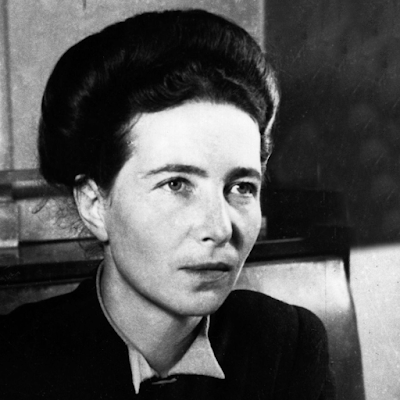
The question was posed, however, much earlier by the woman credited with kickstarting second wave feminism, Simone de Beauvoir, back in 1949 in her book The Second Sex. Her discussion of the question is interesting because it deals with the metaphysical origins of modernity. 

She opens her argument with this:
But first we must ask: what is a woman? 
She acknowledges that some people would answer that there is a feminine quality that women embody and express, an "essence", that is part of the definition of womanhood. However, she rejects the existence of such a quality of femininity:
It would appear, then, that every female human being is not necessarily a woman; to be so considered she must share in that mysterious and threatened reality known as femininity. Is this attribute something secreted by the ovaries? Or is it a Platonic essence, a product of the philosophic imagination? Is a rustling petticoat enough to bring it down to earth? Although some women try zealously to incarnate this essence, it is hardly patentable. It is frequently described in vague and dazzling terms that seem to have been borrowed from the vocabulary of the seers, and indeed in the times of St Thomas it was considered an essence as certainly defined as the somniferous virtue of the poppy

But conceptualism has lost ground. The biological and social sciences no longer admit the existence of unchangeably fixed entities that determine given characteristics, such as those ascribed to woman...Science regards any characteristic as a reaction dependent in part upon a situation. If today femininity no longer exists, then it never existed. 

She claims that there are no innate qualities, and notes that in her time the sciences held character to depend on the social environment. But if there is no such thing as femininity, and we are simply products of our environment, then what does it mean to be a woman?:

But does the word woman, then, have no specific content? This is stoutly affirmed by those who hold to the philosophy of the enlightenment, of rationalism, of nominalism; women, to them, are merely the human beings arbitrarily designated by the word woman. Many American women particularly are prepared to think that there is no longer any place for woman as such; if a backward individual still takes herself for a woman, her friends advise her to be psychoanalysed and thus get rid of this obsession. In regard to a work, Modern Woman: The Lost Sex, which in other respects has its irritating features, Dorothy Parker has written: ‘I cannot be just to books which treat of woman as woman ... My idea is that all of us, men as well as women, should be regarded as human beings.’
This is interesting for several reasons. First, it shows that at the end of the long first wave of feminism, the same result occurred that we are seeing today. The term "woman" lost all meaning. Today, if you ask a progressive what the term means, they will simply say "whatever a woman wants it to mean". If you follow up by asking "can it mean anything then?" they will answer "yes". In 1949, the category was also thought to lack any signifying substance - it was held by progressives to be an arbitrary category that should be jettisoned.

Simone de Beauvoir

Second, Simone de Beauvoir is aware that this attitude has its origins in certain philosophical positions, including that of nominalism. Nominalism is the belief that there are only individual instances of things and that universals have no real existence but are only names. In this view, the feminine is not a really existing quality or essence that gives a distinct nature to women.

Simone de Beauvoir's position on nominalism is complex. On the one hand, she thinks it inadequate because she believes the categories of man and woman to be real - unlike certain later feminists she rejects the idea that there is liberation in escaping the category of woman. However, she also rejects the idea of the masculine and the feminine as being innate qualities that men and women embody and express:
But nominalism is a rather inadequate doctrine, and the antifeminists have had no trouble in showing that women simply are not men. Surely woman is, like man, a human being; but such a declaration is abstract. The fact is that every concrete human being is always a singular, separate individual. To decline to accept such notions as the eternal feminine, the black soul, the Jewish character, is not to deny that Jews, Negroes, women exist today – this denial does not represent a liberation for those concerned, but rather a flight from reality. 
Her defence of the distinction between men and women is not exactly encouraging:
In truth, to go for a walk with one’s eyes open is enough to demonstrate that humanity is divided into two classes of individuals whose clothes, faces, bodies, smiles, gaits, interests, and occupations are manifestly different. Perhaps these differences are superficial, perhaps they are destined to disappear. What is certain is that they do most obviously exist.
Which leads her back to the question her book is intended to answer:
If her functioning as a female is not enough to define woman, if we decline also to explain her through ‘the eternal feminine’, and if nevertheless we admit, provisionally, that women do exist, then we must face the question “what is a woman”?
I have not read all of the remainder of her book. Part of her answer is that women have been defined only in relation to men, as "the Other". She wants, in line with modernity, for women to be autonomous. She has the following negative take on traditional womanhood:
Humanity is male, and man defines woman, not in herself, but in relation to himself; she is not an autonomous being
Her solution is the familiar feminist one of claiming that the differences that have existed between men and women are not the product of an innate masculinity or femininity but are due to socialisation:
One is not born, but rather becomes, a woman. No biological, psychological, or economic destiny defines the figure that the human female acquires in society; it is civilization as a whole that develops this product, intermediate between female and eunuch, which one calls feminine.

I'm sorry to disappoint, but I'm not really sure what her answer is to the question "What is a woman?". She seems to focus on the idea that women are not by nature feminine (which she takes to be a negative thing) and should be autonomous in the sense of living for themselves. She writes of her dislike for marriage, motherhood and family and promotes free love, abortion and careers.

She lived to see her preferences realised in Western society. But we do not live in a culture that can answer the question she raised back in 1949. Our culture still does not know what a woman is.

Wednesday, July 28, 2021

A latter day Hobbes?

When you read the philosophy of Thomas Hobbes you can't help but notice how well it fits with the mindset of some people today. There are Hobbesians among us.

In previous posts I have summarised the philosophy of Hobbes, as set out by Michael Allen Gillespie in his book The Theological Origins of Modernity. Here are some choice quotes from the book outlining Hobbes's ideas:

We are all only individual beings, determined by our idiosyncratic passions. Good and evil for each of us is thus measured not by our progress toward a rational, natural, or supernatural end but by the vector of our desire. No direction is naturally better than any other. Good is what pleases us, evil what displeases us, good what reinforces our motion, evil what hinders it.

And this:

For Hobbes reason means something different than what it did for his predecessors. It is not a separate power that can discern the appropriate ends of life and guide us in a proper direction. It is thus not teleological but instrumental, the spy and scout of the passions. It thus helps us to maximise the satisfaction of our desires but not to train, direct or control them.

 And finally this: 

Thus, while we all desire to exist, what any one of us wants to exist for or wants out of existence can only be specified by the individual. The happiness of each individual thus depends upon his getting what he wants, and this is related to his power...Such power is the basis for what Hobbes believes is rightly called freedom.

You can see here the logic of nominalism (that there are only individual instances of things) and a certain type of materialism (that we are just matter in motion) in undermining a "teleology" - a view that there are proper ends to human life that are discernible through reason. 

What you have instead is a belief that it is the freedom to pursue my own idiosyncratic wants that matters. It does not matter so much what these wants are - one direction is neither better nor worse than another. The important thing is that I have the power to follow my desires without external interference. 

The implications of all this become clearer when you see these ideas expressed in debate. For instance, I recently saw the following posted on social media:


Now, whether or not you completely agree with this assertion, note that this is not Hobbesian, as it suggests that women do have a "telos", a distinct end in life to fulfil. Predictably, this drew a horrified response from some readers, who shuddered at the thought that womanhood might be linked in a meaningful way to motherhood. I noted this in the thread:


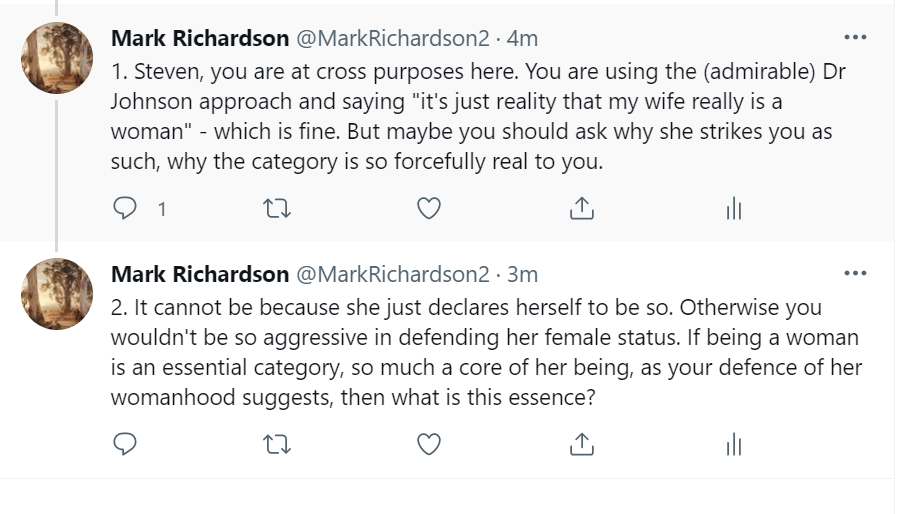
Now, perhaps you think that I was exaggerating in my last remark. But consider what follows when I enter into debate with a poster named Steven.


Steven is channelling Hobbes when he claims that the purpose attached to womanhood is "whatever the woman wants". The argument continued:


I've tried to explain in the comments above that in practice denying that we have natural ends in life does not free the individual to do anything, but instead provides no limits to what is expected of the individual within a technocratic social order. Why would a society be organised to facilitate family formation, a culture of stable family relationships, and the fulfilment of a fatherhood and motherhood role, if none of these are rational, natural or supernatural ends of men and women? 

The digging deeper into Hobbesian soil continued:


It was part of the Hobbesian philosophy that no direction is better than any other. And here we have a latter day Hobbesian claiming much the same thing: that hedonism is as meaningful a direction as responsible parenthood.


Steven is claiming here that the category of womanhood is meaningful because that is how some people define themselves and that it doesn't matter what womanhood is actually thought to be. It could be made to be one thing or something entirely contradictory to that thing. There is no rational limit to how we can define anything, it is an arbitrary decision of the individual (who, in a sense, gets to act just like the God of nominalism).

(Note as well that Steven believes that it is either his wife who gets to define womanhood or else me doing it for her - the option that womanhood is a real thing that both of us can perceive is not part of his mental framework. This fits Hobbes's view that freedom is the power to have my own "motion" left unhindered by that of any other person.)

Steven then began to more aggressively defend his wife's status as a woman. I wondered why he would so vigorously defend a category which he had, to this point, reduced to a merely subjective and arbitrary choice:


Steven chose not to budge from his radical Hobbesian/nominalist framework:


There is a lot to draw from this exchange, but I'll just briefly mention two things. First, Steven's position is a "dissolving" one. This too fits in with Hobbes's philosophy, in particular with his scornful rejection of "quiddity" - the inherent essence or nature of people or things. Second, we have to be open to the possibility that the philosophical foundations of the modern West are part of the problem we face today. In other words, the problem is not just that one political leader, or party, or movement has put things off course, but rather that there are some philosophical assumptions that became prominent in the early modern period that need to be rethought. 

Tuesday, April 27, 2021

Is Tucker a trad?

I admire Tucker Carlson. He is one journalist who is prepared to take a stand on principle, even if that means going against the narrative and drawing fire on himself. He has stood firm even when activists have, literally, arrived on his doorstep.

I think it is unlikely, though, that he could be termed a traditionalist. He recently gave an online interview in which he was asked what a 22-year-old Carlson would do in 2021. Carlson gave a typically trenchant answer, explaining that he would do his own thing in some rural part of the US rather than enter a big corporation, because "the system is collapsing" and "It certainly doesn't want people like me".


So far there's no problem. But then Carlson muses that the current American regime is based on lies and that if he were 22 he might even look further afield, to another country. He states, "but if I were 22, I might look to see if there's another place that's going to treat me as an individual and not as a member of a tribe. A system that actually cares about people, not identity".


This is a very modern, rather than a traditional, way of seeing the world. Remember it was the liberal radical Shelley who, back in 1820, wanted people to be without tribe and identity. Shelley looked forward to the emergence of a new leftist kind of man, whom he described as follows:

The loathsome mask has fallen, the man remains/ Sceptreless, free, uncircumscribed, but man/ Equal, unclassed, tribeless, and nationless,/ Exempt from awe, worship, degree, the king/ Over himself

There is a considerable irony at play here. Shelley helped set in motion a politics which was based on the idea that we would be free when there were no more distinctions between people that might lead to inequality. Once this state of affairs was reached, then human nature would be regenerated and we could do whatever we wanted as individuals, living a kind of Edenic existence on earth.

Shelley targeted the aristocracy and the church as institutions blocking the path to equality. Later on, Marx targeted the bourgeoisie. More recently, we have feminists and critical race theorists targeting white men like Tucker Carlson.

Tucker, quite reasonably, does not want to be targeted. The answer, though, is not to abandon the most recent phase of leftist thought, merely to return to its Shelleyan origins. It's better to dig deeper and uproot the tree that bears such poisonous fruit.

In this spirit, I'd like to go back even further than Shelley. I find it interesting that Tucker believes that unless you treat each person solely as an individual that you are denying their nature. He says, "And never deny who you are. I thought this was all sort of common knowledge, that we all agreed on this some time ago that we shouldn't have to deny our nature in order to succeed. We should celebrate each person as an individual, but we've given that up completely."


This too is a modernist idea. Tucker is suggesting that it is our nature to be wholly individual. That we are just one instance of a thing, rather than being a member of a class of things. If true, those asserting that there are hundreds of different "genders" would be on the right track. 

Where does the idea come from? I'm currently reading The Theological Origins of Modernity by Michael Allen Gillespie. His argument is that toward the end of the medieval era there was a philosophical turn to nominalism which overturned the long established Western belief in philosophical realism. Nominalists reject the real existence of universals, so that there are no really existing "essences" by which things might be grouped together, or share a common nature (for example, no masculine or feminine essence that individual men or women might represent or express).

If you were to remove the nominalism, it is unlikely that you would set apart human nature and identity. Instead, you would see the two as being closely connected. If there is a masculine essence, and I am born a man, then there is a "given line" along which I can develop and fulfil my nature and define my telos (my purposes). Of course, each man is likely to do this a little differently (so there is still individuality), but I belong to a particular class of being (men), and this is deeply infused in my sense of self (being an "essential" part of who I am). Being a man or a woman is not, as Shelley put it, a "detestable distinction" but a core reality that inevitably helps to define us.

Leftists take a radically nominalist approach, usually claiming that "masculine" and "feminine" are merely oppressive social constructs. However, because they also see "patriarchy" as the oppressive social structure that they wish to destroy in order to liberate humanity, they retain male and female as legitimate terms if they are understood as classes within a political system. 

Nominalism has, perhaps, unhelpfully trained the modern Western mind to think only in terms of the discrete individual. This carries over into issues of national or ethnic identity. We do not, as we should, see our membership of a nation or ethny as helping to fulfil aspects of our nature by deepening our connection to a people and place, which then strengthens our commitments to preserve our heritage, to maintain the health of family life, to uphold unity and solidarity (including between the sexes), to love the natural environment of our homeland, and to uphold what we owe to past and future generations. 

To say, "Why can't we just be individuals?" not only strips us of all this, it leaves us vulnerable to those with a stronger sense of who they are as a people. 

A note to Melbourne readers. If you are sympathetic to the ideas of this website, please visit the site of the Melbourne Traditionalists. It's important that traditionalists don't remain isolated from each other; our group provides a great opportunity for traditionalists to meet up and connect. Details at the website.

Thursday, July 12, 2018

Plastic and interchangeable?

Bria was born in Canada as a man but identifies as a woman. To an extraordinary degree:


We are supposed to believe that someone who is biologically male can have periods. Bria, it must be said, is smart enough to attempt to philosophically justify all this. It makes for interesting reading:


The argument is that there are no essential differences between men and women; that the human body is "plastic" and therefore able to be deliberately manipulated into something else; and that given the lack of essential differences, we are fundamentally the same and therefore there can be no "other".

Bria adds some further detail to the argument:


According to Bria we are nothing more than "chemical powered meat robots". The effort to find a secure basis for human dignity within liberal modernity flounders here. It would seem difficult, too, to find within a nature in which all creatures are chemically powered meat robots, anything resembling "natural law" or any principles of ordering oneself or society that would bring a definite telos (purposes or ends) to human life.

If the human body really is so plastic, and we really are as men and women easily interchangeable, so that there is no "other" sex, then it is difficult to take seriously Bria's own new identity as a woman. Bria's chemical robot settings have been changed a bit, that's all. The identity of "woman" would no longer mean very much, or have much wider significance. It would not connect identity to anything deeper than a mere chemical substance. It would not connect identity fundamentally to our core self, nor the self to a definite physical embodiment, nor the self to a discernible essence (the masculine, the feminine) with its own characteristic and meaningful qualities.

If you think of our sex as part of the essence of who we are, and as embedded within our DNA, then our best option is to order ourselves toward it, particularly toward what is best within it. Bria's counterclaim that we are meat robots, plastic and interchangeable, disconnects our sex from whatever stable aspects of the self remain. In this sense, it is self-defeating.

A note to Melbourne readers. If you are sympathetic to the ideas of this website, please visit the site of the Melbourne Traditionalists. It's important that traditionalists don't remain isolated from each other; our group provides a great opportunity for traditionalists to meet up and connect. Details at the website.

Wednesday, March 21, 2018

When there is something there

In an earlier post I noted that right liberalism creates a picture of reality in which there is nothing existing above the level of the individual to defend:
...for right liberals there are only self-creating individuals who have escaped the older identities.

It's important to remember this when you wonder why older generations of Western men did not do more to defend the existence of the West. If you assume that you live in a society that only exists as a collection of self-creating individuals with no distinct ties to each other, then what is there really at the larger level to defend? A person with this mindset will think that everything is OK, as long as the economy is healthy enough for individuals to pursue careers.

It made me wonder if this is another example of philosophical nominalism, i.e. the idea that there are only particular instances of things.

Anyway, there was a good example recently of what happens when a politician does believe in the existence of an entity existing above the level of the individual. I'm referring to the Hungarian Prime Minister, Viktor Orban, who said of his own people that,
It truly is a mystery how after so many defeats we have always risen up again. And how could it be that we are still here after one thousand years? Perhaps because we have always known that our existence has a meaning beyond ourselves. We have always known that here there is a culture, a soul and a spirit which over the centuries has lifted hearts, consoled people and sustained us. We have a uniting and unifying notion: we have national self-respect.

Hungarians exist as individuals but also as part of a larger entity, a people, with a kind of collective soul or spirit, that lives on and that is a source of meaning for those who are part of it. It is felt to be a unique good, to the point that individuals will be motivated to contribute to it and to defend its existence.

It is an enriching aspect of life to belong to such a tradition. It connects you more closely as an individual to a particular culture; to the land and therefore to nature; to language and literature; to history; and to family, ancestry and lineage. It is a grievous loss, a severe narrowing in how life is experienced, when the individual is deprived of this and is left only with himself and his own wants.

If we really wish the good for others, then we will hope for the defeat of the globalising forces that are trying to destroy national traditions, as in Hungary. The Hungarians are blessed to have a leader like Viktor Orban who is willing to resist these forces. I am looking forward to the victory of Viktor Orban in the upcoming Hungarian elections.

Tuesday, October 08, 2013

It's not just that feminists are anti-male...

The term feminist is very unpopular, even amongst young women. For instance, research by the Economic and Social Research Council in the UK found that:
...the label 'feminist' is often forcefully rejected, particularly by young women. New research funded by the Economic and Social Research Council (ESRC) suggests that, in rejecting feminism, women are often seeking to position themselves within conventional norms of femininity and heterosexuality.

"In many contemporary European societies, the term feminism provokes unease and even hostility," says Dr Christina Scharff of King's College London, who carried out the research"...

Playing an important role in the rejection of feminism in both countries are the distorted stereotypes of the 'man-hating feminist', the 'unfeminine feminist' or the 'lesbian feminist'. Many participants in the study did not want to call themselves ‘feminist’ because of these stereotypes.

...Although none of the participants could point to specific individuals, most still viewed the pioneers of gender equality as 'lesbian, man-hating feminists'.

And then there's this:
A study commissioned by the Equal Opportunities Commission (EOC) and published today found that feminism is regarded virtually unanimously in negative terms, ranging from old-fashioned to "ball breaking".

Those questioned felt women were more equal than ever before and believed that issues such as women's greater domestic role or concentration in lower-paid jobs are the result of individual choice and natural differences between the sexes which had to be addressed by individuals rather than, as the women's movement argued, society as a whole.

The findings of the Future Foundation study, Talking Equality, have sent shockwaves through the EOC.

The suspicions that young women have when it comes to the "pioneers of gender equality" are fully justified. And the problem is not just that a fair proportion of these pioneers were man-haters. Equally significant is that they were women who did not like or accept womanhood or femininity. Many were as anti-female as they were anti-male.

I was reminded of this when reading about one of the major pioneers of second wave feminism in the 1970s, Shulamith Firestone. She wrote:
The end goal of feminist revolution must be, unlike that of the first feminist movement, not just the elimination of male privilege but of the sex distinction itself: genital difference between human beings would no longer matter culturally.

That is one of the drives of liberal modernity: to make sex distinctions not matter. If you believe that the end goal of politics is to maximise individual autonomy, then you will want to make your life as self-determining as possible, which will then mean that you will reject predetermined qualities, such as your own sex. As you cannot change your sex, the next best thing you'll be able to do is to make it not matter.

A generation earlier, the same ideas were in circulation. In 1949 Simone de Beauvoir could describe the intellectual temper of her own times as follows:
If today femininity no longer exists, then it never existed. But does the word woman, then, have no specific content? This is stoutly affirmed by those who hold to the philosophy of the enlightenment, of rationalism, of nominalism; women, to them, are merely the human beings arbitrarily designated by the word woman. Many American women particularly are prepared to think that there is no longer any place for woman as such; if a backward individual still takes herself for a woman, her friends advise her to be psychoanalysed and thus get rid of this obsession. In regard to a work, Modern Woman: The Lost Sex, which in other respects has its irritating features, Dorothy Parker has written: ‘I cannot be just to books which treat of woman as woman ... My idea is that all of us, men as well as women, should be regarded as human beings.

That's particularly interesting as it traces the failure to accept sex distinctions to an even deeper change in philosophy: from philosophical realism (which accepted the real existence of masculine and feminine essences) to nominalism (which saw such categories as having no real existence but as being names to group things).

Can sex distinctions be made not to matter? Well, not very easily. A University of California neuroscientist, Larry Cahill, has just recently been interviewed on differences between the male and female brain:
The differences exist at virtually all levels, he says, from those of tiny cells to large structures in the brain, from brain chemistry to what he calls intriguing differences in the way men and women remember emotionally searing events.

And this:
What it is, is just a storm of sex differences, big and little, found all over the place – down to the level of single neurons. We see these differences everywhere, and we started to realize, damn, we simply assume they aren't there. And these sex differences have implications for how the brain works and how to fix brains. That's your big story right there.

For me it's the existence of this huge fire in neuroscience. We've been collectively in kind of denial about it. But we've hit some sort of critical mass in the last couple of years. It's really starting to change.