Showing posts with label quiddity. Show all posts

Monday, October 21, 2024

Wet liberals & classicide

The Victorian Labor Government has just announced its new housing policy. It is going to override current planning laws to build high-rises of up to 20 storeys around train stations (within a 1km radius). This is to accommodate the massive population growth Australia is experiencing from immigration.

One notable feature of this policy is that some of the most beautiful heritage suburbs of Melbourne have been targeted, including Brighton, Hawthorn and Malvern. These are upper-middle class suburbs, with a well-established way of life that is now likely to radically change. 

The Anglo upper middle class in these suburbs are mostly "Teal" in their politics. They are what was once known as liberal wets, being socially liberal but less committed to laissez-faire economics than the liberal "dries". 

The identity of this class was based in part on certain status markers having to do with wealth and lifestyle (a holiday home in Portsea, overseas holidays, designer renovations, and especially children attending expensive private schools). But it was also based, especially for the wives, on holding socially liberal views. This has proven to be tragic, because one consequence of holding to these views is that it makes it impossible to defend your own class existence. It is a class marker that fatally undermines your own existence. It is a "classicide". 

Oddly, the Anglo upper middle class was too conservative - in the bad sense of the word. It failed to adapt quickly enough. When it was clear that social liberalism was the wrong path, it did not abandon it in time in order to secure its own future. It stubbornly clung to the one thing it needed to be rid of.

I want to try to explain one aspect of why socially liberal views were self-sabotaging. To do so I am going to go back to one of the Australian wet liberals of the 1980s, George Brandis. Brandis wrote extensively about his political philosophy, so he is a useful political figure to focus on.


My basic argument is that the liberal wets inherited a political philosophy from the nineteenth century (particularly from John Stuart Mill) that is overly individualistic. Their idea was that the core human good is a freedom to be an autonomous individual, so that we self-determine our own unique purposes in life. Here is a sample of Brandis writing about autonomy:

the sovereign idea which inspires our side of politics has always been the same: our belief that the paramount public value is the freedom of the individual ...

the most important single thing we must do is renew our commitment to the freedom of the individual, and restore that commitment to the very centre of our political value system: not one among several competing values, but the core value, from which our world view ultimately derives.

Liberalism ... has such a central guiding principle - respect for the freedom of the individual, his dignity and his autonomy; his right ... to be the architect of his own life 

Every one of those reforms extended the bounds of human freedom, gave individual men and women greater autonomy ...

There is a kind of metaphysical basis to this kind of thinking which Brandis touches upon here:

To the liberal, the most fundamental characteristic of any society is that it is a coming together of a number of individual persons, each of whom has a unique identity, unique needs and aspirations, the individuality of each of whom is equally important. The pursuit of individual ends, subject to the agreed mutual constraints necessary to social existence, is the dynamic force of human progress.

I firmly believe that this is a faulty metaphysics. It emphasises the idea that our identities, needs and aspirations are unique and wholly individual. This is a view that derives from the early moderns, such as Thomas Hobbes. Hobbes explicitly rejected the earlier view that each kind of creature has a "quiddity", i.e., an essence that gives it a particular nature distinct from other kinds of creatures and therefore at least some commonality in identity, needs and purposes. Instead, his theory was that we are determined at the atomic level to either desire things or be averse to them, and that these determinations are unique to each individual. 

A nineteenth century liberal feminist, Victoria Woodhull, advanced a similar sort of argument:

Now, individual freedom...means freedom to obey the natural condition of the individual, modified only by the various external forces....which induce action in the individual. What that action will be, must be determined solely by the individual and the operating causes, and in no two cases can they be precisely alike...Now, is it not plain that freedom means that individuals...are subject only to the laws of their own being.

Now, one problem with taking this view is that it makes a common moral language very difficult, as there is no way to predict the good for any particular individual, and it also makes the idea of a common good very difficult, because there only exist individual goods known only to the individuals themselves. Language about the good tends to be expressed instead in terms of pluralism or diversity or tolerance or non-discrimination.

The alternative view is to see humans, like other creatures, as having a certain nature, so that it then makes sense that there might be a common telos (end or purpose) in seeking to embody the best aspects of this nature. This does not exclude this nature having a somewhat different expression according to personal traits, but nonetheless it exists as an underlying essence of what makes us recognisably men and women.

The idea of a wholly unique individual nature also distorts the relationship between the individual and society. It makes liberals frame this relationship as either "the individual comes first and society is derived from this fact" (the "good" liberal option) or "society comes first and the individual is merely derivative" (the "bad" non-liberal option). In either case, there is a sundering of individual and community.

Here again is Brandis:

This view of a society of free and autonomous individuals distinguishes in two essential respects Liberal social theory from the approaches of its most important contemporary rivals, conservatism and socialism. Firstly, conservatism and socialism have in common the belief that the basic units, the 'building blocks', of human society are structures much vaster than the individual.

The conservative sees society as a naturally ordered, harmonious hierarchy; while in the eyes of the socialist, the basic structures of society are irreconcilably hostile classes...Both agree that individual persons are but incidents of larger entities...It is the distinctive claim of liberalism that the individual person is the central unit of society and is therefore prior to and of greater significance than the social structures through which he pursues his ends.
The better alternative is to recognise that there is, as Francis Bacon put it, a "double nature of the good". In other words, we fulfil our nature as men and women partly through ourselves as individually embodied and ensouled beings, but also through our membership of communal bodies. These other bodies help to carry certain aspects of our own good, such as our identity, our roles (e.g. as fathers and mothers), our loves, our social commitments, our attachments to people and place, our connection to generations past, present and future, our close connection to a particular culture and so on.

The individual good is not therefore somehow set apart from the good of the communal bodies we belong to. In contributing to the common good, we are advancing our own good as an individual. Nor do the communal bodies render us somehow derivative or incidental. They exist, in part, so that we can be more fully ourselves. 

Are liberal wets entirely individualistic? In the sense I have outlined above, yes. They cannot truly connect the individual to the communities he or she belongs to. However, liberals sometimes do, in a superficial way, concede that society does merit some attention. They might, for instance, add on the word "responsibilities" to their political formulas (for instance, here in Victoria we have something called the "Charter of Human Rights and Responsibilities"). They might sometimes invoke the necessity of maintaining social cohesion, which is a weak and inadequate way of trying to counterbalance liberal individualism, but even this was too much for Brandis. He complained (of the former Liberal PM John Howard) that:
...in qualifying the Liberal Party's commitment to the freedom of the individual as its core value, and weighing it against what he often called social cohesion, Howard made a profound departure from the tradition of Deakin and Menzies.
Most significantly, liberal wets like to see themselves as being less selfish than liberal dries, despite being committed to a radically individualistic politics. How do they manage this? By emphasising the idea that they are committed to equal rights for all people. This is something very big for the Teal types. They will see themselves in individualistic terms as having little connection to any community or tradition of their own. But they are fierce in promoting the idea of the rights of those seen as somehow marginalised. It comes across as a pathological altruism, but I think it's one of the few ways that they are permitted to transcend their own individualistic politics and claim what they believe to be the moral high ground.

Where does the Anglo upper middle class go from here? Well, they will either merge into the new high-rise, densely packed multiculture or they will leave the former heritage suburbs for somewhere else. But I hope that a few younger ones might read this and consider being more politically adaptable, in the sense of letting go of liberalism as a class marker and instead adopting an alternative that makes it possible to defend a way of life.

Wednesday, July 28, 2021

A latter day Hobbes?

When you read the philosophy of Thomas Hobbes you can't help but notice how well it fits with the mindset of some people today. There are Hobbesians among us.

In previous posts I have summarised the philosophy of Hobbes, as set out by Michael Allen Gillespie in his book The Theological Origins of Modernity. Here are some choice quotes from the book outlining Hobbes's ideas:

We are all only individual beings, determined by our idiosyncratic passions. Good and evil for each of us is thus measured not by our progress toward a rational, natural, or supernatural end but by the vector of our desire. No direction is naturally better than any other. Good is what pleases us, evil what displeases us, good what reinforces our motion, evil what hinders it.

And this:

For Hobbes reason means something different than what it did for his predecessors. It is not a separate power that can discern the appropriate ends of life and guide us in a proper direction. It is thus not teleological but instrumental, the spy and scout of the passions. It thus helps us to maximise the satisfaction of our desires but not to train, direct or control them.

 And finally this: 

Thus, while we all desire to exist, what any one of us wants to exist for or wants out of existence can only be specified by the individual. The happiness of each individual thus depends upon his getting what he wants, and this is related to his power...Such power is the basis for what Hobbes believes is rightly called freedom.

You can see here the logic of nominalism (that there are only individual instances of things) and a certain type of materialism (that we are just matter in motion) in undermining a "teleology" - a view that there are proper ends to human life that are discernible through reason. 

What you have instead is a belief that it is the freedom to pursue my own idiosyncratic wants that matters. It does not matter so much what these wants are - one direction is neither better nor worse than another. The important thing is that I have the power to follow my desires without external interference. 

The implications of all this become clearer when you see these ideas expressed in debate. For instance, I recently saw the following posted on social media:


Now, whether or not you completely agree with this assertion, note that this is not Hobbesian, as it suggests that women do have a "telos", a distinct end in life to fulfil. Predictably, this drew a horrified response from some readers, who shuddered at the thought that womanhood might be linked in a meaningful way to motherhood. I noted this in the thread:


Now, perhaps you think that I was exaggerating in my last remark. But consider what follows when I enter into debate with a poster named Steven.


Steven is channelling Hobbes when he claims that the purpose attached to womanhood is "whatever the woman wants". The argument continued:


I've tried to explain in the comments above that in practice denying that we have natural ends in life does not free the individual to do anything, but instead provides no limits to what is expected of the individual within a technocratic social order. Why would a society be organised to facilitate family formation, a culture of stable family relationships, and the fulfilment of a fatherhood and motherhood role, if none of these are rational, natural or supernatural ends of men and women? 

The digging deeper into Hobbesian soil continued:


It was part of the Hobbesian philosophy that no direction is better than any other. And here we have a latter day Hobbesian claiming much the same thing: that hedonism is as meaningful a direction as responsible parenthood.


Steven is claiming here that the category of womanhood is meaningful because that is how some people define themselves and that it doesn't matter what womanhood is actually thought to be. It could be made to be one thing or something entirely contradictory to that thing. There is no rational limit to how we can define anything, it is an arbitrary decision of the individual (who, in a sense, gets to act just like the God of nominalism).

(Note as well that Steven believes that it is either his wife who gets to define womanhood or else me doing it for her - the option that womanhood is a real thing that both of us can perceive is not part of his mental framework. This fits Hobbes's view that freedom is the power to have my own "motion" left unhindered by that of any other person.)

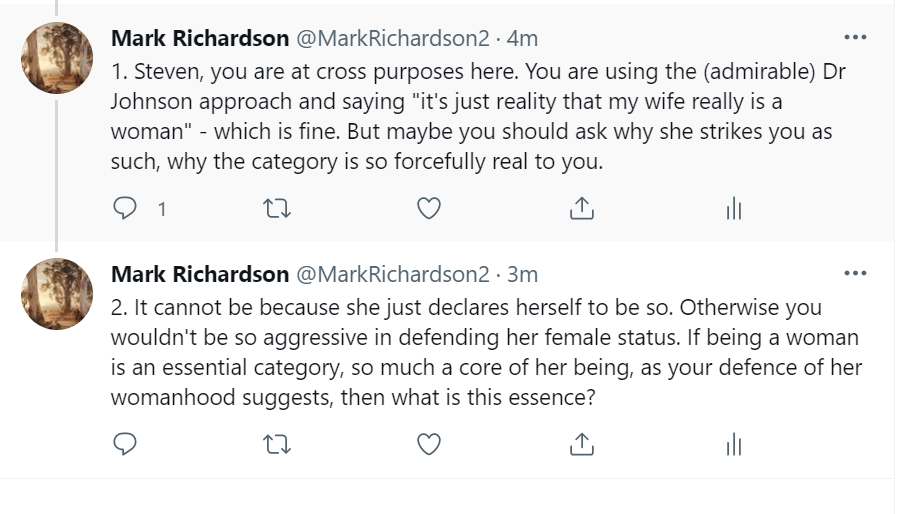
Steven then began to more aggressively defend his wife's status as a woman. I wondered why he would so vigorously defend a category which he had, to this point, reduced to a merely subjective and arbitrary choice:


Steven chose not to budge from his radical Hobbesian/nominalist framework:


There is a lot to draw from this exchange, but I'll just briefly mention two things. First, Steven's position is a "dissolving" one. This too fits in with Hobbes's philosophy, in particular with his scornful rejection of "quiddity" - the inherent essence or nature of people or things. Second, we have to be open to the possibility that the philosophical foundations of the modern West are part of the problem we face today. In other words, the problem is not just that one political leader, or party, or movement has put things off course, but rather that there are some philosophical assumptions that became prominent in the early modern period that need to be rethought. 

Sunday, July 18, 2021

Hobbes & the ends of man

Politics has been quieter than usual since the American election, but I'm pleased to note that the questioning of liberalism continues to grow. Here is a recent example:


The responses to the tweet were mixed, but most recognised that liberalism had reached a point of crisis. One person, though, defended liberalism on the following basis:


I checked this person's feed and he is a reasonably open-minded right-liberal type. What I would like to focus on is his claim that there is no higher meaning outside of the choices we make.

It brought to mind my recent reading on the philosophy of Thomas Hobbes. Hobbes radically diminished the meaning of human life. He thought that everything was merely matter in motion, so that humans were acted on in ways that activated our passions and so freedom and happiness meant having the power to pursue our own idiosyncratic passions without external constraint.

What this means is that humans do not have free will. To be autonomous or self-determining has a truncated meaning in this philosophy. Our actions are not really determined by ourselves, but by the actions of external bodies upon us. We are "self-determining" only in the sense that it is our own passions that we follow without hindrance, rather than someone else's.

Hobbes scorned the medieval philosophers, particularly those who discussed "quiddity" - the inherent nature or essence of someone or something. This is important, I think, in discussing whether there is a higher meaning to things. In the twitter thread, a lot of commenters acknowledged that the liberal principle was destroying society, but they thought that religion had too weak a hold to be able to provide a counteracting principle.

Even though I am religious myself, this attitude surprises me. After all, if you can accept "quiddity" then at the very least, even without being religious, you ought to be able to accept that creatures have natural ends, i.e. that they will seek to fulfil or bring to fruition their inherent nature. For instance, men will seek to develop masculine qualities and to fulfil masculine roles, women the same for the feminine. As we are social creatures, this then has implications for our commitments within a society, including upholding certain social norms that allow our nature to successfully unfold.

The problem is that Hobbes's philosophy does not even allow for such natural ends, let alone supernatural ones. Michael Allen Gillespie, in his book The Theological Origins of Modernity, describes Hobbes's view of ends this way:

We are neither superhuman nor depraved. We are all only individual beings, determined by our idiosyncratic passions. Good and evil for each of us is thus measured not by our progress toward a rational, natural, or supernatural end but by the vector of our desire. No direction is naturally better than any other. Good is what pleases us, evil what displeases us, good what reinforces our motion, evil what hinders it. Or to put the matter in different terms, good is an increase in our power and evil its decrease...Each person in Hobbes' view is thus a self-interested individual who seeks to maximise his own power and satisfaction.

I suspect the problem here is that once a Hobbesian view sinks into political thought, there is an acute sensitivity to the idea that any restraint or self-limitation is not a rational one designed to help us, as social creatures, unfold our own ideal nature but is instead a power play by which one group of people seek to block our own "vector of desire" in order to more readily follow their own. In other words, an appeal to natural ends will be rejected as an attempt to exploit or oppress, because that assumption is built into the framework of a Hobbesian philosophy.

So you cannot then simply argue against one aspect of a Hobbesian view - it needs to be more generally dismantled in order for a different politics to emerge. This is possibly the kind of thing Antonio Garcia Martinez is referring to in his first thesis here: