Showing posts with label teleology. Show all posts

Thursday, October 27, 2022

Our changing ends

One approach to life is to attempt to be fit for purpose - or, more specifically, fit for the purposes that are given to a creature of our kind. But this raises the critical question of what our purposes are.

A more traditional answer might be that there are many such purposes. A man, for instance, has the purpose to protect and provide; to seek God and the spiritual goods of life; to defend his people; to defend his church; to mentor his son to be fit for his adult life as a man; to raise his daughter so that she might be fit for her adult life as a woman; to be a good friend; to reach a potential of physical and intellectual development and so on.

There are barriers to following this path in modern life. A long time ago, an influential strand of philosophy rejected the idea that we are a being of a particular given kind, with attached purposes. The rejection of Aristotelian thought in the Enlightenment also dealt a blow to a teleological view of life. The prevailing idea now is that we are all uniquely individual and that our identities and purposes can and should be self-fashioned, rather than given to us as a part of our nature.

What this means is that rather than orienting ourselves to being fit for purpose, we are more likely to think that the world outside should change to fit whatever we fashion ourselves to be.

Having said this, there are still some remnants of the older view of fulfilling a telos in life. People do still speak of becoming their better self, even if the content of this is left vague. And there are assumptions of purpose even within certain strands of liberalism, particularly when these purposes can be easily measured or quantified, are materialistic and are held to be "rational".

For instance, there is the idea of Economic Man, who pursues a "rational self-interest" in the market, whether as a unit of labour, a consumer or an investor. This participation in the market is assumed to be the higher purpose of human life.

You can see this attitude clearly in a post written for Morgan Stanley back in 2019. In this post, titled "Rise of the SHEconomy", it is noted that very soon large numbers of American women aged 25 to 44 will be single - 45% by the year 2030. 

The author sees this as an encouraging development, as a single and childless woman is better able to participate in the market:
What’s driving this trend? For starters, more women are delaying marriage, choosing to stay single or divorcing in their 50s and 60s. Women are also delaying childbirth or having fewer children than in the past.

“These shifting lifestyle norms are enabling more women, with or without children, to work full time, which should continue to raise the labor force participation rate among single females,” says Zentner. Rising labor-force participation rates should put upward pressure on women’s wages and help increase overall consumer spending.

...The trend is set to boost segments of the economy where single women historically spend more, including apparel and footwear, personal care, food away from home, and luxury and electric automobiles.
Similarly, the author sees much promise in trends by which,
a growing population of prime working-age women in the U.S.—many single and focused on career—will have greater representation in the labor force, help boost wages and create potentially large tailwinds in a number of consumer products categories.

And so, for all the talk of a self-fashioning life, a woman's purposes are being determined here by the metaphysics of modernity. And it is a narrow account of purposes, one that explicitly rejects goods relating to marriage, motherhood, love and spirituality. Woman is becoming Economic Man and is being divested of those purposes that do not fit in with this view of her ends.

A note to Melbourne readers. If you are sympathetic to the ideas of this website, please visit the site of the Melbourne Traditionalists. It's important that traditionalists don't remain isolated from each other; our group provides a great opportunity for traditionalists to meet up and connect. Details at the website. 

Sunday, June 26, 2022

One more story

I have been focusing on one theme in recent posts, namely de-transition stories, and would like to do just one more. The account this time is by a young man, Steven Richards, who transitioned not because of gender dysphoria but because identifying as trans provided a community and a purpose lacking in his life:

I went from being a lonely, insecure teenager to a member of a loving community engaged in a heroic battle against an evil society that desired my destruction. Left-wing oppression narratives disseminated online and in local “queer youth” groups run by adult members of the movement cast “cis” people as villains. "Transitioning" was a baptismal ritual in which I was cleansed of my wicked nature as a “cis male” oppressor and reborn as a virtuous “marginalized” person with a new name and body.

Adult transsexuals online coached me on how to convince my parents, doctors, and therapists that I was suffering from gender dysphoria. The term supposedly refers to an incongruence between one’s sexed body and internal sense of gender but is used among transgender people as a catch-all term for any negative emotion. It’s an attractive narrative for vulnerable teenagers who are struggling with their developing bodies, sexualities, and the looming responsibilities of adulthood.

This is similar to the account by Helena in an earlier post who wrote that adopting a trans identity allowed her to enjoy the camaraderie of like-minded youths and to escape the burden of being a "cis" person within a political milieu where this made you an evil oppressor. 

Transitioning did not make Steven any happier; unfortunately, he decided to keep taking more radical steps along this path before finally deciding that none of this was ever going to be a solution for his emotional problems.

I'm half way through reading the book After Virtue by Alasdair MacIntyre. The content of the book goes some way, I think, in explaining how we could ever have reached this point (I'm not claiming it explains everything, just that it sets out some of the groundwork).

What MacIntyre focuses on is the loss of a teleological view, particularly during the Enlightenment. The classical approach was to think of man as having an untutored nature, that then had to be disciplined by moral precepts and habits, so that he could fully realise his telos (his ends/purposes as a man).

The Enlightenment strongly rejected an Aristotelian teleology, which then severed the inherited store of moral belief from its practical role in guiding man toward his true ends.

If we still had the idea that our nature as men contains within it a potential telos, and that we are to be ordered toward fulfilling this telos through moral self-discipline, then there would not be the same grounds for young men like Steven to believe that purpose was to be found through the rejection of his own sexed body. 

The older Aristotelian view is fast declining within modern culture, but there are still remnants of it. The idea that there is meaning and purpose within our essence as men is not entirely lost. 

Here, for instance, is a comment by a woman defending men from the usual charges:


This woman also recognises the good within the masculine:


Tuesday, February 22, 2022

Sebastian Milbank: biology itself has become the enemy

Does liberalism influence the way that individuals view their own bodies? Sebastian Milbank believes that it does and with dramatically negative consequences. He has penned a very thought provoking article which I encourage you to read in full. I think, though, that I can summarise the basic argument adequately, as I've made similar observations myself. 

It begins with the liberal idea that we are to be liberated from any constraints on ourselves as autonomous individuals. Our sexed bodies, however, do represent such a constraint, as they point to our "telos" - to aspects of what we are designed to be and to do. Milbank himself observes that,

Nothing more expresses the teleological nature of human existence than the fact of our sexed bodies — sex and reproduction are a constant drumbeat reminding us that we don’t exist for ourselves, but for the sake of our descendants.

And so the logic of liberalism is that we must somehow assert our own autonomous self over and against our own body. How do we do this? Milbank believes that the gentler means of achieving this include "such new cultural practices as tattoos, piercings, non-natural hair colours, and of course gender non-conforming grooming and fashion". At a more extreme level there are: 

“gender affirming” surgeries which remove or reshape healthy tissue and organs, transhumanist “body modification” in which people seek to permanently mould their bodies to integrate technology or imitate animals, reproductive surrogacy with “rented wombs”, genetic modification, and voluntary sterilisation.

The key passage in which Milbank sets out the ideological background to these developments is this:

If you want to understand the insanity of the past 20 years over sexuality and gender, you have to first get to grips with what liberalism is. At its heart is the concept of individual autonomy — the idea that the single highest principle of our society should be the absolute power and ownership of a person over their own body and being, and a no less absolute taboo on any outside force that seeks to compromise that autonomy.

Having stripped back many prior norms about male and female roles, sexual ethics and family life in the name of a broadly conceived “freedom” for the individual, liberalism has now taken a more introspective turn. After removing most of the outward and formal demands of law and society on the individual and their body, the individual must now be absolutely freed by purging themselves of the interior restraints they may still possess, and at the same time claim absolute possession of their own physical and psychic self.

In this interior battle, it is biology itself that has become the enemy. Nothing more expresses the teleological nature of human existence than fact of our sexed bodies — sex and reproduction are a constant drumbeat reminding us that we don’t exist for ourselves, but for the sake of our descendants. Severing sex and reproduction have long been a liberal project, and technological progress has certainly helped accelerate that process.

However the ideological project must go still further — even when sex is fully contracepted and bodies safely sterilised, our sexed nature is still stubbornly pointing and gesturing towards reproduction, reciprocity and the renunciation of the self in the embrace of the other.

Wednesday, July 28, 2021

A latter day Hobbes?

When you read the philosophy of Thomas Hobbes you can't help but notice how well it fits with the mindset of some people today. There are Hobbesians among us.

In previous posts I have summarised the philosophy of Hobbes, as set out by Michael Allen Gillespie in his book The Theological Origins of Modernity. Here are some choice quotes from the book outlining Hobbes's ideas:

We are all only individual beings, determined by our idiosyncratic passions. Good and evil for each of us is thus measured not by our progress toward a rational, natural, or supernatural end but by the vector of our desire. No direction is naturally better than any other. Good is what pleases us, evil what displeases us, good what reinforces our motion, evil what hinders it.

And this:

For Hobbes reason means something different than what it did for his predecessors. It is not a separate power that can discern the appropriate ends of life and guide us in a proper direction. It is thus not teleological but instrumental, the spy and scout of the passions. It thus helps us to maximise the satisfaction of our desires but not to train, direct or control them.

 And finally this: 

Thus, while we all desire to exist, what any one of us wants to exist for or wants out of existence can only be specified by the individual. The happiness of each individual thus depends upon his getting what he wants, and this is related to his power...Such power is the basis for what Hobbes believes is rightly called freedom.

You can see here the logic of nominalism (that there are only individual instances of things) and a certain type of materialism (that we are just matter in motion) in undermining a "teleology" - a view that there are proper ends to human life that are discernible through reason. 

What you have instead is a belief that it is the freedom to pursue my own idiosyncratic wants that matters. It does not matter so much what these wants are - one direction is neither better nor worse than another. The important thing is that I have the power to follow my desires without external interference. 

The implications of all this become clearer when you see these ideas expressed in debate. For instance, I recently saw the following posted on social media:


Now, whether or not you completely agree with this assertion, note that this is not Hobbesian, as it suggests that women do have a "telos", a distinct end in life to fulfil. Predictably, this drew a horrified response from some readers, who shuddered at the thought that womanhood might be linked in a meaningful way to motherhood. I noted this in the thread:


Now, perhaps you think that I was exaggerating in my last remark. But consider what follows when I enter into debate with a poster named Steven.


Steven is channelling Hobbes when he claims that the purpose attached to womanhood is "whatever the woman wants". The argument continued:


I've tried to explain in the comments above that in practice denying that we have natural ends in life does not free the individual to do anything, but instead provides no limits to what is expected of the individual within a technocratic social order. Why would a society be organised to facilitate family formation, a culture of stable family relationships, and the fulfilment of a fatherhood and motherhood role, if none of these are rational, natural or supernatural ends of men and women? 

The digging deeper into Hobbesian soil continued:


It was part of the Hobbesian philosophy that no direction is better than any other. And here we have a latter day Hobbesian claiming much the same thing: that hedonism is as meaningful a direction as responsible parenthood.


Steven is claiming here that the category of womanhood is meaningful because that is how some people define themselves and that it doesn't matter what womanhood is actually thought to be. It could be made to be one thing or something entirely contradictory to that thing. There is no rational limit to how we can define anything, it is an arbitrary decision of the individual (who, in a sense, gets to act just like the God of nominalism).

(Note as well that Steven believes that it is either his wife who gets to define womanhood or else me doing it for her - the option that womanhood is a real thing that both of us can perceive is not part of his mental framework. This fits Hobbes's view that freedom is the power to have my own "motion" left unhindered by that of any other person.)

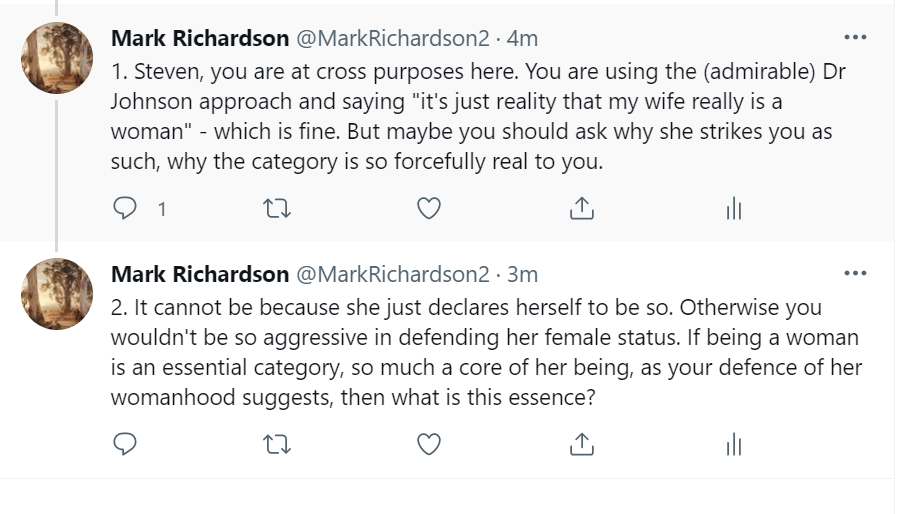
Steven then began to more aggressively defend his wife's status as a woman. I wondered why he would so vigorously defend a category which he had, to this point, reduced to a merely subjective and arbitrary choice:


Steven chose not to budge from his radical Hobbesian/nominalist framework:


There is a lot to draw from this exchange, but I'll just briefly mention two things. First, Steven's position is a "dissolving" one. This too fits in with Hobbes's philosophy, in particular with his scornful rejection of "quiddity" - the inherent essence or nature of people or things. Second, we have to be open to the possibility that the philosophical foundations of the modern West are part of the problem we face today. In other words, the problem is not just that one political leader, or party, or movement has put things off course, but rather that there are some philosophical assumptions that became prominent in the early modern period that need to be rethought.