Showing posts with label common good. Show all posts

Saturday, April 19, 2025

Deeper feminist regret

There is a genre of confessional writing that might be called "feminist regret". I have chronicled many examples of this genre over the years, but I came across the most thoughtful one just this week. It is called "A Requiem for the Patriarchy" and is written by Darleen Lev. 

Darleen Lev has also discussed her thoughts in a long interview with Leslie Boyce (see here) and I will be using this as well to draw out some of her ideas.

It's helpful to begin with some biography. Darleen Lev was born in 1961 and grew up in Chicago. Her (non-biological) father was Jewish and her mother Protestant (though she seems to have been raised Christian). Her mother discouraged her from being a homemaker and she was influenced by the changes in popular culture in the 1970s to think that she could do whatever a man did (she says that TV series like Charlie's Angels had this effect). When the pill became available, she and her friends took this as a freedom to be sexually promiscuous. She did eventually marry but chose to divorce her husband. She supported herself through her work as an academic. She is now in her mid-60s and childless.

Darleen Lev

She describes herself as someone who experienced two different worlds. The world she grew up in before the influence of second wave feminism and then the feminist one that followed. Surveying her life experiences she has come to a principled, and deep, rejection of feminism. 

What made her change her mind about feminism? Well, in comparing culture as it was in her youth to what followed she sees an emerging wasteland. Both family and local community have disintegrated during the course of her lifetime. This has left herself and many of her peers single, unsupported, childless and socially isolated. 

To her credit she does not take the option of blaming men. She has a more interesting analysis which I will break down into three parts.

1. Patriarchy

Darleen Lev draws a distinction between the patriarchy she grew up in and the present day matriarchy. By patriarchy she means something like a family structure in which men are present within the family, are respected for what they bring to family life, and who create stability and security for all those within the family. By matriarchy, she is referring to a social system in which this role of men has been dispensed with.

She does not have a naive view of the older family culture. She acknowledges that a small number of women were abandoned, and that some marriages were unhappy. Nonetheless, she has a sense that the masculine principle is necessary to uphold social life. Without it, communities lose a connection to both order and meaning. And, absent the masculine presence, women are less able to create local community as they once did.

She does not pull her punches in introducing this argument:

The ‘patriarchy’ was a fertile time. Life seemed to spill out of every door. The lively suburban street I grew up on had a patriarch in every home, and enough children, in most households, to form a chorus or one of those dad-trained acrobatic families who performed on the Ed Sullivan show.

But death is the essence of the matriarchy in which we now live, a time when abortion is labeled ‘health care’—the Democrats’ primary promise of a conduit to an ideal existence. Meanwhile, we’re in a fertility crisis that could bring the country to its knees; yet the matriarchy, with its tyranny of ‘care,’ scolds us as ‘right wing’ for caring about the fact that we’re not generating enough new life. 
She develops the argument by listing the people she knows with chaotic family lives or who disavow having children as a matter of principle. I understand her completely in this. My parents' generation had stable marriages and many children. My own did not. To experience this decline can be bewildering. I think, for instance, of my best friend at school who had four sisters. None of them married. None of them had children. This has always seemed tragic to me - and unsettling, suggesting some deeper social malaise.

Darleen Lev seems to be reaching toward an argument I have made myself before, namely that men bring into social life the vertical structure of reality. This is how Lawrence Auster describes it:
Symbolically, the father is the structuring source of our existence, whether we are speaking of male authority, of the law, of right and wrong, of our nation, of our heritage, of our civilization, of our biological nature, of our God. All these structuring principles of human life, in their different ways, are symbolically the father. The rebellion we've discussed is...a rebellion against the father. The belief that the universe is structured, intelligible, and fundamentally good, and that one can participate in this universe - this is the experience of having a father, which is the opposite of the experience of alienation that drives contemporary culture.

Without this, there is not the same conviction of participating in a reality that is, as Auster puts it, fundamentally good. And therefore there is not the same openness to creating new life. 

2. Choice

I recently read an essay by Ted Sadler in the Observer & Review (Volume 2 Issue 2, Number 3) titled "Suicide of the West: Towards a Universal Homogeneous Superstate".  Sadler views contemporary liberalism as a continuation of a longer project that had taken definite shape by the Enlightenment:
The Enlightenment of the eighteenth century looked to a new cosmopolitan super-culture that would replace Christianity: individuals would be uprooted not only from their national or ethnic or local traditions - which could only be the source of prejudices - but also from the similarly cosmopolitan super-culture of Christianity. The new mature enlightened individual would stand naked and proud 'above' all tradition, needing only his 'freedom' and prosperity. (p.236)
By modern times this project was expressed in terms of building a social order upon material prosperity and individual choice:
The homogenization process of the universal homogeneous state means that society is defined as an indiscriminate aggregate of individuals stripped of any other cultural identity: ethnicity, nation, tradition and religion...All individuals, it is assumed, are capable of taking their place in the economy as workers, consumers, tax-payers and benefit-recipients....The assumption is that the social and cultural identity of the universal homogeneous state is nothing in particular: this absence of identity is called 'multi-culturalism', a euphemism for the cultural vacuum that is liberalism....

Liberals themselves, of course, do not say they are affirming a vacuous negativity, but insist that their supreme virtue is freedom. The ideal liberal state is supposed to provide not just economic well-being for everybody, but the freedom of individuals to do what they like, say what they like, think what they like, live however they like, providing it does not infringe on the freedom of others. (pp. 232-33)

Sadler goes on to describe the drift of liberalism toward intolerance. Darleen Levy approaches things from a different angle. She has already identified the disintegrating effect of this project on social bodies like the family and local community. But she also questions whether the project really delivers meaningful choice the way it claims to do.

In her interview, she says (at 22:05) that:

From the moment I hit puberty all that I could think about was having babies. That was my instinct. That's what I wanted to do.

Despite this being what she most wanted to choose, it never happened. She had to contend with her mother pushing her toward careerism. But more than this, there was by this time a dating culture based around casual hookups rather than a culture of courtship as had existed in previous generations. People socialised in bars and at concerts and she found it a difficult environment to assert her desire for a more committed relationship (it had become "shameful and humiliating" to have to admit to the man she was with that she wanted more than something casual). On the occasions she did give voice to this "they would say that that's not what they wanted". 

She is describing a flaw in the liberal model. Some of our more profound life choices cannot be made through our own volition alone. They are more likely to be realised in certain cultural environments and they depend on the choices other people make. In her social milieu, there were no longer rituals of courtship leading to marriage and then to children. The expectation was that encounters were to be casual. Yes, it might still have been possible to find a way through this, but her choice was made much more difficult to realise than it once would have been.

Her solution to this is interesting. She says that,
In my generation we were fumbling around, not knowing how to get what we deep down really wanted...And the lack of community oversight also lends itself to that. You are alone in the middle of nowhere and no-one's really watching you...But if we have to decide what really is better for everyone, perhaps it would be more connection around community...that we are all families that live in this place and we collectively want to create a really nice place for us to thrive in. 
This too highlights an issue within liberalism. If there are no objective goods that contribute to human well-being, but only subjective preferences, then there will develop over time an "indifference to the good". But this then leads to the kind of abandonment that Darleen Lev complains about. There cannot be "community oversight" if there are no agreed upon outcomes to be achieved. If, for instance, you were to say to a liberal "is it not unusual for all four sisters to remain unmarried and childless?" the most common answer you will receive is "well, that is just what they chose to do". As if there were "nothing to see here" and therefore no real concern for what might have led to such an outcome.

Darleen Lev also seems to be reaching toward the idea of a common good - the idea that we might "collectively want to create a really nice place for us to thrive in". What is being recognised here is that our own individual good often depends on the health of the social bodies we are members of. So it does matter to us that others choose in ways that uphold the good of this larger body (an aspect of living in a high trust community - we can trust that others will do the right thing). 

Leslie Boyce, the interviewer, makes a similar point when the two women discuss one of Darleen Lev's female students who has chosen to be a prostitute. Leslie Boyce observes that (1:02:54),
There's a bit of a paradox here because on the individual level we tend to respect choices, let people do things and we're not going to look too hard at what they're doing. And then on the zoom out social level, it's the aggregate of these kinds of choices that end up creating exactly the trends that we're sitting here describing today.
The choices people make matter not only to themselves but to others, because the aggregate of these choices forms the culture we all inhabit. And none of us can claim to live entirely isolated from our own culture. 

3. Disposability

One of the problems identified by Darleen Lev is that marriage has become less durable, in part, because relationships with men are increasingly seen as being disposable. For instance, she writes that,
Most of the women I work with are childless, and destined to remain so. Most are not married, nor are they in lasting relationships. The relationships that I’ve heard about were generally ended by the woman because he didn’t measure up in some way.
She also recounts the story (at 33:58) of going for a walk in the park one day with a female friend and her baby. The husband of this friend had started a new restaurant and was working long hours to establish it. The wife felt aggrieved that he was not home more, but Darleen Lev pointed out that he was a faithful husband whose work was allowing her to spend time with her child. Years later the friend told Darleen that her words had helped save her marriage as her other friends had all advised her to leave. 

This shift to seeing relationships as disposable was noted by one of the first writers of the feminist regret genre, the Australian journalist Virginia Haussegger. In 2002 she wrote a newspaper article titled "The Sins of our Feminist Mothers" in which she confessed that,
For those of us that did marry, marriage was perhaps akin to an accessory. And in our high-disposable-income lives, accessories pass their use-by date, and are thoughtlessly tossed aside. Frankly, the dominant message was to not let our man, or any man for that matter, get in the way of career and our own personal progress.

We should not be at all surprised by this trend. It is not possible for loyalty to be a feature of a society like ours. If the primary and overriding good is a freedom to choose in any direction, then loyalty becomes a vice not a virtue. Loyalty means declining choice. It means renouncing options. When we are loyal there are choices we will not even consider, that are ruled out.

Worse yet if the loyalty is to a cultural identity or tradition that the homogenizing state is set against. This is then doubly an offence. Little wonder that our politicians do not feel the moral weight of betrayal. 

And little wonder that a modern day marriage therapist would argue with me as follows on the topic of what might be reasonable grounds for divorce:


She believes that the very foundation of marriage is the freedom to leave. This is our culture travelling to topsy turvy land, where the meaning of things is put upside down. Instead of a focus on fidelity, or religious commitment or even spousal love as foundations of marriage, it is the freedom to leave which takes centre stage. The notion of marriage vows would then seem to be redundant.

Depth

Some of the women who write feminist regret literature eventually lapse back into feminism. Their discontent relates to their failure to have children; once they reconcile themselves to this, they resume their former ideological commitments. Germaine Greer is something of an example of this. In 1991 she wrote "Most societies have arranged matters so that a family surrounds and protects mother and child," and complained of "our families having withered away" with relationships becoming "less durable every year." As well observed as this might be she nonetheless remained broadly within the feminist camp.

It doesn't seem likely that Darleen Lev will end up in this group of women. There is more than personal regret at her own feminist choices, there is also a recognition that something is deeply wrong at a wider social level, to the point that there is a closure to new life and to community. And she is reaching toward explanations that put her well outside of the Enlightenment project, with its limiting of values to material prosperity and individual choice. 

She clearly believes that a masculine principle is needed to provide a stabilising element within human relationships and even to provide the sense of meaningful order - the goodness - within which a commitment to future life is more likely to be made. 

And she has reached beyond the idea of a society made up of a mere agglomerate of individuals, toward something like a common good, in which communities intentionally set out to uphold the conditions for human flourishing and in which people are supported in realising the more important aspects of life, such as forming a family.

Tuesday, February 18, 2025

Different starting points, foreign nations

The recent debate about the ordo amoris once again made clear that moderns conceive the world very differently to traditionalists. It did so particularly in reference to the relationship between the individual and the communities that the individual belongs to. It helps, I think, to try to understand why things that seem painfully destructive to those of us in the traditionalist camp can make sense to a modern.

A starting point is to consider the modern anthropology that made its appearance in the seventeenth century. It is described by James R. Wood as follows:

In this state of nature, society does not yet exist; rather, the basic unit out of which society is constructed is the detached, pre-social individual, shorn of all prior contexts, natural or social. These abstract, autonomous individuals emerge as naked wills, auto-originating and constructing everything around them driven by rational self-interest. Relations are not there from the outset, and they are entered into only voluntarily.

What does seeing things this way lead to? First, it means that the individual is prior to his or her social relationships. Therefore, these relationships do not help to constitute the self. The individual is already in place, is already self-constituted. Second, whatever social bodies do form are constructed rather than being natural or divinely appointed. Third, they are constructed for utilitarian purposes, as vehicles through which individuals can better pursue their individual interests or desires. 

An Australian liberal politician, George Brandis, gave voice to this understanding of the individual and society in 1984:

It is the distinctive claim of liberalism that the individual person is the central unit of society and is therefore prior to and of greater significance than the social structures through which he pursues his ends.

Note that social bodies here are described as structures; that the individual is prior to these structures and so is not constituted by them; and that the purpose of the structures is the pursuit of our own individual ends.

George Brandis

I'd like you to imagine now that you are someone with this kind of mindset. Consider how this would affect your understanding of nation. It would not matter much to you if there were, for instance, decades of open borders and rapid demographic change. You would feel little sense of loss. It might hardly register at all. After all, your membership of a nation would not constitute part of your identity, as you are self-constituted. All that you are precedes any membership of a nation. And the nation for you would only be a structure through which you pursue your own individual goals. It would not have deeper emotional resonances. As long as the structure is operating to allow you to pursue these goals, then all is well. 

And there's a further aspect to all of this. Let's say you're a modern who has this mindset. You might not want to think of yourself as a selfish individualist. So you would adopt certain "pro-social" stances, to show your more idealistic commitments to society. What might they be? Well, on the left it often takes the form of advocating for the rights of the marginalised and dispossessed. What this means is that instead of just having the attitude that you yourself will pursue your own ends or desires via the social structures you live within, that you wish for others who are somehow excluded from this to be able to do the same. Everyone can join the party. And, again, if this means years of demographic change, it won't seem a difficulty to you, it won't register as an issue, because the nation is only a structure through which people pursue individual ends. There will not be significant change.

The difference between the traditional and modern mindset comes out in another way. If I as a traditionalist see myself as constituted, in part, by being a member of a family and a nation, then I will see them positively as allowing me to fulfil my ends and to more fully express who I am. Moderns however see themselves as being self-constituted. Therefore, the idea that we are formed within and grow and develop within these social bodies will provoke the negative response that this lowers the standing and status of the individual (that it makes the individual "derivative" in a negative sense) and that it limits an individual path of development.

You can see the flipping from the traditional mindset to the modern one in the following quote from a Girton College student. In 1869 Girton College was established as the first women's college at Cambridge University. In 1889, one of its young female students explained the new mindset she developed at the college this way:

We are no longer mere parts - excrescences, so to speak, of a family ... One may develop as an individual and independent unit.

She puts the modern view in clear terms. There is no positive take here on having been formed by and grown up within a family. This makes someone, in her words, an "excrescence" - a pejorative way to describe something that grows out of something else. An excrescence is just a superfluous or abnormal outgrowth. She does not want to see herself as being constituted in part by her membership of a family. Instead, she is to develop solo, as "an individual and independent unit". She has fully modernised.

Girton College, now coeducational

Similarly, George Brandis chose to characterise the two philosophies he thought of as rivals to liberalism this way:

The conservative sees society as a naturally ordered, harmonious hierarchy; while in the eyes of the socialist, the basic structures of society are irreconcilably hostile classes...Both agree that individual persons are but incidents of larger entities
He uses the word "incidents". For Brandis, if the individual is not prior to the structures of a society, he or she is merely a minor or subsidiary outcome of that larger entity. It is a kind of inversion of the traditional view, which held that the entities that gave us our existence (that we are positively derived from) were to be justly honoured. Brandis casts this the other way: that an individual cannot be constituted by these entities because that would make us derivative and therefore lesser.

And so it is not possible to leave the defence of nation, as traditionally understood, to those with the modern view. To put this another way, we have to understand that when a modern uses the word "nation" it has a very different meaning to what we would understand. And this difference goes back all the way to the anthropology that was developed in the seventeenth century.

Nor should we assume that everyone understands our own approach. We need to be able to make the contrast between our understanding and that of the moderns. We can argue, in our attempt to do this, that social bodies are coterminous with our existence as humans, that they have always been, in some form, a part of human existence, and are in this sense natural rather than being later "constructs". We were social creatures from the beginning. 

We are not prior to these bodies, and self-constituted, but our self-identity, our sense of belonging, and our deeper social commitments are partly formed through our membership of these communities. We are members of these bodies in a profound way, such that maintaining their integrity matters deeply to us. 

Social bodies often have a familial character. Therefore, membership of any particular social body cannot be universal. Nor are they to be defined by the common to all purpose of being vehicles for the pursuit of individual self-interest. Extending or equalising the right to participate in this pursuit is therefore not the right approach to being pro-social.

We should act for the common good of the particular family or nation that we are members of through the close bonds of a shared history, culture, ancestry and language. We can do this whilst still recognising a common humanity, and contributing to this good, including the exercise of hospitality and charity to others who are not members of our own communities.

One significant reason for acting for the common good of our own family and nation is that because we are partly constituted by these social bodies, we must uphold them in order to remain integrated in who we are. We lose an aspect of who we are, and the ability to grow to full spiritual and emotional maturity, if we become atomised and rootless. In this sense, a living soul will want to exist as part of a loving family and a closely knit national community - a community that allows a person to feel a connectedness to people and place, to a history and culture, and to generations across time. 

Sunday, August 06, 2023

Mixed messages

You are probably aware that there are two very different takes on the recent Barbie movie. There are some on the right, like Michael Knowles, who think the message of the film is terrific. There is a scene toward the end of the film in which Barbie rejects having a relationship with Ken and tells him that he is enough as he is, but also that he has to find out who he is outside of any relationship with her.

Knowles interprets this in a red pill way. Given that all of the men in the film are shown as simps, who live only for validation from the women, he thinks this is Barbie telling Ken that he is not fit for relationships until he is his own mental point of origin, as the manosphere puts it. For Knowles, the message is that Ken needs to be more masculine, and stronger in his own frame.

This is plausible, but I don't think it is what Gerwig is aiming at. I am on the other side of the fence - I think Barbie is an unabashedly feminist film and that Gerwig believes that problems within feminism can be resolved by men and women going their own way. As I'll demonstrate in a moment, this is the message that at least some feminist women are taking from the film.


There are two problems within feminism that the film seeks to resolve by uncoupling Ken and Barbie. The first is equality. The philosophy of the film is that we have been created without any given ends and that therefore we have to make meaning for ourselves. And this then means that the power to have our self-chosen purposes and ends realised in society becomes critical. Power, though, is a zero sum game. If men have more of it, women have less of it and vice versa. In the film, this is shown as "either/or" - either the men have power or the women do.

So how, then, do you have equality? One way is to do what modern society formally does, and insist on levelling down any power structures. For instance, if white people have more power in a traditionally white society in the sense of dominating its cultural expression, then this has to be deconstructed, whereas the cultural expression of minority groups has to be supported and promoted.

There is something of a nod to this solution in the film, in the idea that the Kens must become activists to gradually improve their position, just as women must do in the real world. Still, the pursuit of power remains a zero sum game, in which whatever women gain, men must lose. And Gerwig believes that at this social level, men must lose. 

So how does someone who sees the world through a modern frame resolve this? How should men respond to a world view based on a zero sum game in which they are slated to lose out? Gerwig says that there is a positive side to feminism for both men and women, one in which both have equal status. And that is that both sexes can equally act as autonomous individuals, shaping their own meaning, via solo development, without regard to the other sex. The Kens can do this just as much as the Barbies can. If each sex goes its own way, their own self-generated life aims can be pursued, without imposing on the other. There is no more reliance on the other sex, no more enmeshing, and therefore no loss of power to pursue our aims.

A feminist mother (Wendy Hahn) took her 15-year-old son to the Barbie movie so that he would absorb exactly this message. She wrote:

In 2023, I am fighting to raise a son who doesn’t become the next Kyle Rittenhouse, Brock Turner or Elon Musk.

Movies, like books, invite dialogue. As a former high school English teacher, I wish all teachers would assign their students to watch “Barbie” in place of summer reading selections like “The Grapes of Wrath.” 

....in the end, Stereotypical Barbie tells Ken to get a life that doesn’t depend on others for happiness ― a life that gives him equal status without infringing upon the status of anyone else. I want that for your sons and my son as well.
The idea is that we can all have "equal status" if we don't "depend on others for happiness". In the context of the film, this means men and women going their own way. The purposes or ends in life no longer revolve around marriage. There is a sacrifice of love for the empowerment to fulfil our own individual ends.

That this is Gerwig's intention is suggested by the fact that her next film has a similar message. Gerwig wrote the screenplay for the upcoming film Snow White. It stars Gal Gadot and Rachel Zegler. An interview with these two actresses went as follows:
Interviewer: You said you were bringing a modern edge to it. What do you mean by that?
Rachel Zegler: I just mean that it's no longer 1937. We absolutely wrote a Snow White that...
Gal Gadot: She's not going to be saved by the prince.
Rachel Zegler: She's not going to be saved by the prince and she's not going to be dreaming about true love. She's dreaming about becoming the leader she knows she can be.

There is a sacrifice of love for power (I am not endorsing the Disney version of "true love" here). Marital love is sacrificed for girl power. The two are set against each other, as they have been within feminism for over a century.

The one exception to this messaging in the Barbie film is that there is some support for the mother/daughter relationship. I expect that this is because there is no zero sum game involved here (mothers, it is said in the film, help launch their high flying daughters into society).

The other problem within feminism that the film tries to resolve is that of cognitive dissonance. Women, we are told in the film, are oppressed because they have to walk a tightrope, for instance, by being thin but not too thin. The kinds of examples given are not all that persuasive: they do not seem, for instance, any more difficult than men having to be bold in approaching women, but not too bold.

However, feminism has, in fact, created significant areas of cognitive dissonance for women. For instance, if the aim is to attain power, then the traditionally feminine qualities will seem lesser than the traditionally masculine ones. So women need to have masculine traits and dial down their feminine presentation to other women, but still retain enough femininity that they will not make themselves entirely unattractive to men. 

Similarly, women who are brought up in a modern feminist culture will absorb from an early age the idea that their role is to assert their own power against that of men. However, this conflicts with the feminine impulse women have to "let go" and be receptive for the right man when it comes to forming relationships with the opposite sex. It is difficult, in other words, for women to have a boss babe mentality and still successfully pair bond with a man.

The film does try to put forward the idea that women can be leaders and still have something of the feminine left in them, but even so you have to imagine that many women who take feminism seriously will have a considerable burden of cognitive dissonance. In my observation, there are many feminists who do not walk the tightrope successfully - they don't come across to men as sufficiently feminine and so the men look elsewhere for partners.

One way to resolve this cognitive dissonance is simply to downgrade the significance of relationships in human life. If relationships don't matter that much, then some of the burden is relieved.

What all this illustrates is how important the intellectual frame is. Imagine if the frame was different. Let's say, for instance, that the masculine and the feminine were thought of as meaningful goods that the individual gets to embody. If these are fully realised within a relationship with the opposite sex, then there exists a common good for men and women to serve, i.e. our own individual good is tied together with a larger, communal good. The focus would shift away from competing for power with the opposite sex. What would matter instead would be the way we order ourselves toward this higher good. The questions to be focused on might be how I as a man can best embody the masculine through my role as a husband or a father, or how I as a woman might best express the feminine through my role as a wife or a mother.

Sunday, May 28, 2023

Descartes: commitment & community

I found a passage written by the philosopher Descartes which I thought interesting (it is from his letter to Elisabeth of Bohemia, 1645). Descartes is recognised as a progenitor of modern thought, but he clearly did not support the radical individualism which has come to characterise liberal modernity. 

He writes:

After acknowledging the goodness of God, the immortality of our souls and the immensity of the universe, there is yet another truth that is, in my opinion, most useful to know. That is, that though each of us is a person distinct from others, whose interests are accordingly in some way different from those of the rest of the world, we ought still to think that none of us could subsist alone and that each one of us is really one of the many parts of the universe, and more particularly a part of the earth, the state, the society and the family to which we belong by our domicile, our oath of allegiance and our birth. 

What I believe he gets right here is not only the idea that we are social creatures, but that we are a part of (i.e. we belong to as an aspect of our being) certain communities. Descartes clearly accepts that our membership of some of these communities is predetermined - that we are born into them. Unlike liberal moderns, he does not push the logic of individual autonomy to the point of rejecting unchosen forms of community.

René Descartes

The next part is more questionable:
And the interests of the whole, of which each of us is a part, must always be preferred to those of our own particular person —with measure, of course, and discretion, because it would be wrong to expose ourselves to a great evil in order to procure only a slight benefit to our kinsfolk or our country. (Indeed if someone were worth more, by himself, than all his fellow citizens, he would have no reason to destroy himself to save his city.) 
Understood a certain way, this makes sense. If I could make money in a way that betrayed my country, then I should certainly set aside my own financial self-interest in favour of preserving the national community I belong to. Even so, the introduction of a kind of moral calculus here rings false. It is also unhelpful, I think, to focus on the idea that there are occasions when it is morally right to destroy ourselves to preserve the community. More typically, in acting to uphold the good of the community we belong to, we are also preserving our own good, as our own good can only be fully realised in common with others.

Descartes continues:
But if someone saw everything in relation to himself, he would not hesitate to injure others greatly when he thought he could draw some slight advantage; and he would have no true friendship, no fidelity, no virtue at all. On the other hand, if someone considers himself a part of the community, he delights in doing good to everyone, and does not hesitate even to risk his life in the service of others when the occasion demands. If he could, he would even be willing to lose his soul to save others. So this consideration is the source and origin of all the most heroic actions done by men. 

Descartes is arguing against the idea that a society can be formed solely on the basis of individual self-interest. If I act solely from selfish motives, then there is no ground for important virtues like loyalty. If, though, I see myself as being part of a community, in the sense that it is an aspect of identity and belonging, this is likely to inspire my social commitments. Descartes' views have been supported by the research of Professor Robert Putnam, who found that when there is less ethnic solidarity, that people tend to "withdraw from collective life" and to "to volunteer less, give less to charity and work on community projects less often". Descartes' basic argument here is also one I have often made myself, as for instance in defending the continuing existence of historic nations:

From this larger body we derive parts of our identity, our loves and attachments, our participation in a larger, transcendent tradition, our sense of pride and achievement, our social commitments, our attachments to place, whether to nature, landscape or urban environment, our connection to a particular cultural tradition, our commitments to maintaining moral and cultural standards, our sense of connectedness to both the history of our own people - to generations past - as well as our commitment to future generations.
I should pause, though, to question one part of Descartes' argument. He says that we should be willing to lose our souls to save others. Perhaps he wrote this for effect, but taken literally I think he is wrong.

Descartes writes in a similar vein:
A person seems to me more pitiful than admirable if he risks death from vanity, in the hope of praise, or through stupidity, because he does not apprehend the danger. But when a person risks death because he believes it to be his duty, or when he suffers some other evil to bring good to others, then he acts in virtue of the consideration that he owes more to the community of which he is a part than to himself as an individual, though this thought may be only confusedly in his mind without his reflecting upon it.

He connects this to a religious piety - to preferring to follow God's will rather than hedonic pleasures:

Once someone knows and loves God as he should, he has a natural impulse to think in this way; for then, abandoning himself altogether to God's will, he strips himself of his own interests, and has no other passion than to do what he thinks pleasing to God. Thus he acquires a mental satisfaction and contentment incomparably more valuable than all the passing joys which depend upon the senses.

In addition to these truths which concern all our actions in general, many others must be known which concern more particularly each individual action. The chief of these, in my view, are those I mentioned in my last letter: namely that all our passions represent to us the goods to whose pursuit they impel us as being much greater than they really are; and that the pleasures of the body are never as lasting as those of the soul, or as great in possession as they appear in anticipation. 
Descartes clearly considers our commitments to family and nation to be higher spiritual goods, through which we follow God's will for us, and are contrasted with a selfish pursuit of hedonic pleasure.

Although I do not subscribe to Descartes' larger philosophy, his views on this topic are preferable to those that were to develop later on, in which the individual was expected to pursue self-interest in the market (as Economic Man), and to develop solo as an individual outside of natural forms of community, with many intellectuals ultimately becoming not only disembedded from their own historic communities but actively hostile to them.

Thursday, January 26, 2023

Revisiting Juliet

Almost a dozen years ago I posted a story about a New York woman named Juliet Jeske. She was 38-years-old at the time and felt cheated of the chance to become a mother by her divorce (her ex-husband had come out as homosexual). 

She herself noted the discrepancy between her left-liberal politics and her more traditional attitude to family:

My politics are liberal, but my personal life is extremely conservative...Which is sort of why the divorce has been so difficult. My marriage gave me support, stability, a companion that I loved very deeply and most importantly a sense of calm.

My one comment on her situation was that it was a pity that her politics did not match what she considered to be important goods in her own personal life:

I've watched a few videos of Juliet Jeske doing stand up comedy. She adopts the mocking tone of the radical leftist and she poses as a sexual radical. She wants to shock and to tear down and to dissolve standards and yet at the same time she wants the very traditional goods of a stable marriage, a hard working husband who will provide material security and motherhood.

Unusually for this website, she popped up in the comments thread and complained that "making personal attacks on me is just pathetic." I replied,

I'm not sure if it's the real Juliet Jeske posting comments here.

If it is I'd encourage her to engage with the main argument. Is it really right to complain about sexual mores if you belong to a political movement which has brought about those mores?

Out of curiosity I recently looked her up to see how she was going. Unfortunately, she never did manage to marry and have children. She now describes herself as a cat lady and says that she spends 15 to 30 hours a week monitoring Fox News. 

Juliet Jeske

She had previously written a series of articles on the difficulty of dating in New York. These articles are honest and insightful and worth reading. For instance, she wrote one about the difficulties of dating in your late 30s:

When I was in my twenties, dating seemed so much easier. Men and women didn’t have such exact standards, long-term compatibility issues weren’t discussed and everyone seemed so much charmed by each other. I see it now in my friends who are about 10 years younger than me. There is a look of hope and optimism in their eyes that is rare in most of us pushing 40. Even if they have had major heartache, a younger person is less likely to have had the soul crushing experience of a divorce. And very few 25 year olds have had long-term relationships, most are simply too young to have had dated anyone for 10 years or more. People in their twenties are generally more innocent and less jaded, so they are willing to take more risks and have greater hope in another person...When I go out with age appropriate men I find that for some of them, everything becomes a deal breaker.

By her mid 40s things had gotten worse. She wrote a post describing her dating life which included the following topics:

1. If your date actually shows up you are halfway there – It’s next to impossible to get a man to actually agree to a date. Expect nothing.

5. Learn to love spontaneity – Like planning more than a day in advance? Have an unusual schedule that can be difficult to plan around? Well then you’re never dating anyone. If you won’t jump up at a moment’s notice and meet some guy you barely know in a dive bar in the Lower East Side, you’re never getting laid again. Get used to meeting up with men when they’re already half drunk.

8. Find the right slut balance – The Madonna/Whore complex runs deep in the urban male. Men will expect and hope that you will have sex with them minutes after you meet them. If you decide to take the plunge too early you’ll be branded a worthless slut and discarded accordingly. If you try to hold out for a second or third date you might be considered a sexless puritanical old maid.

But the post I want to focus on is her original one complaining about hook up culture:

But the most distressing behavior that I really can’t justify or figure out in New York is the casual sex hook up mating habits that I frankly have no desire to engage in. Yes, I know I get on stage and joke and tell a blue streak of obscenities and adult themed humor, but in my personal life I am a committed relationship type of gal. I make no illusions to being anything but this, and I do not judge others for their behavior. If a polyamorous life of multiple lovers works for a person, then I say go for it. Or if a string of emotionally detached one-night stands with perfect strangers is what makes a person happy then great.

...It is just sort of expected by many that you start the physical part of the relationship first, and then see if either partner wants to continue after you have had sex...Or what I like to call how to be treated like something in between a booty call and a girlfriend. And as a person who doesn’t like being treated poorly, these setups are not usually to my liking. The guy will call or text when he wants to hookup but that is about it.
  • You are supposed to be on call to wait for the opportunity and then run to see him
  • Don’t reveal too much about yourself, but listen to him complain about his trials and tribulations
  • Don’t expect commitment, or exclusivity
  • Don’t expect any emotional bonding
  • Don’t expect much effort on his part to impress you, or make you feel like you are important in his life.
Not exactly what I call fun, but again everyone is different and for some people this situation is ideal.

I know there a plenty of men and women who are frustrated like myself out there. I hear it all the time from my friends, sometimes they think the fast life of hookups and one-night stands...is working for them. But they soon grow tired of it and want something steady with one person. But what are we supposed to do when everyone around us seems to be whoring it up? If a guy can so easily get no-strings attached sex, and then never see the woman again if he chooses, then why would they try for anything else? And when a man is tired of the hook-ups himself, how does he then make the transition to getting to know a woman when he has been hooking-up for years?

In theory liberalism is about maximising individual choice. We are supposed to be able to choose in any direction, as long as we don't discriminate against or negatively judge the choices of others. Juliet Jeske clearly wants to be seen to be following this principle, as she nearly always follows up a statement of her own preference with a disclaimer that she is fine if other people choose differently.

But it didn't work for her. She did not get her preference, not even something as basic as being courted, getting married and having children. And there is a reason she did not get her preference: the liberal model does not take into account that many of our deepest aims require other people to act in certain ways. In other words, our own good depends on what other people choose to do.


Juliet Jeske describes the dilemma well. People come to realise that a lifestyle based on casual sex is unfulfilling. However, it is difficult for one person to stand alone against a culture that is already set in place and to defy expectations. She understands that if all women were to be more modest that it would change the culture, but the woman who does this alone is likely to be passed over. And so she feels pressure to be someone she is not and to engage in a dating culture that she knows won't make her happy. There is no "maximum preference satisfaction" for her.

Nor does she help things by running down traditional sexual mores in her comedy routines and by emphasising the idea that goods are merely subjective. 

The traditional approach was to recognise that there is a common good to be upheld. This does not mean sacrificing your own good for that of the collective. It means that your own good is only realised in common with others. The good has to be upheld together within a community. You cannot, after all, marry yourself. And your chances of a good marriage increase or decrease according to the cultural supports, or lack of them, for marriage and family formation that exist within your society.

Sunday, June 06, 2021

It's not just the left

If you oppose open borders, you can't just identify the left as the problem. There is an influential part of the political right which also adopts this policy. Take Sam Bowman as an example. He is a Senior Fellow at the Adam Smith Institute and describes himself as a neoliberal. His mindset is what you'd expect from someone whose intellectual formation took place in a university economics/commerce department.

Bowman tweeted that he favours huge amounts of immigration of unskilled workers into Britain even if it reduces the welfare of his countrymen, for instance, through higher rates of crime.


He advocates this despite describing himself as a selfish person in his personal behaviour:


This is a utilitarian approach to morality, in which it is thought that something is moral if it produces the greatest good for the greatest number. Bowman is arguing that the good for the immigrants would outweigh the evil for the natives and therefore the policy would be moral.

It is a mechanical, calculative approach to morality in which it is assumed that the good is the pursuit of material self-interest in the market. Most of the replies to Bowman quite rightly reflect a different view of the human person, as valuing natural forms of relationships that generate particular duties and loyalties. Many of these replies accused Bowman of being a traitor for urging that the welfare of his own countrymen be sacrificed.

It was also suggested by many of Bowman's critics that he was flaunting his upper-class status in his tweet. A wealthy person would be less likely to be adversely affected by the mass immigration of low-skilled workers. Bowman and his supporters responded by claiming that it was a good thing that the rich would be advantaged:


And this:


Bowman and friends believe that their own living standards will be improved by a mass of low-skilled, low wage immigrants, who can act as a kind of servant class to the wealthy. The mindset appears to be that if some native working class people are negatively affected, this is justified by the benefits to the upper classes and to the immigrants.

Although most people do not share Bowman's Economic Man approach to life, a great many influential people at the top do. If we want to create a better political class, we have to be just as critical of the right liberal types as we are of the left liberal ones. 

(One final point. It is difficult to draw any viable notion of a common good from Bowman's politics. The basic idea of the common good is that the rulers of the UK should rule on behalf of all social classes rather than just their own. But if morality only considers the selfish individual and the entire mass of humanity, i.e. if these are the two parts of the equation, then it is likely that the welfare of one part of the community will be sacrificed, as Bowman advocates. In a sense there is no "polis" for a common good to be exercised within, when there is only me as a selfish individual and the whole of humanity as political and moral actors.)

A note to Melbourne readers. If you are sympathetic to the ideas of this website, please visit the site of the Melbourne Traditionalists. It's important that traditionalists don't remain isolated from each other; our group provides a great opportunity for traditionalists to meet up and connect. Details at the website.

Sunday, November 22, 2020

The failure of a leftist common good

I'd like to continue with the theme of the common good, this time giving some examples of how the leftist common good fails in practice.

But first a quick recap. This series (here and here) began with a leftist claiming that the right is individualist in contrast to the left which cares about community and the common good.

The problem with this way of seeing things is that the leftist view of the common good typically:

a) is built on an understanding of the human person as being autonomous. This "anthropology" assumes that unchosen forms of relatedness are limitations that restrict autonomous choice. Leftism is therefore dissolving of traditional forms of human community and connectedness.

b) assumes that the resulting atomised individuals can nonetheless commit to a common good by supporting state sponsored programmes which aim at inclusion or the provision of welfare or the levelling away of unchosen distinctions between people

The leftist view of the common good starts out with an individualism and ends up with a statism. 

Then there is the issue of the leftist understanding of human nature. Many leftists believe that human nature is perfectible. They have the "hopeful" view that our nature has been corrupted by the existence of power structures in society. If these power structures are abolished, then our nature can be redeemed and we can live in the state of freedom and equality that is our promised land.

At first these power structures were mostly thought to be class distinctions. But the emphasis in more recent times has been on "gender", sexuality and race, with the aim being to abolish patriarchy and whiteness.

This undermines the idea of a common good existing between the members of a community. For instance, men will be thought to belong to a privileged class that exists to exploit the oppressed and victimised class of women. There is no historic complementary relationship in which the good of one sex depends on the achievement of the good of the other. There is no overarching good, such as that of family, which both men and women serve. Instead, there are competing goods set against each other. The good of men stands in a hostile relationship to that of women. 

This has two negative consequences. First, instead of there being a common good, it is thought that the good of men must give way to that of women. Men are there to be allies to women. Within a leftist intersectionalist politics, the good of women ranks above that of men and is therefore the ruling good. Second, men and women are set against each other, perhaps not in terms of individual relationships, but certainly as social classes. The relationship is at least a competitive, if not a hostile, one. There is a setting apart of men and women, rather than a cooperative and complementary relationship.

What does this look like in practice? If I look through my social media feed for the past fortnight, there is no shortage of news items that illustrate these negative outcomes. For instance, it was recently International Men's Day. This is how the United Nations chose to celebrate it:


According to the United Nations men do not pursue their own good, nor a common good, but instead that of women. We are "male allies" who "support women".

And what does standing up for equality mean? Not what you might think it means. The NSW Government, for instance, announced a programme to help those made unemployed by the covid lockdowns get back to work. The Government decided, however, that help would only go to women:
Unemployed women in New South Wales can get a $5,000 boost to their bank accounts from next week.

The state budget will allocate $10million for cash grants to help get women back to work after the coronavirus pandemic saw thousands lose their jobs.

To get the money, women will have to submit an application detailing how they plan to spend it. They can get $5,000 for training and support, $3,500 for childcare, $2,000 for technology and office equipment, $500 for textbooks and $500 for transport.


Consider also the story that ran in the Daily Mail, about a recently published book written by a Frenchwoman, Pauline Harmange, and titled simply I Hate Men. The reviewer, Flora Gill, explained that whilst she did not hate the individual men in her life she agreed with Pauline Harmange that women should hate men in general:

But saying ‘I hate men’ is not the same as saying ‘I hate all men’. Harmange admits this in a roundabout way when she talks about loving her husband.

Hating men means hating not individuals but the toxic traits taught to men and a system that is unfair to women.

So am I willing to say it now in print? To be misunderstood, misquoted and trolled for misandry? Here we go: I hate men.


This setting apart of men and women is evident enough to attract criticism, as in the following tweet:


The following tweet is particularly interesting as it recognises openly the failure of liberal modernity to preserve a common good between men and women:


Sunday, November 01, 2020

Leftism, human nature & the common good

In my last post I noted that leftists see themselves as being committed to a common good and view the right as being individualists.

I disagreed and argued that the leftist vision of a common good is built on top of an individualistic understanding of man (an individualistic anthropology). Leftists see man as an autonomous, self-defining individual, who makes his own meaning. The leftist common good consists of a commitment of these autonomous, self-creating individuals to an egalitarian welfare state. The end result is not community but extraordinary numbers of people living alone.

I'd like to extend this argument. It's easier to understand the leftist mindset if you consider the right liberal politics that leftism is reacting against. Right liberalism began with a view that politics should harness the "low" in human nature, e.g. man's selfishness and acquisitiveness, with people being left at liberty to pursue their own individual profit in the market. Does this mean that right liberals have no concept of the common good? Not entirely. Right liberals usually argue that their brand of individualism creates a spontaneous order in society; an economic and social progress; liberation from traditional "constraints"; and an uncoerced moral sphere. It's common for right liberals to point to data showing improvements in global living standards, health outcomes etc.

Again, this is not the way that traditionalists understand the common good, but you can see why leftists might feel it to be a point of difference with the "right". Left-liberals do not generally begin with the "low" as the basis of their politics. If anything, they swing too far the other way, toward the belief that human nature can be redeemed or regenerated through education or through the deconstructing of power structures in society. They have a "hopeful" (at times utopian) belief either in the innate goodness of man or in the technocratic manipulation of human nature to become whatever it needs to become.

What leftists miss is that this understanding of human nature, the assumption of perfectibility and malleability, undermines the achievement of a genuine common good, in a number of ways.

For example, if man is by nature good, but is made selfish by the existence of power structures in society, then leftists will set out to deconstruct those power structures. As we know, leftists assume that men are an oppressor group benefiting from systemic sexism in society ("patriarchy"); the same applies to white people and so on. To deconstruct these power relations, leftists claim that categories of class, race and sex are oppressive social constructs, without any legitimate basis in nature. 

From this two things follow, both of which harm the common good. First, aspects of our identity which tie us to others in distinct ways come under attack. It is difficult to uphold stable forms of family life or of national identity, if manhood and womanhood are oppressive categories to be overcome, or if our culture and ethny are defined negatively. We shift further toward the mass floating particle society, in which each particle is replaceable within the system.

Second, classes within society are set against each other. If the category "men" is an artificial oppressor class, benefiting from the exploitation of women, then what common good exists between men and women? The only thing men can do, in this understanding, is to relinquish their own good in favour of that of women, which is what you sometimes hear called for (the "be an ally but without imposing yourself" idea). There is a splintering effect on society, with an intersectional politics creating a hierarchy of whose "good" gets to be considered relative to others.

The leftist view of human nature also undermines the common good by placing man outside of nature and of natural limits. If we can change who we are as men, through education or social reform or through some other technocratic process, so that we are then free to choose for ourselves how we will live in harmonious relationships with others, then the virtues of self-knowledge, of prudence and of wisdom are no longer as significant as they once were held to be. We no longer exist within a given framework, with natural ends, purposes and roles that we ignore at our peril. The world can be made as we wish it to be, as we believe it ought to be, and it is only the perverse refusal of others to go along with what we want that prevents it from being so.

It is difficult to pursue a common good from within this mindset. If I can choose anything, at any time in life, without any ill-effect on my well-being, then how can a community be ordered toward securing a common good? What happens in practice is that people fail to secure the basic goods for their own long-term well-being (in the belief that life choices either are, or should be, entirely open), and when they become unhappy, they are counselled (or medicated). Some of the trends here are alarming:


Tuesday, October 20, 2020

Left behind

I ventured into left-wing Twitter recently. A poster had asked how his fellow left-wingers would describe those on the right in a single word. The most interesting answer was this:


I don't think this is right at all and said so:


It led to an exchange which made it clear that what traditionalists believe to be the common good differs greatly from the leftist understanding. The leftists pointed me to an article on Sweden the gist of which was the idea that Sweden was oriented to the common good up to the 1980s when the Social Democrats began to privatise the economy; it then led to a period of growing inequality which all sides of politics are now attempting to overcome.

Here is the leftist ideal:

The centre-left has governed the country for 81 of the past 100 years, striving to be “the people’s home” – or folkhemmet – in which the social democratic state was like a family, caring for all and with no one left behind. Sweden became one of the most socially equal countries in the world.


So the "common good" means that the state ensures social equality, which apparently means a levelling out of all kinds of distinctions - of class, of ethnicity, of sex:
Karl Möller seems an unlikely poster child for a war on inequality. He is the lone male among a dozen women, each with a baby in her arms.

Möller, 45, is part of a city-wide programme in Gothenburg to mix social classes, genders and ethnicities to make Sweden’s second city a more equal place to live.

New integrated “family centres” such as this one, which opened in March, aim to target support at the families who need it most. “It is important for us to be in mixed areas to create more equality,” says manager Helen Antonson.

This concept of a common good hasn't worked on its own terms - Sweden has seen a growing inequality in income and health for some time. Worse, though, is that the concept itself is misconceived: it dissolves many of the connections between people through which stable forms of community are formed. It therefore tends to create anomie and social withdrawal - an excessive individualism rather than community and a common good.

Consider the following graph comparing the percentage of lone person households in Europe in 2016: 


In Sweden the percentage is double some other European countries. In other parts of the world the corresponding figure is often under 10%:


Why do so many Swedes live alone? One Swedish historian put it this way:
Why, then, does Sweden stand out when it comes to the high number of single households? Trägårdh says that Sweden is a "radically individualistic" country with a social structure that enables people to live independently - that is, to avoid having to rely on one another.

"It has something to do both with values and with the types of institutions we have created in Sweden in more recent decades," explains Trägårdh.

"Individual autonomy has been important for a long time here."


To try to make what is happening here clearer, think of it this way. The Swedes are starting out with an individualistic view of man, i.e. that we create meaning for ourselves as autonomous, self-defining individuals. The "common good" part only comes later and consists of a commitment to a state sponsored egalitarianism, in which distinctions between people are levelled.

A traditionalist common good looks very different because it begins with our view of man, namely that our own good is inextricably intertwined with the good of the larger natural forms of community we belong to, and through which we obtain aspects of our identity, our social commitments, our roles and purposes, our loves and attachments, our connection to a particular culture and tradition, and our connection to generations past, present and future.

The leftist "common good" emphasises independence over interdependence and it wants to level away the distinctions on which a traditional common good is formed. As an example of this mindset, consider the way that Monica Silvell, a Swedish bureaucrat, explains the change of ideas about men and women in Sweden:

The old view of men and women complementing one another was replaced by the notion that the sexes were basically similar.

There is a levelling of distinctions ("the sexes were basically similar) and a loss of interdependence ("the older view of men and women complementing one another"). There is no "common good" here anymore, in the sense of the sexes needing each other to fulfil aspects of their own selves. The "common good" becomes, instead, something very different: a commitment to the egalitarian liberal state. As we have seen, this leftist "common good" tends to create "aloneness" rather than stable forms of community.

Saturday, December 14, 2019

Libertarians & the common good

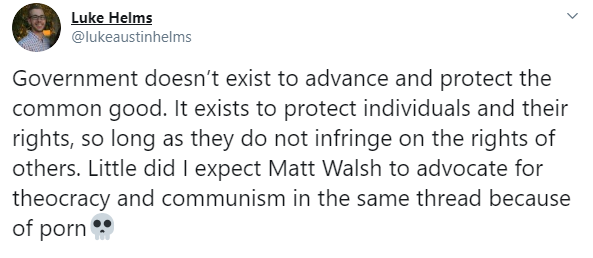
This week there was a debate on social media about whether porn should be banned. I found the response of the libertarian right to be very interesting. They reacted vehemently against the idea of a ban as a matter of principle, claiming that those supporting it were "fascists" or supporters of theocracy and were acting against the ideals of the US as set out by the founding fathers.

The debate was therefore useful in highlighting some important philosophical differences on the right, particularly regarding the notion of a common good.

One person on the right advocating for restrictions on pornography is Matt Walsh. He attracted a lot of fire from libertarians for his stance. Walsh linked the debate to the issue of the common good in this tweet:


The libertarian response accusing Walsh of "theocracy" came soon after:


Back to Walsh:


Back to libertarians:


Once more to Walsh:


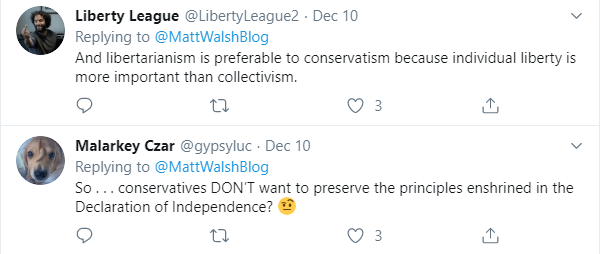
At this point libertarians stepped in to associate any notion of a common good with the sin of "collectivism" or with abandonment of American founding principles. For example:


One of the errors I think libertarians make is to set in opposition the notion of the individual good and the common good. In reality, the two are interconnected. I put it this way in a tweet of my own:


The mistake seems to go back all the way to Locke, from whom the notion of the "individual pursuit of happiness" derives. If my understanding is correct, Locke himself did not believe that individuals should simply "live how they deem fit". He thought they should pursue happiness, by which he meant that they should use their reason to avoid immediate gratification in favour of the higher pleasures associated with a life of self-disciplined virtue.

For this reason, modern day libertarians have drifted away from the mindset of the American founders, who emphasised the connection of virtue to liberty, and licence to the destruction of liberty, a point I will develop below.

Even so, the Lockean outlook has proven to be insufficient. Locke thought that we were born as blank slates, with no inborn nature, and no propensity to either good or evil, but that we were products of our experiences. He seems to have underestimated the fallen nature of man. Left to a purely individual pursuit of happiness, most people struggle to live virtuously.

This does not mean that we have to have our lives controlled in an authoritarian way by a central government. But it does mean that holding to healthy social norms and moral standards in a society is critically important. These are not fetters to individual liberty as Locke would have understood the meaning of liberty, but necessary supports for it.

And Locke's focus on an individual pursuit of liberty is also insufficient. It's not enough to hope that this individual pursuit of liberty will, of itself and without forethought, give rise to the necessary social conditions of life. The significance of a common good has to be explicitly recognised in its own right as a necessary component of individual well-being, and promoted as such.

Let's look at this realistically, taking family life as an example. Locke might have hoped that men and women would act according to reason and understand that their enduring happiness depended on rejecting the impulse toward promiscuity and choose instead to make a commitment toward a lifelong marital bond that would provide them with a secure base to enjoy the higher pleasures of paternal or maternal love, a lasting companionship into old age and so on.

How has that worked out? It turns out that reason struggles to overcome the innate impulse (that Locke never acknowledged) toward hypergamy. It turns out that not everyone shares the personality traits of conscientiousness or agreeableness that support successful pair bonding. It turns out that not all women will act prudently to leverage their assets of youthful beauty and fertility in a timely way that permits them to marry successfully. It turns out that some people will ignore the "save oneself for marriage instinct" and instead became jaded and incapable of deeper emotional attachments. And so on.

Individual reason alone does not uphold standards of virtue within a society. Our society is the living proof of this. The lessons of reason need to be reinforced and supported so that they become social norms and moral and cultural standards. The arts can play a role in this, so too can the churches, so too can schools and universities, as can churches. And, yes, governments have at least some role to play in this as well (think, for instance, of the harm done to family life by the way that family law is currently framed).

Another problem with Locke's concept of the individual pursuit of happiness is that, even understood as a pursuit of virtue, it is focused on the self alone. Here is one way of thinking about this. If I am concerned with the common good, then I will act in ways which uphold this common good. For instance, I will think it important that I deport myself in public in a way which upholds a higher standard. I will want to present myself in public at my best in order to contribute to the communal standard.

I suspect that is why there used to be a standard of common decency or why it was thought important to dress well when in a public place or why it was thought worse to bring our vices into public view than to keep them private. But we have increasingly lost this notion that what we bring of ourselves into the public square matters as part of a common good. People now not only fail to keep their vices private but will identify with them, and standards of dress are sometimes intended just as much to provoke a reaction or to assert individuality as they are to inspire people to a higher standard of the masculine or feminine.

Let's come back now to the libertarian idea that the founding fathers of the U.S. intended government to be morally neutral. I was looking recently at the symbolism of the Great Seal of the United States, which was adopted in 1782. The designer of the seal, Charles Thomson, described the symbolism as follows:
The colours of the pales are those used in the flag of the United States of America; White signifies purity and innocence, Red, hardiness & valor, and Blue, the colour of the Chief signifies vigilance, perseverance & justice.

The mindset here, by design and within the very seal of government, is a pursuit of virtue. The same point comes through very strongly in an article by Mathew Peterson titled "The American Founding was not Libertarian Liberalism". He gives many examples of how the founding fathers associated virtue with liberty and a loss of virtue with licence.

For example, James Madison said at the Virginia Ratifying Convention:
I go on this great republican principle, that the people will have virtue and intelligence to select men of virtue and wisdom. Is there no virtue among us? If there be not, we are in a wretched situation. No theoretical checks—no form of government can render us secure. To suppose that any form of government will secure liberty or happiness without any virtue in the people, is a chimerical idea.

So here then is the challenge for modern day libertarians. What is there in a libertarian politics to ensure that there is "virtue in the people"? Clearly, it doesn't happen of itself. It needs to be fostered in some way. So how? Libertarians not only reject the idea of government upholding moral standards as "fascist" or "theocratic," even worse they reject the notion of a common good as being "collectivist". So presumably they have to somehow connect the pursuit of an individual good to the creation of virtue in society. It hasn't worked this far. How do they think then it is going to work from here on in?