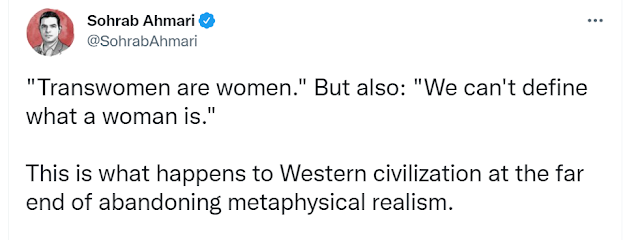
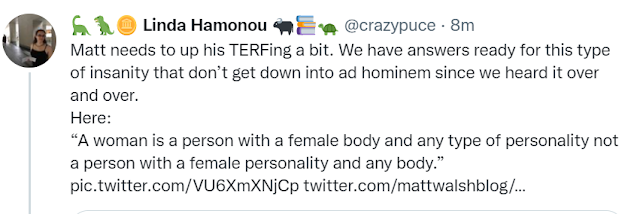
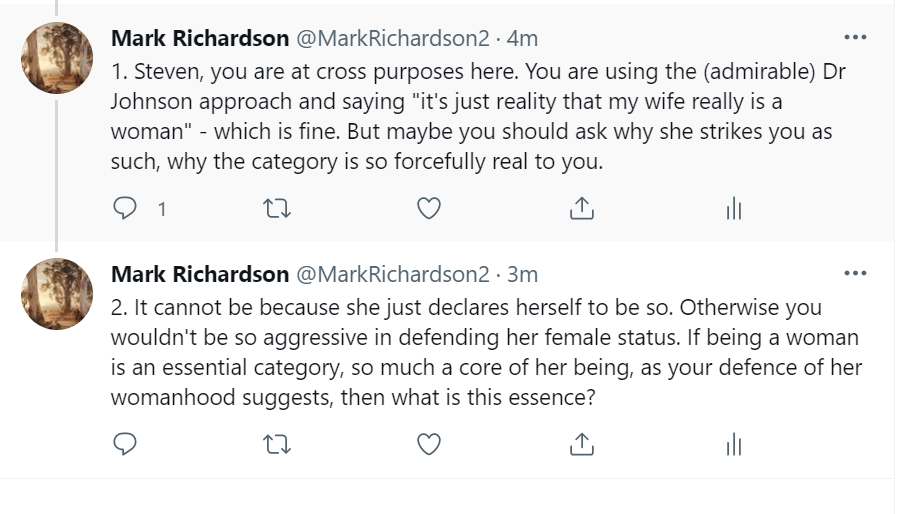
You can see here the logic of nominalism (that there are only individual instances of things) and a certain type of materialism (that we are just matter in motion) in undermining a "teleology" - a view that there are proper ends to human life that are discernible through reason.Sohrab Ahmari had a similar take on the Matt Walsh discussion:
Friday, January 21, 2022
Can modern society define what a woman is?
Friday, January 14, 2022
The rights place
I am currently reading The Unintended Reformation by Brad S. Gregory. I am learning much from the book about the history of ideas - it is worth reading for this alone.
Gregory's most basic argument (I hope I do it justice in this summary) is that an unintended consequence of the Reformation was a proliferation of truth claims and that various attempts to finds ways to adjudicate between these failed. This contributed to the period of political instability and warfare which devastated parts of Europe in the later 1500s and 1600s. This then encouraged a shift from an ethics of the good to one of rights. For a period of time a shared religious culture was able to provide an ethics of the good now missing at the formal, public level, but in the long run the effect was to subjectivise morality, so that the good was whatever I subjectively held it to be.
In Gregory's own words (p.226):
In an attempt to address the unintended problems derived from doctrinal disagreements in the Reformation era, Christian contestation about the good was eventually contained by the sovereign liberal state through individual rights. The political protection of rights has in turn unintentionally fostered the subjectivization of morality by legalizing the self-determined good as a matter of preference.
One of Gregory's many arguments is that the notion of rights was based on a concept of natural law, which made sense within the traditional understanding that man was made in God's image and that the natural world was God's creation. From this could be derived a view that man had been created in certain ways and for certain purposes that should not be violated - hence "rights".
However, when this traditional understanding waned, and was replaced with metaphysical naturalism (i.e. that there are only natural, material processes at work in the universe), then it becomes difficult to view rights as anything other than mere assertions. Gregory makes an interesting point about the incoherence involved in suggesting that moral actions are merely subjective preferences whilst violations of rights are inherently wrong (pp.225-226)
It is not uncommon to hear people insist on the constructed arbitrariness of moral values and yet denounce certain human actions as wrong because they violate human rights. That such a self-contradictory absurdity seems to be widespread and tends to escape the notice of its protagonists suggests both that it is deeply rooted and that it fulfils an important function...
The incoherence of such a pervasive sensibility - moral values are arbitrary but some actions are wrong - derives from unawareness of the historical genealogy of two desires that are contradictorily combined. The first seeks to maximise individual autonomy to determine the goods according to one's preferences (hence the advocacy for arbitrariness). But the second endeavours to uphold human rights as a safeguard against the horrific things human beings can do to one another depending on their preferences (hence the insistence on non-arbitrariness). The first desire is the long-term product of a rejection of teleological virtue ethics, the second a residue of the belief that human beings are created in God's image and likeness. Their combination depends for its appeal on a skepticism that goes only so far but no further. One needs to get rid of a God who acts in history, who makes moral demands and renders eternal judgements consonant with teleological and divinely created human nature. Otherwise human beings would no longer be the neo-Protagorean measure of all things, and the ideologically foundational modern commitment to the autonomous, unencumbered self would be threatened. But one equally cannot permit human actions that are consistent with the scientific finding that human being are nothing more than biological matter-energy. Otherwise human being would be ultimately no different from amoebae or algae....and one could act accordingly depending on one's preferences and desires. So souls must go, but rights must stay; skepticism must be embraced with a carefully calibrated and catechetically inculturated arbitrariness. It must be frozen where it unstably stood after the Enlightenment's supposed supersession of the Reformation era in the late eighteenth century: in just the rights place.
Gregory presses an argument in the book that what has been lost is an ethics of the good practised within a moral community. I thought this when I was still in my twenties, i.e. that a community has to be willing to articulate its vision of the good and to uphold it (reasonably) as a moral standard or norm. If it fails to do so (for instance, in the belief that it is not possible to discern such a good, or to come to a shared understanding of it), then there will be a lowering of the moral understanding within that community.
Thursday, November 18, 2021
The misandry files
One of the worst features of our culture is misandry. The hostility toward men has become so open that it is beginning to draw criticism - just this week I have read two articles in the media focusing on this problem.
The first was written by Bel Mooney. She describes herself as a 60s feminist, but nonetheless is "disturbed" by the "wave of man-hating pervading our TV screens". She mentions several TV shows as evidence, but focuses particularly on Maid which she experienced as "deeply depressing" because every single man depicted in the show is "horrible".

![]() |
| Maid - misandrist TV |
Bel Mooney believes that "we do not help women by demonising all men". However, when she suggested on Facebook that not all men were evil, she met with opposition. One woman told her that "You have to accept that men as a group really are s***".
Mary Wakefield also watched Maid and was similarly struck by its misandry:
I have Netflix, and in particular the series Maid, to thank for the startling discovery of how easy it is to slide into a form of man-hating — not a righteous feminist rage, but a sort of dopey, palliative, unthinking misandry.
She writes about the series that,
The distinctive thing about it is that every male character is an absolute horror. I mean: every single one.She admits that she was initially influenced by the anti-male message, before drawing back:
I looked back at any odd, unasked-for lunge in my past and saw it suddenly as part of a continuum of male sin that ends in wife-beating...My power trip lasted for 24 hours. At breakfast the following day, it occurred to me that I wasn’t remotely oppressed.
She continues:
I suspect it’s everywhere now, this almost invisible bigotry, streamed into our psyches via Netflix and Amazon Prime — what the French philosopher Élisabeth Badinter calls ‘the binary thinking of belligerent neofeminism’.
Where does this misandry come from? Something worth noting is the inversion of values. In traditional societies the role of men was to protect and to provide for women. It seems to me to be no coincidence that men are now characterised as having played the very opposite role. Instead of being protectors, it is asserted that men have historically been abusers of women. Instead of being providers, it is argued that men were exploiters of women (or even that they held women as property).
Inverting a truth is a way of rewriting an aspect of history or of reality. This process did not begin, on a mass scale, until Western society was wealthy enough for upper and middle class women to feel secure and less reliant on the traditionally masculine role.
When was the tipping point? Most likely when the industrial revolution really kicked in and considerably increased average incomes. This took place over several decades from about 1830 to 1860:
According to estimates by economist N. F. R. Crafts, British income per person (in 1970 U.S. dollars) rose from about $400 in 1760 to $430 in 1800, to $500 in 1830, and then jumped to $800 in 1860...Crafts’s estimates indicate slow growth lasting from 1760 to 1830 followed by higher growth beginning sometime between 1830 and 1860.
What was happening to feminism during this time? During the slow rise in income, there was no mass feminist movement. There were individual feminists like Mary Wollstonecraft, but the movement did not catch on. It was toward the end of the period of rapid income growth that feminism in the UK became an influential movement that began to be supported by the state. By the 1860s, the writer Eliza Linton was criticising the feminists of her era as "you of the emancipated who imitate while you profess to hate" and by the 1880s a Girton College girl was no longer looking to men much at all, having adopted the outlook that,
We are no longer mere parts - excrescences, so to speak, of a family...One may develop as an individual and independent unit.
What I am arguing here is that once society reaches a certain level of wealth, to the degree that upper and middle class women no longer fear material deprivation, that conditions exist for the traditionally masculine role to be attacked and subverted.
Modern metaphysics have also laid the groundwork for misandry. Traditionally, for instance, it was thought that the masculine had a real existence as a principle or essence that men could meaningfully embody and that potentially ennobled men as bearers of masculine virtue.
There do still exist women who think along these traditional lines and who associate the word "man" with positive characteristics which they admire:
However, there was a turn away from realism in philosophy centuries ago. What replaced it was nominalism, which emphasised instead the idea of there being only individual instances of things. Masculinity was no longer thought of as a transcendent good connected to virtue, but could now be rejected as being merely a social construct created for the purposes of empowering one group at the expense of another.
Modernist metaphysics is also grounded on a radically individualistic anthropology. Humans are understood to exist in a state of nature as atomised individuals pursuing their own selfish pleasures. They are only brought together into society through a social contract which has the aim of preventing violent conflict.
This anthropology undermines a deeper understanding of a common good in which we develop in relationship with others. Instead, as the Girton girl quoted above put it, it is assumed that we develop as "an individual and independent unit".
If so, we can be reckless in breaking faith with the opposite sex. We no longer need positive relationships between the sexes to fulfil the deeper aspects of our nature or to achieve our higher purposes in life.
What does fit within this modernist metaphysics is the pursuit of individual pleasure. And so, unsurprisingly, there is a shift in which relationships between men and women depend to an ever greater degree on sex itself - on the libido. This is not a basis for relationships that is likely to promote harmony and admiration. Eros alone does not provide for stable and secure relationships: the results over time will often be jaded feelings and a loss of trust, and this too can underlie the expression of misandry from women.
One of the consequences of liberal modernity having such an individualistic anthropology is that there is a loss of the group-focused moral foundations, such as loyalty, that are a part of more traditional societies. When people are focused on the good of the larger communities they belong to, and are loyal to them, it promotes a fellow feeling between the sexes. Men will express pride in "our women" as will women in "our men".
This concern for the larger community is one reason why Eliza Linton, who I quoted earlier, was so critical of the feminists of her time. She wrote of the movement in the 1870s that "it is still to me a pitiable mistake and a grave national disaster." Compare Eliza Linton's loyalty to her nation with the radical disloyalty of the English feminists described by Bel Mooney in her article on misandry. She attended an event to celebrate the 100th anniversary of the founding of a charity for single mothers. The keynote speaker was not only hostile to men but, more specifically, to the men of her own tradition:
The party was held in the fine 18th-century surroundings of London’s Foundling Museum, set up by the great Thomas Coram who was horrified children should be abandoned by mothers too poor or shamed to care for them. The guest speaker was Jane Garvey, then a presenter of Woman’s Hour on Radio 4. She stood on the podium and began with the scornful jibe that there we were, in that room, ‘surrounded by portraits of fat, old, white men in bad wigs’.Again, there is not just a change of moral beliefs here but an inversion. It is no longer loyalty which is thought moral, but a mocking disloyalty.
You can see the tyrants, the invaders, the imperialists, in the fathers, the husbands, the stepfathers, the boyfriends, the grandfathers, and it's that study of tyranny in the home...that will take us to the point where we can secure change.It is only a short distance from this characterisation of men as tyrants to a more active hatred of men as a group. The misandry is not just an unfortunate quirk of a few unhappy women but rests on a set of metaphysical and political assumptions that are, for the time being, baked into our culture.
Thursday, November 04, 2021
Two moralities?
It can seem at times that liberal moderns have a disdain for moral standards. I once wrote a post, for instance, about a controversy surrounding the singer Cardi B. She had made a music video featuring a host of semi-naked women "twerking". In response to criticism she argued that the video showed that women could do whatever they wanted. Fans similarly defended her by arguing that it was empowering for women to express their sexuality however they wanted to and that the video positively expressed female bodily autonomy.
This is the libertine or permissive aspect of liberalism. It almost directly expresses a Hobbesian metaphysics. Hobbes, if you remember, believed that humans were acted on to pursue their passions. No desire could be held to be either better or worse than another. What mattered was a freedom to pursue our own desires with the least constraint from other people. To have this freedom required power. We are therefore "empowered" when we can act with the least constraint in pursuit of our desires whatever they might be. Just like Cardi B.
However, I don't believe that this is the end of the story when it comes to liberal moderns and morality. As I attempted to describe in my last post, most of my liberal acquaintances are not libertines. On the contrary, they are conscientious to a fault and keenly want to be thought of as good people (which perhaps helps to explain their moral conformism, i.e. their need for a group consensus in taking a moral position).
The problem for these liberals is that they are attempting to process moral decisions through a distorted moral framework. Professor Jonathan Haidt identified five moral foundations in world cultures; unsurprisingly the three "group focused" moral foundations have withered away in liberal societies, leaving just the two "individualising" foundations, namely fairness and harm. If you no longer believe that it is moral to uphold the group you belong to, then issues of "fairness" will not consider the impact of moral decisions on the cohesion of your own longstanding communal traditions.
Imagine you are a liberal and have no concern for the "loyalty" moral foundation. It might then seem perfectly moral to you to have open borders because if you are only considering things in terms of "disgrouped" individuals, then there will be no reason to see your relationship with someone living in a different and distant culture any differently to your relationship with your own countrymen. It will, in fact, seem unfairly "discriminatory" or even "racist" to make such a distinction.It has profound consequences to abandon the group focused moral foundations. Not only does it dissolve, over time, the "thicker" forms of human community, it means that we are no longer culture bearers, but rather something like tourists looking on as outsiders to the cultures of others, or even (as in welcome to country ceremonies) acknowledgers of the ancestry of others rather than our own. If we are no longer culture bearers, then we lose to some degree a meaningful connection to people and place and to a tradition that connects us to past and future generations. We have less reason to feel a sense of duty to uphold, defend or improve upon the standards of the tradition we are responsible for and there will not be the same sense of pride and achievement in what our own forebears have accomplished.
As an example of a more traditional mindset, consider the Ephebic oath that the young men of Classical Athens swore:
My native land I will not leave a diminished heritage but greater and better than when I received it.
Of course, having the group focused moral foundations does not mean that you cannot also have the individualising ones as well - it is a matter of balancing the two. In Jonathan Haidt's research, he found that this is what conservatives tend to do.
Which brings me to my final point. It is common for the churches to try to signal a more selfless kind of morality by emphasising the idea of service to others. This, it is true, does not fit in readily within a Hobbesian framework.
It is notable, though, that the end product is usually the same as that of liberal moderns. It leads the churches to call for more porous borders, for a greater flow of refugees, for an end to discrimination and so on. The problem, again, is that the ethos of service to others is being interpreted through the individualising moral foundations that have been left standing within a liberal culture.
There are honourable exceptions to this trend that show how differently an ethos of service appears when it is expressed through a more complete set of moral foundations. You can see this in the writings of Cardinals Robert Sarah (here, here and here) and Raymond Burke (here). Historically, you have figures like Bishop Clemens von Galen of Munster.
Joining a church might therefore have a positive benefit to an individual, but it is not a political solution in itself. It will not, in itself, restore the group focused moral foundations, particularly when these have already been so deeply undermined.
There is no easy way out, but one positive step would be to decisively reject the metaphysics that we have inherited from men like Hobbes. How, for instance, can we restore the moral foundation of loyalty, if we still follow the anthropology which begins with the idea of men being set apart from each other in a state of nature, in a war of all against all, and only brought into coexistence via a social contract?
Sunday, October 31, 2021
On being true
Listening in to liberal friends has made me increasingly aware of how they process moral issues. These people are often highly conscientious and being moral is important to them. But they draw every question back to the same thing. It doesn't matter what the original topic was, it will end up with a nodding agreement about racism or, less frequently, about sexism or more generally discrimination or inclusion. I suspect that, from their point of view, they see themselves as promoting "fairness" in doing so.
This liberal outlook has colonised nearly everything and everyone in a city like Melbourne. If you go to Christian school websites, for instance, the most prominent expression of their values will be inclusion. Some of my liberal friends see themselves as sincere Christians, and attend church services regularly, but their moral framework is still this liberal one.
The problem is that the liberal framework undermines a very significant aspect of moral character. For most of Western history, it mattered that an individual was "true", in the sense of being loyal and faithful to the significant communities he belonged to and to the particular offices he filled within these communities. These communities were richly diverse. There might be a faithfulness to God, to a church, to a religion, to a spouse, to our children, to our extended family, to our nation or people, to the crown, to our local community, our region, our race and our civilisation.
A faithfulness to these communities and particular relationships then helped to motivate an ethos of service and duty. It also gave the individual a place within longstanding communal traditions, so that the individual might see himself as a bearer of that tradition, which not only dignified his responsibilities, but also drew him more closely into a particular culture, and put him in a relationship not only to his own generation, but to past and future generations.
When we uphold this ethos of fidelity, much else follows. If you are faithful to your own tradition, then you will be concerned with the good of that tradition, and this will then mean a wider concern with family life, with culture, with the environment, with the economy, with education and so on. You become more strongly motivated, in other words, to uphold healthy family formation, or to organise the economy so that it does not undermine the family, or to create an environment that will elevate rather than degrade those who live within it.
The word "true" originally did not mean "consistent with fact":
Old English triewe (West Saxon), treowe (Mercian) "faithful, trustworthy, honest, steady in adhering to promises, friends, etc.," from Proto-Germanic *treuwaz "having or characterized by good faith", from PIE *drew-o-, a suffixed form of the root *deru- "be firm, solid, steadfast."You can see here the clustering of moral qualities that the word was used to denote. The liberal moral framework, however, not only ignores the quality of being "true" but undermines it. I get moral points as a liberal if I discard loyalty to my own tradition, so that I do not discriminate. There is a deeply set belief amongst most white liberals that if a white person shows pride in or loyalty to their own traditions, that they are committing a moral evil. This is an inversion of the older view that to be "true" was an essential mark of good moral character.
According to Moral Foundations Theory, differences in people's moral concerns can be described in terms of five moral foundations: Individualizing cluster of Care and Fairness, and the group-focused Binding cluster of Loyalty, Authority and Sanctity.
Monday, September 13, 2021
Kathleen Stock 2
The dream I find most compelling is one of an androgynous and genderless (though not sexless) society, in which one's sexual anatomy is irrelevant to who one is, what one does, and with whom one makes love. ('The Traffic in Women' p.204)
![]() |
| Gayle Rubin |
For the category of sex is a totalitarian one...This is why we must destroy it and start thinking beyond it if we want to start thinking at all, as we must destroy the sexes as a sociological reality if we want to start to exist.
One of the interesting things about this essay, 'The Category of Sex', is that Wittig openly rejects the philosophically "realist" belief in sexual difference, i.e. the idea that there is metaphysically a real category of the masculine and the feminine. She rejects the belief that,
...there are before all thinking, all society, "sexes" (two categories of individuals born) with a constitutive difference, a difference that has ontological consequences (the metaphysical approach)
Perhaps this shows how nominalism, with its emphasis on the idea that there are only individual instances of things, helps to pave the way for the belief that the idea of sex is merely socially imposed.
![]() |
| Monique Wittig |
Wittig famously claimed that lesbians are not women. This makes sense if you accept her argument that "women" only exist as part of a heterosexual dualism by which one political category "men" dominate another category "women". Lesbians escape this kind of sexual "contract". What Wittig did not foresee is that if you so much reduce the category of womanhood it is difficult to sustain a distinctly "woman's" movement. Little wonder that Kathleen Stock rejects the Wittig position.
Stock is more interested in those who accept, as a baseline position, that humans are a sexually dimorphic species (the biological reality position). She wants to consider whether you can argue from this position that gender should nonetheless be abolished.
She begins with those feminists who wish not so much to abolish the categories of "man" and "woman" but any sociocultural differences associated with them. Stock responds by reminding her listeners that the range of such cultural practices is so vast, that the task of abolishing all of them appears unrealistic, particularly as many of them arise in response to the biological differences between the sexes and the fact of heterosexuality.
Stock then makes a cutting point, namely that those who have favoured this type of gender abolition, such as Shulamith Firestone, were aware of the extraordinarily radical social engineering it would require to be successful. Firestone wrote in 1970:
The reproduction of the species by one sex for the benefit of both would be replaced by (at least the option of) artificial reproduction: children would born to both sexes equally, or independently of either, however one chooses to look at it; the dependence of the child on the mother (and vice versa) would give way to a greatly shortened dependence on a small group of others in general, and any remaining inferiority to adults in physical strength would be compensated for culturally. The division of labour would be ended by the elimination of labour altogether (through cybernetics). The tyranny of the biological family would be broken.
![]() |
| Shulamith Firestone |
Stock doesn't believe this transformation would be desirable, even if it were possible. She points out that it would leave children with attachment disorders, that its implementation would be authoritarian, and that there would be medical issues in having male bodies gestate children.
Stock's next argument is quite a departure from the usual politics. Instead of arguing that sex-based cultural practices are always and everywhere a fetter on the self-determining individual, she argues that they can have a positive effect, in providing individuals with a source of meaning, obtained via identity, purpose, achievement and camaraderie. She believes that there is a risk of a "profound loss" for the individual if all of this were to be suddenly abolished.
Kathleen Stock makes it clear that she does not support this version of gender abolition. She then turns to a third version of gender abolition, which involves the eradication of all social norms based around sex. Stock treats this version seriously and spends some time looking at the role of social norms in society. It's an interesting discussion, but lengthy, so I'll save it for the next post.
Sunday, August 29, 2021
Who erased women? (1)
The Guardian ran an article a few weeks ago by an Australian feminist, Jane Gleeson-White. She claims that women are being erased by patriarchal economics (because women's domestic work has not been commodified).
It's an odd argument because a patriarchy, by definition, recognises the reality of the sexes. Whether you support the idea of a patriarchy or not, it could not exist without an acknowledgement of the existence of men and women.
And yet Jane Gleeson-White is correct that there is something like an erasure of womanhood happening in modern society. I wrote about this last month following a debate I had on social media. My opponent argued that it was impossible to define womanhood because womanhood meant whatever people wanted it to mean and that it was "bigotry" to argue otherwise. I pointed out that if womanhood can mean anything and is purely subjective then it is effectively meaningless - it is being erased as a meaningful category.
So who or what is erasing womanhood? In my post I connected the problem to a Hobbesian metaphysics. I won't repeat the argument here, as I'd like to focus instead on how the matter has been argued for politically.
For some decades, the debate about sex followed the general logic of liberalism. Liberals sought to maximise individual autonomy, which was understood to mean maximising the freedom to self-determine and self-define. This meant that predetermined aspects of life were looked on negatively as fetters on the individual. Such predetermined aspects of life included those things we are born into rather than choosing for ourselves, such as our race, our sex and our ethny. The important thing for liberals was to find a way to make such aspects of life no longer matter.
When it came to making our sex not matter, an early step was to separate sex and gender. Being masculine or feminine was no longer something tied naturally to our sex but was instead a separate thing, "gender", that was an oppressive and artificial social construct that could be abolished through such measures as advertising standards or educational programmes. If masculinity and femininity could be abolished, men and women could be made to be the same, and therefore "equal". The fact of biological sex would no longer matter and the liberal project would be realised.
Furthermore, by making gender separate from biological sex it was possible to have a range of personalised expressions of gender. Gender could now be held to be multiple and fluid. Individuals could identify with one or more of a bewildering range of new genders.
And if it is what I identify with that defines my gender, why not make this the same for my sex? It is my identity that now defines my sex rather than the other way round (i.e. instead of my body defining me as male or female, my identity defines whether my body is male or female).
The emergence of transsexualism, as well as the ever expanding variety of "gender expressions", poses a challenge for feminism. The category of womanhood has become, at the very least, leaky. Those who are biologically male can now claim to be part of the women's movement and to occupy female spaces, and it isn't clear if the concept of a woman's movement will make sense to those raised to believe in 52 or more genders.
There has been resistance by old school feminists. The problem is that they have run into the problems that anyone challenging liberalism faces - they are accused of discriminating against a previously oppressed group fighting for the right to self-define ("transphobia").
Which brings me to Kathleen Stock, a professor of philosophy at the University of Sussex. She is a lesbian radical feminist, but not really of the type your parents might have known. She has been forced down the same path as the rest of us - she realises that the tide of politics is against her and that what is needed is a rethink of some of the assumptions on which politics is based.
In an online lecture she does a remarkably good job of getting to the heart of things, namely the feminist project to make our sex not matter. She admits that radical feminists have had a project to abolish gender, but argues that this is not achievable. She adds that even if it were possible to abolish these distinctions, this would not be desirable, as it would remove important sources of meaning, identity, camaraderie and achievement for individuals.
Nor does she think it wise to abolish social norms regulating relationships between the sexes. She notes that these have been looked on negatively in previous feminist thought as "trapping" the sexes into certain roles, but responds by looking into the literature on social norms and finding that they are inescapable for humans who are hardwired to be social and that they can have a beneficial effect. She gives as an example the social norm that it is dishonourable for a man to hit a woman as having a rational origin in the different size and strength of men and women.
She finishes by arguing that social norms should be judged on whether or not they promote the well-being of men and women. This is, again, a reasonable position with a long pedigree in Western thought, although it does require some debate on what constitutes well-being.
There are some promising aspects of Professor Stock's lecture. I think it's been common for feminists to uphold the categories of male and female only as markers of entry into a political class. The importance of the category of womanhood then becomes for women to seek and to uphold the rights and privileges they have within the political/economic system.
I think it's possible that Kathleen Stock still thinks at least a little along these lines. She says elsewhere, for instance, that,
There’s a liberal idea that we’ll just keep progressing towards a glorious Utopia. I don’t think that’s right anymore. The picture of human nature that underlies it is flawed. The relationship between men and women is probably always going to be, on some level, antagonistic.
She still puts, at the forefront, the idea of men and women being locked in an antagonistic relationship. Similarly, she says in her lecture that although there are social norms that are beneficial for men, she is only interested personally in promoting those that are beneficial for women. So she is still placing herself on "team women" rather than trying to arrive at some larger framework that will be workable for both sexes.
Nonetheless, she has moved the argument a considerable way toward something else, in particular, by recognising that sex based cultural practices are not only real and inevitable, but also mostly play a positive role in helping to regulate the relationships between men and women, and in providing a source of meaning and identity.
In my next post I'll look in more detail into Professor Stock's lecture. There's some interesting information that's worth delving into.
Sunday, August 22, 2021
What does it mean to be modern? (2)
In the first part of this series, I quoted Michael Allen Gillespie's definition of modernity:
...at its core, to think of oneself as modern is to define one's being in terms of time. This is remarkable. In previous ages and other places, people have defined themselves in terms of their land or place, their race or ethnic group, their traditions or their gods, but not explicitly in terms of time...To be modern means to be "new," to be an unprecedented event in the flow of time, a first beginning, something different than anything that has come before, a novel way of being in the world, ultimately not even a form of being but a form of becoming.
To understand oneself as new is also to understand oneself as self-originating, as free and creative in a radical sense, not merely as determined by a tradition or governed by fate or providence. To be modern is to be self-liberating and self-making, and thus not merely to be in a history or tradition but to make history.
Sunday, August 15, 2021
What does it mean to be modern? (Part 1)
What does it mean to be modern? Michael Allen Gillespie, in his work The Theological Origins of Modernity, gives this answer:
...at its core, to think of oneself as modern is to define one's being in terms of time. This is remarkable. In previous ages and other places, people have defined themselves in terms of their land or place, their race or ethnic group, their traditions or their gods, but not explicitly in terms of time...To be modern means to be "new," to be an unprecedented event in the flow of time, a first beginning, something different than anything that has come before, a novel way of being in the world, ultimately not even a form of being but a form of becoming.
To understand oneself as new is also to understand oneself as self-originating, as free and creative in a radical sense, not merely as determined by a tradition or governed by fate or providence. To be modern is to be self-liberating and self-making, and thus not merely to be in a history or tradition but to make history. To be modern consequently means not merely to define one's being in terms of time but also to define time in terms of one's being, to understand time as the product of human freedom in interaction with the natural world. Being modern at its core is thus something titanic, something Promethean.
This description of modernity helps us to understand why people have such difficulty in breaking cleanly from the modernist project. This project is now something that we live within, and by its nature it has broken with the past as a living tradition, making it difficult to connect to any genuine alternative.
Gillespie goes on to trace the development of the concept of modernity. Modernism, in its current meaning, took some time to emerge. Those who wanted to challenge either the present or the recent past, often did so by looking back to antiquity rather than by embracing "modernity". Gillespie mentions the "quarrel of the ancients and the moderns" that took place in the seventeenth century. When I did some further reading on this I learned that in France the establishment literary figures who supported throne and altar were the ones who considered themselves "moderns". These writers attacked the more radical literary figures who looked back to antiquity. So there was not yet a progressivism in the form that we would recognise.
What is more recognisable are movements like the Italian Futurists of the early 1900s. Below is a sketch by the Italian architect Antonio Sant'Elia that was part of a series called "The New City" (1914).
Sant'Elia's vision of the new city has been described as follows:
The city was a backdrop onto which the dynamism of Futurist life is projected. The city had replaced the landscape as the setting for the exciting modern life. Sant'Elia aimed to create a city as an efficient, fast-paced machine. He manipulates light and shape to emphasize the sculptural quality of his projects. Baroque curves and encrustations had been stripped away to reveal the essential lines of forms unprecedented from their simplicity. In the new city, every aspect of life was to be rationalized and centralized into one great powerhouse of energy. The city was not meant to last, and each subsequent generation was expected to build their own city rather than inheriting the architecture of the past.
The Italian Futurists were influential enough to have buildings approved by Mussolini, such as a new train station in Florence completed in 1934:
The heating plant and main controls cabin for this station are considered masterpieces of Futurist architecture (1929):
In Australia you can see modernism extending its influence among the elite in the interwar period. It was not uniformly so in the 1920s, though. Here is part of a speech given by Sir William Irvine, who at that time was the Chief Justice of the Supreme Court of Victoria. In opening a local high school in 1928 he said,
Such schools present the young with opportunities of rising not merely to technical and industrial efficiency, so that they may make more money or higher wages. That is a useful object and may be the aim of the majority who enter this and other schools but there is something higher.”
The more chances given to the rising generation in the way of education, says Sir William, the better for all concerned...It was the aim of education to bring the minds of people into paths of thought leading to vistas of intellectual truth and beauty. Secondary education should be a means of drawing out the creative intellect of the youth of this fair country, in order that their efforts would lead towards the benefit of all, so that their minds might be uplifted above the sordid cares of ordinary life, and so that they might enjoy the priceless heritage of English history.
Irvine is clearly not interested in the technological alone and he holds the heritage of his own people in high regard - and so is not entirely a modern. But in the 1930s there continued to develop a strongly technocratic spirit in Australia, and it dominated at the highest level politically in the 1940s. After WWII there still existed a pride in the past at the local level, with the formation of local historical societies, the writing of local and family history, the erection of monuments to honour pioneers and so on. But even this changed by the 1990s. By this time there was an intensely focused campaign, particularly in the schools, to reject the past as something oppressive, something that was not to be identified with.
By this point, it was no longer so easy to think of yourself as a bearer of a culture or of a tradition. This was a logical end point of the understanding of what it means to be modern as set out by Michael Allen Gillespie. If we define ourselves as self-originating, not tied to people or place, nor to history, then it is logical to cut our ties to the past and to our own tradition.
We are no longer culture bearers. That has deep implications that I'll discuss in the second part of this series.
Wednesday, July 28, 2021
A latter day Hobbes?
When you read the philosophy of Thomas Hobbes you can't help but notice how well it fits with the mindset of some people today. There are Hobbesians among us.
In previous posts I have summarised the philosophy of Hobbes, as set out by Michael Allen Gillespie in his book The Theological Origins of Modernity. Here are some choice quotes from the book outlining Hobbes's ideas:
We are all only individual beings, determined by our idiosyncratic passions. Good and evil for each of us is thus measured not by our progress toward a rational, natural, or supernatural end but by the vector of our desire. No direction is naturally better than any other. Good is what pleases us, evil what displeases us, good what reinforces our motion, evil what hinders it.
And this:
For Hobbes reason means something different than what it did for his predecessors. It is not a separate power that can discern the appropriate ends of life and guide us in a proper direction. It is thus not teleological but instrumental, the spy and scout of the passions. It thus helps us to maximise the satisfaction of our desires but not to train, direct or control them.
And finally this:
Thus, while we all desire to exist, what any one of us wants to exist for or wants out of existence can only be specified by the individual. The happiness of each individual thus depends upon his getting what he wants, and this is related to his power...Such power is the basis for what Hobbes believes is rightly called freedom.
You can see here the logic of nominalism (that there are only individual instances of things) and a certain type of materialism (that we are just matter in motion) in undermining a "teleology" - a view that there are proper ends to human life that are discernible through reason.
What you have instead is a belief that it is the freedom to pursue my own idiosyncratic wants that matters. It does not matter so much what these wants are - one direction is neither better nor worse than another. The important thing is that I have the power to follow my desires without external interference.
The implications of all this become clearer when you see these ideas expressed in debate. For instance, I recently saw the following posted on social media:
Sunday, July 18, 2021
Hobbes & the ends of man
Politics has been quieter than usual since the American election, but I'm pleased to note that the questioning of liberalism continues to grow. Here is a recent example:
The responses to the tweet were mixed, but most recognised that liberalism had reached a point of crisis. One person, though, defended liberalism on the following basis:
I checked this person's feed and he is a reasonably open-minded right-liberal type. What I would like to focus on is his claim that there is no higher meaning outside of the choices we make.
It brought to mind my recent reading on the philosophy of Thomas Hobbes. Hobbes radically diminished the meaning of human life. He thought that everything was merely matter in motion, so that humans were acted on in ways that activated our passions and so freedom and happiness meant having the power to pursue our own idiosyncratic passions without external constraint.
What this means is that humans do not have free will. To be autonomous or self-determining has a truncated meaning in this philosophy. Our actions are not really determined by ourselves, but by the actions of external bodies upon us. We are "self-determining" only in the sense that it is our own passions that we follow without hindrance, rather than someone else's.
Hobbes scorned the medieval philosophers, particularly those who discussed "quiddity" - the inherent nature or essence of someone or something. This is important, I think, in discussing whether there is a higher meaning to things. In the twitter thread, a lot of commenters acknowledged that the liberal principle was destroying society, but they thought that religion had too weak a hold to be able to provide a counteracting principle.
Even though I am religious myself, this attitude surprises me. After all, if you can accept "quiddity" then at the very least, even without being religious, you ought to be able to accept that creatures have natural ends, i.e. that they will seek to fulfil or bring to fruition their inherent nature. For instance, men will seek to develop masculine qualities and to fulfil masculine roles, women the same for the feminine. As we are social creatures, this then has implications for our commitments within a society, including upholding certain social norms that allow our nature to successfully unfold.
The problem is that Hobbes's philosophy does not even allow for such natural ends, let alone supernatural ones. Michael Allen Gillespie, in his book The Theological Origins of Modernity, describes Hobbes's view of ends this way:
We are neither superhuman nor depraved. We are all only individual beings, determined by our idiosyncratic passions. Good and evil for each of us is thus measured not by our progress toward a rational, natural, or supernatural end but by the vector of our desire. No direction is naturally better than any other. Good is what pleases us, evil what displeases us, good what reinforces our motion, evil what hinders it. Or to put the matter in different terms, good is an increase in our power and evil its decrease...Each person in Hobbes' view is thus a self-interested individual who seeks to maximise his own power and satisfaction.
I suspect the problem here is that once a Hobbesian view sinks into political thought, there is an acute sensitivity to the idea that any restraint or self-limitation is not a rational one designed to help us, as social creatures, unfold our own ideal nature but is instead a power play by which one group of people seek to block our own "vector of desire" in order to more readily follow their own. In other words, an appeal to natural ends will be rejected as an attempt to exploit or oppress, because that assumption is built into the framework of a Hobbesian philosophy.
So you cannot then simply argue against one aspect of a Hobbesian view - it needs to be more generally dismantled in order for a different politics to emerge. This is possibly the kind of thing Antonio Garcia Martinez is referring to in his first thesis here:
Sunday, July 11, 2021
Hobbes & the metaphysics of modernity
The dictionary definition of metaphysics is as follows:
a division of philosophy that is concerned with the fundamental nature of reality and being and that includes ontology, cosmology, and often epistemology
What is obvious from this definition is that all politics, including those of liberal modernity, must be based on a set of metaphysical assumptions. What matters then is not the impossible aim of excluding metaphysics, but trying to get the metaphysics broadly right, so that a human community is not thrown off course.
I have recently read Michael Allen Gillespie's The Theological Origins of Modernity. One of his arguments is that liberalism is based not so much on a rejection of Christian metaphysics, but developed from the theological debates that took place in the West following the adoption of a nominalist world view from the fourteenth century onward.
Gillespie sees Descartes and Hobbes as being two key proto-liberal thinkers. In order to demonstrate the metaphysical assumptions involved in the development of liberal thought, I'd like to focus on Gillespie's treatment of Hobbes. I think it is clear from his explanation of Hobbes's thought, that Hobbes was not operating neutrally from within a metaphysical vacuum, but rather that the edifice of Hobbes's thought was built upon a series of metaphysical assumptions about the nature of the cosmos; a theory of knowledge; the nature and purposes of man; the relationship between God and man and so on.
Hobbes
Gillespie begins with an account of Hobbes's physics. As interesting as this is, for the purposes of brevity I am going to skip it and focus on one aspect only of Hobbes's thought, namely his anthropology. There is enough in this alone to demonstrate the metaphysical commitments of the early modern philosophers.
It was Hobbes's view that men are "complex automata". As such, we do not have free will. Instead, we are moved by our passions (which are aroused by the impact of external objects on our bodies). If we have no free will then we cannot strive for moral perfection. Instead, our happiness depends on satisfying our bodily desires.
What are these desires? Only the most rudimentary desires, such as seeking to preserve our own lives, are basic to men. As a nominalist, Hobbes was committed to the idea that we are radically individualistic beings with idiosyncratic passions. To quote Gillespie "Thus, while we all desire to exist, what any one of us wants to exist for or wants out of existence can only be specified by the individual. The happiness of each individual thus depends upon his getting what he wants, and this is related to his power...Such power is the basis for what Hobbes believes is rightly called freedom".
You can see already how the underlying philosophy colours the meaning of terms like "freedom". With Hobbes the concept of freedom is stood on its head. We are free, according to previous ways of thinking, when we are not slaves to our passions. With Hobbes, we are free when there is nothing to impede our passions. As Gillespie puts it:
There is no freedom God bestows on us with an infusion of his will. Hobbes believes such pious hopes merely subordinate us to the passions of priests and religious fanatics. Humans are bodies driven by passions, and to be free for Hobbes is to pursue the objects of our passions without external constraints. This is practical but not metaphysical freedom...While we are thus predestined to be the kinds of beings we are and to have the passions that we have, this does not affect our freedom because it is precisely these passions that define our identity.
You can see how this overlaps with modernist thought. Moderns tend to identify freedom with an absence of external constraints; they tend to define their identity around their idiosyncratic passions; and in the English speaking tradition there has long been a hypersensitivity to the idea of priests representing an external tyranny. What is different, perhaps, is that moderns tend to combine, in an unprincipled way, the voluntarist idea that we create who we are as an act of our own will with a materialist and determinist view of the cosmos.
For Hobbes the next step is to emphasise the significance of power in being able to pursue our desires unimpeded:
The degree of our freedom depends on our power...Our power depends on the strength of our bodies, the number of our supporters, the extent of our external resources, and above all on our capacity to reason. For Hobbes reason means something different than what it did for his predecessors. It is not a separate power that can discern the appropriate ends of life and guide us in a proper direction. It is thus not teleological but instrumental, the spy and scout of the passions. It thus helps us to maximise the satisfaction of our desires but not to train, direct or control them. To live by right reason, for Hobbes, is thus not an end but a means. Indeed, the purpose of deliberation is not to moderate the passions, as Petrarch believed, but to increase our power to get what we want.
This too is recognisably modern. You see it when women defend the unconstrained display of sexuality as empowerment. Note too the way that concepts like "reason" so readily change their meaning when placed within a different metaphysics.
The unfolding of Hobbes's thought leads to a particular take on what the ends of human life are:
We are neither superhuman nor depraved. We are all only individual beings, determined by our idiosyncratic passions. Good and evil for each of us is thus measured not by our progress toward a rational, natural, or supernatural end but by the vector or our desire. No direction is naturally better than any other. Good is what pleases us, evil what displeases us, good what reinforces our motion, evil what hinders it. Or to put the matter in different terms, good is an increase in our power and evil its decrease...Each person in Hobbes' view is thus a self-interested individual who seeks to maximise his own power and satisfaction.
It is interesting how enduring this view of man has been. In the later twentieth century, for instance, both the left and the right of politics adopted a game theory which required individuals to act in a self-interested way, just like Hobbesian man might be expected to act.
What does it mean to envisage a society made up of millions of idiosyncratically individual actors, each attempting to further his own power so that he has the means to satisfy his desires? First, given that our needs are limitless, there is an impetus to master/conquer nature to provide the resources to satisfy these unlimited wants, thereby providing conditions that might provide security. Second, in a state of nature, men will compete for finite resources; the natural condition of man is therefore a war of all against all.
Conclusion
This is obviously not an exhaustive account of Hobbes's thought. I hope it has shown, though, not only that metaphysics matters, but that liberal modernity is undergirded by its own metaphysics. We live in a society that has been shaped over time by a metaphysics that has been in place for some centuries now.
The alternative does not need to be an attempt to base politics on the metaphysics of any one particular church and its theology. We do, however, need to "unconceal" the metaphysics on which modernity is based and challenge aspects of it. This includes its nominalism; its reductive anthropology; its reduction of authoritative knowledge to either an apodictic science or to whatever grants power/mastery over nature; and its generally base understanding of human ends/purposes.