Showing posts with label empowerment. Show all posts

Sunday, September 24, 2023

Empowerment and misery

There is a feminist by the name of Amanda Montei who has taken autonomy theory to the next level. If you recall, a key aspect of liberalism is a commitment to individual autonomy. Autonomy is thought of as a power to self-determine in whatever direction we choose, with the predetermined aspects of life, such as the sex we are born into, being looked on negatively as impediments artificially imposed upon the individual.

Amanda Montei


Feminists have long sought to apply this theory to the lives of women. It has led them to prefer women to be independent of men, to reject roles traditionally associated with womanhood, and to believe that the aim of life for women is to be empowered, meaning to be able to do as they wish, in whatever direction, without negative consequence or judgement. 

It might, at first glance, sound nice to be "empowered" in this way. It sounds strong and commanding and in control. But the logic of empowerment doesn't foster strength and well-being. As we shall see, it leads Amanda Montei to a kind of pitiable frailty and misery.

First, though, here is Amanda Montei's brain on autonomy theory (from her book Touched Out: Motherhood, Misogyny, Consent, and Control):

On those of us marked girl...it is not just toy dolls or our parents that insist on our inevitable maternity. Every aspect of the world...tells us how to be woman, largely indistinguishable from mother. As Melissa Febos writes in Girlhood, "Patriarchal coercion is a ghost", an immeasurable figure that looms, hovers, hardly seen, correcting, policing, molding. The afterimages of our gendered socialization haunt the body, telling us how to be, what to say, who to become...We are compelled toward surrender, as the whole world rambles on, telling us who and what our bodies are for.

She begins by claiming that being a girl or a woman is merely a social construct, and that girls are simply "marked" as girls as if they could be assigned some other identity. This is a good example of why feminists are in no position to criticise transsexuals for undermining female identity when they have done such a good job of it themselves.

She then harps on about an all powerful, ghost-like patriarchy, hiding behind the scenes, robbing women of their autonomy by "telling us how to be, what to say, who to become". 

Note the difficulty she is in already. First, she is at war with herself. She has taken her own womanhood to be something artificially and oppressively imposed upon her by shadowy forces she cannot control, rather than something essentially good about her own personhood that she can then seek to express and embody the higher forms of as a way of fulfilling her own being and purposes in life.

Second, she has adopted an impossibly radical world view, one in which the only things that are legitimate are the ones that are self-given. Therefore, she has already taken a negative and hostile stance toward motherhood as this is a "given" of womanhood and is therefore alien to her radical concept of personhood.

Third, wrapped up in this mindset she is already a hapless victim of the world she inhabits. She is not a strong woman in control of her own life. She inhabits a mental realm in which things are done to her that she does not like and that she cannot resist. The focus on autonomy has created a person who, if anything, is relatively low on self-determination and self-empowerment.

Despite this outlook on life, Amanda Montei did decide to marry and have children. This was not a good move for someone seeking to maximise their individual autonomy, as children inevitably make claims on us as parents. We sacrifice a part of our autonomy in order to serve other goods when we take on the role of father or mother.

Predictably Amanda Montei fell in a heap. Rather than being a strong woman, she couldn't cope with the idea of sacrificing for or serving her own children. Nor was she open to any of the joys of motherhood, as her sense of victimhood and resentment was too overwhelming.

It reached the point that she could not bear the touch of her own young children, feeling this to be a violation of her bodily autonomy. She went as far as to compare her children wanting to hug her to rape culture. 

"The book is really about motherhood after Me Too,” Montei says. “And the connections between rape culture and the institution of motherhood, the continuity between these two kinds of cultural institutions and the way that they see women’s bodies."

And this:

But over time I came to see that the basic tenets of rape culture run through our cultural expectations of American mothers. Just as we normalize sexual violence against women, we normalize the suffering of women in motherhood.

And so you get to this version of motherhood:

What I wanted, more than anything, was...to feel as though I fully inhabited and had my body. But all the ideas about how I should act as a mother - how I should respond to my children's near-constant requests for snacks, their demands for attention, their volatile emotions, their hands down my shirt or smushing my face - felt like insects crawling on me. I found myself frequently rubbing my face, itching my scalp, trying to delouse.

She thinks of her children as being like insects requiring her to "delouse". She continues:

Other times I burst into anger, yelling at my children or my husband, demanding space or help, simply because I felt so small, like a little creature myself, shouting in the wide expanse of darkness and nothingness...I struggled with the physicality of caring for children, but even more with my growing awareness that the lack of autonomy I felt in motherhood reiterated everything I had been urged to believe about my body since I was a girl. 

Where in this passage is the power in empowerment? Her obsession with autonomy has led her to feel small, a "little creature" lost in a "wide expanse of darkness and nothingness". Nor is she in control of anything: she is lost to her negative emotions, taking things out on those who love her, believing herself to be a victim of vast impersonal forces. 

Matt Walsh made a video in response to Amanda Montei. I'm pleased to report that he began with first principles, by denying that autonomy is always and everywhere the highest good to be pursued in life:

As a woman your body does not belong entirely to you. As a man your body doesn't belong entirely to you. You are not an autonomous island floating alone out in the sea. Neither am I. I have responsibilities. I have obligations. I owe myself to others, especially my family and when I say that I include my body as I am not in this life separable from my body...to be entirely autonomous in your body is to be entirely autonomous in your person, but no person is autonomous, we all have duties that transcend whatever claims we might want to make to autonomy...I am not a self-created being existing only for whatever purpose I decide.

The last sentence is particularly good, coming as it does from a relatively mainstream conservative with a large following. I might not have framed the other part exactly as Matt Walsh does (as I don't think it is just about obligations, though these exist, but more about higher goods in life, including caritas love and fulfilling higher aspects of our being as men and women). 

To be fair, Matt Walsh goes on to say:

The author, a feminist named Amanda Montei, has written not a revelation that she is a child of God who exists for a higher purpose, but rather a lament that everybody in the world, including her children, especially her children, are using and victimising her. This is not an expression of motherly love but a long, weird and weirdly sexualised whine.

Walsh also describes well Amanda Montei's pathetic victim mindset:

Yet another is the insistence on being a victim in all things. Notice how she describes all of her sexual encounters as horrific drudgeries that she had to cope with and endure miserably. That's not because the encounters were non-consensual, she did consent, but she is still a victim of them somehow. She's the victim of everything. She's the victim of everything that she herself does. She's the victim even of her own children's affection. She is cringing through life, waiting for every moment to be done so that she can get to the next moment and complain about that one too. 

His finishing statement is also fine. It is too long to transcribe in full, but here is an excerpt:

We all have to experience hardship. There is nothing special about that. You get credit for enduring it with some semblance of dignity and strength and courage...We all have crosses that we bear. And you can choose to carry yours with grace or you can whine and cry and milk it for every ounce of pity you can get out of it. And if you choose the latter option then it is all for nothing. Suffering is an opportunity, an opportunity to become stronger, to gain wisdom, to gain perspective, but you squander that opportunity if you whimper and moan and gripe the whole time. Now you still have to suffer, but you aren't even becoming a better person through it, you're actually becoming a worse person, it's the worst of all worlds...you've only become smaller and weaker, until you become an exceptionally small and weak person.


Sunday, August 06, 2023

Mixed messages

You are probably aware that there are two very different takes on the recent Barbie movie. There are some on the right, like Michael Knowles, who think the message of the film is terrific. There is a scene toward the end of the film in which Barbie rejects having a relationship with Ken and tells him that he is enough as he is, but also that he has to find out who he is outside of any relationship with her.

Knowles interprets this in a red pill way. Given that all of the men in the film are shown as simps, who live only for validation from the women, he thinks this is Barbie telling Ken that he is not fit for relationships until he is his own mental point of origin, as the manosphere puts it. For Knowles, the message is that Ken needs to be more masculine, and stronger in his own frame.

This is plausible, but I don't think it is what Gerwig is aiming at. I am on the other side of the fence - I think Barbie is an unabashedly feminist film and that Gerwig believes that problems within feminism can be resolved by men and women going their own way. As I'll demonstrate in a moment, this is the message that at least some feminist women are taking from the film.


There are two problems within feminism that the film seeks to resolve by uncoupling Ken and Barbie. The first is equality. The philosophy of the film is that we have been created without any given ends and that therefore we have to make meaning for ourselves. And this then means that the power to have our self-chosen purposes and ends realised in society becomes critical. Power, though, is a zero sum game. If men have more of it, women have less of it and vice versa. In the film, this is shown as "either/or" - either the men have power or the women do.

So how, then, do you have equality? One way is to do what modern society formally does, and insist on levelling down any power structures. For instance, if white people have more power in a traditionally white society in the sense of dominating its cultural expression, then this has to be deconstructed, whereas the cultural expression of minority groups has to be supported and promoted.

There is something of a nod to this solution in the film, in the idea that the Kens must become activists to gradually improve their position, just as women must do in the real world. Still, the pursuit of power remains a zero sum game, in which whatever women gain, men must lose. And Gerwig believes that at this social level, men must lose. 

So how does someone who sees the world through a modern frame resolve this? How should men respond to a world view based on a zero sum game in which they are slated to lose out? Gerwig says that there is a positive side to feminism for both men and women, one in which both have equal status. And that is that both sexes can equally act as autonomous individuals, shaping their own meaning, via solo development, without regard to the other sex. The Kens can do this just as much as the Barbies can. If each sex goes its own way, their own self-generated life aims can be pursued, without imposing on the other. There is no more reliance on the other sex, no more enmeshing, and therefore no loss of power to pursue our aims.

A feminist mother (Wendy Hahn) took her 15-year-old son to the Barbie movie so that he would absorb exactly this message. She wrote:

In 2023, I am fighting to raise a son who doesn’t become the next Kyle Rittenhouse, Brock Turner or Elon Musk.

Movies, like books, invite dialogue. As a former high school English teacher, I wish all teachers would assign their students to watch “Barbie” in place of summer reading selections like “The Grapes of Wrath.” 

....in the end, Stereotypical Barbie tells Ken to get a life that doesn’t depend on others for happiness ― a life that gives him equal status without infringing upon the status of anyone else. I want that for your sons and my son as well.
The idea is that we can all have "equal status" if we don't "depend on others for happiness". In the context of the film, this means men and women going their own way. The purposes or ends in life no longer revolve around marriage. There is a sacrifice of love for the empowerment to fulfil our own individual ends.

That this is Gerwig's intention is suggested by the fact that her next film has a similar message. Gerwig wrote the screenplay for the upcoming film Snow White. It stars Gal Gadot and Rachel Zegler. An interview with these two actresses went as follows:
Interviewer: You said you were bringing a modern edge to it. What do you mean by that?
Rachel Zegler: I just mean that it's no longer 1937. We absolutely wrote a Snow White that...
Gal Gadot: She's not going to be saved by the prince.
Rachel Zegler: She's not going to be saved by the prince and she's not going to be dreaming about true love. She's dreaming about becoming the leader she knows she can be.

There is a sacrifice of love for power (I am not endorsing the Disney version of "true love" here). Marital love is sacrificed for girl power. The two are set against each other, as they have been within feminism for over a century.

The one exception to this messaging in the Barbie film is that there is some support for the mother/daughter relationship. I expect that this is because there is no zero sum game involved here (mothers, it is said in the film, help launch their high flying daughters into society).

The other problem within feminism that the film tries to resolve is that of cognitive dissonance. Women, we are told in the film, are oppressed because they have to walk a tightrope, for instance, by being thin but not too thin. The kinds of examples given are not all that persuasive: they do not seem, for instance, any more difficult than men having to be bold in approaching women, but not too bold.

However, feminism has, in fact, created significant areas of cognitive dissonance for women. For instance, if the aim is to attain power, then the traditionally feminine qualities will seem lesser than the traditionally masculine ones. So women need to have masculine traits and dial down their feminine presentation to other women, but still retain enough femininity that they will not make themselves entirely unattractive to men. 

Similarly, women who are brought up in a modern feminist culture will absorb from an early age the idea that their role is to assert their own power against that of men. However, this conflicts with the feminine impulse women have to "let go" and be receptive for the right man when it comes to forming relationships with the opposite sex. It is difficult, in other words, for women to have a boss babe mentality and still successfully pair bond with a man.

The film does try to put forward the idea that women can be leaders and still have something of the feminine left in them, but even so you have to imagine that many women who take feminism seriously will have a considerable burden of cognitive dissonance. In my observation, there are many feminists who do not walk the tightrope successfully - they don't come across to men as sufficiently feminine and so the men look elsewhere for partners.

One way to resolve this cognitive dissonance is simply to downgrade the significance of relationships in human life. If relationships don't matter that much, then some of the burden is relieved.

What all this illustrates is how important the intellectual frame is. Imagine if the frame was different. Let's say, for instance, that the masculine and the feminine were thought of as meaningful goods that the individual gets to embody. If these are fully realised within a relationship with the opposite sex, then there exists a common good for men and women to serve, i.e. our own individual good is tied together with a larger, communal good. The focus would shift away from competing for power with the opposite sex. What would matter instead would be the way we order ourselves toward this higher good. The questions to be focused on might be how I as a man can best embody the masculine through my role as a husband or a father, or how I as a woman might best express the feminine through my role as a wife or a mother.

Friday, July 21, 2023

Trouble in feminist paradise

I saw an interview with the cast of the newly released Barbie film and it demonstrated that feminism is still really a creature of political liberalism.

In the interview there is a discussion of what it means to be a Ken, i.e. one of the male dolls. Two responses were given, both of some interest.

Kate McKinnon, who plays "weird Barbie" in the film, pushed the idea that the point is to reject gender roles altogether. She said "Gender roles deny people half their humanity...we just need to be ourselves". The journalist commenting on this agreed and wrote:

That’s the point, plain and simple: Trying to shove oneself into a category or box, rather than simply being yourself and letting people apply adjectives to you as they see fit, limits yourself as a human being.

Rather than thinking about whether they’re “acting like a Ken” or “acting like a Barbie,” people should simply worry whether they are acting like themselves – that is how you truly come alive.

This is simply liberalism applied to the issue of our sex. Liberalism wants to maximise our individual autonomy, understood to mean our ability to self-determine or self-define who we are and what we do. Therefore, pre-determined characteristics, such as our sex, are thought of negatively as limitations that should be made not to matter.

Kate McKinnon as Weird Barbie

One of the problems with this view is that it makes who we are less meaningful. In the pre-liberal understanding, I as a man get to embody the masculine, which exists as a meaningful category within reality (an "essence"), which then means that my identity and role as a man is connected to a larger, transcendent good that I can strive toward as an ideal.

What liberalism replaces this with is a notion that our sex is not meaningful in this way, but rather I am just me, not connected to anything outside of my own self. I could be one thing or I could be another, and either way it wouldn't matter. There cannot be, in this view, any ideals connected to being a man or a woman, nor any standards, and in this respect the categories become radically unimportant.

This is not the end of the feminist story. One of the ideas within liberal modernity is that the good in life is a power to enact our own individual desires rather than having to serve someone else's. This then leads to the distinct ideal of female empowerment, which is understood to mean women being able to act in whatever direction they wish, without negative judgement or consequence. 

But this makes relationships between men and women a zero sum game. You either have independent boss babes or you have The Handmaid's Tale. And this comes out in the second comment made by a woman on the Barbie interview panel. Issa Rae said,

I think a Ken for me is just kind of there. I think a Ken is a great accessory. That's what I loved about Greta's imagining of Barbie is that the Kens are just supplemental characters to these Barbies. Barbies can do everything, Kens are there to support and don't necessarily have their own story and I think that's not necessarily a negative thing, it's incredibly strong for a man to be in supportive roles.

Issa Rae is drawing out the logic of the way that feminism frames reality. In a pre-liberal mental universe, men and women served common goods. They did this, in part, because the framework was not so radically individualistic. Instead of attempting individual empowerment, men and women acted to serve the larger common good of the families and communities they belonged to. There was also a common good in the sense that men and women only fully expressed who they were in relationship to each other, as husbands and wives, within a spousal union.

Issa Rae

In the newer liberal mental universe, men and women become competing political classes. There is no mutual service toward a common good. Instead, there is the effort to self-empower to enact our own individual desires. So either the woman gets to empower, with the man serving her, or vice versa (apparently, the plot of the Barbie film revolves around this notion of two such alternative worlds).

This understanding of a zero sum game, in which something that is beneficial to men is assumed to be a loss for women, does not gel well with the liberal emphasis on political equality. Feminists have long proclaimed that they want equality, so how then can someone like Issa Rae endorse the idea of men as being a supporting cast for women?

The explanation I have heard from women is that men are already empowered to do whatever they want and therefore any empowerment for women is just a progressive move toward equality. I have also heard women acknowledge that it is unequal but that it is nonetheless justified because men previously dominated (so that it is a kind of historical balancing of the books).

We are stuck within this feminist framing. We are trapped within the idea that manhood and womanhood are limiting to who we are rather than adding a meaningful layer to our existence. And, perhaps worse, we cannot escape the zero sum game mentality, in which the sexes are radically set apart from each other, in non-complementary roles, and where gender war will proceed eternally because of the lack of any common ground. 

The truly liberating option would be to step outside the frame.

Sunday, February 26, 2023

Empowered to be alone?

Chrissie Swan is a 49-year-old Australian TV and radio presenter. Last year she confirmed that she had separated from her partner of 15 years, with whom she has three children. They still live amicably under the same roof.

She recently discussed the reason for the separation. It piqued my interest because it resembles what other middle-aged women have told me about why they left their husbands/partners. 
...in saying goodbye to this chapter, she regained herself. When Chrissie was 45-year-old, she noticed – like many other women – she took care of everyone's needs before her own. Four years later, she is happier than ever and is embracing her best single life.

"I was 45 and I thought, I'm not having much fun. To be honest, I was doing exactly what most women do and I was putting everyone first," she told 7News.

Despite the pressure for women to find 'the one' in their 20s and 30s, Chrissie feels that she has rather gained a better appreciation for life and everything on offer. "I think society tells us that we don't need to be by ourselves as women," she said. "We are the mothers, the friends and the wives... we're supposed to get our life blood from being of service to people, and that wasn't true for me at all."
What Chrissie Swan is describing, in talking about service to others, is the altruistic love that was once thought to characterise the feminine personality. For instance, in 1958 Marie Robinson wrote that,
Related to this feeling in her, to her sense of security, seeming almost to spring from it, indeed, is a profound delight in giving to those she loves. Psychiatrists, who consider this characteristic the hallmark, the sine qua non, of the truly feminine character, have a name for it: they call it “essential feminine altruism.” The finest flower of this altruism blossoms in her joy in giving the very best of herself to her husband and to her children. She never resents this need in herself to give; she never interprets its manifestations as a burden to her, an imposition on her.
So here is the unusual thing. Chrissie Swan is rejecting altruistic love, even though it is how past generations of women expressed a core aspect of themselves, and even though she was not making that many sacrifices in terms of her own individual ambitions and lifestyle. After all, she was pursuing a busy, high status, successful and well paid career during this time, and she had the wealth to outsource much of the domestic work. 

In other words, her service to her family did not prevent her from pursuing other aims in life; nor need it have been burdensome in terms of workload. So why then choose to go solo?

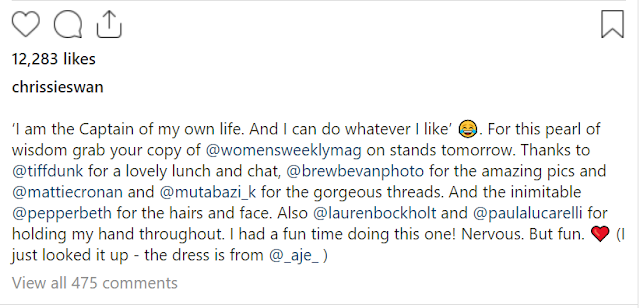
A possible reason is that the world picture that women like Chrissie Swan receive from the culture includes the idea that the aim of life for women is empowerment. This is defined as having the power to freely do whatever you have a mind to do without negative consequence or judgement. As evidence that this mindset has influenced Chrissie Swan there is the following social media post:


She is justifying her decision to leave her partner on the basis that "I am the Captain of my own life. And I can do whatever I like". She is asserting here her "empowerment" as an individual and her commitment to solo development.

What this is leading to is a phenomenon in which some middle-class Western women are now seeing the family stage of life as a temporary aberration. They have a single girl period in their teens and twenties, then find a decent family-oriented guy to have children with in their 30s to mid-40s, before reasserting a full commitment to the empowerment model in later middle-age.

Chrissie Swan

The empowerment model is incompatible with marriage and family life. It is sold to women as representing the good of their sex, but this is highly questionable. Here is how Chrissie Swan describes her new lifestyle:
I have been spending a fair bit of time utterly alone...It’s a weird kind of exhilaration and joy from knowing all I need is myself....Last Friday I even went apple picking alone - and I highly recommend it. I’ve spent some time in my vege patch (I have no idea what I’m doing). I’ve also been buying myself flowers and taking myself out on walking dates, coffee dates, lunch dates and to the movies. Best company ever!
Yes, having quiet time to decompress is important for people with high pressure working lives. I cannot believe, though, that she could not have negotiated this with her partner. And I simply do not accept the idea that a woman buying herself flowers and taking herself out on dates is the higher good for the female sex. It is, rather, a deprivation of one of the higher goods in life, namely spousal union.

There is a conflict in our culture between the goods of empowerment and spousal union. The good of empowerment I think is not only a lower good, but mostly a false one. To date yourself and then later to spend old age alone does not fit the design for human life, at least not for the ordinary person. It takes a great deal of energy for someone to convince themselves otherwise and to make their peace with it.

The good of spousal union, like all higher goods, is not easily achieved. It does not just happen naturally, but requires an uncommon level of commitment for a couple to work their way through difficult times. It also has a logic of its own. For instance, it makes sense for those oriented to spousal union to try to maintain a sexual polarity, so that we bring something to the union that we cannot provide ourselves - hence, no pride in being entirely self-sufficient. In the past, marital unions were conceived in terms of spouses gifting something to each other, which is difficult to do if there is a complete flattening of distinctions between men and women. 

It is also the case that a spousal union asks of us that we be worthy of being joined together with our spouse. We are challenged to show a better aspect of who we are. The emphasis is not just on feeling, or for that matter, on receiving. There is instead a challenge of being - of what we are called to be in relationship with our spouse.

Thursday, November 04, 2021

Two moralities?

It can seem at times that liberal moderns have a disdain for moral standards. I once wrote a post, for instance, about a controversy surrounding the singer Cardi B. She had made a music video featuring a host of semi-naked women "twerking". In response to criticism she argued that the video showed that women could do whatever they wanted. Fans similarly defended her by arguing that it was empowering for women to express their sexuality however they wanted to and that the video positively expressed female bodily autonomy.

This is the libertine or permissive aspect of liberalism. It almost directly expresses a Hobbesian metaphysics. Hobbes, if you remember, believed that humans were acted on to pursue their passions. No desire could be held to be either better or worse than another. What mattered was a freedom to pursue our own desires with the least constraint from other people. To have this freedom required power. We are therefore "empowered" when we can act with the least constraint in pursuit of our desires whatever they might be. Just like Cardi B.

However, I don't believe that this is the end of the story when it comes to liberal moderns and morality. As I attempted to describe in my last post, most of my liberal acquaintances are not libertines. On the contrary, they are conscientious to a fault and keenly want to be thought of as good people (which perhaps helps to explain their moral conformism, i.e. their need for a group consensus in taking a moral position).

The problem for these liberals is that they are attempting to process moral decisions through a distorted moral framework. Professor Jonathan Haidt identified five moral foundations in world cultures; unsurprisingly the three "group focused" moral foundations have withered away in liberal societies, leaving just the two "individualising" foundations, namely fairness and harm. If you no longer believe that it is moral to uphold the group you belong to, then issues of "fairness" will not consider the impact of moral decisions on the cohesion of your own longstanding communal traditions. 

Imagine you are a liberal and have no concern for the "loyalty" moral foundation. It might then seem perfectly moral to you to have open borders because if you are only considering things in terms of "disgrouped" individuals, then there will be no reason to see your relationship with someone living in a different and distant culture any differently to your relationship with your own countrymen. It will, in fact, seem unfairly "discriminatory" or even "racist" to make such a distinction.

It has profound consequences to abandon the group focused moral foundations. Not only does it dissolve, over time, the "thicker" forms of human community, it means that we are no longer culture bearers, but rather something like tourists looking on as outsiders to the cultures of others, or even (as in welcome to country ceremonies) acknowledgers of the ancestry of others rather than our own. If we are no longer culture bearers, then we lose to some degree a meaningful connection to people and place and to a tradition that connects us to past and future generations. We have less reason to feel a sense of duty to uphold, defend or improve upon the standards of the tradition we are responsible for and there will not be the same sense of pride and achievement in what our own forebears have accomplished.

As an example of a more traditional mindset, consider the Ephebic oath that the young men of Classical Athens swore:

My native land I will not leave a diminished heritage but greater and better than when I received it.

Of course, having the group focused moral foundations does not mean that you cannot also have the individualising ones as well - it is a matter of balancing the two. In Jonathan Haidt's research, he found that this is what conservatives tend to do.

Which brings me to my final point. It is common for the churches to try to signal a more selfless kind of morality by emphasising the idea of service to others. This, it is true, does not fit in readily within a Hobbesian framework.

It is notable, though, that the end product is usually the same as that of liberal moderns. It leads the churches to call for more porous borders, for a greater flow of refugees, for an end to discrimination and so on. The problem, again, is that the ethos of service to others is being interpreted through the individualising moral foundations that have been left standing within a liberal culture. 

There are honourable exceptions to this trend that show how differently an ethos of service appears when it is expressed through a more complete set of moral foundations. You can see this in the writings of Cardinals Robert Sarah (herehere and here) and Raymond Burke (here). Historically, you have figures like Bishop Clemens von Galen of Munster. 

Joining a church might therefore have a positive benefit to an individual, but it is not a political solution in itself. It will not, in itself, restore the group focused moral foundations, particularly when these have already been so deeply undermined.

There is no easy way out, but one positive step would be to decisively reject the metaphysics that we have inherited from men like Hobbes. How, for instance, can we restore the moral foundation of loyalty, if we still follow the anthropology which begins with the idea of men being set apart from each other in a state of nature, in a war of all against all, and only brought into coexistence via a social contract? 

Saturday, August 15, 2020

Does Emma Watson's formula really empower women?

Emma Watson, the actress best known for her childhood role in the Harry Potter films, is a feminist. She recently had this to say:

This might sound benign, but the moral formula she puts forward here has significant consequences. She is claiming that women are empowered when they can do whatever they want, no matter what it is that they want.

Of course, if this were just a case of wanting to wear different types of shoes, it would be harmless. But as a general principle of society, the liberal formula goes well beyond that. After all, if women are empowered when they can do exactly what they want, then the woman who wants to be a good mother by making personal sacrifices for her child is on exactly the same plane as the woman who sells herself on Only Fans to fund a drug habit. As James Kalb so often writes, all desires are equally desires. According to the formula, both women are empowered as long as they can follow their desires.

If you think my example is a bit extreme, consider the case of singer Cardi B who I wrote about last year. She and her fans responded to criticisms of her twerking videos by using the Emma Watson defence, namely that it is empowering for women to do whatever they want. Cardi B has just this month taken the principle even further by releasing a video that would have made prostitutes of yore blush. It is being marketed widely (with the lyrics, but not the video, partly censored) to girls, presumably in part because it fits in well with the ruling ideal of female empowerment.

The liberals who pushed the idea that we should do whatever we want as long as it did not interfere with the rights of others to do the same did not envisage Cardi B as the end product of their moral formula. They assumed that people would choose to act according to the middle-class standards for men and women of their era, i.e. as gentlemen and ladies. They thought that education would refine people, and reveal their inner high character.

It was not a realistic assessment of human nature. Nor did they account for the logic of their formula, i.e. for its failure to discriminate between the moral choices that we make. The message this formula sends is that there are no moral goods as part of the nature of things but only the satisfaction of individual wants. This alone would be enough to gradually erode a gentlemanly code of ethics, but in the longer run the subversion becomes more active. After all, if I am empowered when I can act to satisfy my desires, then it is moral for me to transgress and to break through restraints placed on my behaviour. The further I go in shocking sensibilities, the more liberated and empowered I am. Cardi B becomes the role model.

There was a time when acting exactly as you want would not have been thought empowering, but as lacking self-restraint. There was a range of moral terms to express this failure of self-discipline: dissolute, licentious, decadent, debauched, abandoned, incontinent, promiscuous, profligate, dissipated. The terminology suggests the moral concept: that in acting in an unrestrained way to gratify desires, we are no longer fully ourselves, but are lost in some way to our vices. Lost, not empowered.

Monday, January 28, 2019

Just how free is Cardi B?

Cardi B is a popular Caribbean-American singer. A recent song, "City Girls", currently has 32 million views on YouTube. The song not only has coarsely sexual lyrics, the video clip features more than a dozen women dressed in G-strings twerking, i.e. shaking their backsides suggestively.

It's supposed to be sexy, but I couldn't help but find it culturally alien. It just seems so odd - there are women standing on their heads twerking, others on their back, some of them squatting. It looks atavistic - a reversion to a primitive mating ritual.

I think there's a reason for my response to the video, which I'll explain later. But I'd like to begin with this:


Stephanie Hamill's complaint is that Cardi B's video does not empower women. That's a poor way of criticising what's on display. After all, in a liberal society "female empowerment" means women rejecting customary restraints on their behaviour in order to do whatever they feel like doing.

Cardi B is dutifully following the logic of female empowerment. She is expressing her sexuality as she wants to, without regard for any traditional standards or norms. She is taking empowerment to the next level.

And that's exactly what many of those commenting on Stephanie Hamill's tweet pointed out. A selection:


Cardi B herself replied to Stephanie Hamill along similar lines:


So saying the video is not "empowering" is ineffective. People will just respond by arguing that the video shows women asserting their power to act however they want, without judgement, and that there should be no negative consequences in doing so. This is precisely in line with what female empowerment is understood to mean.

So what is a better way of criticising the video? Liberals would have us believe that they are creating a society based on freedom and equality, by which they mean a society of equally autonomous individuals. However, the issue of female empowerment highlights that you cannot have an equality of autonomy - that this cannot, in practice, be realised, and therefore the attempt to achieve it is misconceived. Second, the issue of female empowerment demonstrates the falsity of the liberal understanding of freedom.

In other words, the liberal approach does not deliver in practice either true freedom or equality - and these are the very things that liberalism attempts to base itself on.

Let's start with equality. Some of the comments to Stephanie Hamill's tweet pointed out that there is a double standard when it comes to sexual expression. Women are "empowered" by twerking their naked backsides, but if men were to expose themselves in public in a similar way they would be condemned.

What this points to is that it is difficult to apply the principle of acting however you feel to both sexes. In general, if you want women to be able to choose whatever they feel like, without judgement or consequences, then men have to be the ones to enable these choices, to bear the brunt of the fallout of these choices, and to act responsibly to hold society together.

It's not surprising, then, that at a time when women are encouraged to be "empowered", men's behaviour is increasingly scrutinised, monitored and policed and that men are often held to traditional standards in a way that women no longer are.

Which brings me to the most important point to be made in all this. It was once thought that man was a "rational animal", meaning that man had both an animal nature but also a rational nature that could discern the good and that could direct the animal passions to their proper ends. Freedom was understood to mean the achievement, through disciplined habits of virtue, of a rational self-control over our own person.

It's not that the animal passions are necessarily bad or to be suppressed; the insight is that we are only free to act as we know we should when we are in our right mind, rather than under the control of our animal passions.

And that was embedded within Western culture for millennia. That's why there are so many derogatory terms in our language for a loss of rational self-control over our animal impulses: dissolute, dissipated, wanton, licentious, promiscuous, libertine, loose, profligate - even the term "liberal" was once sometimes used in a pejorative way in this sense.

And I think that's why Cardi B's video seems so culturally alien to me. There is no restraint on the animal passion side of human nature in it. It depicts humans as rutting animals; there is no influence of the rational nature that was once considered pivotal to human freedom.

Would someone under the direction of their rational nature favour sexual immodesty? I don't think so. The higher good is for men and women to achieve a deep and stable emotional and physical intimacy with a person of the opposite sex, one that will provide enduring support even into old age.

Someone who is oriented to this goal will act modestly when it comes to their sexuality. They will be oriented to spousal love, and will want to give of themselves to that end, not promiscuously.

The aim for women, just as for men, is not to be "empowered" in the liberal sense, but to order themselves to the good, including the common good of the communities they belong to.

Monday, March 26, 2018

So what changed?

If you were to think of the way that female character is formed, in big picture terms, then a great change has occurred over the past 150 years.

It was once the case that women were expected to cultivate virtue. There was no single purpose in doing so. It might have been intended to benefit a woman's spiritual life. Or, perhaps, to help her become a better wife, mother or daughter. A woman might have cultivated virtue to overcome personal character flaws, or perhaps character flaws typical of her sex. Alternatively, the cultivation of virtue might have been aimed at fulfilling or realising the better parts of her nature as a woman (so that a part of her own essence was allied to the good).

And then liberalism entered the scene and said to women that there was no need to cultivate virtue. The liberal message was that you should simply do what you want, or be what you want, as long as you didn't restrict others from doing the same. If there were any ethical standards they were now aimed at "liberating" individuals from unchosen standards or identities, or else enforcing the "non-interference" rule (even if this itself became highly intrusive) via concepts like non-discrimination, equality, inclusiveness and so on.

Our society does not celebrate women being virtuous but being "empowered," which is to say, placed on a path of solo development, in which family relationships and biological sex are thought of as accidental to identity or life purposes.

This means that there has been a shift in what gives a measure of self-discipline to women's lives. The effort to succeed academically and the demands of workplace professionalism do require self-discipline from young women. But personal relationships less so. If personal relationships do not provide the social context in which virtue is practised, then they become a sphere in which fewer bounds are acknowledged, not even those imposed by nature.

There will never be a better culture of relationships when there is so little emphasis on virtue. If we men are dissatisfied with how things are, then we have to set things back on track - we have to steer the culture back the right way.

There will be women who will be on board. After I started writing this post, a young woman on Twitter made the following thread:


This young woman is helping to pave a way forward to something better, by identifying specifically feminine virtues to cultivate. She adds the following to her list:


Note the variety of traits that she is promoting. Some of them are virtues we typically associate with women; others are qualities that are rarer in women but of high value in relationships.

The last one is an overarching trait, in which feminine identity is connected to a transcendent good:


She has articulated all this exceptionally well. She has reconnected to virtue, to family and to womanhood and in doing so denied to liberalism a power over her own mind. The more who can do this, the stronger will be the pushback within the mainstream culture.

A note to Melbourne readers. If you are sympathetic to the ideas of this website, please visit the site of the Melbourne Traditionalists. It's important that traditionalists don't remain isolated from each other; our group provides a great opportunity for traditionalists to meet up and connect. Details at the website.

Friday, November 05, 2010

Men's role is to empower women for what exactly?

There was an article in the New York Times recently which described women as being "empowered" by their growing advantage in education and careers:

You could easily compile statistics to make the case that women — at least Western women — are already empowered. In the United States, we are 50 percent of the workplace (and 51.4 percent of managerial and professional jobs). We receive three college degrees for every two earned by men (along with 60 percent of all master’s degrees, about half of all law and medical degrees and 43 percent of M.B.A.’s). Working wives are coming close to bringing in nearly half the household income. Single, childless urban women under 30 actually earn 8 percent more than their male peers.

Elizabeth Cady Stanton would be pleased. She was one of the early American feminists who wrote in 1887:

The two great sources of progress are intellect and wealth. Both represent power, and are the elements of success in life. Education frees the mind from the bondage of authority and makes the individual self-asserting. Remunerative industry is the means of securing to its possessor wealth and education...

Even back then, Stanton's aim was "power" which was to be achieved through education and career. Hence, the more that women succeed at university and at work the more they are held to be "empowered".

The purpose of this power for Stanton? It was not directed to any social aim. It was intended to bring to women an autonomous existence. In Stanton's own words, the aim was the "self-dependence of every human soul", in which a woman had "self-sovereignty; because, as an individual, she must rely on herself". Stanton believed in the "isolation of every human soul and the necessity of self-dependence".

But if women get autonomy through education and careers and thereby became empowered, what then of the family? Well, it gets downgraded in importance. Stanton wrote of family relations as being "incidental":

it is only the incidental relations of life, such as mother wife, sister, daughter, which may involve some special duties and training

She wrote also that,

the love of offspring ... calls out only the negative virtues that belong to apathetic classes, such as patience, endurance, self-sacrifice

(Stanton's attitudes not only fit in with the larger liberal culture, but they possibly have a personal origin as well. There were 11 children in Stanton's family but all of the boys died young. In her wikipedia article we find this:

Writing of her brother, Eleazar's, death in 1826, Stanton remembers trying to comfort her father, saying that she would try to be all her brother had been. At the time, her father's response devastated Stanton: "Oh, my daughter, I wish you were a boy!")

So Stanton's wishes have been fulfilled and young women are now doing better in their educational and career results than men. So are women now empowered? According to the New York Times article, the answer is no. The changes have not yet made women feel empowered:

It isn’t true until it feels true. That’s because measuring women’s power by looking only at women — and by looking mostly at the workplace — paints a false picture.

It seems that the problem is men. Women won't feel properly empowered until we men get with the female empowerment programme:

The life-work dilemma for women has long been that “the workplace has changed in their favor, but home hasn’t,” she says. Men, however, “have the opposite problem. More is expected of them at home, but expectations have not shifted at work.”

Younger couples say they want and expect parity in their relationships. But many women still carry a chip on their shoulders, chiseled in part by years of keeping all those to-do lists in their heads. And if men can find no relief from the pressures of work, they are not going to be able to fit into the revamped economy of home.

How then to inch toward change? Can we make it “manly” (or even better, “gender neutral”) to spend a day with a child, or earn less money but have more family time, or be the only parent at a parent-teacher conference because your wife has a meeting?

It's an odd sensation reading this as a man. The female journalist, Lisa Belkin, assumes that our role as men is to prop up a female individualism. She makes this explicit later in the article:

Empowering American women can no longer focus only on women — on leveling playing fields or offering mothers “on-ramps” and “offramps” or shattering ceilings one at a time. All those efforts must continue, yes. But none will succeed if we don’t change our expectations for men. Or, more accurately, men’s expectations for themselves.

So men are merely instruments to be manipulated for the empowerment of women? I don't think so, sister.

Note too the difficulty that feminists have here. According to them, the maternal role is the subordinate, secondary and disempowering one. And yet that's the role they want men to pick up. But if the good in life is to be "empowered" by careers, why would men do this? Feminists are forced into the position here of arguing to men, "do this even though we believe it will hurt you".

And then there's Lisa Belkin's suggestion of persuading men to get with the programme by making it "manly" to do so. The assumption here is that there is no unchanging essense to masculinity, but that it's whatever we make it to be. Which makes it not very much at all.

So what's a New York Times feminist to do? She looks approvingly to Sweden where policy pushes men into taking child care leave. Initially in Sweden, either the husband or wife could choose to take the paid leave offered by the state. Only 4% of men chose to do so. The state therefore decided not to allow men and women to choose. Some of the leave had to be taken by the husband. So now 80% of men take paid leave.

The problem for Lisa Belkin is that liberalism is supposed to be about autonomous choice and not state coercion. So she is forced into a verbal contortion to express her support for what the Swedes have done:

By steering men toward a particular path, Sweden redefined the nature of choice. Parental leave was transformed ... from an emotional decision to a financial one; from something mothers do to something every parent does. Would that same kind of redefinition — of the relationship between work and home, of the roles of men and women — work on this side of the Atlantic?

Sweden redefined the nature of choice alright. You are allowed to choose what the feminist state wants you to choose.

The next time you hear a liberal say they respect difference, just remind them that liberals aren't too good at accepting differences in the roles of men and women. The preferred end point of liberalism is one in which, in Lisa Belkin's words, parental roles are "gender neutral", i.e. identical.

I won't launch into it now, but there's also a discussion to be had here about the purposes of power. Is it really true that power is to be deployed to prop up our own individualistic purposes? Can you run a society along these lines?

I would have thought that power was properly directed toward larger social aims, such as the proper functioning of social institutions. Or, at the individual level, it's purpose is to direct the will toward the expression of character and moral purpose. Already in 1887, Elizabeth Cady Stanton seems to reduce it to an instrument of mere "self-assertion".