Showing posts with label patriotism. Show all posts

Sunday, August 23, 2026

Tony Abbott is not our man

I was listening to a discussion between Reuben Slife and Marc Barnes, and they ventured into the topic of how the idea of nation changed during modernity.

Marc Barnes: You have the loss and sometimes the very deliberate loss of the concept of the people...that there are peoples who operate together, who have a charity, who have a love for each other, and who have a sense of their own being, as having a history. That's precisely what gets swept away as ignorant, as the enlightened modernity turns to the elevation of the individual and the contractual relationship, so that "peoples" become this sort of thing that you may or may not enter into, but it always doesn't really penetrate to the depths of a person.

Reuben Slife: The people is a basic concept of politics...yet the concept does take on a different meaning in the Enlightenment where it becomes a, what would you call it?, an agglomeration of a bunch of individuals into a whole, it becomes a numerical thing, and like you add it up into the people, and so when you say "we the people" you mean something like "all of us, the free individuals, who made our rational choices, banded together and said this is the rational thing". It's related to social contract theory and all of that. But as you said there's the difference between that and this really ancient sense of me being a part of a unity that pre-exists me and that has a history that defines me and within which I operate and that starts getting lost in Enlightenment modernity, even as it starts to substitute a different concept for the people.

This may seem like an academic discussion of sorts but, unfortunately, it is still highly relevant to the way that politics is playing out today.

Reuben Slife (left) and Marc Barnes

I'm going to use my own country, Australia, as the example, although conditions are similar elsewhere. For decades, both of our major parties, Liberal and Labor, have been committed to extraordinarily high levels of immigration. This makes sense if you have two underlying political assumptions.

The first is the modern concept of nation as being, as Reuben Slife puts it above, "an agglomeration of a bunch of individuals....it becomes a numerical thing." The second is a belief that the primary role of government is to increase the GDP - not to have better living standards, but just to have a larger economy.

If you adopt both of these principles, then adding more people means you are both "building the nation" rather than replacing it, and "building the economy" even if GDP per capita is stagnant, so that there is no real improvement in the standard of living. 

Therefore, if we wish for our political class to act differently, we need to challenge both assumptions. This will require some effort. I was reminded of the difficulties involved when having a polite debate on the issue with a left-leaning work colleague. He readily conceded that real GDP was stagnant, but was nonetheless adamant that immigration was a good thing because it meant the GDP numbers would go up. The idea has been around so long it is just something that is not critically examined, not by either side of politics.

The other highly relevant aspect of the Slife/Barnes discussion is the changing notion of the word "nation". Modernity did not abandon the older lexicon - it keep the same philosophical terms but radically changed their meaning. This includes words like freedom, justice and rights. This makes a political "theory of mind" much more difficult. We hear moderns using certain words and assume that we have a common point of reference. But we don't.

I have a very specific example of this to use: the Australian politician and former Prime Minister, Tony Abbott. In response to the rise of the populist One Nation Party, Abbott is trying to win back conservative voters by highlighting his commitment to patriotism. He created a social media video with Senator Michaelia Cash, in which she says, "Tony, I love our flag, I love our country, and I love our values":


It would be easy for an ordinary socially conservative Australian to think that these two were patriotic in the same sense that they themselves are. But the truth is different. These two have the Enlightenment model of nation, the one in which countries are just agglomerations of individuals who choose to live in a certain place.

And so Tony Abbott made another video explaining that anybody could be an Australian as long as they held to certain liberal political values, including supporting "a healthy pluralism, an equality of rights, freedom of expression, of conscience, of religion". 

What is the effect of holding such a view? Well, it means that you lose any specific identity to your nation. It means that a nation is no longer made up of a particular, distinct people, with its own history, culture and tradition. Abbott has been consistent in promoting such a view. Here are some quotes from his speeches over the years:

a. More than any other, the English-speaking culture is prepared to take people from anywhere on their own terms. No one who can speak English is really a foreigner in any of the English speaking countries. (source)

b. The essential principle animating the Federation Fathers...was citizens’ greater freedom to pursue their individual destinies. (source)

c. My instinct is to extend to as many people as possible the freedom and benefits of life in Australia. A larger population will bring that about provided that it’s also a more productive one. (source)

d. I want to say how brave every single migrant to this country is, because every single one of you has done something that those who are native born have never done. You have been gutsy enough to take your future in your hands and to go to a country which is not yours and make it your own...[migrants] make the very best Australian citizens eventually. They are the most worthy, the most welcome parts of the Australian family. (source)

e. The immigrant who feels like a stranger in our midst is really at the heart of the Australian story. To the extent that it is a celebration of our nation, Australia Day is necessarily a salute to an immigrant culture. (source)

f. A very significant part of Howard's achievement has been to massage away the pessimistic and narrow-minded aspects of Australian conservatism. Fear of Asia, mistrust of difference, obsessive concern with whether people are getting more than their share are much less part of our national make-up than they were. (source)

I would hope that these quotes demonstrate just how distant Abbott is from any principled defence of the existing Australian national identity, let alone a defence of the founding people of Australia. It cannot happen with him, it will not happen with him, because the political principles which animate him do not allow for it to happen. 

Our task is to make sure that we do not keep voting for those who remain trapped in the Enlightenment paradigm. We should not mistake his nation for ours. We do not have the same understanding of what the word means. 

In the short term we can vote for populist candidates, even if they do not perfectly represent us. In the longer term, we need to deliberately raise a generation to hold a different set of principles, one that does allow for a defence of who we are. 

Wednesday, September 28, 2022

Pope Francis on love of homeland

Pope Francis is not exactly known for being a conservative in the Catholic Church, but nonetheless he recently made a good defence of patriotism. Speaking on the topic of the morality of defending one's own country, he stated:

To defend oneself is not only licit, it’s also an expression of love toward one’s homeland; whoever doesn’t defend something, doesn’t love it. Instead, those who defend, love.

I particularly like the way he framed this, as it captures something important about patriotism. When you belong to a genuine national tradition, you see the good in it, and this naturally draws our love - it becomes a love of a significant good, perhaps even a type of transcendent good (a good that draws us to a higher aspect of reality and of ourselves). It then becomes natural to want to defend this good, which is why people will make sacrifices to uphold their national tradition, including making commitments to family life, to raising the next generation, to wanting to maintain the moral standing of the nation they are a part of, to creating a worthy national culture and so on.

The Catholic Church has something of a mixed record on the issue of defence of homeland, and no doubt it was easier for Pope Francis to make his comments, given that he was supporting the right of Ukraine to obtain weapons, and Ukraine is currently considered a progressive cause. 

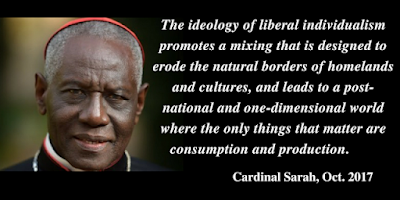
Still, there are many voices within the Catholic Church arguing for patriotism, so Catholics should not be pressured into thinking that they must support globalism. Cardinal Robert Sarah is one such voice:


Cardinal Sarah is aware that globalism favours a technocratic vision in which people become "fungible", i.e. become mutually interchangeable units of production or consumption to the detriment of their personhood.

Similarly, Cardinal Burke has given an extensive speech on the issue, drawing on the work of St Thomas Aquinas. Cardinal Burke concludes by rejecting a globalist agenda:

It is clear that we and our homelands have responsibilities within the international community, but those responsibilities can only be fulfilled through a sound life in the family and in the homeland. Patriotism, in fact, fosters the virtue of charity which clearly embraces citizens of other nations, recognising and respecting their distinct cultural and historical identity.

...The divine authority, in accord with the order written upon the human heart, does not make just and legitimate a single global government...On the contrary, God meets us and orders our lives for the good in the family and in the homeland.


A note to Melbourne readers. If you are sympathetic to the ideas of this website, please visit the site of the Melbourne Traditionalists. It's important that traditionalists don't remain isolated from each other; our group provides a great opportunity for traditionalists to meet up and connect. Details at the website. 

Thursday, January 16, 2020

Cardinal Burke, Christianity & love of country

Cardinal Raymond Burke gave a speech last year on the issue of patriotism. It's worth reading as it affirms traditional Catholic teaching that many Catholics might not be aware of.

His speech is titled "Filial piety and national patriotism as essential virtues of the citizens of heaven at work on earth".

Cardinal Burke begins by reminding his listeners that there is a transcendent truth by which we should attempt to order our lives:
Our happiness during our earthly pilgrimage and at its destination, eternal life, depends on the conformity of our daily living with the truth, that is, with the good order with which God has created and sustains the world and, in a most particular way, man and woman.

But is a patriotic love of country an aspect of this truth, of this good order which God has created? According to the church it is, as a matter of justice, piety and charity.

How are these virtues connected to patriotism? Let's begin with piety. Cardinal Burke says,
It is the virtue of piety...which expresses our recognition of the truth and our humble obedience before the truth...Piety...inspires and strengthens us to live the truth of our being as creatures created in the image and likeness of God to know, love and serve Him...

I'll go off topic for a moment here to point out that liberalism is impious when it claims that there is only meaning when we author or define our own being, in any direction, according to our own designs.

To put it simply, piety is recognising that we are created by God, that this is a truth of our being, and that it is right to love and to serve God.

What does this have to do with patriotism? This can be explained in terms of the virtue of justice. Justice means giving what is due to others. We have a debt to those who have formed us, who are responsible for our being. If God is primary in this respect, as outlined above, our parents and our family are secondary, as is our country. Therefore, piety is rightly directed not only toward God but to giving due honour and reverence, love and service, and fulfilling our obligations and duties toward our family and our nation. In this sense, piety toward God rightly flows as well into piety toward family and nation. It is the same virtue, the same "obedience before the truth" and one that calls forth charity, an expression of love, in this case, of family and nation.

Cardinal Burke quotes the theologian Louis Bouyer who wrote (in 1963):
The virtues of filial piety and piety toward fatherland...are annexes of the virtue of justice

Cardinal Burke goes on to note that filial piety is included as one of the commandments:
While the Fourth Commandment commands us to honour our father and mother, to show to our parents the piety which flows from the recognition that they have cooperated with God in giving us the gift of human life, it also commands the piety owed to the wider community in which marriage and family are possible and indeed flourish.

This quote from St Thomas Aquinas is also significant:
I answer that, Man becomes a debtor to other men in various ways, according to their various excellence and the various benefits received from them. On both counts God holds first place, for He is supremely excellent, and is for us the first principle of being and government. In the second place, the principles of our being and government are our parents and our country, that have given us birth and nourishment. Consequently man is debtor chiefly to his parents and his country, after God. Wherefore just as it belongs to religion to give worship to God, so does it belong to piety, in the second place, to give worship to one’s parents and one’s country.

Cardinal Burke comments:
It is clear from the Angelic Doctor’s exposition that, not only is patriotism not a sin, but it is a requirement of nature itself. The term, worship, when applied to one’s parents and one’s country, as St Thomas makes clear, is distinct from divine worship which is given to God alone. The second sense of worship is analogous and refers to the piety or devotion shown to those who cooperate with God for our good.

The New Catholic Encylopedia puts all this very clearly:
But patriotism as a form of charity, or love, has a more specific object in its actuation than mankind or the human family as such. According to St Thomas Aquinas, the particular love of one’s fatherland is an important aspect of that preferential form of charity that is called pietas. Through piety the person has an obligation of love to God, parents, and fatherland. Each is in some sense a principle of man’s being: God through creation; parents through procreation and education; fatherland through a formation of one’s cultural and historical identity.

It is also worth noting Cardinal Burke's comment on this passage:
Patriotism is an aspect of the grace of piety, which in its turn is an essential part of the matter of charity. Christ gives the grace of piety, through the outpouring of the Holy Spirit, in order that we can live the truth of our human nature.

Patriotism as such is a precept of the natural law.

That's a powerful way to understand the issue.

Cardinal Burke understands as well the importance of nations in fostering intergenerational loyalties, so that we do not fall into the "presentism" of liberal modernity:
This piety is at once a deeply personal virtue and a powerful force to bring together the generations, allowing the young to take root in the soil of the old and the old to engraft their experiences onto the young, so that we sense that home is a place where the passing day partakes of long ages past and to come.

From the Catholic catechism:
[t]he love and service of one’s country follow from the duty of gratitude and belong to the order of charity

Finally, Cardinal Burke states very clearly the opposition of the Catholic Church to the replacement of nations by a world government:
It is clear that we and our homelands have responsibilities within the international community, but those responsibilities can only be fulfilled through a sound life in the family and in the homeland. Patriotism, in fact, fosters the virtue of charity which clearly embraces citizens of other nations, recognising and respecting their distinct cultural and historical identity.

...The divine authority, in accord with the order written upon the human heart, does not make just and legitimate a single global government...On the contrary, God meets us and orders our lives for the good in the family and in the homeland.


A note to Melbourne readers. If you are sympathetic to the ideas of this website, please visit the site of the Melbourne Traditionalists. It's important that traditionalists don't remain isolated from each other; our group provides a great opportunity for traditionalists to meet up and connect. Details at the website.

Saturday, July 27, 2019

Richard Chenevix Trench

Richard Chenevix Trench
It's common today for Christianity to be associated with open borders and globalism. But it wasn't always so. It was once held to be perfectly normal within Christian culture for people to express a patriotic love of country.

As an example, I'd like to revive some poems by a once popular, but now largely forgotten, nineteenth century English poet, Richard Chenevix Trench.

Trench was a senior ranking cleric in the Church of England, being appointed the Dean of Westminster Abbey and later the Archbishop of Dublin.

He wrote the following poem (from a volume published in 1835) on sighting the British flag flying at Gibraltar on the way home from an overseas journey:
Gibraltar

England, we love thee better than we know,—
And this I learned, when, after wanderings long
Mid people of another stock and tongue,
I heard again thy martial music blow,
And saw thy gallant children to and fro
Pace, keeping ward at one of those huge gates
Which, like twin-giants, watch the Hereulean straits:
When first I came in sight of that brave show,
It made my very heart within me dance,
To think that thou thy proud foot shouldst advance
Forward so far into the mighty sea;
Joy was it and exultation to behold
Thine ancient standard's rich emblazonry,
A glorious picture by the wind unrolled.

Trench wrote the next poem after vising the Italian town of Sorrento. He thought the place so delightful that the thought of living there was appealing. However, he knows he would not be content doing so, as we only find peace doing "Heaven's work and will" and this means carrying out our "appointed task" in our "natural sphere", i.e. our homeland. Trench believes that God intends for each one of us to serve our own nation and that if we abandon this sacred duty, and choose to act selfishly, we will not find inner peace.

TO ENGLAND.

WRITTEN AFTER A VISIT TO SORRENTO.

They are but selfish visions at the best,
Which tempt us to desire that we were free
From the dear ties that bind us unto Thee,
That so we might take up our lasting rest,
Where some delightful spot, some hidden nest
In brighter lands has pleased our phantasy:
And might such vows at once accomplished be,
We should not in the accomplishment be blest,
But oh! most miserable, if it be true
Peace only waits upon us, while we do
Heaven’s work and will: for what is it we ask,
When we would fain have leave to linger here,
But to abandon our appointed task,
Our place of duty and our natural sphere?

The following poem also captures Trench's patriotic feeling. He writes that although our eternal promise is a better country than any on earth (heaven) he is still, in his living heart, a son of England:
ENGLAND.

We look for, and have promise to behold
A better country, such as earth has none—
Yet, England, am I still thy duteous son,
And never will this heart be dead or cold
At the relation of thy glories old,
Or of what newer triumphs thou hast won,
Where thou as with a mighty arm hast done
The work of God, quelling the tyrants bold.
Elect of nations, for the whole world’s good
Thou wert exalted to a doom so high—
To outbrave Rome’s “triple tyrant,” to confound
Every oppressor, that with impious flood
Would drown the landmarks of humanity,
The limits God hath set to nations and their bound

(The last part of the above poem seems to refer to England's victory in the Napoleonic Wars. He is accusing Napoleon of trying to extinguish nations, the "landmarks of humanity", through conquest, thereby violating God's act of appointing nations and their boundaries.)

There are other interesting poems by Trench on other themes, but I'll leave these for a future post.

A note to Melbourne readers. If you are sympathetic to the ideas of this website, please visit the site of the Melbourne Traditionalists. It's important that traditionalists don't remain isolated from each other; our group provides a great opportunity for traditionalists to meet up and connect. Details at the website.