Showing posts with label Christianity. Show all posts

Saturday, July 20, 2024

Conservatism: A Rediscovery Part 2

I'm reading the book Conservatism: A Rediscovery by Yoram Hazony. In the first post on this topic I focused on Hazony's dismay that conservatism was often understood to mean conserving Enlightenment liberalism and I illustrated his point with the following social media post:


Rebecca is one of those people that Hazony is frustrated with. She identifies conservatism with the liberal principle of individual autonomy, of a freedom "to be who we want and do as we wish".

Interestingly, quite a few readers challenged Rebecca's claim that Christianity was set against the American political founding. Rebecca often argues that Christianity is a source of authoritarianism and therefore does not fit in with the "constitution, freedom and liberties". Her opponents had this to say:

And this:


Which raises the interesting question of what role Christianity had in making the American political system successful or not. My own view is that America would have floundered without it, but that it is nonetheless not sufficient in itself as a basis for a successful political conservatism.

Why did America need Christianity? Well, Christianity provided something of a limit to the worst features of political liberalism. If liberalism says "what matters is that I am free to be who I want and do as I wish" then all that matters is that I do not interfere with others doing the same. The moral focus tends to be on non-interference: on openness, tolerance, non-discrimination and on on. But otherwise there is a very permissive society in which anything goes.

But Christian metaphysics introduces a different kind of principle. If God created the world, including us, then there is a good in the reality that we inhabit that we can discipline ourselves to follow. Value does not simply come from the act of choice itself; what we choose matters. There are qualitative distinctions between what is higher and lower within our character and within our actions. Christian metaphysics upholds the ancient Western characteristic of thinking of some things as having a noble quality and others as base.  

And so, even if political liberalism was permissive, the Christian culture that was embedded in American life was not. It had standards of decency, and positive ideals of human character. However, once the influence of Christianity ebbed, then the dissolving logic of political liberalism was able to unfold, to the detriment of American social life. There was no longer a clear way to define the good, or to acknowledge any form of authority outside of our own wills (expect what was defined formally by the law). 

Which raises a further question. Could the formula of Christianity plus political liberalism ever be a viable one? I don't think so. First, it is inevitable that those raised in a public culture that is liberal will chafe against the restraining influence of Christianity. If you believe that what matters is individual preference, then the standards once set by Christianity, which are accorded an authority outside of our own wills, will come to be looked on negatively as "authoritarian". In recent times this way of thinking has become more extreme with some on the left worried about a tyrannical Christian theocracy:


At the same time, if liberalism is installed as the system through which public life is organised, then it is likely to exert an influence on the Christian churches, making them increasingly liberal over time. This is a widespread issue, not just affecting American churches. In 1975 the Catholic Church made reference to the problem in a document titled Persona Humana:

What the Catholic Church recognised here is a tendency to erase qualitative distinctions in our character and acts, and therefore to collapse into secular liberal values, by appealing to the idea of everyone having equal dignity as images of God and/or that the only thing that matters is that we love one another (the "all you need is love" mantra). 

Finally, there are aspects of tradition that are not as clearly or definitively upheld in the Bible as they might be, and therefore a political conservatism or traditionalism is needed alongside Christianity to defend them. For instance, the Bible does assume that people belong to nations, i.e., that these are the expected forms of human community that derive from and that are blessed by God (see here). However, the defence of nations is not an overt focus of the New Testament, and so it is not likely that a Christian culture, by itself, would prove adequate to this particular cause - at least not in the modern era when such powerful forces are dedicated to a globalist order.

And so I don't think the combination of an Enlightenment liberalism, restrained by a Christian culture, was ever likely to hold. There needed instead to be a mutually reinforcing relationship between a certain type of conservative politics and Christianity. What that conservative politics would look like then becomes the key issue.

Monday, January 22, 2024

Patria & Christianity

Christianity is sometimes held to be a universalist religion. I think that's a flawed understanding, given the assumption in both the Old and New Testaments that people live in God-given nations.

First, let me acknowledge that Christianity is clearly not a tribal religion. The Christian God is conceived to be the God of all nations. Second, it is also clear that we are to extend the moral code of the Bible to all people, not just to those who belong to our own group.

I'd like to focus on one particular Bible passage, from a letter written by Paul to the Ephesians (3:15). The usual translation runs as follows:

For this reason I bow my knees before the Father, from whom every family in heaven and on earth is named, that according to the riches of his glory he may grant you to be strengthened with power through his Spirit in your inner being.

One interesting thing about this passage is that the word translated here as "family" is in its original Greek the word patria. Patria in modern English means "one's native country or homeland". And what did it mean to the Greeks? 

According to the Expositor's Greek Testament:

The noun πατριά [patria]...means sometimes ancestry, but usually family, race or tribe, i.e., a number of families descended from a common stock, nation or people...Here the word seems to have the widest sense of class, order, nation, community.

The scholars I turned to for the definition of "patria" see it as having a wider meaning than "family" in the sense that we use the term (there is a different word in the Bible for one's household). They consider it to refer to family in a more extended sense such as a clan (think of the Scottish Highland clans who share a common surname denoting a shared ancestry or lineage) or to a tribe or nation (see here for a definition).

So Paul is writing that every extended family/clan/nation on earth is named from God the Father. What does this mean? Well, there are different interpretations, but some commentaries emphasise the idea that "patria" are divinely instituted, albeit imperfectly realised, models of community. Ellicott, for instance, defines "patria" as:

every body of rational beings in earth or heaven united under one common fatherhood, and bearing the name (as in a family or clan) of the common ancestor.
He explains the passage as meaning:

The Apostle looks upon the fathers whose names they delight to bear as the imperfect representatives of God, and upon the family itself, with its head, as the type in miniature of the whole society of spiritual beings united in sonship to the Father in heaven

Another commentator writes:

God is the prototype Father; He is the archetypical Father. Every other family derives its family pattern from Him. There is a policy of Scripture that relationship to God revolves around the family. Our descent from the Father affects our nature...

...there is the idea that God formed the principle of the family as a divine institution. This is especially important in our time because of the assault on the family. The family originates in the very nature of God as Father

The Expositor's Greek Testament has this:

The sense, therefore, is “the Father, from whom all the related orders of intelligent beings, human and angelic, each by itself, get the significant name of family, community”. The various classes of men on earth, Jewish, Gentile, and others, and the various orders of angels in heaven, are all related to God, the common Father, and only in virtue of that relation has any of them the name of family. The father makes the family; God is the Father of all; and if any community of intelligent beings, human or angelic, bears the great name of family, the reason for that lies in this relation of God to it.

On this interpretation, God created the patria which are patterned on a model of community that spans both the earth and the heavens. God is the ultimate source of all the patria and the patria function in this world as a necessarily imperfect manifestation of a more perfect or ideal model of community derived from God the Father.

Where else in the Bible do we find the word "patria" being used? Well, there is Luke 2:4:

And Joseph also went up from Galilee, from the city of Nazareth, to Judea, to the city of David, which is called Bethlehem, because he was of the house and lineage of David

Here patria has been translated as lineage, but the commentary again states that the word itself means "Lineage, ancestry; a family, tribe. As if feminine of a derivative of pater; paternal descent, i.e. a group of families or a whole race." This passage is not as meaningful as the first one but is an example of ancestry or tribe being part of the cloth of human community in the Bible.

More significantly there is Acts 3:25. This is normally translated as follows:

You are the children of those prophets, and you are included in the covenant God promised to your ancestors. For God said to Abraham, ‘Through your descendants all the families on earth will be blessed.’

Here, again, the word patria has been translated by "families", even though it means a more extended family of people with a common lineage or ancestry. The King James Version opts for the word "kindreds". Meyer's NT commentary insists the translation should be "nations". Barnes writes:

The word translated "kindreds" πατριαὶ patriai denotes "those who have a common father or ancestor," and is applied to families. It is also referred to those larger communities which were descended from the same ancestor, and thus refers to nations, Ephesians 3:15. Here it evidently refers to "all nations."

So God is saying to Abraham that, through his descendants, all the nations on earth will be blessed. Why would there be mention of nations being blessed if nations are not part of the divine order?

Wednesday, September 28, 2022

Pope Francis on love of homeland

Pope Francis is not exactly known for being a conservative in the Catholic Church, but nonetheless he recently made a good defence of patriotism. Speaking on the topic of the morality of defending one's own country, he stated:

To defend oneself is not only licit, it’s also an expression of love toward one’s homeland; whoever doesn’t defend something, doesn’t love it. Instead, those who defend, love.

I particularly like the way he framed this, as it captures something important about patriotism. When you belong to a genuine national tradition, you see the good in it, and this naturally draws our love - it becomes a love of a significant good, perhaps even a type of transcendent good (a good that draws us to a higher aspect of reality and of ourselves). It then becomes natural to want to defend this good, which is why people will make sacrifices to uphold their national tradition, including making commitments to family life, to raising the next generation, to wanting to maintain the moral standing of the nation they are a part of, to creating a worthy national culture and so on.

The Catholic Church has something of a mixed record on the issue of defence of homeland, and no doubt it was easier for Pope Francis to make his comments, given that he was supporting the right of Ukraine to obtain weapons, and Ukraine is currently considered a progressive cause. 

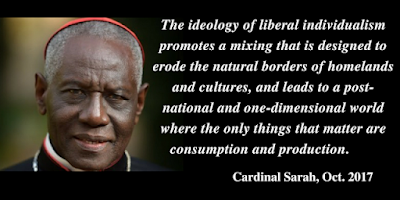
Still, there are many voices within the Catholic Church arguing for patriotism, so Catholics should not be pressured into thinking that they must support globalism. Cardinal Robert Sarah is one such voice:


Cardinal Sarah is aware that globalism favours a technocratic vision in which people become "fungible", i.e. become mutually interchangeable units of production or consumption to the detriment of their personhood.

Similarly, Cardinal Burke has given an extensive speech on the issue, drawing on the work of St Thomas Aquinas. Cardinal Burke concludes by rejecting a globalist agenda:

It is clear that we and our homelands have responsibilities within the international community, but those responsibilities can only be fulfilled through a sound life in the family and in the homeland. Patriotism, in fact, fosters the virtue of charity which clearly embraces citizens of other nations, recognising and respecting their distinct cultural and historical identity.

...The divine authority, in accord with the order written upon the human heart, does not make just and legitimate a single global government...On the contrary, God meets us and orders our lives for the good in the family and in the homeland.


A note to Melbourne readers. If you are sympathetic to the ideas of this website, please visit the site of the Melbourne Traditionalists. It's important that traditionalists don't remain isolated from each other; our group provides a great opportunity for traditionalists to meet up and connect. Details at the website. 

Tuesday, January 22, 2019

The Bible, nations & migration

Scott Greer makes a good point in this tweet:


As an example, when an American Catholic priest, Fr Frank Pavone, announced his support for border protection he was roundly condemned by people who assumed that this was unChristian:


It seems to me that there is an important issue to be resolved here when it comes to Christianity. I'm going to try to explain what the issue is and how it might be resolved, but I want to make it clear at the outset that I do so without claiming theological expertise, so I am very much open to listening to other points of view.

The issue is that there seem, at least on the surface, to be two principles in the Bible that run against each other. Those who think that the Bible is supportive of open borders can point to some passages in the New Testament. The most powerful one is Matthew 25:31. In this passage, Matthew writes of the second coming of Jesus and of Judgement Day. He writes that Jesus says "I was a stranger and you took me in" as one criterion of who will be judged righteous.

Another is the parable of the Good Samaritan in Luke. In this parable, the "good neighbour" is a Samaritan who has mercy for an Israelite, despite the two groups being in opposition. The field of mercy, benevolence and compassion is here defined as extending even to our enemies (which fits with the "love thy enemy" principle).

Unsurprisingly, there are liberal Christians who, on the basis of such passages, argue for open borders or for large scale refugee programs. An example:


The Australian Catholic Migrant and Refugee Office bases its support for immigration and refugee programs on the ground that:
In the Gospel, Jesus compels us to welcome the stranger (Matthew 25:35)

Is it, then, an open and shut case? Does Christianity compel us to accept a borderless, nationless, one world philosophy?

Well, no. There are other passages in the Bible, in both the Old and New Testaments, which clearly indicate that it is part of God's design for people to live in nations. The aim is not to dissolve such distinctions.

Even the Matthew quote, about the second coming, begins with the natural division of mankind into distinct communities: "All the nations will be gathered before him." This suggests that Matthew himself thought that the "take in the stranger" message was not to be understood in a way that would undermine the existence of unique nations of people.

From Paul (Acts 17:26) "From one man he made every nation of humanity to live all over the earth, fixing the seasons of the year and the national boundaries within which they live."

From Deuteronomy 32:8 - "When the Most High gave the nations their inheritance, When He separated the sons of man, He set the boundaries of the peoples."

Remember, too, the Tower of Babel (Genesis 11:1–9). This describes humanity attempting to defy God's plan for people to live in separate nations, with different languages, which then displeases God. God punishes those who seek to erase national distinctions.

There is more, which I will try to explain shortly. But I'd like to return to Matthew. How can you reconcile the principle of hospitality that Matthew sets out ("I was a stranger and you took me in") with the Biblical principle of a humanity divided into distinct nations with borders established by God?

I think it helps to consider how hospitality might have been understood within the existing Hebraic tradition and culture. Here is how one professor describes the background to New Testament hospitality:
The terrain surrounding Jerusalem is rugged and unforgiving: rocky hills with little water to the west, forbidding desert to the east, scorching temperatures most of the year. Travel could be dangerous, so hospitality to the traveller was an ongoing need and a sacred duty. The New Testament is full of images and stories of guests received, both those already known as friends and those strangers who are taken in and transformed into guests. Among nomadic tribes, the guest comes under the protection of the host, who guarantees inviolable safety. The important elements of hospitality include the opportunity for cleansing dusty feet, scented oil to soften dried skin and mask odors of the road, food, shelter, security, and companionship.

It should be noted too that there had been, historically, a custom of nomadic pastoralism among the Jews:
A nomadic camp consisted of about 25 to 50 members. Any less and it would be difficult to protect the family and any more would be difficult to feed. Usually the oldest member of the family was the head, or chief, of the tribe. The remainder of the clan would consist of his brothers, sons, nephews and grandsons as well as their wives and children. Each clan was an independent entity with the chief as judge and ruler. He had the ultimate authority in all manners including where they go, discipline, management of the flocks and herds and the daily tasks of the camp.

When a clan became too large to support, it was divided and separated with all of the clans belonging to one tribe. The name of the tribe was generally that of the original family patriarch and each clan of the tribe carried the name of its original patriarch.

...One of the major responsibilities of the clan is to provide hospitality to anyone who comes to them. This may be a member of a related clan or even an enemy of another tribe. In both cases it was the responsibility of the clan to provide food, shelter and protection as long as they were within their camp.

You can see from this:

1. Hospitality is especially important when conditions of travel are difficult. You have to imagine a time before modern transport and communications systems.

2. There was already a well-developed culture of hospitality existing at that time, in which protection was to be afforded the traveller.

You can see why Matthew would not have thought it a contradiction to accept hospitality as a test of benevolence whilst at the same time accepting nations as a divinely ordained plan for humanity.

Hospitality was embedded within the culture, to the point that it had rituals that were observed. There was likely to be a single guest who would be temporarily hosted before continuing his travels. The guest might be known already to the clan (lowest level of benevolence) or be a stranger (higher level) or even from a hostile tribe (highest). However, most guests would have been fellow Jews.

Given that a patriarch ruled the clan, that guests were mostly travellers, and that most guests were fellow Jews, it's not the case that the culture of hospitality would have ceded either political power or cultural dominance to a radically different population.

In other words, hospitality as a test of benevolence would not have led to many millions of permanent residents arriving suddenly from a different continent.

The problem is that there are some Christians today who want a form of hospitality that does have this outcome, i.e. one that would lead the host nation to be subsumed under the weight of mass immigration. For instance, the female pastor quoted above claims that there are no limits on immigration allowed by the Bible:


This seems to me to be taking the letter of the law rather than its underlying principle.

Earlier I wrote that there were other reasons for doubting that the Bible compels us to have open borders. One of them is that there are multiple defences of "storge" in the New Testament, the type of love that is generally associated with love of family and nation.

The use of terms like "agape" and "storge" to describe different kinds of love is not always clear cut, but one scholar describes "storge" in the New Testament as denoting "a natural affection, a sentiment innate and peculiar to men as men...Hence of the natural love of kindred, of people and king (the relation being regarded as founded in nature)".

Paul, in Acts 1:31, says of the unrighteous that they are without storge, translated usually as "without natural affection". This is part of a longer text in which Paul states that God reveals himself to man in the creation, but that the unrighteous choose to act nonetheless in a series of naturally disordered ways, one piece of evidence for this is that they lack "storge".

Then there is Paul's second epistle to Timothy, in which he writes "But mark this: There will be terrible times in the last days. People will be lovers of themselves, lovers of money, boastful, proud, abusive, disobedient to their parents, ungrateful, unholy, without love [without storge], unforgiving, slanderous, without self-control, brutal, not lovers of the good, treacherous."

That Paul regarded such natural kinship relations, and the duties flowing from them, as being part of a rightly ordered community is evident from other passages. Paul writes for instance, in 1 Timothy 5:8, that "if any provide not for his own, and especially for those of his own house, he has denied the faith, and is worse than an unbeliever." Similarly (1 Timothy 5:4) "But if any widow have children or nephews, let them learn first to shew piety at home, and to requite their parents: for that is good and acceptable before God."

This idea of love of kin and country as a naturally ordered affection survived into the culture of Christian countries. Metternich in 1820 wrote of "one of the sentiments most natural to man, that of nationality." And in 1828 Eliza Fenton, on a sea journey to Australia, was unsettled to find that one of the crew was an Englishman turned Arab. She observed that,
His taste seems to lie in laying bare the unsightly movements of the human heart and crushing its better feelings, or dwelling on them with bitterness and ridicule...Poor fellow! though it always makes me nervous to hear him speak, I pity him too; he may not always have been what he now is; has he been made this [way] by disappointment or alienation from the humanising relationships of life?

The significant point in all this is that the loves that we have for family and people, i.e. the natural affections (and duties) that flow from kinship, are not alien to New Testament thought, and their absence is considered proof of unrighteousness and of the fall of society and social relationships in the end days.

Finally, I'd like to look at some of the traditional teaching of the Catholic Church on the question of both patriotism and immigration.

The Catechism (2241) is supportive of secure borders: "The second duty is to secure one's border and enforce the law for the sake of the common good." As the Catholic Encyclopedia puts it (in the entry on "justice"): "It is the function of the State to protect its subjects in their rights and to govern the whole body for the common good."

Also from the Catholic Encyclopedia (on "migration"): "The justification [for restriction] is to be found in the right of a nation to control the variations of its own population....Restrictive measures are also justified...on the general ground that a national family has a right to say who shall join it."

From Catholicism.org:
Patriotism is a great virtue. To be a patriot is to love one’s fatherland. This means that it is to love the land of the people that sired you. Patriotism is a natural overflow of the virtue of piety — that is, the virtue of the home. As piety would have us rendering what is due in justice to parents and other family members, patriotism would have us render the same to our nation, its government, and our fellow citizens. Both of these are a matter of justice, for the virtues of piety and patriotism are parts of that cardinal virtue. Over and above justice is the theological virtue of charity, which also enters into a consideration of Catholic piety and patriotism. After God, we love our neighbors, that is, those who are “nigh” to us, meaning near us. Those most near to us are our parents and our siblings.

Our charity, as well as the just demands of piety and patriotism, spread out in broadening concentric circles from the family home to the neighborhood, to the town or city, to the state, to the region, to the nation (or empire), of which we are a resident, citizen, or subject. If we see our country as “our people” — something much more possible in homogeneous, non-pluralistic societies — it is much easier to see how piety quite naturally becomes patriotism...Thus patriotism is a rootedness in the land and its people.

Tuesday, July 10, 2018

Bishop Schneider: mass migration a plan to undermine identity

Bishop Athanasius Schneider has an interesting family history. His forebears were Black Sea Germans, invited by Catherine the Great to that part of the Russian Empire. However, during the Communist era, the Black Sea Germans were persecuted. Schneider's parents were sent away to a gulag (forced labour camp); years later they finally returned to West Germany - the logical place to resettle given their German ethnicity.

He was interviewed this week on a variety of issues and this is what he had to say about immigration:
CWR: Having moved around so extensively as a child – you were born in Kyrgyzstan, then moved to Estonia, then Germany, and joined your order in Austria – what are your thoughts on the whole idea of immigration, whether in Europe or the United States, or in general?

Bishop Schneider: We have to distinguish between different types of immigrations. I was a migrant, with my family, because we were persecuted and deported. When people are really persecuted, you need to help them. But as for the phenomenon of the European so-called immigration, it is clear and evident by what we can observe, that this is an orchestrated action of the international powerful political organizations. It is the aim, the clear aim, to take away from Europe its Christian and its national identity. It is meant to dilute the Christian and the national character of Europe. The majority of the so-called migrants are Muslims, so there is going on also an Islamisation of Europe.

Of course, these people are not guilty, but they are used as means by powerful organizations. This we cannot accept. We have to state that it is not just to destroy the Christian and national identity of Europe by means of this artificial immigration. International political powers stimulated and fostered the war in Syria in order to have some occasions to start the great immigration process. The immigration from Africa via the Mediterranean Sea is as well artificially created – they put the people in ships and boats, and create then situations of shipwrecking. It’s already very evident. We cannot as a Church be instrumentalized in the process of the destruction of the Christian and national identity of Europe.

It is refreshing that the Bishop takes seriously the importance of preserving the character and identity of Europe and that he recognises that immigration is being used as a political tool by powerful elites.

In another interview Bishop Schneider added the following:
Bishop Athanasius Schneider of Kazakhstan, 57, told an interviewer from Milan’s Il Giornale last week that “the phenomenon of so-called “immigration” represents an orchestrated and long-prepared plan by international powers to radically change the Christian and national identities of the European peoples.”

The Church, he said, was being exploited.

“These powers use the Church's enormous moral potential and her structures to more effectively achieve their anti-Christian and anti-European goal,” he stated.

“To this end they are abusing the true concept of humanism and even the Christian commandment of charity. "

Asked to comment on Italy’s new and very outspokenly Euro-skeptic Minister of the Interior, Matteo Salvini, the bishop said that he did not know Italy’s political situation well, but that he applauded any European government’s attempt to emphasize their nation’s sovereignty and “historical, cultural, and Christian identity” against “a kind of new Soviet Union” with “an unmistakably Masonic ideology”: the European Union.

A note to Melbourne readers. If you are sympathetic to the ideas of this website, please visit the site of the Melbourne Traditionalists. It's important that traditionalists don't remain isolated from each other; our group provides a great opportunity for traditionalists to meet up and connect. Details at the website.

Thursday, February 27, 2014

Is the bishop out of order?

The Catholic Church is struggling right now. The latest news is that a Catholic bishop, Mgr Jean-Michel di Falco, has spoken out against parties wanting to restrict immigration into France. Why? The Catholic bishop offers up this theology:
It would be betraying Christ not to proclaim over and over again today his message of love for all, without discrimination of any sort. Remaining silent would be to renounce him. Is the Church like one of those luxury hotels rising arrogantly over shanty towns where everything is arranged so that tourists don't have to come into contact with the misery and poverty? And are the walls of our cathedrals too thick to be permeated by the voices of those who suffer? God speaks through immigrants also. And what if it were the face he takes on to make us rediscover that which is essential? While our indifference and our disdain do not grasp the full relevance for today of Christ's words: "They have eyes that don't see and ears that don't hear."

I wish the bishop would think these things through. Not much can survive such a theology and certainly not the Church.

I'll begin with my minor criticism of his position. If Catholic France were to follow this policy, then Catholic France will abolish itself. If Catholics show their virtue by the degree to which they welcome the mass immigration of Muslim Africans into their country, then you might as well start taking down the cross and putting up the star and crescent.

Is it really the destiny of the Church to abolish itself?

My major criticism is that the bishop's theology dissolves the particular relationships that we are made for in favour of an abstract universalism - and this goes against the Old and New Testaments, the natural law and church tradition.

What the bishop is arguing is that it is wrong to have a particular love for your coethnics, as a particular love discriminates against those who aren't part of your ethny. We should have a love for all without discrimination is the key to the Bishop's theology.

But how then can our other particular loves be defended? Am I allowed to have a paternal love for my daughter as a father? Isn't this a particular love, a love that discriminates, rather than an abstract universal love for everyone equally? What about my wife? Don't I have a particular love for her that is designed to be to the exclusion of all others? How can this be, if there only exists a universal, non-discriminatory love? And is it moral for me to honour my own parents, rather than everyone's parents equally?

Isn't it true that secular moderns use very similar language to that of the bishop to argue against the traditional family? Don't secular moderns say that it doesn't matter what form the family takes, what matters is that we love without discrimination? Therefore, argue the secular moderns, it doesn't matter if a woman deliberately creates a fatherless family, or if we have families with two fathers and no mother. How can the bishop argue in principle against these secular moderns when he is so closely aligned to them?

The Bishop is leaving no place for fidelity: no place for the particular relationships that call us to a service that is selfless in one sense but that nonetheless fulfils important aspects of self and identity

His is a theology that is dissolving of true human relationships.

One final point. The bishop assumes that it is migrants who are the voice of suffering. That is a rash assumption. It is just as likely to be the native French who feel abandoned by those in power; who feel powerless; who feel intimidated; who are subject to violence.

Why is the bishop indifferent to their cause?

A Christian has a choice when it comes to relationships. He can interpret Christ's message the way that the bishop has, as dissolving particular loves and duties in favour of a non-discriminatory, universal love.

The choice made traditionally by the Church, and the one that fits more consistently with the Bible and with natural law, is to retain the particular loves and relationships we were made for, but to recognise that one of these particular relationships is with the stranger, who is made in God's image.

If you take the second option, the one held by the Church through most of its history, then you need to order the relationships in such a way that our duty to each can be upheld, so that one relationship doesn't rule out the others, and each is given its due weight.

Sunday, June 30, 2013

Another significant Benedict quote

In 1997 the then Cardinal Ratzinger, later to be Pope Benedict, gave a long interview to a German journalist, Peter Seewald.

In this interview, Pope Benedict rejected the idea that men and women are interchangeable in their roles in society. He explained the belief in interchangeable roles in a similar way that I do. According to Pope Benedict, moderns think of freedom as being a liberty to self-author or self-create. But to be free to self-author means rejecting the given parts of our nature.

Pope Benedict described the modernist mentality this way:
The idea that 'nature' has something to say is no longer admissible; man is to have the liberty to remodel himself at will. He is to be free from all of the prior givens of his essence. He makes of himself what he wants, and only in this way is he really 'free and liberated'. Behind this approach is a rebellion on man's part against the limits that he has as a biological being. In the end, it is a revolt against our creatureliness. Man is to be his own creator - a modern, new edition of the immemorial attempt to be God, to be like God.

Moderns believe that in taking this approach they are maximising individual freedom. That's supposed to be the selling point.

But what kind of freedom is it really? In the traditional view, my identity as a man connects me to a masculine essence, which exists independently of me as an objective value. But in the modern view, there is only an arbitrary, invented identity that doesn't connect me to anything outside myself. It seems that in adopting the modern view I am losing something rather than liberating myself.

Monday, December 03, 2012

Canadian Anglicans, what are you doing?

Think you've heard it all? Earlier this year a group of eight female Anglican priests performed a play in the Christ Church's Cathedral in Hamilton, Canada. A large audience greeted the play with laughter and a standing ovation.


Smiling Canadian priestesses

What's so bad about that? Well, the play was Eve Ensler's Vagina Monologues. It's a play in which a young teenage girl finds salvation in lesbian sex with an older woman and in which the men are presented as hellish rapists and abusers of women. If you read the play you can't help but think it's the product of a very sick mind. And yet here we have it being performed by smiling priestesses in an Anglican Cathedral and being cheered on by the audience.

Even though these people are fellow Westerners, I don't see myself as belonging to what they have become. They are hurtling away from me; the split is irrevocable.

Saturday, May 05, 2012

Sisters of Marxianity

Laura Wood has posted some items which are rightly critical of the Leadership Conference of Women Religious (LCWR), the largest organisation of American nuns.

I went to the LCWR website and found it to be inspired more by radical leftist ideology than by Christianity. A good example is a statement on racism which runs like this:
Racism in its institutional form continues because some people assume, consciously or unconsciously, that white people are superior. Therefore, the dominant race of whites develop and maintain institutions that privilege people like themselves and give less credibility to the contributions of other peoples and cultures. White privilege often goes unnoticed because it has been internalized and integrated as part of one’s outlook on the world by custom, habit and tradition.

Peggy McIntosh, author of White Privilege: Unpacking the Invisible Knapsack, wrote about her experiences of white privilege. Her education gave her no training in seeing herself as an oppressor and advantaged person. Any work to benefit others was to allow "them" to be more like whites. She described white privilege as similar to an invisible weightless knapsack of special provisions, assurances, tools, maps, guides, codebooks, passports, visas, clothes, compass, emergency gear, and blank checks.

Social rules about what work is, who works for whom, how work is compensated, and the social process by which the result of work is appropriated operate to establish relations of power and inequality. These relations are reinforced by a systematic process in which the energies of the have-nots are continuously expended to maintain and augment the power, status, and wealth of the haves. This structural relationship between social groups is exploitation. (Iris Marion Young, Justice and the Politics of Difference)

That's a left liberal analysis of race, not a Christian one. The left liberal analysis goes like this:
i) The aim of politics is to disband unchosen social ties so that we are left as self-determining individuals subject to the same autonomous conditions of life

ii) Our race, just like our sex, is predetermined rather than self-determined and therefore must be made not to matter

iii) But race does still seem to matter. Some races do worse than others in education, in employment, in crime statistics etc.

iv) This is to be explained by a dominant group setting themselves up as a false racial category (whites) in order to enjoy an unearned privilege at the expense of an oppressed group (blacks)

v) Whiteness is therefore an artificial and oppressive social construct which only those whites seeking supremacy would want to uphold.

vi) White privilege is also to be regarded as systemic, as the institutions and culture of society were created to serve it

vi) Whites should therefore seek to deconstruct themselves and their society as whiteness is a uniquely immoral category associated with race supremacy and privilege

When the nuns endorse Peggy McIntosh's complaint that she was not educated to see herself as a white oppressor they are following not Christianity but left-liberalism.

Christianity cannot follow along the same lines as left-liberalism as Christianity accepts that we have a creator which means that we do not autonomously self-create who we are. To put this another way, if you believe that you are autonomously self-created, then you do not have the Christian view of man's relationship to God.

So Christians will focus on different things to liberals. Less on achieving equally autonomous life conditions and less on making predetermined qualities not matter.

If race does matter in certain respects that does not invalidate the core purposes of Christianity. It does not require Christians to resort to a class/oppressor analysis or to seek to deconstruct white people and white society.

The minds of the nuns of the LCWR have been colonised by a secular ideology. They may as well be just any other kind of leftist academic or political activist. They have made themselves redundant as nuns and therefore it is no surprise that their numbers are falling so rapidly.

Sunday, April 29, 2012

A Christian defence of nationalism

Ruskin at Occidental Traditionalist has posted an interesting Christian defence of nationalism. He writes:
Before birth God assigns to every man the species, sex, family, and nation to which s/he will be given. These assigned identities can never be truly revoked. In this case we are dealing specifically with the nation and to a lesser extent; the family. Since God has pre-selected for us our nation it is our responsibility to love what God has chosen. To express our appreciation, beyond prayer, would be to love one's nation, the people who built it, the land which sustains it, and the culture which had sprung forth from it.

Reading that is going to give a liberal a headache, as the emphasis here is not on self-chosen identity but on appreciating an identity we are assigned by God - an identity that is so part of us that it cannot be wholly abandoned.

Ruskin argues, tellingly I believe, that we express our appreciation for what God has chosen by acting on our responsibility to love our nation, our forebears, and the land and culture to which we are connected.

Wednesday, December 28, 2011

We need to reform Christian culture

Why has the West fallen so far? The major culprit is the state ideology, namely secular liberalism. But I think it has to be recognised as well that the current Christian culture also feeds into this liberalism and so reinforces the problem.

In short, we are going to have to challenge the current Christian culture with a more traditionalist one.

So what is the problem with Christianity today? One problem has to do with a preeminent Christian virtue, that of caritas. In the Bible we read quotes like the following:

Jesus said unto him, Thou shalt love the Lord thy God with all thy heart, and with all thy soul, and with all thy mind.

38 This is the first and great commandment.

39 And the second is like unto it, Thou shalt love thy neighbour as thyself.

40 On these two commandments hang all the law and the prophets.
And this:

as you would that men should do to you, do you also to them in like manner

Such quotes have led to a belief amongst many Christians that the highest virtue, and the path to salvation, is a selfless love of the other that transcends any particular distinctions. This can then lead to the idea that the best Christian is the one who goes furthest in sacrificing himself for the "other".

You can see how this fits in with liberalism. The liberal script is similar: the liberal elite considers itself morally superior insofar as it practises non-discrimination toward the other, unlike the non-liberal mainstream.

The current, popular understanding of caritas within Christian culture has major problems. It dissolves the particular loves and loyalties on which communities are founded in favour of a "perfected love" which is proved by "selflessly" transcending the particular. The Christian subject effectively becomes an abstracted individual, just as the liberal subject is abstracted.

Once again, we traditionalists are up against what has become established as an orthodoxy. So how do we challenge this orthodoxy?

Not by rejecting caritas as a virtue. If we love God, and if we hold that men are made in the image of God, then our loving concern for other men does not stop at those to whom we are more particularly related.

However, that doesn't mean that our particular loves and duties are rendered null and void. The Catholic Church has recognised this by formulating an "ordo caritas":

The exercise of charity would soon become injudicious and inoperative unless there be in this, as in all the moral virtues, a well-defined order...

The precedence is plain enough...Regarding the persons alone, the order is somewhat as follows: self, wife, children, parents, brothers and sisters, friends, domestics, neighbours, fellow-countrymen, and all others.

It's important, too, that Christians don't talk themselves into an abstracted sense of self that isn't enjoined on them by the Bible. As I pointed out in a previous discussion of this issue:

If I love my neighbour as I love myself I will wish for him the objective goods in life. That will include that he enjoy membership in a traditional community of his own. I will want his life to be rightly ordered.

But remember - I am loving him as I love myself - so to the extent that I wish upon him this objective good so too would I wish it upon myself and to those closest to me.

And my first responsibility in working for the achievement of these goods is to myself and those closest to me extending out in a circle to my family and friends, my neighbours, my countrymen and then all others.

Nor is caritas to be understood as a forced emotionalism. The Catholic doctrine is that the seat of caritas is to be found in the will rather than the emotions:

Its seat, in the human will. Although charity is at times intensely emotional, and frequently reacts on our sensory faculties, still it properly resides in the rational will a fact not to be forgotten by those who would make it an impossible virtue.

Finally, it's also important to remember the context in which Jesus was teaching. Judaism at the time of Jesus was divided into a number of currents: the Pharisees, the Sadducees and the Zealots. Jesus appears to criticise the leading faults of each of these currents. The Zealots, for instance, were focused on violence; the Sadducees were elitist; and the Pharisees were concerned with the letter of the law:

An important binary in the New Testament is the opposition between law and love. Accordingly, the New Testament, presents the Pharisees as obsessed with man-made rules (especially concerning purity) whereas Jesus is more concerned with God’s love; the Pharisees scorn sinners whereas Jesus seeks them out. Because of the New Testament's frequent depictions of Pharisees as self-righteous rule-followers, the word "pharisee" has come into semi-common usage in English to describe a hypocritical and arrogant person who places the letter of the law above its spirit.

The story of the Good Samaritan can be read in the light of this. An "expert in the law stood up to test Jesus" and asked Jesus who exactly was his neighbour that he should love as himself. Jesus then told the story of the man who was robbed and who wasn't helped by passers-by until a stranger, a Samaritan, came by.

A reader, Gerry T. Neal, commented on this in a previous discussion as follows:

Jesus was not interested in answering the man's question but in addressing the spirit that lay behind it. By asking "who is my neighbor", the lawyer was hoping to get a definition of "neighbor" that would enable him to say "okay, these are the people I have to love, I don't have to love these other people". This reflects the legalistic attitude of "I will do what is required of me - but only the very minimum".

The parable Jesus tells, in which a robbed person, left to die on a highway, is ignored by the people who should be most concerned with helping him, and is helped by a member of a despised rival ethnic group, speaks to that attitude. The people who walked by the man in need found reasons to justify their not stopping to help. That is the kind of justification the lawyer was looking for. Jesus was not willing to give it.

This parable then, does not mean that our specific duties to love specific people, have been abrogated by Jesus and replaced with a universal command to love everybody equally. It means that our requirement to love our family and kin, our friends and neighbors, and our countryman, does not translate into an excuse for a lack of compassion and charity towards others to whom we do not have those specific bonds of attachment.

We are not to have a "closed off" attitude of doing the minimum required by the letter of the law. That's not supposed to be the motivating spirit. Jesus emphasised this because his interrogator was a Pharisee. If we were walking along and saw someone of another ethnic group in trouble would we help out? Or would we turn our backs because we thought, in a legalistic sense, we weren't obliged to assist?

Surely it is possible to think that we would stop and help a fellow human being, as an act of loving concern (caritas), without then dissolving all particular human relationships into an abstracted "serve the other". The former is clearly enjoined on us by the Bible. The latter is not.