She recently discussed the reason for the separation. It piqued my interest because it resembles what other middle-aged women have told me about why they left their husbands/partners.
...in saying goodbye to this chapter, she regained herself. When Chrissie was 45-year-old, she noticed – like many other women – she took care of everyone's needs before her own. Four years later, she is happier than ever and is embracing her best single life.What Chrissie Swan is describing, in talking about service to others, is the altruistic love that was once thought to characterise the feminine personality. For instance, in 1958 Marie Robinson wrote that,
"I was 45 and I thought, I'm not having much fun. To be honest, I was doing exactly what most women do and I was putting everyone first," she told 7News.
Despite the pressure for women to find 'the one' in their 20s and 30s, Chrissie feels that she has rather gained a better appreciation for life and everything on offer. "I think society tells us that we don't need to be by ourselves as women," she said. "We are the mothers, the friends and the wives... we're supposed to get our life blood from being of service to people, and that wasn't true for me at all."
Related to this feeling in her, to her sense of security, seeming almost to spring from it, indeed, is a profound delight in giving to those she loves. Psychiatrists, who consider this characteristic the hallmark, the sine qua non, of the truly feminine character, have a name for it: they call it “essential feminine altruism.” The finest flower of this altruism blossoms in her joy in giving the very best of herself to her husband and to her children. She never resents this need in herself to give; she never interprets its manifestations as a burden to her, an imposition on her.So here is the unusual thing. Chrissie Swan is rejecting altruistic love, even though it is how past generations of women expressed a core aspect of themselves, and even though she was not making that many sacrifices in terms of her own individual ambitions and lifestyle. After all, she was pursuing a busy, high status, successful and well paid career during this time, and she had the wealth to outsource much of the domestic work.
In other words, her service to her family did not prevent her from pursuing other aims in life; nor need it have been burdensome in terms of workload. So why then choose to go solo?
A possible reason is that the world picture that women like Chrissie Swan receive from the culture includes the idea that the aim of life for women is empowerment. This is defined as having the power to freely do whatever you have a mind to do without negative consequence or judgement. As evidence that this mindset has influenced Chrissie Swan there is the following social media post:
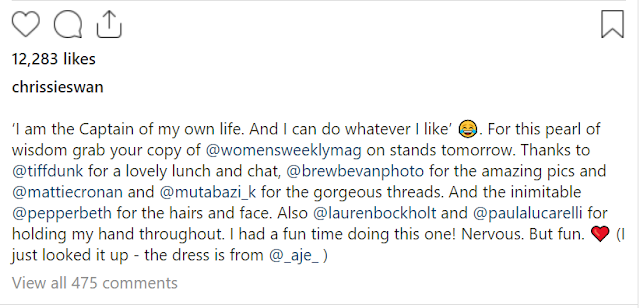
She is justifying her decision to leave her partner on the basis that "I am the Captain of my own life. And I can do whatever I like". She is asserting here her "empowerment" as an individual and her commitment to solo development.
What this is leading to is a phenomenon in which some middle-class Western women are now seeing the family stage of life as a temporary aberration. They have a single girl period in their teens and twenties, then find a decent family-oriented guy to have children with in their 30s to mid-40s, before reasserting a full commitment to the empowerment model in later middle-age.
 |
| Chrissie Swan |
The empowerment model is incompatible with marriage and family life. It is sold to women as representing the good of their sex, but this is highly questionable. Here is how Chrissie Swan describes her new lifestyle:
I have been spending a fair bit of time utterly alone...It’s a weird kind of exhilaration and joy from knowing all I need is myself....Last Friday I even went apple picking alone - and I highly recommend it. I’ve spent some time in my vege patch (I have no idea what I’m doing). I’ve also been buying myself flowers and taking myself out on walking dates, coffee dates, lunch dates and to the movies. Best company ever!
Yes, having quiet time to decompress is important for people with high pressure working lives. I cannot believe, though, that she could not have negotiated this with her partner. And I simply do not accept the idea that a woman buying herself flowers and taking herself out on dates is the higher good for the female sex. It is, rather, a deprivation of one of the higher goods in life, namely spousal union.
There is a conflict in our culture between the goods of empowerment and spousal union. The good of empowerment I think is not only a lower good, but mostly a false one. To date yourself and then later to spend old age alone does not fit the design for human life, at least not for the ordinary person. It takes a great deal of energy for someone to convince themselves otherwise and to make their peace with it.
The good of spousal union, like all higher goods, is not easily achieved. It does not just happen naturally, but requires an uncommon level of commitment for a couple to work their way through difficult times. It also has a logic of its own. For instance, it makes sense for those oriented to spousal union to try to maintain a sexual polarity, so that we bring something to the union that we cannot provide ourselves - hence, no pride in being entirely self-sufficient. In the past, marital unions were conceived in terms of spouses gifting something to each other, which is difficult to do if there is a complete flattening of distinctions between men and women.
It is also the case that a spousal union asks of us that we be worthy of being joined together with our spouse. We are challenged to show a better aspect of who we are. The emphasis is not just on feeling, or for that matter, on receiving. There is instead a challenge of being - of what we are called to be in relationship with our spouse.

