Monday, March 30, 2020

Cardinal Robert Sarah on globalism

This is an excerpt from the book The Day Is Now Far Spent by Cardinal Robert Sarah. It criticises the reduction of men to a function within a capitalist society (consumers). This doesn't mean that a Soviet type command economy is superior, but rather that there has to be a way to place limits on the logic of the market, so that society (and the concept of man) is not shaped so entirely around it:
Interviewer: What connection is there between the consumer society, mass culture, and the standardization of ways of life?

Capitalism tends to reduce humanity to one central figure: the consumer. All economic forces attempt to create a buyer who can be the same anywhere on the globe. The Australian consumer must resemble the Spanish or the Romanian consumer exactly. Cultural and national identities must not be a hindrance to the building of this interchangeable man.

The standardization of consumer products is the perfect reflection of the aridity of this soulless civilization. The consumer society encourages ever-increasing production, the ever-greater accumulation and consumption of material goods. It presents to man an unimaginable abundance of material goods to consume and attempts to stimulate human greed more and more. The abundance of material goods is almost frightening. A human being seems obliged to consume what happens to be within his reach.

Materialism seeks to provoke an unlimited need for enjoyment. It totally misunderstands the needs of the interior life. In order to flourish, each person must be recognized in his uniqueness. The essence of capitalism imprisons man within himself, isolates him and makes him dependent.

Mass consumption leads to a dangerous, sterile form of gregariousness. The standardization of ways of life is the cancer of the postmodern world. Men become unwitting members of a great planetary herd that does not think, does not protest, and allows itself to be guided toward a future that does not belong to it.

Individual isolation and the degradation of persons, who are doomed to be no more than elements lost in the mass of consumers, are the two most horrible children of capitalism.

God's creature is deadened. He places his heart as a burnt offering on the altar of artificial happiness. He no longer knows the taste of true joys. He is an animal that eats, drinks, revels, and enjoys. The critical sense has become a ghost from the past.

Globalized humanity, without borders, is a hell.

This raises a question for traditionalists. If part of the problem is the logic of the market that seeks to make us into interchangeable units of production and consumption, how can we try to organise society to avoid this outcome?

I won't attempt a complete answer to this. I do think we need to have a bias toward smaller scale local production, so that the interests of these businesses are better aligned with the cohesion of local communities. It might be possible to harness modern technology to help make such local "micro industry" more competitive.

Maybe too there are ways to open up more space for people outside of the market (i.e. a better work/life balance so that people can pursue non-market interests or lead less hectic lives). For instance, we could find ways to make housing more affordable, to avoid spending decades paying off a mortgage. Better family stability would allow for greater financial independence. Where possible, rein in the creeping trend for people to be on call for work after hours.

The domestic sphere was also once better protected from the business world. Women, as mothers, once played a key role not only in making the home a haven from the corporate world, but also in giving life to local communities. Perhaps we could honour this role better than we do now.

The point is to harness the market and to encourage men to build up the financial resources to do good for their families and communities but without reducing the function or purpose of man to his role as a consumer.

D.H. Lawrence on sex distinctions

In 1920 the English poet and novelist D.H. Lawrence drafted an unfinished work titled Mr Noon. It's an account of his life around the year 1912 when he ran off with Frieda Weekley. Frieda was German born and had been part of a circle of German radicals who espoused, amongst other things, free love.

Lawrence is not easy to categorise politically. In his ideal political order,
...each man shall be spontaneously himself – each man himself, each woman herself, without any question of equality entering in at all; and that no man shall try to determine the being of any other man, or of any other woman.

That's partly in line with modernity (the emphasis on autonomy, on a self-determining individual) and partly not (the lack of interest in equality). Nor did he really follow through in an intellectually consistent way with autonomy - he recognised that there was a given nature that we either lived within or suffered the consequences of, and he thought too that we were dependent in significant ways on others (in marriage, in having a sense of a homeland etc.)

The upshot is that from a traditionalist point of view Lawrence is flawed but nonetheless still interesting - more so than most other modern authors (for me, his great appeal is that he writes as an embodied creature living within a created reality with spiritual meaning).

This is Lawrence, in Mr Noon, affirming a relatively traditional view of sex distinctions in which the aim is to uphold a sexual polarity between the masculine and feminine:
Ah the history of man and woman...the fatal bond that binds man to woman and woman to man, and makes each the limit of the other. Oh what a limitation is this woman to me! And oh what a limitation am I to her almighty womanliness.

And so it is, the two raging at one another. And sometimes one wins, and the other goes under. And then the battle is reversed. And sometimes the two fly asunder, and men are all soldiers and women all weavers. And sometimes all women become as men, as in England, so that the men need no longer be manly. And sometimes all men become as women, so the women need no longer be womanly. And sometimes - but oh so rarely - man remains man, and woman woman, and in their difference they meet and are very happy.

But man must remain man, and woman woman. There is something manly in the soul of a man which is beyond woman and in which she has no part. And there is something in woman, particularly in motherhood, in which man has no part, and can have no part. For a woman to trespass into man's extremity is poison, and for a man to trespass into woman's final remoteness is misery.

So there we are - the old, eternal game of man and woman: the time-balancing oscillation of eternity. In this we live and from this our lives are made. There is a duality in opposition, between man and woman. There is a dual life-polarity. And the one half can never usurp the other half - the one pole can never replace the other. It is the basis of the life-mystery. 

Note that Lawrence felt that in his own time women had become mannish - not a surprising result given that by 1920 there had been 60 years or so of first wave feminism in England. It's to Lawrence's credit as well that he recognised that it is a struggle - a cultural achievement - to keep the polarity of men and women balanced, i.e. that it was not something that you could passively assume would always be there.

Lawrence went on to urge men to uphold their masculine side of the polarity - even if they came under pressure to give way:
For a woman doesn't want a man she can conquer: no, though she fight like hell for conquest...Ultimately, a woman wants a man who, by entering into complete relationship with her, will keep her in her own polarity and equipoise, true to herself. The man wants the same of a woman. It is the eternal oscillating balance of the universe.

Lawrence did not get everything right. His criticisms of conventional sexual morality seem misguided now, given what has happened following the sexual revolution. It's not that Lawrence wanted people to follow their base instincts, but he does seem to have underestimated the potential for this to happen in the absence of traditional social norms.

Tuesday, March 24, 2020

Understanding postmodernism

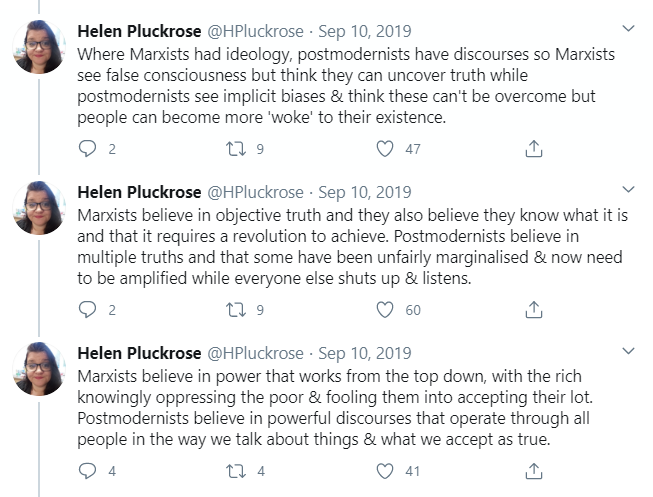
I've participated in a few discussions with fellow dissident rightists about postmodernism. There is an awareness that this is something to be understood. I'm therefore sharing a discussion about it made originally on Twitter by Helen Pluckrose. She is not a traditionalist but a secular humanist liberal, so she is on the opposite side of the fence to us. I have to give her credit, though, for making some of the distinctions between Marxism and postmodernism clear.

Helen believes that much of postmodernist thought derives from Foucault:


She believes also that Marxism greatly influenced postmodernism but that it is important to understand the distinctions:


She begins to discuss the particular differences here:


She gives the following example of an academic supporting a postmodernist approach. The academic is not concerned with students being able to assess how truthful a proposition is, based on evidence or quality of definitions or logic, but on being able to identify expressions of power within language:


Helen compares this postmodernist approach to the Marxist one, which is based more on a materialist, economic, class based understanding of the world. The following excerpt is from a World Socialist Website and it criticises from the Marxist perspective a campaign launched to reframe American history:


Sometimes those on the left just lump everyone on the right into the same category. They can't be bothered to understand the differences between, say, a classical liberal, a traditionalist or a white nationalist. We should try to avoid the same mistake. Helen Pluckrose, as a secular humanist liberal, admits that she finds some things to support in Marxism and some things in postmodernism, but also has criticisms of both. They are all connected to a degree in their political lineage but are not the same. It's easier, I think, to make effective criticisms of all of them if we understand the distinctions between them.

Saturday, March 14, 2020

Molly on love

I recently wrote a post on duality between men and women, pointing out a basic way that the instincts of men and women fit together in a complementary union. However, I was careful as well to note that relationships between the sexes aren't always simple to navigate. Take, as an example, the following tweets from an American woman named Molly. She begins with this:


She elaborates with the following:


Her base impulse was to associate love with an intensity of feeling, and this intensity of feeling was brought on by the thrill of uncertainty, of being left on the edge of her seat not knowing if the person would stay or go, of not knowing securely what the other person felt, of chaos and pain and so on.

This attitude has been recognised in the manosphere for some time, with young men being advised not to give away commitment too easily but to make a woman work for it; to remain something of a mystery; to keep excitement in the relationship and so on.

Even so, it's not an attitude that fits well with marriage. In marriage a man makes a firm and clear commitment to a woman - she is not meant to feel uncertain whether he will stay or not. Similarly, in marriage a man vows to protect and provide - he is not meant to make her experience chaos and pain.

So what's the solution? Well, at least part of the strategy is the one that Molly herself suggests, which is to try to overcome base impulse with something more elevated, namely a love that is settled in the will, that wills the good of the other person, that is willing to self-sacrifice for the larger good of the marriage and the family, and that aims to cultivate, as best we can, the finer qualities of our masculinity and femininity (as Molly puts it both for ourselves and for our spouse).

But this more elevated concept of love doesn't come to all people readily. It helps if it is part of the culture, of the ground within which people grow and form character. It cannot be taken for granted, but needs to be deliberately fostered generation by generation.

Monday, March 09, 2020

Duality & the traditional family

I saw the following tweet recently:


I found it interesting as an example of the duality that can exist between men and women (she clarifies later that she meant to say "filling" it with love). Obviously there are points of difference between men and women that set the sexes apart, but there are also points of difference that are complementary, through which the sexes "fit together" in a significant way.

Men do have an instinct to be the providers and protectors who create a protected space in which women like Rachel Bock can then exercise their nurturing and homemaking instincts.

This is an example of duality in role or function. If the role or function of men and women were exactly the same ("gender role convergence") then the basis for relationships would become thinner. Men and women would no longer need each other as much, nor would we have as much to gift to the other sex, nor would there be the same feeling of gratitude to the other sex.

This "gender role convergence" is what is happening in modern society. It explains, in part, why modern women so often express the feeling that they don't need a man, or why so many people in the most "gender" advanced societies, like Sweden, live alone. If complementary roles are lost, then the motivation to establish and maintain relationships will be less compelling.

The novelist Rachel Cusk discussed this issue some years ago when writing about her divorce. She believes that her parents brought her up to follow male values, so that when she married and had a child she felt confused in her identity. She couldn't readily embrace the more feminine values described above by Rachel Bock, namely to make a house feel warm, to fill it with love and children, food and comfort. And so she did a role reversal with her husband, who agreed to stay home to do this while she pursued her career.
To act as a mother, I had to suspend my own character, which had evolved on a diet of male values...motherhood, was not a place where I could actually live...its values, its codes of conduct, its aesthetic were not mine.

So for a while I didn't belong anywhere. I seemed, as a woman, to be extraneous. And so I did two things: I reverted to my old male-inflected identity; and I conscripted my husband into care of the children. My notion was that we would live together as two hybrids, each of us half male and half female. He gave up his law job, and I gave up the exclusivity of my primitive maternal right over the children.

It didn't work out. She wanted both herself and her husband to be hybrids, half male and half female. That was her notion of equality. Instead, her husband seemed to be content with the homemaking role and with being dependent - and Rachel Cusk had been brought up to value independence above all. And so her feelings for her husband changed:
I had hated my husband's unwaged domesticity just as much as I had hated my mother's; and he, like her, had claimed to be contented with his lot.

Why had I hated it so? Because it represented dependence

Which brings her to an interesting insight about duality. Rachel Cusk admits that rather than her mother being dependent on her father, both were dependent on the other and that in this arrangement there was a duality between the two that connected them closely together:
...it might be said that dependence is an agreement between two people. My father depended on my mother too: he couldn’t cook a meal, or look after children from the office. They were two halves that made up a whole. What, morally speaking, is half a person? Yet the two halves were not the same: in a sense my parents were a single compartmentalized human being. My father’s half was very different from my mother’s, but despite the difference neither half made any sense on its own.

But she herself had a notion of equality in which people remained disconnected:
My notion of half was more like the earthworm’s: you cut it in two but each half remains an earthworm, wriggling and fending for itself.

She was aware of one of the negative consequences of being entirely self-sufficient:
Sometimes my awareness of my own competence alarmed me. How would I remain attached to the world if not by need? I didn’t appear to need anyone: I could do it all myself. I could do everything. I was both halves: did that mean I was whole?

The official model now is the earthworm one. Men and women are no longer supposed to have complementary, interdependent roles. Equality is understood to mean sameness in role and function. It is common to hear feminists complain that men aren't fully embracing the earthworm model by doing as much of the "emotional work" as women, by which they mean the kind of homemaking work described in Rachel Bock's tweet.

The danger is that this model will undermine the duality between men and women. If we become self-sufficient, we have less need to be in a relationship with the other sex. We won't have the same compelling need to fulfil ourselves in a significant way in a relationship with the opposite sex. We will then become fussier, more demanding, less grateful and less willing to compromise in relationships.

As it happens, Rachel Cusk's vision of marriage crumbled. She ended it and then sought desperately to regain some of the maternal role she had relinquished, even to the point of insisting that the children belonged to her, by right, as the mother. She began as well to accept aspects of her feminine psyche:
...when my children cry a sword is run through my heart. Yet it is I who am also the cause of their crying. And for a while I am undone by this contradiction, by the difficulty of connecting the person who acted out of self-interest with the heartbroken mother who has succeeded her. It seems to be the fatal and final evolution of the compartmentalized woman

Traditionalists do not put individual autonomy at the front rank of human values. And so we are more likely to accept the interdependent model of relationships, one which upholds the duality between men and women.

The traditional model does, however, have drawbacks which have to be considered. First, it does leave the husband and wife more dependent on each other, both emotionally and materially, and so it is a difficult model to work with in a liberal society which encourages people to act out of self-interest and which tells people that there should be no limitations on their choices.

If we want an interdependent model to prosper, then we have to make wider changes, both to culture and the law. At the moment, for instance, men are asked to take considerable risks in supporting a wife financially. She can leave for any reason and he can then be forced to continue to support her financially, even as an ex-husband. It is understandable that many men see this as an unacceptable condition of marriage.

Also, the traditional model requires a husband and wife to pair bond deeply enough to survive the more difficult times in a lifelong relationship. It isn't likely to succeed in a culture in which men and women are damaged or jaded even before they marry. The drawn out culture of casual relationships doesn't fit well with the traditional model.

Finally, traditionalists should be sensitive to those women who want to pursue interests outside of the motherhood role. It doesn't have to be all or nothing. Perhaps some women could devote their younger, fertile years to motherhood and then pursue a career option (including part-time) afterwards (most people feel like they've proven everything they need to after spending 15-20 years in a career, it doesn't have to go on for the standard 40 years). Perhaps there is work that women could do in the community, alongside their maternal role. Perhaps there is creative work that women could do at home whilst also fulfilling their nurturing role. There are options.

A note to Melbourne readers. If you are sympathetic to the ideas of this website, please visit the site of the Melbourne Traditionalists. It's important that traditionalists don't remain isolated from each other; our group provides a great opportunity for traditionalists to meet up and connect. Details at the website.

Wednesday, February 26, 2020

Why does Sophie Lewis want to abolish the family?

Sophie Lewis is a radical feminist who is trying to revive the idea of abolishing the family. The website Vice gave her a glowing review in a piece titled "We can't have a feminist future without abolishing the family".

Her plan is straightforward enough:
"In Lewis's utopian future, the family as we know it no longer exists. Everyone, regardless of gender, is a surrogate; we mother each other."

Apparently there won't be any fathers, just mothers of both sexes. And our mothers won't be those who gave birth to us ("gestators" is her term for those who fulfil this role, children are "neonates"). That's why Sophie Lewis refers to her own mother as her "closest bio-relative"; her "mothers", after all, could be any number of men and women who form some sort of loose care-giving circle.

Her ideas do fit in well (in a radical way) with the state ideology. If liberals want us to be self-defined, then deconstructing unchosen kinship relationships will be thought of as progressive. But this still leaves the question of why someone like Sophie Lewis is attracted to this modernist mindset. No one, after all, is forcing her to push the liberal worldview to ever more radical outcomes.

I do think I can explain why she thinks the way she does. But you'll have to permit me a little philosophical detour. In the recently published book Our Borders, Ourselves, Lawrence Auster asserts that the father represents more than just himself as an individual man:
Symbolically, the father is the structuring source of our existence, whether we are speaking of male authority, of the law, of right and wrong, of our nation, of our heritage, of our civilization, of our biological nature, of our God. All these structuring principles of human life, in their different ways, are symbolically the father. The rebellion we've discussed is...a rebellion against the father. The belief that the universe is structured, intelligible, and fundamentally good, and that one can participate in this universe - this is the experience of having a father, which is the opposite of the experience of alienation that drives contemporary culture.

The Danish historian Henrik Jensen has a similar view. His view of the "father" is described as follows:
The masculine — which Henrik calls the “father” — is not simply about men as individuals but is an essential aspect of culture.

He sees it as the vertical dimension, which includes everything that human beings have looked up to, from God on high to ideals and excellence as well as the father’s traditional moral authority.

That vertical dimension is the source of our higher aspirations. This upward reach needs a strong foundation of healthy human relationship — which the more horizontally inclusive world of mothering traditionally has provided. As Henrik said to me, there needs to be a balance between the two.

If we do not accept the father in this larger symbolic sense then we are unlikely to accept the "structuring principles of human life" as described by Auster and Jensen.

This is an especially acute problem for women. A woman cannot as easily, on her own, approach this "structuring source of reality" - she won't have the same strength of instinct for it as a man. Women often describe their inner life as being more like an "ocean" - something undifferentiated and difficult to control or order.

So a woman is likely to be pushed to extremes on this issue. On the one hand, she needs men to uphold this vertical dimension within society, to provide the structuring source that is outside of herself. Hence women are often more devoted to institutions like the church than are men.

On the other hand, the authority is more alien to a woman than it is to a man and so, without trust, a woman can more easily lurch into rebellion. She can reject the whole vertical dimension of life as an evil patriarchal conspiracy against women.

If a woman is in rebellion (as men can be too) it is likely that she won't just reject one aspect of the vertical dimension, but that she will reject what she perceives to be the "structuring source of reality" as a whole. And for many women today the symbol of this is the white male. We stand as the symbol for the whole vertical dimension of life.

When you come across women like Sophie Lewis you can predict two things. First, that her relationship with her father will be troubled. Second, that there will be a denial of the entire realm of structuring principles, i.e. a denial that there is a nature to things or that there is an "essential" existence to things.

In terms of her relationship with her father, Sophie Lewis quotes from a book titled Daddy Issues by Katherine Angel:
The anger and rage we might feel towards a father . . . is not something we can expel, once and for all, and nor does it yield a clear solution. Rage has instead to be folded into everything else we may simultaneously feel; it does not simply burn itself out.

And this is how she looks back on her relationship with her father when she was a child:
My dad taught both his children by example to treat Mum with contempt—and this, I later realized, was of course also a profound form of contempt for us. Of the innumerable cutting quips generated over the years by this man’s delectable talent for cruelty, perhaps the pithiest is one he typed in a wink-wink nudge-nudge email to my partner, five years ago, calling me an arrogant know-it-all...

To do full justice to the pain I’m talking about would be beyond the remit of this essay. I will not, whatever I imagine to the contrary, have exorcised it simply by writing the above paragraphs. I will burn a cord this weekend, with my friends, and meditate, once more, on letting go. But my suspicion is I cannot, in the end, stuff all my hurt into a sacrificial body and watch it go up in smoke.

Her rejection of the white male is alluded to by her interviewer in this anecdote:
She made us green tea, pouring mine into a mug that read “I’ve got 99 problems and white heteronormative patriarchy is basically all of them.”

The writer that Sophie Lewis admires most is Donna Haraway who wrote "A Cyborg Manifesto". Read the following description of this essay and look out for the attempt to break down traditional "structuring principles of reality":
Haraway begins the "Manifesto" by explaining three boundary breakdowns since the 20th century...

Haraway highlights the problematic use and justification of Western traditions like patriarchy, colonialism, essentialism, and naturalism (among others). These traditions in turn allow for the problematic formations of..."antagonistic dualisms" that order Western discourse...She highlights specific problematic dualisms of self/other, culture/nature, male/female, civilized/primitive, right/wrong, truth/illusion, total/partial, God/man (among others).

Haraway's cyborg theory rejects the notions of essentialism...and asserts that "cyborg politics is the struggle for language and the struggle against perfect communication, against the one code that translates all meaning perfectly, the central dogma of phallogocentrism."

What do we take from all this? The "horizontally inclusive world of mothering" is of course indispensable to any society. But so too is the vertical dimension that men are responsible for. The female journalist who described Henrik Jensen's views went on to say about feminised Nordic societies that:
I found it surprising and almost counterintuitive to discover that placing so much priority on nurturing and mothering functions — caring for the special needs of each child, ensuring that each person grows in his or her unique way — does not lead to a close-knit and deeply connected society. Not in our day and age. Ironically, and perhaps paradoxically, the result is hyperindividuation, which leaves us self-focused, isolated, and victimized.

Liberalism is a terrible vehicle for men to uphold the vertical structure as it is so dissolving of the institutions and culture of a society. It is little wonder that the vertical structure has thinned out so much, and little wonder that this thinning out has led to contempt and rebellion among Western women.

(Liberals are by nature in rebellion even when they dominate a society, which explains why they see themselves as rebels even when they have become the establishment.)

It is also true that fathers who fail to bring up their daughters with loving care and guidance often produce young women who rebel - not just against them personally as fathers, but against the whole notion of a structuring principle of reality.

Civilisations don't just keep running of themselves. They are actively upheld by men who understand the importance of their role in maintaining the vertical structure. It is not the case that women will always be repelled by this - women need men to provide a structuring source and there will be intelligent women in any age who will lend their support to this project.

A note to Melbourne readers. If you are sympathetic to the ideas of this website, please visit the site of the Melbourne Traditionalists. It's important that traditionalists don't remain isolated from each other; our group provides a great opportunity for traditionalists to meet up and connect. Details at the website.

Sunday, February 23, 2020

Are we limited by our sex?

The liberal idea is that we are free when we are autonomous, so that we can self-determine or self-define our own lives. The logic of this principle means that any aspect of life that is predetermined is seen as a negative limitation or restriction on the individual. Our sex is predetermined and therefore liberals describe it pejoratively as a "prison" or a "box" or a "straitjacket" that the individual needs to be liberated from.

How do liberals seek to liberate the individual from their sex? In a variety of ways, but in general they seek to make our sex not matter. The aim is to move toward a unisex society in which men and women become more the same. There is an assumption in liberal society that men and women should be equal and equality is understood to mean sameness.

The fact of being a man or a woman is, in a philosophical sense, a kind of limitation. It means we are not all things, but are created to be a certain kind of being. Our nature is "limited" in this very particular sense that we are not "omnibeings"  - creatures without a distinctive nature who can instead be or become anything they wish.

If you accept this basic limitation, then the existence of sex distinctions in society will no longer be seen as restricting individual development but as promoting it. If I was created to be a man, then I will want to develop my nature as a man to fulfil who I am and what I was made to be. Therefore, a unisex culture of sameness won't liberate me, nor will it remove limitations on me, but will instead impede my self-development.

This is true, for instance, in the way that we come to a deeper sense of who we are through the "gender binary" that liberals are so keen to deny and dismantle. A man in the presence of an attractively and impressively feminine woman will be brought to a stronger sense of who he is as a man. Men and women respond to each other instinctively and viscerally, as a kind of interplay between the sexes. 

Women feel this as much as men do:


The American academic Camille Paglia noted something similar when she wrote:
When an educated culture routinely denigrates masculinity and manhood, then women will be perpetually stuck with boys, who have no incentive to mature or to honor their commitments. And without strong men as models to either embrace or (for dissident lesbians) to resist, women will never attain a centered and profound sense of themselves as women.

We do not develop entirely solo. It helps our own self-development when the opposite sex is obviously and admirably "sexed".

And, unless we believe that we are gods, without limitations on our being, then our sex is not a restriction to be dismantled, but a significant aspect of who we are that needs to be developed rather than suppressed. Which is the point that this man is making:


A note to Melbourne readers. If you are sympathetic to the ideas of this website, please visit the site of the Melbourne Traditionalists. It's important that traditionalists don't remain isolated from each other; our group provides a great opportunity for traditionalists to meet up and connect. Details at the website.

Tuesday, February 18, 2020

The political man

Mark Moncrieff has drawn out a point I made in a recent post concerning political commitments. He's done a particularly good job of it. You can read it here.

Tuesday, February 11, 2020

Doris Lessing, feminism, secular religion

Doris Lessing was a celebrated novelist, who won the Nobel Prize in Literature in 2007.

She was born to English parents and grew up in Rhodesia in the 1920s. She moved back to England in the 1930s, got married, had children and then divorced in 1943, leaving the children with their father.

She became part of the great shift of Western intellectuals toward communism at this time, although she left the Communist Party after the Soviet invasion of Hungary in 1956. Later in life she became interested in Sufism.

I found an interview with Lessing in the New York Times from 1982 that raises some interesting themes.

The interview begins with Lessing distancing herself from feminism:
The idea that she has abandoned feminist concerns particularly irks her, since she never wrote from a consciously feminist point of view but was adopted by feminists in search of a heroine: ''What the feminists want of me is something they haven't examined because it comes from religion. They want me to bear witness. What they would really like me to say is, 'Ha, sisters, I stand with you side by side in your struggle toward the golden dawn where all those beastly men are no more.' Do they really want people to make oversimplified statements about men and women? In fact, they do. I've come with great regret to this conclusion.''

There are three themes here. First, Lessing identifies feminism as being hostile to men and as setting men and women apart from each other. I think that's worth noting as you sometimes hear the argument that feminism was somehow friendlier in the past than it is today. That is not how Lessing experienced it, despite being supportive of leftist causes herself.

Second, there is the utopianism of the radical left, the idea that human nature can be acted on, perhaps through education, or the dismantling of oppressive social norms or institutions etc., to create an ideal society  - a "golden dawn" in which an ideal of freedom and equality will be realised. This helps to explain the first theme - the hostility to men expressed by feminists. If it is men, acting through the patriarchy, that are the brake on achieving utopia, then men become the enemy of humanity and the villains holding back the realisation of humanity's ultimate purposes. Little wonder, given this world view, that feminists would be so hostile to the opposite sex.

Third, there is the idea that leftism is, to some degree, a kind of secularised religion. Lessing goes on to draw out this point:
''There are certain types of people who are political out of a kind of religious reason,'' she says, digging dirt ferociously out of the kitchen table. ''I think it's fairly common among socialists: They are, in fact, God-seekers, looking for the kingdom of God on earth. A lot of religious reformers have been like that, too. It's the same psychological set, trying to abolish the present in favor of some better future - always taking it for granted that there is a better future. If you don't believe in heaven, then you believe in socialism.

''When I was in my real Communist phase, I and the people around me really believed - but, of course, this makes us certifiable - that something like 10 years after World War II, the world would be Communist and perfect.''

''I was once an idealistic and utopian Communist,'' she said, ''and no, I am not proud of it. The real politicos are a very different animal, and I'm angry that I didn't notice that very evident fact.

I think it's worth pointing out here that the alternative to being a utopian socialist is not to be unconcerned with "the city of man". It is to recognise that human nature is flawed, and therefore social institutions and norms have an important role in limiting the ill effects of the baser aspects of our nature (as well as fostering the nobler ones). You do not make progress in society by abolishing all restraints on human nature; the task is a more complicated one of making some sort of good order out of the biological, social and spiritual nature of man, a task that draws more on the steady accumulation of wisdom, the making of culture, and the fostering of virtue than on simplistic political formulas.

Sunday, January 26, 2020

Melbourne Traditionalists 2020

I've reported previously on the encouraging growth of our Melbourne Traditionalists group over the past two years. We've been fortunate to bump up a notch in numbers each year, and each step forward in numbers gives a greater sense of the group's potential.

Hopefully there will be further growth in 2020. If you are sympathetic to traditionalist ideas (as put forward at this site or at the Melbourne Traditionalists site), I'd encourage you to get in touch about attending one of our gatherings.

There are no formal membership requirements at this stage and it's common for people who come along to express relief at having found a milieu in which they can freely discuss politics. Most of those involved are on the younger side, but we have a range of ages in attendance.

I look forward to seeing some of you at a future gathering!

Thursday, January 16, 2020

Cardinal Burke, Christianity & love of country

Cardinal Raymond Burke gave a speech last year on the issue of patriotism. It's worth reading as it affirms traditional Catholic teaching that many Catholics might not be aware of.

His speech is titled "Filial piety and national patriotism as essential virtues of the citizens of heaven at work on earth".

Cardinal Burke begins by reminding his listeners that there is a transcendent truth by which we should attempt to order our lives:
Our happiness during our earthly pilgrimage and at its destination, eternal life, depends on the conformity of our daily living with the truth, that is, with the good order with which God has created and sustains the world and, in a most particular way, man and woman.

But is a patriotic love of country an aspect of this truth, of this good order which God has created? According to the church it is, as a matter of justice, piety and charity.

How are these virtues connected to patriotism? Let's begin with piety. Cardinal Burke says,
It is the virtue of piety...which expresses our recognition of the truth and our humble obedience before the truth...Piety...inspires and strengthens us to live the truth of our being as creatures created in the image and likeness of God to know, love and serve Him...

I'll go off topic for a moment here to point out that liberalism is impious when it claims that there is only meaning when we author or define our own being, in any direction, according to our own designs.

To put it simply, piety is recognising that we are created by God, that this is a truth of our being, and that it is right to love and to serve God.

What does this have to do with patriotism? This can be explained in terms of the virtue of justice. Justice means giving what is due to others. We have a debt to those who have formed us, who are responsible for our being. If God is primary in this respect, as outlined above, our parents and our family are secondary, as is our country. Therefore, piety is rightly directed not only toward God but to giving due honour and reverence, love and service, and fulfilling our obligations and duties toward our family and our nation. In this sense, piety toward God rightly flows as well into piety toward family and nation. It is the same virtue, the same "obedience before the truth" and one that calls forth charity, an expression of love, in this case, of family and nation.

Cardinal Burke quotes the theologian Louis Bouyer who wrote (in 1963):
The virtues of filial piety and piety toward fatherland...are annexes of the virtue of justice

Cardinal Burke goes on to note that filial piety is included as one of the commandments:
While the Fourth Commandment commands us to honour our father and mother, to show to our parents the piety which flows from the recognition that they have cooperated with God in giving us the gift of human life, it also commands the piety owed to the wider community in which marriage and family are possible and indeed flourish.

This quote from St Thomas Aquinas is also significant:
I answer that, Man becomes a debtor to other men in various ways, according to their various excellence and the various benefits received from them. On both counts God holds first place, for He is supremely excellent, and is for us the first principle of being and government. In the second place, the principles of our being and government are our parents and our country, that have given us birth and nourishment. Consequently man is debtor chiefly to his parents and his country, after God. Wherefore just as it belongs to religion to give worship to God, so does it belong to piety, in the second place, to give worship to one’s parents and one’s country.

Cardinal Burke comments:
It is clear from the Angelic Doctor’s exposition that, not only is patriotism not a sin, but it is a requirement of nature itself. The term, worship, when applied to one’s parents and one’s country, as St Thomas makes clear, is distinct from divine worship which is given to God alone. The second sense of worship is analogous and refers to the piety or devotion shown to those who cooperate with God for our good.

The New Catholic Encylopedia puts all this very clearly:
But patriotism as a form of charity, or love, has a more specific object in its actuation than mankind or the human family as such. According to St Thomas Aquinas, the particular love of one’s fatherland is an important aspect of that preferential form of charity that is called pietas. Through piety the person has an obligation of love to God, parents, and fatherland. Each is in some sense a principle of man’s being: God through creation; parents through procreation and education; fatherland through a formation of one’s cultural and historical identity.

It is also worth noting Cardinal Burke's comment on this passage:
Patriotism is an aspect of the grace of piety, which in its turn is an essential part of the matter of charity. Christ gives the grace of piety, through the outpouring of the Holy Spirit, in order that we can live the truth of our human nature.

Patriotism as such is a precept of the natural law.

That's a powerful way to understand the issue.

Cardinal Burke understands as well the importance of nations in fostering intergenerational loyalties, so that we do not fall into the "presentism" of liberal modernity:
This piety is at once a deeply personal virtue and a powerful force to bring together the generations, allowing the young to take root in the soil of the old and the old to engraft their experiences onto the young, so that we sense that home is a place where the passing day partakes of long ages past and to come.

From the Catholic catechism:
[t]he love and service of one’s country follow from the duty of gratitude and belong to the order of charity

Finally, Cardinal Burke states very clearly the opposition of the Catholic Church to the replacement of nations by a world government:
It is clear that we and our homelands have responsibilities within the international community, but those responsibilities can only be fulfilled through a sound life in the family and in the homeland. Patriotism, in fact, fosters the virtue of charity which clearly embraces citizens of other nations, recognising and respecting their distinct cultural and historical identity.

...The divine authority, in accord with the order written upon the human heart, does not make just and legitimate a single global government...On the contrary, God meets us and orders our lives for the good in the family and in the homeland.


A note to Melbourne readers. If you are sympathetic to the ideas of this website, please visit the site of the Melbourne Traditionalists. It's important that traditionalists don't remain isolated from each other; our group provides a great opportunity for traditionalists to meet up and connect. Details at the website.

Sunday, January 12, 2020

Stacey's feminism

I saw the following tweet this morning:


It was followed by this exchange:


Stacey seems to be pushing the idea that women should pursue their collective self-interests whilst men should also pursue women's collective self-interests. I replied:


And that's where feminism is at. There is an assumption, a remarkable assumption, that men in the past pursued their collective self-interests at the expense of women. So that it can now be justified as "equality" if the reverse is true and we have a society in which both sexes pursue the material self-interests of women.

This ideology helps to explain why there is so little gratitude for the sacrifices of men, past and present, within a feminist culture. How can there be gratitude when feminists assume that men did not make sacrifices, but instead acted out of a collective self-interest?

I think Stacey and other feminists are in for a shock. If feminists were to succeed in convincing people that the point of life is to pursue our self-interests, then relationships between men and women would degrade very quickly. Stacey is trying to circumvent this by requiring men to follow women's self-interests, rather than their own. But that just sets up an ideological tension. She is, in effect arguing:

1. The point in life is a pursuit of one's own material self-interests.
2. Men should pursue women's self-interests.

The second part of the argument contradicts the first. Therefore, it's not likely to hold in the longer term.

Stacey is wrong about Western culture. I've been reading Our Borders, Ourselves by the late Lawrence Auster. In the chapter "What is the West" Auster observes that "one of the characteristic features of Western culture is the drive toward self-transcendence". He elaborates by describing this as "the idea that man attains the true order of his being only by being united with a truth outside his own being." Auster complains that this aspect of Western culture has been undermined:
On the Left, the reduction of the human being to the power-seeking and resentful self not only denies the spirit but by doing so denies the balance of earthly and spiritual that is the essence of the West.

Young Western men have been drawn historically to family life for many reasons. Obviously the sex instinct played a part, as did a desire to have children and to fulfil masculine aspects of self related to being a father and husband. In the past, too, there was a social function to marriage, as sex roles were more differentiated than they are today. Men who wanted to preserve their own family and national traditions would also have sought out marriage.

But added to all this was the drive that Lawrence Auster describes. A man's love for a woman can, at its best, focus a man on a good outside of his own self that (hopefully) balances both the earthly (a flesh and blood woman/carnal desire) and the spiritual (the good of love/a transcendent sense of the feminine/mystery in the unity and drawing together and attraction of the masculine & feminine). This then can powerfully inspire a man toward sacrificial love and toward deeper loyalties and commitments.

But it only works if a man keeps the balance right (e.g. does not idolise & remains aware of human infirmities & works within the limits of human nature) and if women inspire this kind of love by embodying feminine virtue sufficiently.

And here's the thing. Whereas Western women were once raised toward habits of feminine virtue, they are now encouraged to rebel against it. Lawrence Auster writes about this in his book, in a section titled "The Rebellion against the Father":
In all its forms, the phenomenon we've been discussing represents the loss of authority in a father image. Symbolically, the father is the structuring source of our existence, whether we are speaking of male authority, of the law, of right and wrong, of our nation, of our heritage, of our civilization, of our biological nature, of our God. All these structuring principles of human life, in their different ways, are symbolically the father. The rebellion we've discussed is...a rebellion against the father. The belief that the universe is structured, intelligible, and fundamentally good, and that one can participate in this universe - this is the experience of having a father, which is the opposite of the experience of alienation that drives contemporary culture. (p.12)

We live in a culture shaped by intellectuals who have rebelled against the "structuring sources of our existence" and who prefer to stand, instead, within their own individual orbit, as beings defiantly organised by their own will and desires and choices alone.

There is an element of this mindset, it seems to me, in the aggressive way that some women promote abortion, or refigure their bodies with tattoos, or speak gracelessly or dress immodestly. The same kind of women will often hate male authority figures (commonly identified these days as old white men), but will believe at the same time in a diffuse, universal ethic of care. The latter is the go to version of morality because it is not a structuring principle of reality - it doesn't judge right or wrong and nor does it direct our loves and loyalties in any given direction (hence the apparent contradiction of leftist women hating conservative men with a passion whilst at the same time claiming universal benevolence).

Lawrence Auster wrote about the effect of feminism on men and women that,
All that's left to attract them to each other is their bodies, their bare utility, or their power, with the further result that...the love, sympathy, and friendship that used to prevail between men and women is reduced to jungle combat. (p.134)

You can see this in Stacey's feminism. Men exist for utility (serving women's purposes). What matters is a contest for power and material self-interest.

It's not difficult to predict that women will get far less out of men this way than under the old culture, in which men thought of marital love as one aspect of attaining "the true order of their being".

A note to Melbourne readers. If you are sympathetic to the ideas of this website, please visit the site of the Melbourne Traditionalists. It's important that traditionalists don't remain isolated from each other; our group provides a great opportunity for traditionalists to meet up and connect. Details at the website.

Monday, January 06, 2020

A change of heart?

Six years ago Chrissy Stockton (writing as Amy Glass) wrote a piece titled "I look down on young women with husbands and kids and I'm not sorry".

The argument is one that crops up every now and then in feminist circles. The problem to be addressed is this:

1. Liberalism wants maximum individual autonomy. This means that each individual is to be free to choose as they wish without restraint, unless it limits the choice of others.

2. This presents a conundrum if a woman chooses to be a stay at home mother. On the one hand this choice does not maximise her autonomy as she is choosing to be interdependent within a family rather than an independent individual focusing on solo development. This fails the liberal principle. On the other hand, if she cannot choose to be a stay at home mother the liberal principle is also denied.

Chrissy Stockton argues in her piece that the stay at home option is the one that fails the test:
Every time I hear someone say that feminism is about validating every choice a woman makes I have to fight back vomit.

Do people really think that a stay at home mom is really on equal footing with a woman who works and takes care of herself?

Here she is clearly advancing the argument that what matters is independence. She goes on to draw out the argument that motherhood, being something common to women, is not a uniquely self-determined achievement - it is not "exceptional":
Having kids and getting married are considered life milestones. We have baby showers and wedding parties as if it’s a huge accomplishment and cause for celebration to be able to get knocked up or find someone to walk down the aisle with. These aren’t accomplishments, they are actually super easy tasks, literally anyone can do them. They are the most common thing, ever, in the history of the world.

...I want to have a shower for a woman when she backpacks on her own through Asia, gets a promotion, or lands a dream job not when she stays inside the box and does the house and kids thing...

...You will never have the time, energy, freedom or mobility to be exceptional if you have a husband and kids.

So in this worldview showing your independence by backpacking alone in a foreign country is a greater achievement than getting married and having children. (Which may help explain those articles encouraging women to journey solo to those parts of the world most dangerous to women - this being the realm of liberal female accomplishment.)

Chrissy Stockton wrote another piece at around the same time titled "Successful women do not fall in love". Again, this is one of those opinions that appears in feminist thought from time to time. The argument is that if what matters is a uniquely self-determined accomplishment, and if this accomplishment is our career, that love distracts us from our career goals and should be suppressed. Alexandra Kollontai, writing in the early twentieth century, put it this way:
this motive was a leading force in my life ... to shape my personal, intimate life as a woman according to my own will ... Above all, I never let my feelings, the joy or pain of love take the first place in my life ...

I still belong to the generation of women who grew up at a turning point in history. Love ... still played a very great role in my life. An all-too-great role! It was an expenditure of precious time and energy ... utterly worthless ... We, the women of the past generation, did not yet understand how to be free. The whole thing was an absolutely incredible squandering of our mental energy, a diminution of our labour power.

A century later Chrissy Stockton followed suit by arguing that it is important for a woman to guard against the impulse toward self-sacrificing love:
We’re kind of brainwashed to take care of other people, and make them happy and for me, being single is kind of an armor guarding against whatever cultural or biological intuitions are telling me, as a woman, to be self-sacrificial.

...I am in love with myself, in love with building my work, which will outlive me, and in love with proving people wrong, the ones who told me what I couldn’t do– be happy and secure and the center of my own world.

There were criticisms of Chrissy Stockton's attitude toward mothers. She defended herself by writing:
If we were convinced that motherhood and being a wife was a freely made goal that did not in any way encumber women, my post wouldn’t have over 200k social shares, I wouldn’t have received hundreds of emails in the span of a few days...

That's a revealing comment. It shows how much Chrissy Stockton based her ideas on a liberal worldview. Note that being a wife and mother are put in question because they are not "freely made goals" (i.e. not self-determined) and because they "encumber women". The dictionary definition of encumber is "restrict or impede (someone or something) in such a way that free action or movement is difficult." Liberals often use the term "encumbered self" in a disparaging way.

This is highly significant for what comes next. To this point in time, Chrissy Stockton's ideal is a world in which we are not restricted, in which our free action or movement is not impeded. It is also a world in which self-sacrificing love is a barrier to achievement and in which relationships are too ordinary to matter. And it is a world in which we are to develop solo, in denial of the longstanding belief that we are fundamentally social creatures.

Fast forward to the present day. Has Chrissy Stockton proved her critics wrong and become "happy and secure and the center of my own world"? Well, no. She does have an interesting job as an editor of an online magazine. She admits, though, that she has an anxiety disorder and that she is frustrated in love. She has also come around to the view that love is a fundamental human need. Most interestingly, she acknowledges that an unrestrained dating culture undermines her own ability to form loving relationships - an illustration of why restraint can work toward the human good (and should not always be sacrificed to the liberal aim of maximising individual autonomy).

Here she is, for instance, describing how a hook up culture can leave people jaded and less able to pair bond:
I don’t have an infinite reservoir inside me of love and affection and self-confidence. When a guy ghosts me...it has a cost. I have to spend months getting over this.

Instead of viewing marriage and motherhood as being "super easy" to achieve, she now worries that they won't happen for her:
Men and women seem so different. There are so many ways we don’t speak the same language and yet there’s this overwhelming sense that I should one day find complete partnership with a dude. It seems like such an unlikely thing that we understand each other’s needs and are free enough from baggage and emotional dis-ease that this will become a reality.

It feels very disorienting to be asking for someone to at least be polite when they decide they don’t want to see you anymore. I don’t think these guys would behave rudely to a stranger they met off the street, but they are rude to me and it is sad and confusing.

Men lose interest when they’ve slept with you. It’s not the beginning of anything for them, it’s the end.

I just want to be full-time adored.

It’s scary that it’s [getting married] supposed to be so important but also that it’s so hard

It’s scary to be worn down. There are many things that get better with aging but you have to work purposefully at not getting bitter and the more tired I get the harder it is to frame my dating life as something other than failing. What is going to happen if I fail for another 10 years? I think it would be just fine to be single for 10 years or the rest of my life but I’m not sure I can take the pressure of knowing that I failed at something that is so fundamental to our humanity.

She is now complaining not of being encumbered by marriage but of men's fear of commitment. She writes to one such man as follows:
Maybe you’re afraid of commitment. The way someone runs from a scary monster or a man with an axe. But I’m a girl with a cozy bed and a full heart and a hand to hold. I want to love you...

Maybe you’re just busy. Though we all know “busy” means something like “I have a lot I’d rather do” and like I told you when we were in bed with our whole bodies touching: I just don’t know what else there is, besides this.

From previously having diminished the importance of relationships with men, she now utters the line "I just don't know what else there is, besides this."

She wrote this about another man who would not commit:
I spent a lot of nights that spring touching his skin and playing him music and telling him how great he was. In retrospect every feeling I was trying to hold in was completely called for, natural, and appropriate for the situation.

Nothing about the act of caring for someone makes you crazy. It’s human to care. It’s human to have a relationship with the people who touch us and play music for us and tell us how great we are. But we were in a silent competition to care less than the other person, to keep it more casual, to act more indifferent. Which is a pretty gross way to go through life.

She had once commended the suppression of love as a way of staying free to focus on career. Now an indifference to love is described as "a pretty gross way to go through life".

Here is a poem she wrote idealising love for a man:
We sit under cedar rafters
Cross legged and
Palms pressed
Together
I say that I will make you the best person you can be
And
You will make me
Too
And
I trust you completely
And
Everything in our lives together will be good and beautiful
And
With my eyes big like
Saucers
In the Cancerian full moon
(Imagine that light on your skin in your bedroom at night)
I confess
(Light a candle with a wooden match)
Each
(Wrap each arm around your body and
Compress
And
Soften)
And
(Exhale deeply)
Every
(Soften)
Way that I love him.
(Soften).

Her strident views on solo development and achievement also seem to have mellowed:
I don’t think I’m a particularly strong woman...And here’s the thing: I shouldn’t have to be strong. Why should I have to possess every single positive quality?...

...Here’s another thing: we need each other. We need each other to be different.

It’s so easy to see this with parenting. It’s not very controversial to say it seems ideal for kids to be raised by two parents. We acknowledge that mothers and fathers generally bring something different (and valuable) to the table

...The gift of community is that we don’t have to be uniform. We don’t have to do everything on our own, our gifts serve the collective and our weaknesses are balanced by it.

I don’t want to have to be strong when I think the ways I am weak are a price I pay for the other valuable assets I bring to my community. I am good at making people feel loved. I don’t care if it makes me too vulnerable sometimes. I’m okay with that. When people tell me all women are strong, there is a way I hear “it’s not okay for you not to be strong.” There is a way that this devalues characteristics that have long been associated with women.

Instead of promoting solo achievement along tough masculine lines, she is now defending what is brought by the feminine to a community.

Chrissy Stockton's story illustrates some of the weaknesses in the liberal worldview that is currently our state ideology. Her younger self was wrong to believe that it is only a uniquely self-determined achievement that brings meaning. There are experiences "fundamental to our humanity" that we do not uniquely self-determine but that still bring fulfilment, including loving relationships with the opposite sex. Nor are all women suited by nature to a lone wolf life of personal ambition or rugged individualism; Chrissy Stockton acknowledges that her own gifts as a woman are more relational.

The liberal belief that we should liberate people from restraints has also failed women like Chrissy Stockton. Some of the restraints on behaviour in traditional societies were aimed at fostering family formation and preserving the ability of people to pair bond. Without them men and women increasingly lose trust in and admiration for the opposite sex. In theory Chrissy Stockton has been sexually liberated, but it has left her working "purposefully at not getting bitter".

Chrissy Stockton does seem to have had something of a change of heart over the past six years. Perhaps others will do likewise and there will be a better chance to open up a conversation about the place of liberalism within Western culture.

A note to Melbourne readers. If you are sympathetic to the ideas of this website, please visit the site of the Melbourne Traditionalists. It's important that traditionalists don't remain isolated from each other; our group provides a great opportunity for traditionalists to meet up and connect. Details at the website.
Tuesday, December 31, 2019

The radical centre?

One of the more unusual posts I've read this year is a piece titled "Driven to the Edge" by Ronald Dworkin. Dworkin's background is with right-liberal think tanks promoting smaller government. He sees his mission as bringing people back to the centre of politics, which is not an unexpected aim for a right-liberal type, but his analysis of what is going wrong is based on Marx's theory of social alienation. I didn't see that one coming!

Using Marx's theory of alienation has its advantages and disadvantages. The advantage is that Dworkin doesn't follow the usual script of explaining discontent along the lines of "it's people who are uneducated" or "it's people who don't want to give up power". Instead, he sets out clearly why people are increasingly alienated in modern society; at times he sees the same things that traditionalists see.

The disadvantage of using a Marxist theory of alienation is that Dworkin brings everything back to the economic system. He is not anti-capitalist, but he sees the way that advanced capitalism works as being at the root of the problem. As capitalism isn't going away anytime soon, he thinks that there is no way of bringing back the older, more functional forms of society. He proposes instead some economic policy reforms to ameliorate the situation we find ourselves in.

Dworkin is right that capitalism presents challenges to the survival of traditional institutions. But mixed in with the influence of the economic system are ideological beliefs which also push society in a particular direction. And if you control the institutions within a community which enculturate young people, you also have some power to influence the shape of that community.

A good example of this is Dworkin's analysis of our growing alienation from the opposite sex. Dworkin correctly notes that the economic system wants us as fungible units of production and consumption and that sex distinctions have no utility within this system:
Advanced capitalism takes alienation a step further. It has stripped men and women of their “otherness.” Men and women once had a sense of mystery about them—a gender specific nature—causing each to remain slightly inaccessible to the other, while at the same time stoking admiration in the other’s eyes. This disappeared when advanced capitalism pushed gender-neutrality to wring more profit from exchangeable bodies working in space. With male and female nature denied, men and women became consumers with needs; gender itself became a consumption good. The new state of affairs heightens MGTOW suspicions about women, as the charm of “otherness,” rooted in nature and designed to foster sympathy and understanding between the two sexes, is eclipsed by a paranoid fear that women scheme to meet their needs...

It gets worse. The lack of “otherness” detracts from sexual excitement, as people lose their allure in each other’s eyes. As a woman’s mind and nature cease to be any different from a man’s, only her body stimulates some men...In all this, the number of men living alone has more than doubled since the 1970s...

If the loss of sex distinctions is due solely to an advanced capitalist economy, and that economy is here to stay, then androgyny is inescapable:
At the same time, advanced capitalism cannot be reversed. Gender neutrality is inevitable. The alienation between men and women will persist, even as it continues to be glossed over...today’s political center cannot be what it was in Tocqueville’s America, with the latter’s strong two-parent families, small businesses, robust local communities, and widespread religious belief. That center belongs to another age.

Dworkin reasons that children give a purpose to life, so there should be economic policy reforms to help people have children. For instance, women might get money to raise children as single mothers:
Social Security might be adjusted over the coming decades, such that, instead of people getting large monthly sums starting in their late 60s, they would get smaller monthly sums starting in their 20s. This would make raising children, often by single parents, more feasible.

One problem with Dworkin's analysis is that the aim of making sex distinctions not matter goes back some way, certainly before the arrival of advanced capitalism. And it was initially justified as part of the "liberty and equality" levelling mindset that took hold amongst the leftist intelligentsia by the later 1700s. The proto-feminist Mary Wollstonecraft wrote at this time:
A wild wish has just flown from my heart to my head, and I will not stifle it…I do earnestly wish to see the distinction of sex confounded in society

There was a contest in Western culture about what constituted freedom. Those who saw human nature as corrupted and imperfectible tended to view freedom as a matter of restraining our own vices, i.e. as a contest between the noble and the base within human nature reflecting on individual character; those who thought human nature could be acted on and perfected tended to think in terms of a social progress toward an ultimate state of human community, one in which there was no need for restraining social norms, or institutions, or hierarchies, but only the sovereign individual motivated by an abstract, universal love.

The latter group did not like sex distinctions, seeing them as limiting to the individual. An example is the English poet Percy Bysshe Shelley, writing in the early 1800s. In his attitude to marriage, you see the shift from the idea of individuals needing to exercise restraint in order to access the higher aspects of their nature, to the idea of restraint being a merely arbitrary and regressive block to choice and change:
That which will result from the abolition of marriage will be natural and right; because choice and change will be exempted from restraint.

Predictably for someone with this mindset, Shelley looked forward to the abolition of sex distinctions:
...these detestable distinctions will surely be abolished in a future state of being

You have a combination, then, of a change in mindset in which sex distinctions are thought to be regressive and a limitation on freedom with an economic system in which individuals are prized as interchangeable units of production and consumption, with sex distinctions having no positive function within the system (except for the need to create a future labour force - but in an era of mass migration this has been outsourced).

Can we change mindsets? Yes, we can, but we're unlikely to be funded to do so by those possessing large amounts of capital. That's the conundrum. One possibility is to start small and create institutions that can enculturate young people within a more traditional mindset (e.g. via churches, schools, political organisations, fraternities, independent media sites). Another possibility is a frontal assault on the failed ideology of individual autonomy, not just by one isolated writer, but as a movement of Western intellectuals.

I mentioned earlier that a strength of Dworkin's approach is that it pushes him to take more seriously than most other mainstream writers the sources of people's alienation in modern life. I can't quote as much as I'd like to (it's worth reading the whole article), but as an example he clearly recognises the difficulty of family formation for women who accept the usual modern life path:
...the sexual revolution and capitalism’s promise of meaningful work have tempted some women with a plan for life that requires perfect timing and cooperation to be executed: A woman, too, will satisfy her sexual urge during her twenties and egotistically pursue her career, just like men. Then, when the maternal instinct kicks in, she will find the right man whose ego will not be threatened by all the men she has slept with, who will marry her and give her children, while also supporting her in her career. The plan is untenable...Today, 45 percent of Americans are single, the highest percentage in history.

The phrase "that requires perfect timing and cooperation" is well observed. Women are encouraged to sleep around in their teens and their 20s and then, having undermined the family guy ethos among the men of their age cohort, find a man willing to commit to them and have children in the relatively short space of time left to them. It's extraordinarily ill-conceived.

Here, too, Dworkin is too much of an inevitabilist. It is not just advanced capitalism that pushes young women to be imprudent. It is also the mindset I wrote about earlier, the one that claims that we should be able to choose in any direction without restraint or limitation, even from the logical consequences of our choices. Young women are generally told that if the life script isn't working it's not so much because it is ill-conceived but because men or the patriarchy or sexism or toxic masculinity are somehow subverting it. That there is nothing in nature to limit what we might choose to do and if there is it can be acted on through the use of some technology (e.g. freezing eggs). Some women report simply not being brought up to focus at all on the issue of family formation, the assumption being that it will happen of itself.

In other words, if the messaging were different, so too might be the results. If political concepts were different, so too might be the results. If the understanding of life and what brings meaning were different, so too might be the results. Yes, you would still have people with power preferring to encourage ideas about a lifestyle based on career and consumption, but within a community that cared about family formation there could at least be counter-messaging.

A note to Melbourne readers. If you are sympathetic to the ideas of this website, please visit the site of the Melbourne Traditionalists. It's important that traditionalists don't remain isolated from each other; our group provides a great opportunity for traditionalists to meet up and connect. Details at the website.

Sunday, December 29, 2019

The heroine's journey

Saw this on Twitter:


It hammers the anticulture very well. I would only add to it that the heroine's journey does not end with the birth of her child. She must also conquer those aspects of her own nature which damage the marital relationship, and she must resist the impulse to undermine her husband's efforts to socialise her son(s).