Showing posts with label libertarianism. Show all posts

Saturday, December 14, 2019

Libertarians & the common good

This week there was a debate on social media about whether porn should be banned. I found the response of the libertarian right to be very interesting. They reacted vehemently against the idea of a ban as a matter of principle, claiming that those supporting it were "fascists" or supporters of theocracy and were acting against the ideals of the US as set out by the founding fathers.

The debate was therefore useful in highlighting some important philosophical differences on the right, particularly regarding the notion of a common good.

One person on the right advocating for restrictions on pornography is Matt Walsh. He attracted a lot of fire from libertarians for his stance. Walsh linked the debate to the issue of the common good in this tweet:


The libertarian response accusing Walsh of "theocracy" came soon after:
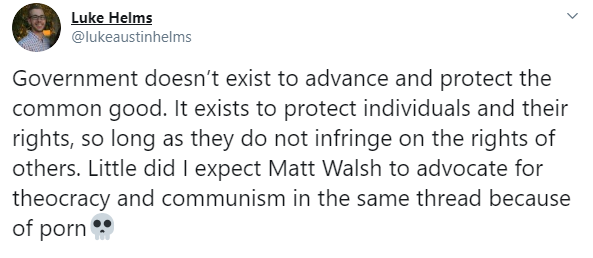

Back to Walsh:


Back to libertarians:


Once more to Walsh:


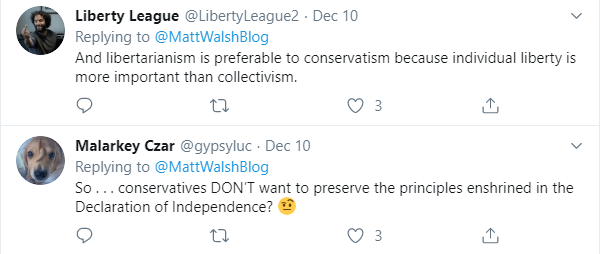
At this point libertarians stepped in to associate any notion of a common good with the sin of "collectivism" or with abandonment of American founding principles. For example:


One of the errors I think libertarians make is to set in opposition the notion of the individual good and the common good. In reality, the two are interconnected. I put it this way in a tweet of my own:


The mistake seems to go back all the way to Locke, from whom the notion of the "individual pursuit of happiness" derives. If my understanding is correct, Locke himself did not believe that individuals should simply "live how they deem fit". He thought they should pursue happiness, by which he meant that they should use their reason to avoid immediate gratification in favour of the higher pleasures associated with a life of self-disciplined virtue.

For this reason, modern day libertarians have drifted away from the mindset of the American founders, who emphasised the connection of virtue to liberty, and licence to the destruction of liberty, a point I will develop below.

Even so, the Lockean outlook has proven to be insufficient. Locke thought that we were born as blank slates, with no inborn nature, and no propensity to either good or evil, but that we were products of our experiences. He seems to have underestimated the fallen nature of man. Left to a purely individual pursuit of happiness, most people struggle to live virtuously.

This does not mean that we have to have our lives controlled in an authoritarian way by a central government. But it does mean that holding to healthy social norms and moral standards in a society is critically important. These are not fetters to individual liberty as Locke would have understood the meaning of liberty, but necessary supports for it.

And Locke's focus on an individual pursuit of liberty is also insufficient. It's not enough to hope that this individual pursuit of liberty will, of itself and without forethought, give rise to the necessary social conditions of life. The significance of a common good has to be explicitly recognised in its own right as a necessary component of individual well-being, and promoted as such.

Let's look at this realistically, taking family life as an example. Locke might have hoped that men and women would act according to reason and understand that their enduring happiness depended on rejecting the impulse toward promiscuity and choose instead to make a commitment toward a lifelong marital bond that would provide them with a secure base to enjoy the higher pleasures of paternal or maternal love, a lasting companionship into old age and so on.

How has that worked out? It turns out that reason struggles to overcome the innate impulse (that Locke never acknowledged) toward hypergamy. It turns out that not everyone shares the personality traits of conscientiousness or agreeableness that support successful pair bonding. It turns out that not all women will act prudently to leverage their assets of youthful beauty and fertility in a timely way that permits them to marry successfully. It turns out that some people will ignore the "save oneself for marriage instinct" and instead became jaded and incapable of deeper emotional attachments. And so on.

Individual reason alone does not uphold standards of virtue within a society. Our society is the living proof of this. The lessons of reason need to be reinforced and supported so that they become social norms and moral and cultural standards. The arts can play a role in this, so too can the churches, so too can schools and universities, as can churches. And, yes, governments have at least some role to play in this as well (think, for instance, of the harm done to family life by the way that family law is currently framed).

Another problem with Locke's concept of the individual pursuit of happiness is that, even understood as a pursuit of virtue, it is focused on the self alone. Here is one way of thinking about this. If I am concerned with the common good, then I will act in ways which uphold this common good. For instance, I will think it important that I deport myself in public in a way which upholds a higher standard. I will want to present myself in public at my best in order to contribute to the communal standard.

I suspect that is why there used to be a standard of common decency or why it was thought important to dress well when in a public place or why it was thought worse to bring our vices into public view than to keep them private. But we have increasingly lost this notion that what we bring of ourselves into the public square matters as part of a common good. People now not only fail to keep their vices private but will identify with them, and standards of dress are sometimes intended just as much to provoke a reaction or to assert individuality as they are to inspire people to a higher standard of the masculine or feminine.

Let's come back now to the libertarian idea that the founding fathers of the U.S. intended government to be morally neutral. I was looking recently at the symbolism of the Great Seal of the United States, which was adopted in 1782. The designer of the seal, Charles Thomson, described the symbolism as follows:
The colours of the pales are those used in the flag of the United States of America; White signifies purity and innocence, Red, hardiness & valor, and Blue, the colour of the Chief signifies vigilance, perseverance & justice.

The mindset here, by design and within the very seal of government, is a pursuit of virtue. The same point comes through very strongly in an article by Mathew Peterson titled "The American Founding was not Libertarian Liberalism". He gives many examples of how the founding fathers associated virtue with liberty and a loss of virtue with licence.

For example, James Madison said at the Virginia Ratifying Convention:
I go on this great republican principle, that the people will have virtue and intelligence to select men of virtue and wisdom. Is there no virtue among us? If there be not, we are in a wretched situation. No theoretical checks—no form of government can render us secure. To suppose that any form of government will secure liberty or happiness without any virtue in the people, is a chimerical idea.

So here then is the challenge for modern day libertarians. What is there in a libertarian politics to ensure that there is "virtue in the people"? Clearly, it doesn't happen of itself. It needs to be fostered in some way. So how? Libertarians not only reject the idea of government upholding moral standards as "fascist" or "theocratic," even worse they reject the notion of a common good as being "collectivist". So presumably they have to somehow connect the pursuit of an individual good to the creation of virtue in society. It hasn't worked this far. How do they think then it is going to work from here on in?

Monday, September 03, 2018

South Africa & libertarianism

The South African government is changing the constitution to permit it to take the land of white South African farmers without compensation. Property rights, it seems, don't matter much in the real world if you lose state power to a different group. Even the right to life is not very secure for white South African farmers, with thousands being murdered in farm attacks in the past two decades.

This led me to think some more about libertarianism, a political philosophy that has been influential on the right, particularly in America. I should say from the outset that I have never been attracted to libertarianism, regardless of its real world practicality, because I believe that we fulfil ourselves as individuals (develop toward our natural ends) within unchosen, uncontracted forms of community, such as family and ethnic nation. The individual derives from these the deeper forms of identity and the strongest loyalties and social commitments. We live better, more meaningful lives within these traditional forms of community.

Libertarians prefer to think in terms of the individual developing solo within the market, with the only permissible social commitments being voluntary, contracted ones (i.e. to "civil society" understood to mean voluntary associations, like sports clubs). What South Africa suggests, though, is that this ideal, if it can exist at all, can only survive within a relatively homogeneous society. Property rights and even personal security are much more likely to endure when there is a natural fellow feeling between people who share a common history, culture and tradition, and not when there is a contest within society for power, and the spoils of power, between different groups.

I expect that some libertarians would concede this point. There has been something of a drift lately of libertarians toward the dissident right, with a concern for the securing of borders. Perhaps these libertarians have grasped that their preferred model of society cannot thrive when there is rapid demographic change and the newer groups are self-confidently asserting their own power in society.

Although I welcome libertarians drifting the right way, there is a problem in trying to base a defence of borders on a pragmatic "libertarianism won't work without it". The problem is that libertarianism begins with a concept of man as being an atomised, rights-bearing individual, whose purposes are individual, whose connection with others is voluntarily contracted, and whose best interests are secured by a pursuit of individual ends and personal profit within a free market. This understanding of man, this "anthropology", is blind to communal tradition - it does not tie us, by nature or purpose, to those we share a particular tradition with.

Libertarian anthropology pushes toward open borders, even though libertarianism is more conceivable within a homogeneous, settled society. There is a conflict, in other words, between the anthropology and the type of society libertarianism requires. .

Friday, July 14, 2017

Reply to a libertarian

My previous post on the Cato Institute attracted some interest, including a comment from a libertarian named Kurt who wrote:
The Cato Institute approves a model of society in which there are simply individuals in pursuit of their own self-interest (in particular their economic self-interest).

So do I. There is nothing in libertarianism that precludes people from living a more traditional lifestyle, if they so choose. In fact many libertarians do just that. It seems you have a beef with those who want to make choices differently than you.

They must band together, as a collective force. They must go on strike?

In a certain sense all human endeavors are collective. For example, a start-up company. You seek out others who share your commitment to a particular goal, then work together to accomplish that goal. So what? I work with all kinds of people in my daily life and in pursuit of my life goals. As long no coercion is involved, this is perfectly compatible with libertarianism.

One's body being the most private and precious of all property.

Of course. This is a tautology, especially with regards to bio-medicine and life extension.

I will say it again. There is no reason why like-minded individuals cannot live a "traditional" life in a libertarian society. It appears that your problem with libertarianism is not that it prevents you from living your own life, but that you can't force your choices onto others.

Kurt is suggesting that you can make society in general run along libertarian lines but within this society individuals could voluntarily associate to purse a traditional lifestyle together.

I want to point out a few of the problems with Kurt's suggestion. First, it does not allow for the preservation of real, historic nations of people. If the Poles, for instance, were to adopt Kurt's advice, they would not be able to say "we want to preserve our existing Polish identity at the state level, for instance, through immigration policy." You could not assert, at the public level, one thing over another as that would be "coercion" against individual preference. The best you could do would be for individual Poles to try to keep their tradition going by gathering together somewhere in Poland as part of a voluntary association.

In the meantime, you would have an influx of people into Poland not sharing the Polish identity or tradition and, most likely, being willing to use their resources and influence to make sure that the native tradition did not prosper. Would the little pockets, the little remnants, of Polish communities survive? Even if a few did, the effect of libertarianism would not be neutral - it would have forever impacted on the real existence of the Poles as a nation of people.

It's the same when it comes to family. A traditional society requires a stable form of family life. Libertarians, though, believe that family is whatever people choose it to be. Furthermore, libertarians see the family as a purely voluntarily association that people can choose to join or leave at any time and for any reason.

And so a traditionalist community would be radically countercultural within a libertarian society. It would require a massive undertaking by individuals without large-scale resources, to set up their own towns, schools, universities and mass media, where a traditionalist understanding of family could prosper in opposition to the libertarian one. In a sense, traditionalists would be creating their own society from scratch. It is a daunting prospect, that involves escaping libertarian norms, rather than one easily accomplished within a libertarian system.

And here's another issue. Libertarianism is not value neutral. Libertarianism rests upon a particular understanding of man and society that has evolved over time from a mishmash of intellectual influences. Kurt himself acknowledges that he agrees with "a model of society in which there are simply individuals in pursuit of their own self-interest (in particular their economic self-interest)".

So it is not possible for Kurt to claim that, in pushing for a libertarian model of society, he is not imposing his own world view on others. Libertarians are, in fact, imposing a very specific concept of man, his purposes, his relationship to others and the sources of meaning, value and human dignity. From these assumptions then flow the libertarian concept of how society should be organised politically.

Furthermore, once you accept the libertarian/classical liberal world view, then a particular kind of morality emerges, one that is inevitably held to seriously by the "thinkers" within such a society. For instance, if what matters is an untrammelled pursuit of individual self-interest by all, then it becomes critical that I do not in my own choices hinder or limit the choices of others. So the moral thing then becomes "non-interference" which leads to a moral system centred on attributes such as openness to the other, respect for diversity, non-discrimination, and tolerance. Particular loyalties, especially those based on inherited attributes such as race, sex, ethnicity - even culture - are thought of negatively as limitations, perhaps even "bigotry".

So a traditionalist community is once again going to be radically countercultural within a libertarian society. It is going to be countercultural at a deeper philosophical level, and, more immediately, in terms of the moral values of that society. The traditionalist community is going to be put in the position of having to resist the moral norms of the larger society, no easy task given the way that people generally conform to the leading ideas of the society they inhabit.

Finally, there is the issue of truth claims. If you set out to create a society with a multitude of religions and cultures, then it becomes difficult to hold to the deeper truth claims of any of them. To be part of one tends to become something like a "personal preference" or a "sentimental attachment" without a wider significance. The centre moves elsewhere, most likely to some sort of commercialised lifestyle and culture. In practice there is a hollowing out of the culture.

I remember the comment of one American classical liberal who forcefully insisted on cultures and religions being inconsequential:
Cultures and religions are either about weddings and music and fancy clothes or they're about to get their asses kicked...If all religions and cultures are equal then none is superior, and that is how we keep them in line.

Kurt, I hope you can understand from all this why I don't find the prospect of trying to maintain a traditionalist community within a libertarian system appealing. It is certainly not the ideal for traditionalists to aspire to. Nor does it make sense for traditionalists to accept the organisation of society according to a value system so much at odds with our own.

Sunday, July 09, 2017

Libertarianism is not traditionalism 2

I published a post a few days ago on the Cato Institute, a leading libertarian organisation. I was therefore interested to find this in my Twitter feed:


Libertarians, like other right-liberals, look to the free market to regulate society. They believe that this is the engine of human progress. Hence the following quote:
"Capitalism reduces the oppression of traditional societies that impose hierarchies of gender and caste,” writes Cudd, because embedded within market exchange itself is the idea that each individual should be free to pursue her self-interest.

So there you go. The Cato Institute approves a model of society in which there are simply individuals in pursuit of their own self-interest (in particular their economic self-interest).

To a traditionalist this is a model of society that is not only ultimately unworkable, but that also has too limited a view of individual life. Are we really just atomised individuals in pursuit of our own individual profit? Is that what defines us as humans? Are men and women simply interchangeable units within a system of production and consumption?

Capitalism, as an economic system, should not define what humans are. Nor should it define our concept of society. Nor our understanding of the roles of men and women in society.

Does anyone really believe that if we tell young men and women that the highest good is to pursue their own individual self-interest that we will arrive at successful relationships between men and women? Stable families? High levels of trust between the sexes? A commitment to raise children successfully?

Capitalism alone cannot create a good society. It's necessary to keep to those traditional values and institutions that cohere or successfully order a society and which express deeper truths about man, community, belonging and identity.

The one good thing to draw from the Cato tweet is that it reminds us of what to look out for. Perhaps it is, in fact, true that a market system encourages the idea "that each individual should be free to pursue his or her self-interest." This idea goes back a long way in Western political theory - it brings to mind the view of man and society of John Locke in the late 1600s. It is likely that men made wealthy in the market will be attracted to the idea and give patronage to those holding it. But wherever and whenever it arises it needs to be vigorously opposed.

Tuesday, July 04, 2017

Cato libertarians take a step to the left

The Cato Institute is a leading libertarian organisation in the U.S. The Institute recently published a significant article about race. It's fascinating to read because it shows the logic of how left-liberalism developed out of classical/right-liberalism.

But I need to quickly set the scene for this. All forms of liberalism begin with the idea that what matters is a freedom of the individual to be autonomous: to have the liberty to choose to be or to do whatever, as long as it does not limit a similar liberty for others to choose to be or to do whatever.

But this raises the question of how a society of atomised, autonomous individuals each seeking their own subjective good can be successfully regulated. Although there is no single answer given by liberals, the dominant form of liberalism in the mid-1800s, classical liberalism, emphasised the idea that the market could best regulate society. Millions of individuals could participate in the free market, each seeking their own profit, but the hidden hand of the market would ensure that the larger outcome was a positive one for society.

So what went wrong? The classical liberals would say that as long as everyone had an equal opportunity to participate in the market, then everyone had an equal human dignity as an autonomous individual.

But in the later 1800s this was queried. If I am poor and uneducated do I really have the same opportunity in the market as someone who is born to private schools and so on? The new liberals thought that there needed to be a greater role for government intervention to overcome institutional disadvantage.

And so the modern left emerged. For decades there has been a right-liberal party which emphasises markets (Republicans, Tories etc.) and a left-liberal one which emphasises government programs to overcome inequality (Democrats, Labour etc.). Libertarians have mostly been purist right-liberal types, pushing for limited government, markets, and liberty understood as individual autonomy.

So it is no surprise that the Cato Institute piece on race begins as follows:
Libertarians tend to think of freedom as either a means to an end of maximum utility—e.g., free markets produce the most wealth—or, in a more philosophical sense, in opposition to arbitrary authority—e.g., “Who are you to tell me what to do?” Both views fuel good arguments for less government and more personal autonomy.

That's exactly what you would expect from someone on the liberal right. Autonomy, free markets, limited government, freedom. But look at what happens next:
Yet neither separately, nor both taken together, address the impediments to freedom that have plagued the United States since its founding. Many of the oppressions America has foisted upon its citizens, particularly its black citizens, indeed came from government actors and agents. But a large number of offenses, from petty indignities to incidents of unspeakable violence, have been perpetrated by private individuals, or by government with full approval of its white citizens.

You can tell what this is leading up to. It's leading up to the left-liberal idea that there are institutional, systemic barriers to equal participation. That disparities in outcomes are to be explained in terms of institutional oppression, racism and systemic discrimination. And that's exactly where the Cato writer goes:
Take, for example, the common libertarian/conservative trope: “We believe in equal opportunity, not equal outcomes.” Most people, outside of the few and most ardent socialists, should believe that is a fair statement. But to say such a thing as a general defense of the status quo assumes that the current American system offers roughly equal opportunity just because Jim Crow is dead. Yet, that cannot possibly be true.

Think of the phrase “Don’t go there, it’s a bad neighborhood.” Now, sometimes that neighborhood is just a little run down, doesn’t have the best houses, doesn’t have the best shopping nearby, or feeds a mediocre school. But, more often, that neighborhood is very poor, lacks decent public infrastructure, suffers from high unemployment, has the worst schools, and is prone to gang or other violence. And, in many cities—in both North and South—that neighborhood is almost entirely populated by minorities.

There are only two conclusions possible when facing the very real prospect that thousands or millions of Americans live in areas you warn your friends not to go, even by accident: Either everyone in those areas is a criminal, or is content to live among and be victimized by criminals; or there is some number of people, and probably a large one, trapped in living conditions that cannot help but greatly inhibit their opportunities for success and advancement.

He goes on at length about racism and white supremacy and how the Federal Government has helped to overcome this more than markets have. He stops a short of endorsing big government solutions, but you can see how the logic of his argument prepares the ground for this.

The mainstream left and right are not so different from each other. They both exist within the same philosophical framework, sharing the same assumptions about what human life is for. Mainstream leftism is an attempt to perfect the liberalism that came before it, to realize it in a more equitable and consistent way.

The challenge for those who dislike what the modern West has become is to step outside of the liberal framework entirely - to be neither of the left nor of the classical liberal/libertarian right.

Monday, July 11, 2011

John Anderson & the Sydney Push


John Anderson
When you look at the intellectual movements of the twentieth century you lose any sense of surprise that the West has entered a period of decline. The marvel is that the West hasn't sunk more quickly.

Let me give just one example. Back in 1927 the powers that be made the decision to appoint John Anderson as the professor of philosophy at Sydney University.

Anderson began as a fellow traveller of the Communist Party, but when he realised the nature of the regime in Russia he became a Trotskyist. But during the 1930s he moved away from Marxism altogether in favour of a left-libertarianism (i.e. he combined anti-statism with anti-capitalism).

Anderson's was a pessimistic form of leftism:

In one talk he canvassed the 'fallacy of optimism' and criticised notions of 'good' and 'progress'. Optimistic theories are based on the view that the ultimate nature of reality is good, he argued, or that good is more real than evil: 'But reality as such can be neither good nor bad.' (Christine Wallace, Greer: Untamed Shrew, p. 74)

In Anderson's universe there were no transcendent values and therefore nothing that was in itself either good or bad:

As a committed empiricist, Anderson argued that there is only one realm of "being" and it can be best understood through science and naturalistic philosophy. He asserted that there is no supernatural god and that there are no non-natural realms along the lines of Platonic ideals. He rejected all notions that knowledge could be obtained by means other than descriptions of facts and any belief that revelation or mysticism could be sources for obtaining truth. He was arguing that traditional Christian concepts of good and evil were only meant for slaves and that, in actuality, the idea of morality was empty.

So if morality is empty and a restriction on our freedom, then what is the non-servile intellectual to do? This is the "solution" Anderson arrived at:

For Anderson, the term "good" was valid when applied objectively to human activities which were free, critical and creative but the more common subjective applications were to be avoided or exposed as deceptive. Not surprisingly, Anderson's influence was both extensive and controversial as he constantly examined and fearlessly criticized hallowed beliefs and institutions.

This is a typical modernism. Anderson has rejected the idea of an inherent good and replaced it with a good that we make for ourselves through an assertion of our "free, critical and creative" self. This requires the individual to reject forms of authority external to itself:

With Anderson, every icon was to be smashed - God, immortality, free will, moralism, the common good of society, the lot ...

For Anderson, there was no point in trying to create an alternative icon - instead, the ideal was to be in permanent opposition, as it was through struggle that the non-servile self was expressed:

Andersonians argued that there was no such thing as a general 'good', that the state was always a malign force and that reform was, in any case, always doomed to fail.

In his 1943 journal article 'The Servile State', Anderson laid down his core views on reform and the state. Meliorism ignores the permanence of struggle, he wrote: 'The scientific student of society, then, will not be concerned with reform. What he will be concerned with is opposition - what he will be above all concerned to reject is "social unity". " (Wallace, p.78).

Finally, Anderson viewed sexual morality in particular as a form of repressive authority:

In a journal article in 1941, Anderson argued that sexual repression had a central place in any repressive system, and that 'freedom in love is the condition of other freedoms, that while in itself it does not constitute culture, there can be no culture without it.'

In short, Anderson believed that culture was dependent on promiscuity.

These journal articles were being published in Australia in the early 1940s - one of the key periods of intellectual and political decline in our country.

Why bother with Anderson? It so happens that he was one of the more influential of Australian academics:

He is, arguably, the most important philosopher who has worked in Australia. Certainly he was the most important in both the breadth and depth of influence.

Anderson was the leading figure in the Freethought Society at Sydney University and out of this group came the Libertarian Society. It was this libertarian group that gave rise to the Sydney Push - a group of intellectuals in the 1950s and 60s who were determined to live a libertarian/anarchist, Andersonian lifestyle:

the libertarians at the Push's heart had their own special put-downs, 'authoritarian', 'neurotic' and 'illogical' being the worst insults. Positions or behaviour which did not meet expectations were condemned for 'inconsistency' - at least as loaded an epithet as 'servility'.

In terms of relationships, the Push followed the ideas of both Anderson and Wilhelm Reich. Reich was a psychiatrist who believed that sexual repression was responsible for neuroticism and political authoritarianism. Therefore, the Push believed that sexual "freedom" (i.e. being uninhibited) was the primary freedom on which other freedoms turned. What mattered then was proving that you could engage in sexual relations without any associated moral feelings.

This was the life outlook that Germaine Greer walked into as a young woman. She fell in love with a leader of the Push called Roelof Smilde, but it didn't work out in the end because Push culture didn't exactly encourage emotional connection:

Emotional denial was a key element of Push culture ... The explicit repression of jealousy, though imperfectly achieved, was essential to Push promiscuity. No emotion was allowed, no sign of shock, disappointment or distress permitted when one's lover sallied forth with another.

You have to wonder what might have happened if Germaine Greer had been in a milieu in which she had been better able to find love with a man.

The Push helped to bring about the 1960s counterculture. Members of the Push such as Greer and Richard Neville shifted to England and became leading figures in the political scene there.

So, if you want to know the origins of the 60s counterculture you have to go back to the libertarians of the Push in the 1950s, which itself had its origins in the philosophy of David Anderson as fully developed by the early 1940s, which itself developed from a rejection of his earlier Marxism held in the 1930s.

How is a society or a tradition supposed to survive such an intellectual climate? Should we really be surprised if things didn't ultimately hold together so well?

It matters what the political class of a society believes. Western society has not been served well by its intellectual classes. It's something that we have to try to turn around and get right.

Monday, May 02, 2011

Libertarians: communities have no rights

Libertarians can be very hostile to communal traditions. Take a recent discussion on immigration at the libertarian Reason magazine (hat tip VFR). One commenter bravely took a stand against open borders:

What about the rights of a community of individuals to decide that they don't want their culture to be overwhelmed and subsumed by an alien culture, with widely divergent norms, language, etc?

The response? Well, there was this:

In a Libertarian World that community should have no trouble purchasing an apartment building and requiring that any tenants are only WASPy WASPs. I'll enjoy mocking them while eating a burrito.

An apartment building? Tenants? Is that how libertarians conceive of a national tradition holding together?

It reflects the libertarian idea that a society of millions of atomised individual wills can be regulated through the market, specifically through property rights (a form of radical right liberalism). So the libertarian quoted above assumes that if you're going to have any kind of communal existence it will be through an assertion of individual property rights (a group of individuals buying a building and deciding who can be tenants).

Another libertarian posted an equally extreme reply:

What about the rights of a community?

No such thing, dumbass. Every individual has the right to not be Mexican. That's it.

Americans have no right to assert their existence as Americans, states this libertarian. There is only an individual right to not have a particular ethnicity or group identity.

This view was then challenged by a commenter who wrote:

So Israel *should* allow a right of return to any Palestinian? (Hell, I guess it should allow any Arab, even one whose ancestors didn't come from Palestine, to come to Israel.) Since the members of the community have no more than the right of its individuals not to be Arab.

The libertarian answer?

Yup. The fake "right of a community to exclude others from entering its vicinity" is not a property right.

The focus is so much on individual property rights, that there is no other collective right to assert national sovereignty - not even when there are important issues of security at stake.

Another libertarian put the issue like this:

"What about the rights of a community of individuals to decide that they don't want their culture to be overwhelmed and subsumed by an alien culture, with widely divergent norms, language, etc?"

Then each of those individuals, respectively, can refuse such people use of their property. What they can't do is tell willing neighbors what to do with theirs. That's the issue.

Again, individual property rights trump everything else. There is no national sovereignty or collective decision making. There's just me as an individual property holder deciding what I'll use my property for. Libertarians value being an individual property holder more than they value being an American.

Here's another libertarian:

Rights are individual and inherent...communities have no rights.

What if I'm an individual who wants to live in a community? How am I supposed to protect this communal existence? Libertarian answer:

Strong property rights so you can buy some land, build an underground bunker and seal yourself away from the scary people who look and talk different than you.

Individual property rights again, plus hostility to the idea that people might want to preserve a distinct tradition of their own.

Another libertarian explained it slightly differently. He saw an advertising sign in his American town which was entirely in Spanish - no English. That was great in his view, because it showed that the market was responding to what people wanted:

The other day I was sitting at a light and above me was a large, prominent billboard advertising a food product (don't remember) entirely in Spanish. The whole billboard: Spanish. No english whatsoever.

As a libertarian my immediate thought was how cool that is. This is capitalism at work. No one forced them to write the sign in English and Spanish. No one is forcing them to take it down (yet). No legislative process took place to force advertising that was previously ignoring a minority community.

Sorry dude, capitalism (when it's allowed to work) figures out what the needs and desires of a community are, and that's that. If that means my "culture" is "overwhelmed and subsumed", too bad for me. I'll get over it and brush up on my Spanish.

This guy so much believes in the regulation of society by the market, that if it means the extinguishing of his own national tradition, then that must be a good thing that he should just adapt to.

Another libertarian commenter:

Restrictions on immigration violate the property and contract rights of Americans. If I want to hire or rent to some guy from Guatemala, it should be between him and me, period.

And another:

if the population of Saudi Arabia could all find and legally acquire places to live, then yes, they could all immigrate to the US. It is the right of property owners to rent or sell their property to whomever they want.

One commenter objected that open borders might lead to overcrowding and he asked how many people the libertarians thought America could hold. The answer?

Hong Kong -- which is not too crowded at all, has virtually no natural resources but quite a bit of parkland, and was the most laissez faire place on earth for decades -- has more than 3000 persons per square mile. That density would allow the US's 3.8 million square miles to hold over 10 billion people.

10 billion? That really is open borders to the max.

Somehow we in the West have to get over this kind of politics. It's a politics which claims to deliver freedom, but it ends up being a very limited kind of freedom, in which about the only thing I'm free to do is to dispose of my property as I wish.

You cannot regulate a society through individual property rights alone, any more than you can regulate it effectively by a class of state bureaucrats.

Thursday, September 02, 2004

Libertarian or libertine?

Catallaxy is an Australian website which is on the "right libertarian" end of liberal politics. I find it interesting to observe how the libertarianism of many contributors leads on to a very permissive view of morality.

For instance, in one discussion the Labor Party was condemned as supporting "authoritarian" plans to force hard core porn sites to have age filters. I asked the question of what alternative they would propose to protect children from access to adult sexuality.

I received the reply from c8to, who I believe is running for the Australian senate on a "democratic liberal" ticket, that,

I'm not entirely sure early sexualisation is as bad as it's meant to be. It certainly will change society, but will it necessarily change it for the worse? I think sexualisation has been increasingly pushed back over modern history.


I had expected the argument from libertarians that it was illegitimate for the state to regulate morality, or else, that access to porn wouldn't have much of an effect on children. But here was a realistic assessment that porn actually would have a significant effect, but that we ought to accept this as a positive development!

It's the same with the issue of drugs. Again, you expect libertarians to argue that the fight against drugs gives the state too much power. But in a recent discussion, Jason Soon went further by agreeing that there was a "great possibility" that legalising drugs would mean "that a lot more people would be taking pot, coke, amps, etc" but that this was OK as there was nothing "intrinsically bad" about taking such drugs anyway.

The liberalism of these libertarians, therefore, is not just some "neutral" device for allowing people to make their own decisions on moral issues. Instead, the liberalism has an "active" effect of leading people to draw a certain set of remarkably permissive views on moral issues.